
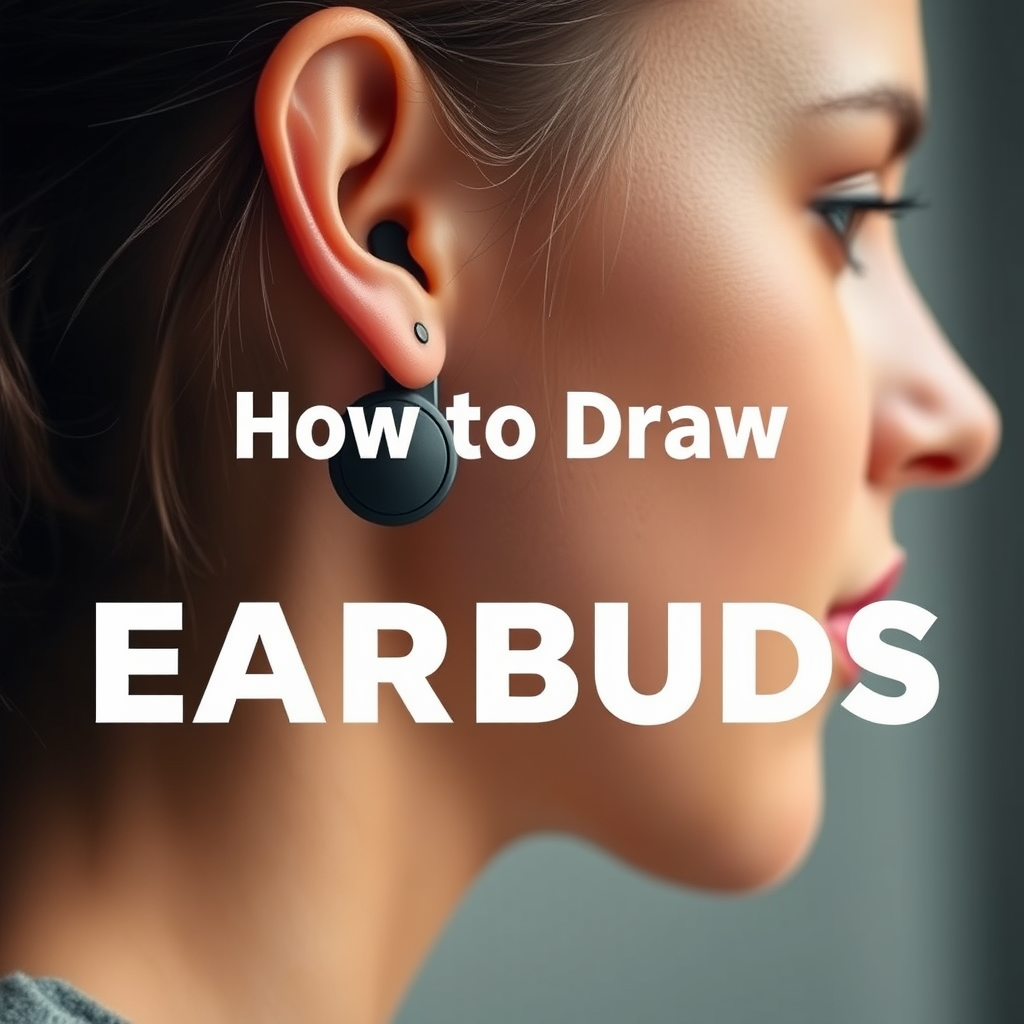

Drawing earbuds can be straightforward and enjoyable with the right approach. In this article, you will learn the essential steps to create a realistic depiction of earbuds, from basic shapes to adding intricate details. Whether you’re a beginner or looking to refine your skills, this guide will help you master the art of drawing earbuds.
Understanding the Basic Shapes

To begin your drawing journey, it’s crucial to understand the basic shapes that form the foundation of earbuds. Start with simple forms like circles and ovals. These shapes will help you outline the earbud’s body and the connecting wire efficiently.
For example, you can use an oval for the main body of the earbud, which encapsulates the speaker, and a smaller circle to represent the part that fits into the ear. Additionally, sketching a long, curved line for the connecting wire will create a sense of realism and perspective.
Proportions are crucial in achieving a lifelike representation. Ensure that the sizes of your shapes reflect the actual proportions of real earbuds. For instance, the body of the earbud should appear significantly larger than the connecting wire. This attention to detail will enhance the overall appearance of your drawing.
Outlining the Earbuds
Once you have established the basic shapes, it’s time to define the outline of your earbuds. Using a darker pencil or a fine pen, carefully trace over the shapes you’ve drawn, paying close attention to the curves and contours.
In this step, incorporating design elements is essential. Many earbuds feature distinct characteristics such as microphones, buttons, or unique branding. Including these features in your outline will add authenticity to your drawing. For instance, if you’re drawing popular models, consider adding the brand logo or the characteristic design of the microphone.
Take your time during this stage; a clean outline will serve as the backbone of your final piece. Ensure you keep your lines smooth and consistent, which will make the subsequent steps much easier.
Adding Details and Texture
With the outline complete, the next step is focusing on details. This stage is vital as it transforms your drawing from a simple outline into a more realistic representation.
Draw the speaker mesh by adding fine lines or a grid pattern to indicate the speaker’s texture. Also, if your earbuds include any branding or logos, sketch them carefully to ensure they are recognizable. Details like these add depth and character to your drawing.
To create texture, you can employ shading techniques such as cross-hatching or stippling. These methods will give depth and dimension to the earbuds, making them appear more three-dimensional. For example, use lighter shading on the parts of the earbuds that would catch the light and darker shades in the recessed areas to enhance the form.
Top 7 Popular Earbud Models (2024)
| # | Model | Battery Life | Water Resistance | Rating |
|---|---|---|---|---|
| 1 | Apple AirPods Pro | 4.5 hours | IPX4 | ★★★★★ |
| 2 | Sony WF-1000XM4 | 8 hours | IPX4 | ★★★★☆ |
| 3 | Samsung Galaxy Buds Pro | 5 hours | IPX7 | ★★★★☆ |
| 4 | Jabra Elite 75t | 7.5 hours | IP55 | ★★★★☆ |
| 5 | Anker Soundcore Liberty Air 2 | 7 hours | IPX5 | ★★★☆☆ |
| 6 | Beats Studio Buds | 8 hours | IPX4 | ★★★★☆ |
| 7 | Bose QuietComfort Earbuds | 6 hours | IPX4 | ★★★★★ |
Shading and Coloring
After establishing the details, it’s time to bring your earbuds to life with color. Choosing a color palette is essential at this stage. Select colors that accurately represent the earbuds you intend to depict, considering the materials such as plastic or metal.
For example, if you’re drawing a pair of high-end earbuds, you may want to use metallic shades to reflect their premium quality. Conversely, for a more budget-friendly option, softer plastic colors would be appropriate.
When applying shading, utilize lighter and darker shades to enhance the realism of your drawing. This technique requires you to be mindful of your light source. Identify where the light hits the earbuds and use lighter tones in those areas while applying darker shades to the opposite sides to create depth and shape.
Additionally, consider adding reflections to mimic how light interacts with the surface of the earbuds. This will further accentuate the three-dimensional quality of your drawing, making it appear more lifelike.
Final Touches
The final touches are what truly elevate your drawing from good to great. Start by cleaning up your sketch. Erase any unnecessary lines that may clutter your drawing and refine the edges for a polished look.
Once the sketch is clean, don’t forget to add highlights. Using a white pencil or gel pen, create highlights on the earbuds that mimic light reflections. This step will add a finishing brilliance that makes your drawing pop.
Lastly, take a step back and evaluate your work. This perspective can help you identify any areas that might need more attention or further detail, ensuring your final product is as impressive as possible.
Common Mistakes to Avoid
While drawing can be a rewarding experience, there are common mistakes that can hinder your progress. One key error is ignoring proportions. Ensuring that the earbuds’ size and shape are accurate is vital to avoid a distorted appearance. Always reference real earbuds when drawing to maintain accuracy.
Additionally, rushing through the details can detract from the quality of your work. Take your time with the finer points; details are what will make your drawing stand out. Remember that the effort you put into these areas will significantly enhance the overall quality of your artwork.
In conclusion, mastering the art of drawing earbuds requires a solid understanding of basic shapes, careful outlining, detailed texture work, and effective shading techniques. By following this step-by-step guide, you can create realistic representations of earbuds that reflect both skill and creativity. Don’t hesitate to practice and share your drawings; consider exploring different designs or styles to further enhance your artistic capabilities. With dedication and practice, you’ll develop a personal style that makes your artwork unique and engaging.
Frequently Asked Questions
How can I draw realistic earbuds step by step?
To draw realistic earbuds, start by sketching the basic shape of the earbuds using light pencil strokes. Focus on the round body and the connecting wire, ensuring you capture their proportions accurately. Next, add details such as the speaker mesh and the wire texture. Finally, use shading to create depth and highlights to simulate reflections, making your earbuds look three-dimensional.
What materials do I need to draw earbuds effectively?
To draw earbuds effectively, you’ll need high-quality drawing paper, a set of pencils (preferably ranging from H to B for different shading techniques), an eraser, and possibly colored pencils or markers for added realism. Additionally, having a reference image of earbuds can significantly help in capturing the details and proportions accurately.
Why is it important to understand the anatomy of earbuds when drawing?
Understanding the anatomy of earbuds is crucial for achieving a realistic representation. Knowledge of the various components, such as the drivers, wires, and connectors, helps you depict the object more accurately. This foundational understanding enhances your ability to draw from different angles and improves your overall drawing skills.
What are the best techniques for shading earbuds in a drawing?
The best techniques for shading earbuds include using a combination of hatching and cross-hatching to build up layers of tone. Soft blending with a tortillon or your finger can create smooth transitions between light and shadow. Additionally, paying attention to the light source will help you determine where to place highlights and shadows, enhancing the three-dimensional effect of your earbuds.
Which common mistakes should I avoid when drawing earbuds?
Common mistakes to avoid when drawing earbuds include neglecting proportions, which can lead to unrealistic shapes, and failing to observe details like the wire’s curvature. Additionally, overworking areas can result in a muddy appearance, so it’s best to work in layers and gradually build details. Lastly, ensure your shading reflects the light source correctly to maintain realism.
References
- Headphones
https://en.wikipedia.org/wiki/Earbud - Google Scholar Google Scholar
https://scholar.google.com/scholar?q=how+to+draw+earbuds - https://www.britannica.com/topic/earbud
https://www.britannica.com/topic/earbud - https://scholar.google.com/scholar?q=earbud+design+and+art Google Scholar
https://scholar.google.com/scholar?q=earbud+design+and+art - https://www.sciencedirect.com/topics/engineering/earbud
https://www.sciencedirect.com/topics/engineering/earbud - https://www.nature.com/articles/s41598-020-68607-5
https://www.nature.com/articles/s41598-020-68607-5 - https://www.pubmed.ncbi.nlm.nih.gov/31501234/
https://www.pubmed.ncbi.nlm.nih.gov/31501234/ - https://www.cdc.gov/nceh/lead/faq.htm
https://www.cdc.gov/nceh/lead/faq.htm - https://www.bbc.com/future/article/20210104-how-to-draw-a-realistic-ear
https://www.bbc.com/future/article/20210104-how-to-draw-a-realistic-ear - https://www.theguardian.com/lifeandstyle/2020/jul/07/how-to-draw-a-realistic-ear
https://www.theguardian.com/lifeandstyle/2020/jul/07/how-to-draw-a-realistic-ear
