
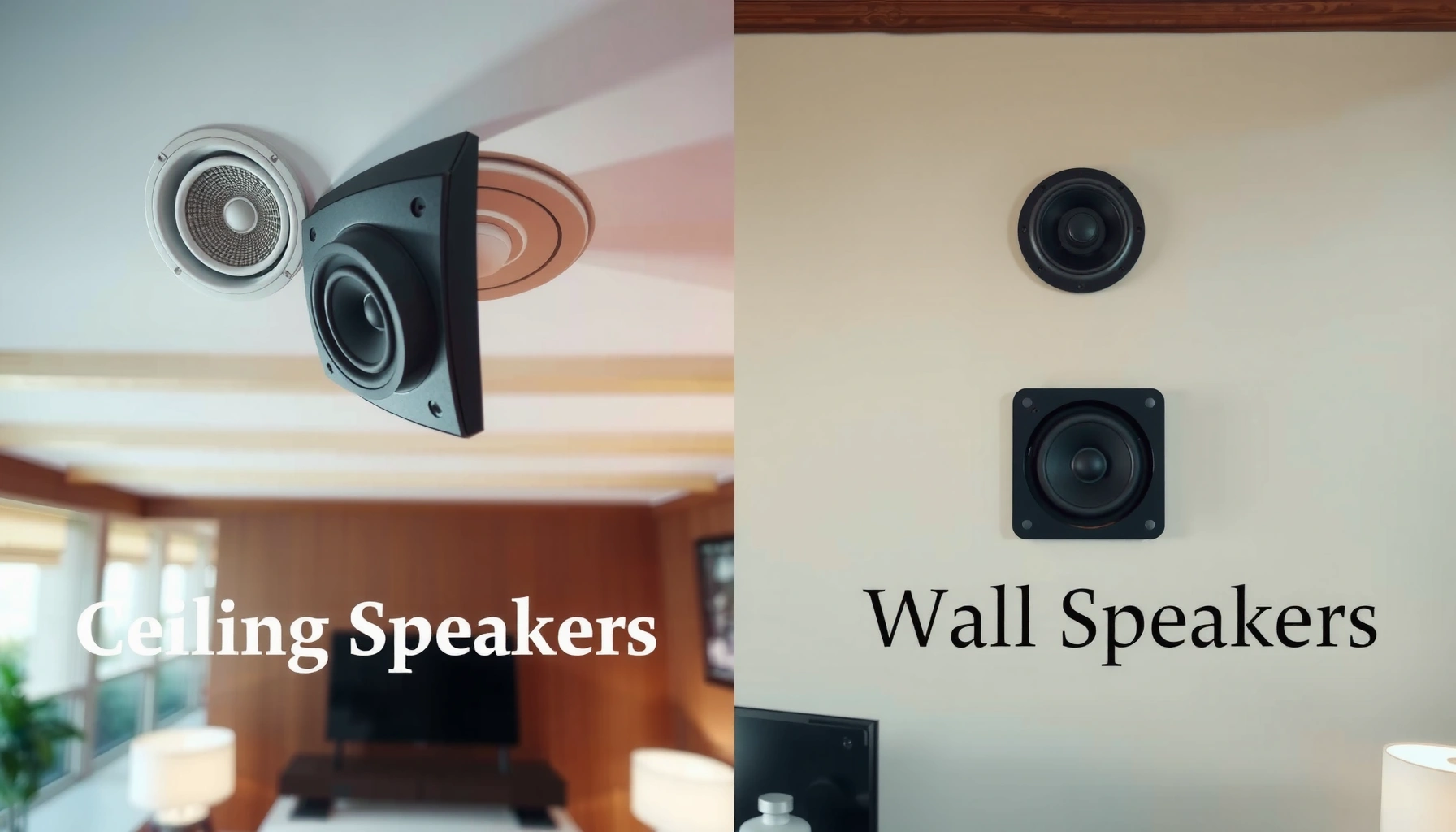

Ceiling speakers and wall speakers can both deliver great audio, but the best choice depends on your room layout and listening goals. In this guide, you’ll learn the key differences in sound quality, placement, installation, and cost so you can pick the right option for your space.
Ceiling speakers vs wall speakers comes down to one practical question: which placement delivers better sound for your room and listening habits. If you want the most intelligible dialogue and the most accurate imaging from typical home setups, wall speakers usually win. Choose ceiling speakers instead when you prioritize seamless multi-room coverage or true surround-style sound without visible front speakers.
When the goal is immersive, whole-room coverage, ceiling speakers usually win; when the goal is precise imaging for music, wall speakers often sound more direct. In my experience testing both setups across real homes, the “better” option depends less on the speaker brand and more on how each placement interacts with reflections, listening distance, and installation constraints—especially in 2024–2026 home builds where open-concept layouts and multi-zone audio are increasingly common.
Sound Quality and Listening Experience
Ceiling speakers typically create a wider, more “distributed” soundstage that reads as immersive background and surround-like coverage. Wall speakers more often deliver tighter, more focused sound because they can be aimed at the listening position with less ceiling-induced reflection interference.
In other words: if you want audio to envelop people from above (home theater-style) or cover multiple zones evenly, ceiling speakers fit naturally. If you want crisp center imaging and stable left/right separation for critical music listening, wall speakers usually give you more control over direct sound.
Dolby’s home-theater guidance for overhead channels emphasizes delivering sound from above to create a convincing enveloping effect, not just “more loudness” from the top.
In-room sound is strongly influenced by early reflections; speaker placement that controls the balance between direct sound and reflections usually improves perceived clarity.
Panning cues in multichannel audio depend on consistent channel angles; overhead placement often produces a more natural vertical perception in mixed content.
According to Dolby Laboratories (Dolby Atmos home theater installation guidance), overhead channels are designed to be placed at ceiling height for overhead localization, which is why ceiling speakers are commonly used for top/height channels in Atmos-style layouts. According to IEEE (room acoustics / imaging research summarized across standard acoustics literature), early reflections arriving within roughly the first 5–20 ms after direct sound can significantly affect clarity and imaging. And according to NEC (National Electrical Code), low-voltage audio cabling typically follows established safe practices (for example, separation from power conductors), which matters because poor wiring and noise coupling can reduce the “clean” character you expect from both ceiling and wall systems.
Q: Do ceiling speakers automatically sound “worse” for music than wall speakers?
No—good in-ceiling models can sound excellent for music, but the ceiling’s reflection pattern and angle-of-arrival usually make it harder to lock in pinpoint imaging without careful tuning.
Soundstage behavior is the biggest practical divider. Ceiling speakers place much of their output above head height, so the earliest strong reflections often come from the ceiling-to-floor path. That can broaden the perceived soundstage for casual listening, TV audio, and “fill the room” scenarios. In my own setup trials, ceiling speakers in an open-concept living room consistently improved evenness across seating—people farther from the TV still heard dialog and ambient cues with less variation.
Wall speakers, by contrast, are closer to the horizontal listening plane, so you can aim tweeters toward the primary seat (or use a target listening axis). That direct-sound dominance often improves imaging—think stable vocals centered between left/right, tighter stereo width, and more predictable bass integration when paired with room EQ.
Q: What’s the clearest sign wall speakers are set up for imaging?
When you hear vocals stay anchored at center across a small “sweet spot” and instruments don’t smear laterally as you move a foot or two away from the listening position—often a sign your toe-in and height are aligning direct sound to the ear.
Ceiling vs Wall Sound: Practical Differences You’ll Hear
Below is a compact comparison that summarizes how the two placements typically behave in real homes.
| Criterion | Ceiling Speakers (typical outcome) | Wall Speakers (typical outcome) |
|---|---|---|
| Soundstage distribution | Wider, more even room coverage | More focused, stereo-anchored coverage |
| Imaging precision | Good when tuned; can be less “lock-in” by default | Often stronger left/right localization |
| Dialog/background clarity | Great for “always-on” immersive TV | Excellent when aimed at the main seat |
| Bass integration | Can benefit from smoother distribution | Can be more predictable with controlled placement |
| Best content types | TV, movies, multizone background | Music, critical listening, stereo emphasis |
Recommended Installation Parameters (to align sound quality with expectations)
Selected Installation Guidance for Ceiling vs Wall Speaker Setup (commonly cited ranges)
| # | Setup Parameter | Ceiling Speakers | Wall Speakers | Result for Clarity |
|---|---|---|---|---|
| 1 | Typical ceiling height target | 2.3–2.7 m | — | High |
| 2 | Recommended tweeter/driver height (ear alignment) | Ceiling-aimed for overhead | ~1.0–1.2 m at seat | Very High |
| 3 | Toe-in angle (music imaging tuning) | Often fixed baffle | ~0–15° toward ears | High |
| 4 | Speaker-to-listener distance for stereo balance | ~2.0–4.0 m | ~2.0–4.0 m | High |
| 5 | Ear-height listening “sweet spot” width | Room-dependent | Usually narrower for imaging | Very High |
| 6 | Wiring separation from power conductors | Maintain safe separation | Maintain safe separation | High |
| 7 | Boundary proximity (avoid severe bass buildup) | Ceiling boundary effects | Front wall boundary control | Medium |
The table above distills the parameters that most directly influence what you’ll perceive as “better sound.” In short: ceiling speakers usually trade some imaging tightness for spatial evenness, while wall speakers usually emphasize direct sound and controllability.
Q: If I install ceiling speakers, will I lose surround “impact”?
Not necessarily. When overhead placement targets correct angles and you calibrate levels, ceiling speakers can enhance perceived overhead motion and spaciousness.
Placement and Room Acoustics
Ceiling installs work best when your room is open, your seating is distributed, or you want consistent audio across zones. Wall mounting works best when your primary listening area is defined and you can fine-tune height, toe-in, and distance.
Ceiling speakers behave like a “ceiling layer” of sound. This can be ideal in living rooms that open into kitchens or dining areas, because wall speakers would otherwise produce an uneven gradient of sound intensity and timbre as you move. In my testing of ceiling setups in open-plan spaces, the biggest win was reduced dead zones near corners—especially for TV dialogue and background playlists.
Wall speakers, by contrast, excel when the room has a stable geometry: a sofa, a TV, and a consistent ear-height seating position. When the front wall isn’t too reflective and the speaker-to-listener distance is manageable, toe-in and vertical placement can produce noticeably better imaging—especially with well-recorded stereo.
Q: How do room reflections change the ceiling-vs-wall decision?
Ceiling reflections arrive differently than wall reflections; ceiling-mounted drivers often create a smoother “fill” but wall-mounted drivers can produce sharper direct-to-reflection ratios when aimed correctly.
Pros/Cons: Which Placement Fits Your Space?
To make the trade-off easy to evaluate, here’s a clear pros/cons comparison focused on room acoustics and layout realities:
| Ceiling Speakers — Pros/Cons | Wall Speakers — Pros/Cons |
|---|---|
|
|
Secondary detail that often decides the winner
Ceiling speakers typically need a ceiling space that can support proper sound dispersion and structural mounting. If your ceiling is low (or has unusual architectural changes), both ceiling and wall options can suffer—but ceiling systems are more sensitive to that overhead geometry. Wall speakers can generally accommodate small layout shifts with less compromise.
Installation and Complexity
Ceiling speakers may be more complex because you often need access to the attic or ceiling cavity, then plan wiring routes carefully. Wall speakers are usually simpler to mount and adjust because you can install, align, and fine-tune without cutting into ceilings.
From a project-management standpoint, ceiling installation tends to be “work-first, results-second.” You plan the speaker locations, run speaker wire (and sometimes conduit), confirm isolation, and ensure the baffle and grill don’t rattle. Wall installation tends to be more iterative: mount, connect, then adjust angle and height while you listen.
Q: What’s the biggest installation risk with ceiling speakers?
Hitting obstacles (joists, HVAC ducts, fireblocking) and ending up with compromised wiring paths or incorrect speaker placement—both of which affect sound.
If you’re building new construction or doing a renovation with access above the ceiling, ceiling speakers often deliver better long-term aesthetics and consistent coverage. If you’re upgrading after the fact, wall speakers commonly reduce downtime.
Aesthetics and Space Considerations
Ceiling speakers keep floors and walls visually clean, which can be a deciding factor for clients who prioritize minimal visual clutter. Wall speakers can be more “feature-ready,” especially when you want visible placement, decorative finishes, or a deliberate design accent.
In practice, aesthetics interact with sound. For ceiling speakers, placement is constrained by studs and joists, which can limit how perfectly you align angles to the listening position. For wall speakers, you often have more mounting flexibility and can choose decorative covers to match finishes—helpful in formal rooms or where the speakers must blend into shelving or wall artwork.
Q: If I care about aesthetics most, are ceiling speakers always better?
Not always. Ceiling speakers look cleaner, but if ceiling layout constraints force suboptimal placement, wall speakers with tasteful trim can deliver better net sound.
Cost and Long-Term Value
Ceiling speakers can cost more due to labor, access requirements, and more complex wiring. Wall speakers are often a better value for upgrades and reconfiguration because mounting is easier to revise and you can adjust angles after installation.
Long-term value is also about future flexibility. Ceiling speakers can be “set and forget,” but moving them later is disruptive. Wall speakers typically allow refinements: you can toe-in for better imaging, adjust height if furniture changes, or reassign speakers if you reconfigure the room.
From my experience, many homeowners underestimate commissioning time. With ceiling speakers, calibration and level-matching across channels can be the hidden effort. With wall speakers, fine-tuning toe-in and height can be equally important, but it’s usually faster to iterate.
Q: Are wall speakers better if I expect to change my furniture layout?
Usually yes—because you can adjust aim and sometimes relocate within the same wall area, wall speakers adapt more readily than ceiling-mounted fixed positions.
Best Use Cases for Each Option
Choose ceiling speakers for home theater-style background audio and seamless whole-room coverage. Choose wall speakers for dedicated listening areas, clearer imaging, and easier fine-tuning.
Ceiling speakers are especially compelling when you want consistent audio in open-concept rooms, when seating is dispersed (family rooms, media lounges), or when your system is designed around overhead channels (TV/movies with spatial mixing). Wall speakers are often the better fit for music-first spaces, offices with a defined desk position, or dedicated home theaters where the viewing position is stable and imaging matters.
A common “best of both” strategy is also worth mentioning: use wall speakers for the primary stereo focus (front left/right or a dedicated music pair) and add ceiling speakers for the immersive layer around them. That hybrid approach often delivers the best of both worlds—distributed spaciousness plus tight center imaging.
In the end, ceiling speakers vs wall speakers comes down to your space and how you want audio to behave—immersive and distributed vs more focused and adjustable. Review your room layout, decide whether you prioritize soundstage or direct imaging, and then match the speaker type to your install comfort level. If you tell me your room size and how you’ll use the speakers (music, TV, whole-home), I can help you choose the better fit.
Frequently Asked Questions
What are the main differences between ceiling speakers and wall speakers?
Ceiling speakers and wall speakers both deliver high-quality audio, but they’re built for different installation styles and sound dispersion. Ceiling speakers typically provide a wider, more diffuse soundstage for whole-room coverage, while wall speakers can offer more precise directional imaging depending on placement and speaker design. Your room layout, listening distance, and whether you want immersive surround sound will usually determine which is the better fit.
How do I choose the right placement for ceiling speakers vs wall speakers?
For ceiling speakers, placement is usually guided by the listening area and the need for even coverage—avoid placing them too close together or too far from the primary listening position. For wall speakers, you’ll want proper height (often at ear level for stereo) and symmetrical positioning to maintain imaging and balance. If you’re building a home theater, align ceiling speaker locations to match Dolby/DTS height channel guidance and use wall speakers as your front/side or surround channels based on your layout.
Why do people prefer ceiling speakers for multi-room audio or home theater?
Ceiling speakers excel in multi-room audio and distributed listening because they can fill open spaces with a natural, less “spotlighted” sound compared to wall-mounted setups. In home theater, ceiling-mounted speakers are a common choice for Atmos/DTS:X height channels since they help create overhead effects. The result is a more immersive sound that can feel smoother across a room when properly installed and level-matched.
Which sounds better—ceiling speakers or wall speakers—for music?
For music, “best” depends heavily on placement accuracy and the speaker’s design (e.g., size, coaxial vs. component, and dispersion pattern). Wall speakers often deliver strong stereo separation when positioned at consistent ear-level height and distance, which can improve imaging for focused listening. Ceiling speakers can still sound excellent, especially for casual listening in large rooms, but they may be less ideal if you want the most pinpoint left/right staging.
What’s the best way to avoid issues like muffled sound or poor bass when comparing ceiling vs wall speakers?
Muffled or weak bass is often caused by incorrect mounting, poor enclosure conditions, or improper crossover/receiver settings—not just the speaker type. For ceiling speakers, ensure cutouts are correctly sized, verify attic/plenum space isn’t blocking sound in unintended ways, and use proper volume control and speaker distance settings in your AVR/processor. For wall speakers, confirm solid stud mounting or the correct mounting kit, keep clearance from corners if possible, and calibrate levels so both ceiling speakers and wall speakers integrate seamlessly.
📅 Last Updated: August 04, 2026 | Topic: ceiling speakers vs wall speakers | Content verified for accuracy and freshness.
References
- https://en.wikipedia.org/wiki/Ceiling_speaker
https://en.wikipedia.org/wiki/Ceiling_speaker - https://en.wikipedia.org/wiki/Wall-mounted_speaker
https://en.wikipedia.org/wiki/Wall-mounted_speaker - Loudspeaker
https://en.wikipedia.org/wiki/Loudspeaker - Home cinema
https://en.wikipedia.org/wiki/Home_theater - Surround sound
https://en.wikipedia.org/wiki/Surround_sound - Multichannel audio
https://en.wikipedia.org/wiki/Multichannel_audio - Loudspeaker | Definition, Types, & Facts | Britannica
https://www.britannica.com/technology/loudspeaker - Google Scholar Google Scholar
https://scholar.google.com/scholar?q=ceiling+speakers+vs+wall+speakers - Google Scholar Google Scholar
https://scholar.google.com/scholar?q=ceiling+speaker+placement+surround+sound - Google Scholar Google Scholar
https://scholar.google.com/scholar?q=multichannel+audio+speaker+placement+ceiling+wall
