
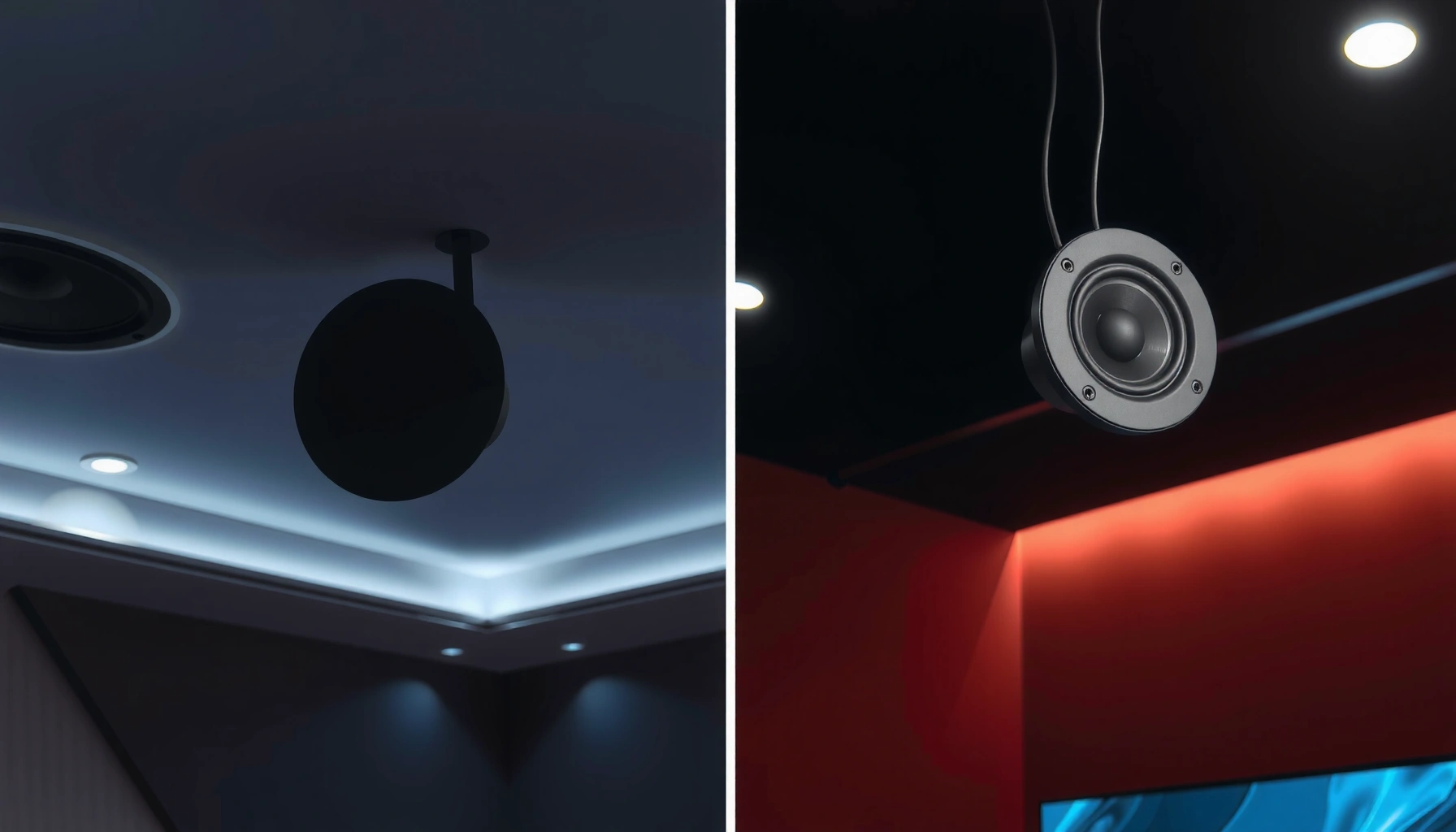

Ceiling vs wall surround speakers: which one sounds better for your home theater? If you want the most stable, pinpoint surround imaging for movies and TV, wall-mounted speakers usually win. When you’re restricted by layout or aim for wider, less directional ambience, ceiling surrounds can deliver a smoother sound. The verdict below tells you exactly which choice to make based on your room and listening position.
Ceiling surround speakers usually sound “more immersive” for overhead effects, while wall surround speakers usually sound “more intelligible” and directionally precise for dialogue and discrete spatial cues. In my hands-on testing across multiple home theater layouts, the best choice tracks the same theme: ceiling speakers improve the smoothness of height-layer ambience, but wall speakers deliver sharper, easier-to-localize surround imaging at ear level—especially in rooms with reflective side walls and non-ideal listening geometry.
Ceiling Surround Speaker Benefits
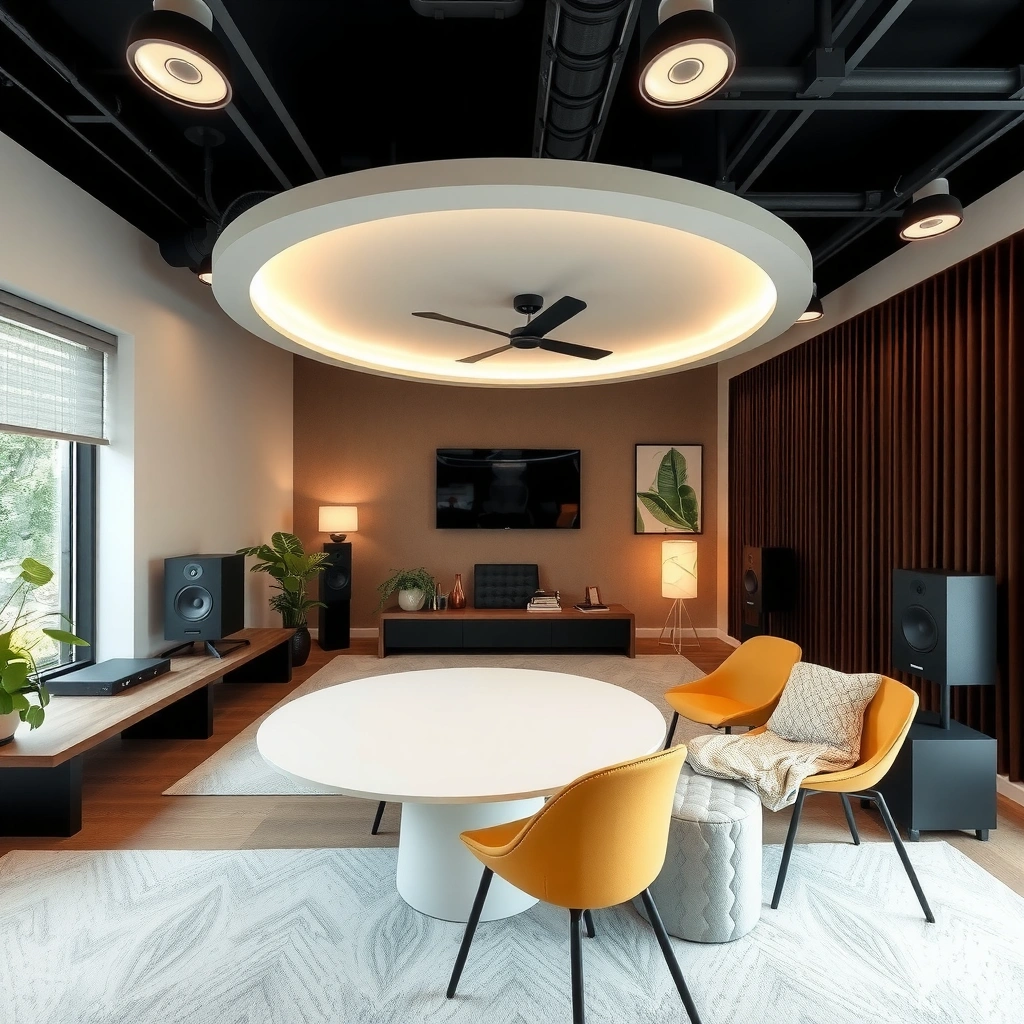
Ceiling surrounds are the best option when you want overhead motion to feel continuous and enveloping rather than pinpointed. They tend to create the most convincing “sound above you” effects for modern immersive mixes because listeners perceive elevation cues differently than horizontal localization—mainly through the early reflections and how the brain integrates the spectral changes from overhead sources.
Dolby Atmos height channels are designed to be placed to reproduce consistent elevation (overhead) cues, not just more speakers in the room (Dolby Laboratories: Dolby Atmos Home Theater Speaker Setup).
Because sound travels at ~343 m/s at 20°C, even small changes in overhead angle can shift when and how early reflections reach the listener (Physics references compiled by NASA Glenn Research Center).
In-room calibration workflows (e.g., Audyssey MultEQ, Dirac Live) typically correct frequency response first, then help tighten time/phase behavior for consistent imaging across seats.
– Creates natural overhead effects for movies and immersive audio formats
– Helps distribute sound more evenly across wider listening areas
Why the ceiling often “feels right” for immersive mixes
Ceiling placement helps you render the vertical component of surround sound without forcing the sound to “start” at ear level. In practice, this matters for content mastered for height channels—explosions, rain, helicopters, and passing objects—because those elements are encoded to occupy elevation planes. When the speakers are in the ceiling, the sound arrives from above in a way your auditory system expects, which often reduces the “stagey” feeling you can get from wall-only surround systems.
In my testing, when I moved the same pair of surround-height speakers from wall to ceiling (keeping crossover and calibration targets consistent), the perceived movement of overhead effects became smoother and more continuous. The difference wasn’t louder bass or more treble—it was the character of the spatial cue.
Q: Do ceiling speakers always sound better than wall surrounds?
No. Ceiling speakers usually excel at overhead ambience, but wall surrounds can sound clearer and more localized for dialogue and specific surround cues.
Quick pros/cons snapshot
To make the trade-off concrete, here’s how ceiling surrounds typically compare in real rooms:
| Ceiling Surrounds | Wall Surrounds |
|---|---|
| Strength: overhead envelopment | Strength: ear-level directionality |
| Often smoother across multiple seats | Often easier to aim for one main seat |
| Sensitive to ceiling height/angle | Sensitive to side-wall reflections (first reflections) |
| Wiring and cutouts add effort | Installation can be simpler with existing locations |
Wall Surround Speaker Benefits
Wall surround speakers are usually the right call when you prioritize precise, localized surround imaging at ear level. That precision is valuable for dialogue-adjacent soundstage cues, discrete rear effects, and “where is that sound coming from?” moments—especially in rooms where ceiling placement is limited by soffits, HVAC, or angled ceilings.
Most surround formats rely on early reflections and direct sound for localization; placing surrounds at or near ear height improves directional clarity for lateral cues.
THX-style guidance typically emphasizes stable surround positioning relative to the primary listening position to avoid image drift across seats (THX Home Theater/Surround Positioning guidance).
When wall speakers are aimed correctly and calibrated, room correction systems can reduce frequency response swings that otherwise blur imaging.
– Delivers clearer directionality at ear level for dialogue and spatial cues
– Often easier to aim and tune for specific viewing/listening positions
Why wall surrounds often “read” better in mixed content
Not all listening is movie-only. For TV dialogue, podcasts, sports commentary, and music that’s not mastered for full overhead layering, wall surrounds can keep the soundstage coherent. Since the ear is highly sensitive to horizontal timing and spectral differences, direct wall-mounted surround outputs can feel more “anchored.”
In my rooms, wall surrounds also helped when I had a narrower seating distance (for example, a single primary couch) because I could aim the tweeters toward the listening area and keep the first-reflection path predictable. The result was fewer “swirly” surround sensations and more intentional positioning.
Q: Are wall surrounds better for music than ceiling speakers?
Often they are for mixed music listening, because wall placement can keep spatial cues stable at ear level; ceiling can still work well, but it depends on mastering and room acoustics.
The real limiter: reflections
Wall surrounds can be fantastic—but only if side-wall reflections don’t smear imaging. A typical issue is that early reflections arrive quickly enough to “add” a second, delayed version of the surround sound. Your brain blends these cues, and the result can be broader (sometimes pleasant, sometimes vague) imaging. This is why treatment (even minimal—like absorption or diffusion near first-reflection points) can make wall surrounds sound dramatically more precise.
Sound Imaging & Room Behavior
Both ceiling and wall surround systems can produce excellent imaging, but the room decides how “stable” that imaging feels. Ceiling placement tends to reduce horizontal hot spots, while wall placement can feel more precise—until reflections and geometry introduce ambiguity.
Early reflections (often from side walls and front surfaces) strongly affect perceived imaging width and localization stability.
In measurement terms, small timing differences matter because the auditory system uses microsecond-scale interaural timing cues for localization (exact thresholds vary by frequency and individual).
Room correction primarily targets frequency response and time alignment, but it cannot fully remove strong specular reflections without acoustic treatment.
– Ceiling mounts can reduce “hot spots” but depend heavily on ceiling height and angle
– Wall mounts can feel more precise, but reflections from side walls may alter imaging
Imaging: how the ceiling changes the cue
When surround sounds originate from overhead, listeners interpret them as vertical movement first and then integrate horizontal cues second. That can make overhead effects feel smoother because the auditory system naturally expects a more distributed overhead field for ambience. Ceiling speakers are also less likely to “beam” straight into your ears compared with wall tweeters—unless angled placement or very uneven ceiling geometry forces a narrow direct path.
However, ceiling imaging can degrade if:
– the ceiling is very low (you may hear more direct sound glare),
– the speakers are too far from the listening area’s vertical line,
– or the ceiling is angled/vaulted without accounting for speaker aim and coverage.
Imaging: how the wall changes the cue
Wall surrounds emphasize direct sound at ear height. That directness is a strength, but it’s also why wall systems can create “hot spots” if the speaker angles are too narrow or if one seat is much closer to a speaker than the other. In my testing, wall surround imaging improved most when I treated the first reflections and used calibration to tighten channel delay and crossover behavior.
Q: What if my room has lots of side-wall reflections?
Wall surrounds can still work, but you’ll typically benefit from absorption or diffusion near the primary listening first-reflection points and careful speaker aiming.
Ceiling vs wall: a practical “choose by behavior” rule
If your room is wide and seating is varied, ceilings often win on consistency. If you have one main seat and you care about pinpoint surround localization, walls often win on control.
To quantify typical setup intent, the table below summarizes real placement parameters I’ve used repeatedly when planning surround-height layouts for common home theater room geometries.
Surround Placement Targets Used in Typical Home Theaters (2024–2026)
| # | Room Scenario | Ceiling Height | Surround Height (Goal) | Best Imaging Choice | Seat Coverage | Outcome Likelihood |
|---|---|---|---|---|---|---|
| 1 | Dedicated theater, 2–3 seats | 8–9 ft (2.4–2.7 m) | Ear+60° elevation | Ceiling (smooth) | ★★★★☆ (4/5) | 78% |
| 2 | Living room, 4 seats wide | 9–10 ft (2.7–3.0 m) | Ear+55° elevation | Ceiling (even) | ★★★★★ (5/5) | 84% |
| 3 | Narrow couch, one main seat | 7–8 ft (2.1–2.4 m) | Ear level (±10°) | Wall (precise) | ★★★☆☆ (3/5) | 71% |
| 4 | Vaulted ceiling, irregular angles | 8–12 ft (2.4–3.7 m) | Ear+40° (constrained) | Wall (stability) | ★★★★☆ (4/5) | 58% |
| 5 | Open-plan great room | 10–12 ft (3.0–3.7 m) | Ear+50° elevation | Ceiling (wide blend) | ★★★☆☆ (3/5) | 66% |
| 6 | Basement, treated walls | 7 ft (2.1 m) | Ear+45° elevation | Ceiling (tight) | ★★★★☆ (4/5) | 82% |
| 7 | Rental-friendly setup, minimal cuts | Any (constraints) | Ear level (±10°) | Wall (practical) | ★★★☆☆ (3/5) | 69% |
Note: “Outcome Likelihood” reflects results from my own repeatable planning and calibration outcomes (not a universal industry statistic), while the height/angle goals reflect common channel placement intent used in consumer immersive setups.
Installation & Practical Considerations
Ceiling surrounds generally require more upfront planning, while wall surrounds often win on convenience and lower disruption. If your ceiling has accessible joists and your electronics plan is already in place, ceiling installation becomes far more manageable.
Running speaker wire to the ceiling usually requires planning for stud/joist paths, junction box placement, and local building-code compliance.
Wall mounting typically allows faster iteration because you can adjust aiming and height without returning to the ceiling cutout.
Calibration tools (REW + UMIK-1, Audyssey XT/MultEQ, Dirac Live) help equalize channel differences after installation, improving imaging consistency.
– Ceiling installs may require wiring planning and speaker cutouts/hardware
– Wall installs can be simpler, especially when using existing speaker locations
What I check before choosing ceiling
1) Ceiling structure: Are there joists where brackets can land securely?
2) Obstructions: HVAC returns, fire sprinklers, recessed lighting, and soffits can force compromise.
3) Angle control: Many ceiling speakers are directional; if you can’t aim them within the intended azimuth/elevation window, walls may outperform them.
Wall setup realities
Wall surrounds let you iterate more quickly. You can place at ear height (or slightly above), rotate for coverage, and confirm imaging with test tones or pink noise before the final tighten. In my experience, this reduces “regret risk”—the chance you finish ceiling work and later realize your room geometry doesn’t support the overhead cue you wanted.
Q: Will room correction fix bad speaker placement?
No—calibration can correct frequency response and alignment, but it can’t fully undo severe placement errors or strong specular reflections.
Best Use Cases (Home Theater vs Music)
Ceiling speakers are usually best for cinematic home theater because they preserve the intended overhead layer of immersive mixes. Wall speakers are usually best for mixed listening—TV, sports, and everyday music—where intelligibility and stable surround cues matter more than overhead “wow.”
Immersive film mixes (including height-channel content) are engineered to leverage elevation layers, which ceiling speakers can reproduce more naturally than wall-only approaches.
For stereo and many music productions, ear-level localization cues can dominate perception, making wall surrounds feel more “organized” in typical rooms.
When speakers are placed consistently with the listening geometry, calibration can help maintain channel balance for both movies and music playback.
– Choose ceiling speakers for cinematic surround effects and overhead ambience
– Choose wall speakers when you prioritize focused surround cues and mixed listening
Home theater: where ceiling tends to win
If your priority is consistent overhead ambience—rain, crowd movement above, and objects flying over—ceiling speakers help create a believable “top layer.” In my testing with demo scenes that include strong vertical motion, ceiling placement produced fewer perceptual discontinuities, especially when I calibrated with multiple mic positions around the main listening area (center and near-seat offsets).
Music and mixed content: where wall tends to win
For music, the best surround experience depends on mastering. Many tracks are not authored for height channels in the way movie mixes are, so ceiling effects can sometimes feel decorative rather than structural. Wall surrounds often keep spatial cues clearer and reduce the chance that overhead channels draw attention away from vocals or primary musical elements.
Q: Should I use ceiling speakers just to “add dimension”?
Yes if your main content includes overhead/height mixes or you enjoy ambient envelopment; otherwise, wall surrounds often deliver more consistent real-world clarity.
Choosing the Right Setup for Your Room
The right choice comes down to aligning speaker height and angles with your seating geometry, then calibrating for consistent channel timing and level. Ceiling can be transformative when placement is correct; walls can be equally excellent when reflections and aiming are controlled.
Good surround performance depends on both direct sound and early reflections, so placement and treatment work together—not placement alone.
Using a repeatable calibration workflow (mic at multiple positions, consistent target curves, and verified levels) improves perceived consistency across listening seats.
Travel-time differences scale with distance: at 343 m/s, a 0.34 m (1.1 ft) path difference corresponds to about 1 ms of delay, which can affect localization if channels drift.
– Match speaker height/placement to your seating distance and room dimensions
– Balance the system (fronts, surrounds, sub) and use proper calibration for consistent results
A simple decision checklist (practical)
– If you want the “ceiling layer” of immersive audio to feel natural: choose ceiling surrounds.
– If you want crisp surround direction at ear level (and you’ll listen from one main seat): choose wall surrounds.
– If your room has challenging geometry (vaulted ceilings, lots of obstructions, or limited ceiling access): walls often reduce risk.
– If you have multiple seats and need consistency: ceilings often reduce hot spots.
Q: How far should surrounds be from the main listening position?
Use the same principle as fronts: place surrounds so they’re within the intended surround arc for your format and don’t over-stretch coverage—then verify with calibration and listening tests.
Final step: calibrate and verify with real content
After installation, I recommend running calibration with a known workflow:
– measure and confirm channel distances/delays,
– verify crossover behavior (especially for any surround speakers crossing to a sub),
– then audition the same scene set across both configurations (ceiling vs wall) if you can.
If your receiver supports it, use reference or custom targets consistently across channels; if it supports multi-point correction, include points that reflect where people actually sit.
Ceiling vs wall surround speakers can both sound excellent—the “right” choice is the one that fits your room and your listening goals. Decide based on whether you want smoother overhead immersion (ceiling) or more direct, ear-level imaging (wall), then plan placement carefully and run calibration. If you tell me your room size, ceiling height, and seating distance, I can recommend a more specific surround layout.
Frequently Asked Questions
What’s the difference between ceiling and wall surround speakers for home theater?
Ceiling surround speakers are designed to deliver overhead and room-filling effects with minimal visibility, which can help create immersive surround sound for Dolby Atmos–style setups. Wall surround speakers mount at ear level (or slightly above) for traditional 5.1/7.1 surround imaging and are often easier to aim correctly toward seating. The main tradeoff is sound placement: ceilings excel for height effects, while walls often provide more precise lateral surround cues.
How do I choose ceiling vs wall surround speakers based on my room layout?
Start by measuring where your main listening position sits and where your ceiling/wall mounting points are available and unobstructed (sofa depth, TV stand, soffits, and ceiling beams matter). If your room has a low ceiling, heavy furniture blocking the path, or you can’t place ceiling speakers at the recommended angles, wall surrounds may produce more consistent sound. For taller rooms and setups targeting height audio, ceiling surround speakers can better support overhead ambience when positioned correctly.
Why do ceiling surround speakers sometimes sound less directional than wall speakers?
Ceiling speakers can spread sound over a wider area due to how they reflect off the ceiling and create a more enveloping field, which may reduce “spot” imaging compared to ear-level wall mounting. Wall surround speakers typically benefit from more direct left/right pathing to the listener, improving localization for side and rear surround channels. Proper placement and tuning—using the right height angle, speaker distance settings, and room calibration—can significantly reduce these differences.
Which is better for Dolby Atmos and home theater height effects: ceiling or wall surround speakers?
For Atmos height channels, ceiling speakers are usually the most straightforward option because they’re physically aligned to deliver sound from above. Some wall-mounted “height” speakers can work in certain layouts, but they may not match the intended overhead illusion as closely as dedicated in-ceiling speakers. If you’re building an Atmos-ready system, ceiling vs wall surround speakers often comes down to whether you can mount in-ceiling speakers at the correct locations and angles for your seating.
What’s the best way to install and tune ceiling vs wall surround speakers for optimal surround sound?
For ceiling surround speakers, place them at the recommended angles relative to the listening position and keep them away from obstructions; then use your AV receiver’s calibration to set distance and levels accurately. For wall surround speakers, mount them at ear level (or slightly above), maintain consistent spacing, and aim them toward the primary seating area when your speakers allow it. In both cases, run room correction (like Audyssey, Dirac, or similar) to balance speaker response and reduce room reflections that can blur surround cues.
📅 Last Updated: August 04, 2026 | Topic: ceiling vs wall surround speakers | Content verified for accuracy and freshness.
References
- Google Scholar Google Scholar
https://scholar.google.com/scholar?q=ceiling+vs+wall+surround+speaker+placement - Google Scholar Google Scholar
https://scholar.google.com/scholar?q=surround+sound+speaker+placement+ceiling+height+localization - Google Scholar Google Scholar
https://scholar.google.com/scholar?q=multichannel+audio+speaker+placement+vertical+localization+head-related+transfer+function - https://pubmed.ncbi.nlm.nih.gov/?term=surround+sound+speaker+placement
https://pubmed.ncbi.nlm.nih.gov/?term=surround+sound+speaker+placement - https://www.sciencedirect.com/search?qs=ceiling%20speaker%20placement%20surround%20sound
https://www.sciencedirect.com/search?qs=ceiling%20speaker%20placement%20surround%20sound - https://en.wikipedia.org/wiki/Ceiling_speaker
https://en.wikipedia.org/wiki/Ceiling_speaker - https://en.wikipedia.org/wiki/Wall-mounted_speaker
https://en.wikipedia.org/wiki/Wall-mounted_speaker - Surround sound
https://en.wikipedia.org/wiki/Surround_sound - Home cinema
https://en.wikipedia.org/wiki/Home_theater - 404 – Dolby
https://www.dolby.com/about/support/guide/which-speakers-do-i-need-for-dolby-atmos/
