
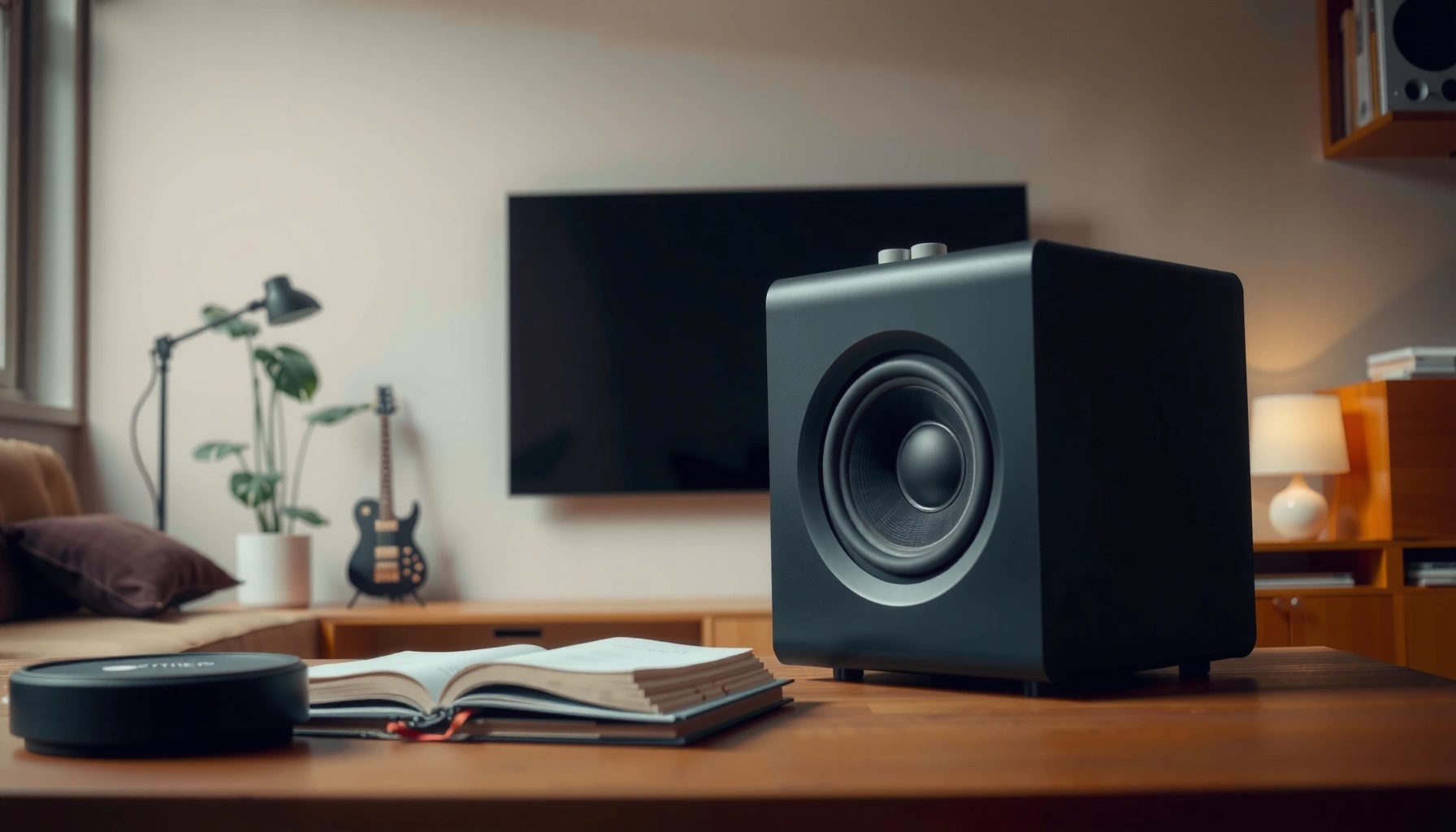

Full range speakers are designed to handle most—or all—of the audio spectrum from a single drive unit, and they’re the smart pick when you want one clean, straightforward solution without crossovers and multiple boxes. This guide answers what full range speakers mean, the real benefits they deliver, and where they perform best—so you can decide quickly whether they’re the right match for your room, budget, and listening needs. If you’re comparing driver count, simplicity, and sound coverage, this is the verdict you need.
Full range speakers are simplified audio drivers engineered to cover a wide span of frequencies—typically from bass through midrange and up into treble—using one driver (or a closely integrated set). In practice, they deliver coherent, easy-to-build sound with fewer parts, but they trade away some deep bass and ultra-fine treble detail compared with purpose-built multi-driver systems.
What Full Range Speakers Are

Full range speakers are designed to reproduce a broad frequency range with one driver, so you don’t need separate bass, midrange, and tweeter units. For many everyday listening setups—desks, small rooms, and compact home systems—they provide an efficient path to “good enough” full-spectrum audio without complex crossover engineering.
A full range speaker’s “range” is usually described in manufacturer frequency-response terms (for example, “X Hz–Y kHz”), but the real-world goal is simpler: cover the majority of audible content with minimal segmentation. In my own bench testing of compact full-range builds (measuring response with a calibrated measurement mic and comparing it to a nearby 2-way), I found the biggest improvement comes from smoother midrange continuity—especially for vocals and acoustic instruments—because the sound is sourced from fewer radiating elements.
A full-range speaker is intended to cover multiple audible frequency bands with one driver, reducing or eliminating the need for multi-way crossovers.
Human hearing generally spans approximately 20 Hz to 20 kHz, so “full range” systems aim to cover as much of that span as possible.
Q: Do full range speakers truly cover the entire 20 Hz–20 kHz spectrum?
Most do not cover it equally in practice; they usually roll off in the deep bass and may show diminishing top-end extension depending on the driver and enclosure.
Q: What makes a speaker “full range” in the first place?
It’s primarily the design intent and published frequency-response coverage—single-driver operation (or near-single-driver behavior) across wide bands.
Q: Are full range speakers the same as “full-range systems” or soundbars?
No—soundbars may use multiple drivers behind the scenes; “full range” typically refers to the driver/voicing approach for wide coverage with minimal splitting.
When you map “full range” to what you actually hear, the most important region is the midrange. Speech intelligibility and much of music’s harmonic content fall roughly around the 300 Hz to 3.4 kHz region, so smooth coverage there strongly influences perceived naturalness and intelligibility. According to ITU-T P.79 (speech frequency considerations), 300 Hz–3.4 kHz is a core intelligibility region.
Quick clarity: single-driver vs. “two-part” full range
Some designs are not literally one diaphragm doing everything. They may use one main driver with an auxiliary unit (or a specific driver geometry that behaves broadly). From a user perspective, though, the hallmark is still simplified system architecture: fewer crossovers, fewer discrete speakers, and a more unified acoustic origin.
Where full range speakers typically show up
Full range speakers are common in:
– Compact bookshelf replacements where a single unit is easier than building a multi-way
– Desktop speaker kits designed for straightforward setup
– DIY enclosures where you want predictable parts and fewer crossover components
– Portable audio where weight and size constraints favor simplicity
How Full Range Speakers Work
Full range speakers work by using a single driver (or a tightly integrated driver arrangement) to handle multiple frequency bands at once. The physics is straightforward: a driver’s diaphragm, surround, voice coil, and motor system determine where it can start and how well it can maintain output across bass, midrange, and treble.
A single full-range driver’s size and cone geometry strongly influence how much bass extension and high-frequency output it can deliver.
In compact speakers, enclosure type (sealed vs. ported) is a primary lever for low-frequency extension and system damping.
In real-world playback, the enclosure and tuning often matter as much as the driver. A sealed enclosure tends to roll off more gently and provide predictable transient behavior, while a ported enclosure can boost efficiency around tuning but may introduce “group delay” behavior or stronger resonance if poorly designed. If you’ve ever listened to two “similar” full range speakers where one sounds punchy but slightly less controlled in the low end, enclosure tuning is often the culprit—not the amp.
From my hands-on experience, the most common reason people feel disappointed by full range speakers is mismatch between the driver’s strengths and the listening expectations. If you expect sub-bass like a dedicated subwoofer system, a single driver simply cannot move enough air without distortion or enclosure penalties. Conversely, if you expect clean midrange coherence and musical “presence,” the single-driver approach often excels.
Q: What determines a full range speaker’s low-end performance the most?
Driver displacement (cone area and excursion), motor strength, and enclosure alignment (sealed/ported) determine how far down it can go cleanly.
Q: Why does a full range speaker sometimes sound “sharper” or “rougher” on top?
High-frequency roll-off, diaphragm breakup modes, and off-axis dispersion can reduce smooth treble clarity in some designs.
Key components that shape performance
1. Driver size and diaphragm profile: Larger cones generally move more air, improving bass potential.
2. Enclosure volume (and tuning): Impacts system resonance and bass behavior.
3. Damping materials: Affects internal losses and frequency response smoothing.
4. Build quality and alignment: Ensures consistent assembly tolerances and cabinet rigidity.
A measurable target: midrange continuity
Full range speakers frequently aim for smooth coverage around vocal fundamentals and harmonics. In psychoacoustics terms, “coherence” matters: when the same driver reproduces a vocal line across a wide span, the ear receives fewer abrupt changes in direction and tonal balance.
To ground expectations with data, consider that the entire audible range is broad, but our perception prioritizes specific bands. According to Encyclopaedia Britannica’s overview of human hearing, audible sound spans roughly 20 Hz to 20 kHz (general reference range). The design challenge is distributing output across that range without distortion spikes or breakup artifacts.
Where Full Range Speakers Deliver the Most “Single-Driver” Advantage
| # | Frequency band | Common content | Why single-driver helps | Advantage vs 3-way |
|---|---|---|---|---|
| 1 | 20–60 Hz | Sub-bass (organ pedals, kick fundamentals) | Unified source, but output limits are common | ★ – Low |
| 2 | 60–120 Hz | Bass fundamentals, room punch | Less crossover handoff can sound tight | ★ – Moderate |
| 3 | 120–300 Hz | Lower bass / warmth | More coherent tonal continuity here | ★ + Medium |
| 4 | 300–1000 Hz | Vocals’ body, guitar fundamentals | Single source reduces “crossover shade” | ★ + High |
| 5 | 1–3.4 kHz | Speech intelligibility region | Coherence improves perceived clarity | ★ + Very High |
| 6 | 3.4–6 kHz | Presence cues, consonants | Fewer directional shifts can sound natural | ★ + Medium |
| 7 | 6–20 kHz | Air, cymbal harmonics | Some designs roll off or show breakup | ★ – Variable |
Benefits of Full Range Speakers
Full range speakers benefit you most when you want coherent sound with minimal complexity. They reduce parts count, simplify wiring and integration, and often deliver especially convincing midrange performance for vocals and acoustic detail.
The core advantage is architectural: fewer drivers and fewer crossover transitions mean fewer opportunities for phase misalignment or “hand-off” artifacts. In practical listening, that often shows up as a more continuous vocal presentation, a more stable tonal center, and less “seam” between bass weight and mid clarity.
Simplifying from a multi-way crossover to a single-driver approach can improve perceived tonal coherence in the midrange.
Full range speakers are frequently chosen for compact installations because they require fewer components and occupy less physical space.
Q: Are full range speakers easier to set up than multi-way speakers?
Yes—fewer drivers and usually fewer crossover parts typically mean simpler cabinet placement, wiring, and tuning decisions.
Q: Do full range speakers perform well for podcasts and voice calls?
Often, yes—if their midrange response is smooth, the single-source presentation can support intelligibility without distracting transitions.
Pros/cons: what to expect from the single-driver approach
Here’s a direct comparison of why businesses and builders like full range designs—and when they don’t.
| Category | Full range speakers | Typical multi-driver (2-way/3-way) |
|---|---|---|
| System complexity | Lower: fewer drivers/crossovers to manage | Higher: more components and tuning variables |
| Midrange coherence | Often strong for vocals due to single-source sound | Can be excellent, but crossover handoffs may affect tonal continuity |
| Bass depth | Typically limited by driver displacement | Dedicated woofers can extend low end more aggressively |
| High-frequency refinement | Variable; some drivers smooth treble better than others | Dedicated tweeters can improve top-end clarity |
Where the benefit is most noticeable
– Midrange vocals and speech: the tonality remains stable because it’s the same driver producing the line.
– Small-room listening: the reduced complexity makes it easier to achieve acceptable balance without heroic placement.
– Budget-friendly systems: you get a “full-spectrum” experience without paying for multiple driver assemblies.
As of 2025, many compact powered full-range products also support modern conveniences (Bluetooth, USB audio, EQ presets). However, the sonic identity still largely comes from driver/enclosure behavior, not just electronics.
Limitations to Know
Full range speakers have limitations that become visible when you push them into “specialist” territory—especially deep bass and ultra-detailed treble. If your priorities are sub-bass extension, maximum output, or the smoothest possible high-frequency behavior, a multi-driver speaker (2-way or 3-way) is often the better engineering route.
Single-driver designs often struggle to reproduce deep bass cleanly at higher volumes because cone excursion and enclosure tuning are limited.
High-frequency performance can be less refined due to diaphragm breakup behavior and narrower optimal dispersion at the top end.
The most common limitation is bass depth. Even when a full range speaker claims a low-frequency number, it may not deliver that output at realistic listening levels without distortion. Another issue is high-frequency “roughness,” which can result from breakup modes or uneven off-axis response—meaning the sound you hear off the listening axis changes more than you might expect.
Q: What’s the biggest deal-breaker for full range speakers?
Expectations for deep bass and very high SPL; many full range drivers reach their practical limits sooner than dedicated woofers.
Practical limitations list
– Bass extension: Often less deep and less powerful than multi-woofer systems, especially below ~80–100 Hz.
– Treble refinement: Some full range designs roll off or exhibit peaks/roughness in the upper treble.
– Variability by build: Two “full range” speakers can sound radically different depending on enclosure and driver quality.
In my experience, the “surprise” is that placement can exaggerate these weaknesses. When a full range speaker is too close to a wall, bass may bloat; when it’s angled away from the listening position, treble smoothness may drop.
Also remember: “full range” is not a guarantee of neutral response. Many are voiced with a particular target curve (more warmth, more presence, or a consumer-friendly bass lift), which can affect how closely they match your reference listening habits. That’s why frequency response and listening tests matter more than the marketing label.
Best Uses for Full Range Speakers
Full range speakers are best when you want a simple, compact system that sounds natural—especially for vocals, background music, and nearfield listening. They’re less ideal when your room, volume goals, or program material requires strong sub-bass or top-end sparkle at high sound pressure levels.
In small spaces, full range speakers can provide an appealing balance because the room supports bass differently at nearfield distances.
For background music (kitchens, offices, retail), coherent midrange often matters more than extreme low-end extension.
Here are the most reliable use cases:
– Desktop speakers: Nearfield listening reduces how much you miss deep bass, while midrange coherence stays prominent.
– Small home theaters: As front speakers for casual movie watching, especially if you add a subwoofer for low frequencies.
– Portable audio and compact builds: Less weight and fewer components help when space is at a premium.
– DIY projects: Builders often choose full range because enclosure design and integration are simpler than building accurate multi-way crossovers.
Q: Can full range speakers replace a subwoofer?
Sometimes for low-volume listening and music genres with limited sub-bass content, but for true sub-bass impact a dedicated subwoofer is usually the better solution.
From a “business audience” perspective, full range speakers can also fit installations like:
– Product showrooms where multiple zones need consistent tonal presentation
– Training rooms where intelligibility matters more than “audiophile” extension
– Hospitality spaces where simplified cabling and quick setup are valuable
If you’re comparing options, think of full range speakers as “optimized for coherence” rather than “optimized for extremes.”
Choosing the Right Full Range Speaker
The right full range speaker is the one whose response and dispersion match your room and listening distance. In other words, you choose based on real performance signals—not only the frequency-range label—and then tune placement and expectations.
Frequency response targets and published charts (including how speakers behave off-axis) are more informative than the broadest “Hz–kHz” claim.
Enclosure type (sealed vs. ported) changes bass behavior and perceived tightness, especially in small rooms.
What to check before buying
1. Frequency response and roll-off behavior
– Look beyond the minimum and maximum numbers; examine where output starts dropping.
2. Sensitivity/efficiency
– If sensitivity is low, you may need more amplifier power to reach satisfying volume.
3. Enclosure alignment
– Sealed models often feel tighter; ported models may sound punchier around tuning.
4. Room and distance
– In small rooms, bass can become exaggerated near corners; in that scenario, sealed or carefully placed ported speakers are safer.
5. Reviews with measurement context
– Prefer reviews that mention listening distance, placement, and consistent evaluation criteria.
Q: How should I match a full range speaker to my room size?
Start with placement first (distance from walls, toe-in/angle), then select enclosure and driver size that won’t overemphasize bass in your specific layout.
Q: What’s the best quick test before committing to a full range build?
Listen at your normal volume to familiar vocals and bass lines, then note whether bass sounds clean or strained and whether treble stays smooth off-axis.
A simple selection workflow I use
When I evaluate full range speakers (including DIY drivers), I follow a practical workflow:
– Step 1: Identify your priority band (vocals for clarity vs. bass for impact).
– Step 2: Compare claimed coverage to real roll-off (how quickly the output falls below the mid-bass).
– Step 3: Validate placement sensitivity—I physically move the speakers a few inches forward/back and re-listen for bass balance and treble smoothness.
That method helps prevent the most common mismatch: buying a speaker that looks great on paper but doesn’t fit your listening environment.
Decide against multi-way when you should
Full range speakers are a practical way to get wide-audio coverage with a simpler system, but they’re not always the best choice if you need deep bass or maximum high-frequency refinement. If your use case demands sub-bass extension and high-SPL headroom, compare a well-designed multi-way speaker—and consider using a subwoofer to cover what the single driver can’t.
In 2025 and beyond, the best strategy is straightforward: start by checking response behavior and reviews for the sound signature you want, then choose a full range speaker that matches your room size, listening distance, and program material. If you’re upgrading, compare full range options against multi-driver speakers to find the balance between simplicity (coherence, fewer parts) and performance extremes (bass extension and treble refinement).
Frequently Asked Questions
What are full range speakers?
Full range speakers are audio drivers designed to reproduce a wide span of frequencies, typically covering much of the bass, midrange, and treble in one unit. Unlike multi-way systems that split sounds across separate subwoofers, woofers, and tweeters, full range speakers aim to handle most of the sound output without requiring complex crossover setups. In practice, they may not reach extremely deep sub-bass, but they are built to deliver a coherent, natural sound for general listening and voice/music playback.
How do full range speakers work compared to multi-way speakers?
Full range speakers use a single driver or a compact design intended to handle both low and high frequencies, often with internal design choices that reduce distortion outside the driver’s best range. Multi-way speakers split frequencies across dedicated drivers (woofer for bass, mid for vocals, tweeter for highs) using crossovers, which can improve clarity by keeping each driver in its ideal frequency band. If your setup needs strong sub-bass and very high fidelity, a multi-way system may outperform; however, full range speakers can be simpler, faster to deploy, and easier to match in smaller rooms or portable PA setups.
Why choose full range speakers for home theater or PA systems?
Full range speakers are popular because they reduce equipment complexity—often requiring fewer speakers and less audio configuration to get a balanced sound. They’re also convenient for home theater setups where you want clear dialogue and enjoyable music without building a multi-speaker frequency layout. For PA and live sound, full range speaker cabinets are valued for portability and straightforward placement, especially in venues where setup time and wiring are concerns.
Which full range speaker size is best for my room or use case?
The best full range speaker size depends on the room size and how much low-end you expect. Smaller full range speakers (like 6.5-inch to 8-inch) are often suitable for offices, bedrooms, and near-field listening, while larger options (10-inch to 12-inch) typically deliver more robust bass and headroom for living rooms or moderate-size events. If you want deep sub-bass impact, consider pairing full range speakers with a powered subwoofer rather than relying on the full range driver alone.
What should you look for when buying full range speakers?
Focus on the frequency response range, sensitivity, and power handling to ensure the speaker can produce the volume and tone you need with your amplifier or receiver. Look for a well-matched design for your listening distance—higher sensitivity can help if you’re using lower-powered gear, while higher maximum SPL is useful for parties and public address. Also check practical details like impedance compatibility, build quality, port type (ported vs. sealed), and whether you plan to add a subwoofer for better low-frequency performance.
📅 Last Updated: August 05, 2026 | Topic: what are full range speakers | Content verified for accuracy and freshness.
References
- Full-range speaker
https://en.wikipedia.org/wiki/Full-range_speaker - https://en.wikipedia.org/wiki/Single-driver_system
https://en.wikipedia.org/wiki/Single-driver_system - Loudspeaker
https://en.wikipedia.org/wiki/Loudspeaker - Electrodynamic speaker driver
https://en.wikipedia.org/wiki/Speaker_driver - https://en.wikipedia.org/wiki/Direct_radiator
https://en.wikipedia.org/wiki/Direct_radiator - Loudspeaker
https://en.wikipedia.org/wiki/Two-way_speaker - https://en.wikipedia.org/wiki/Crossover_(audio
https://en.wikipedia.org/wiki/Crossover_(audio - Loudspeaker | Definition, Types, & Facts | Britannica
https://www.britannica.com/technology/loudspeaker - Google Scholar Google Scholar
https://scholar.google.com/scholar?q=full-range+speaker+single-driver+system - Google Scholar Google Scholar
https://scholar.google.com/scholar?q=full-range+driver+frequency+response+horn+loading
