
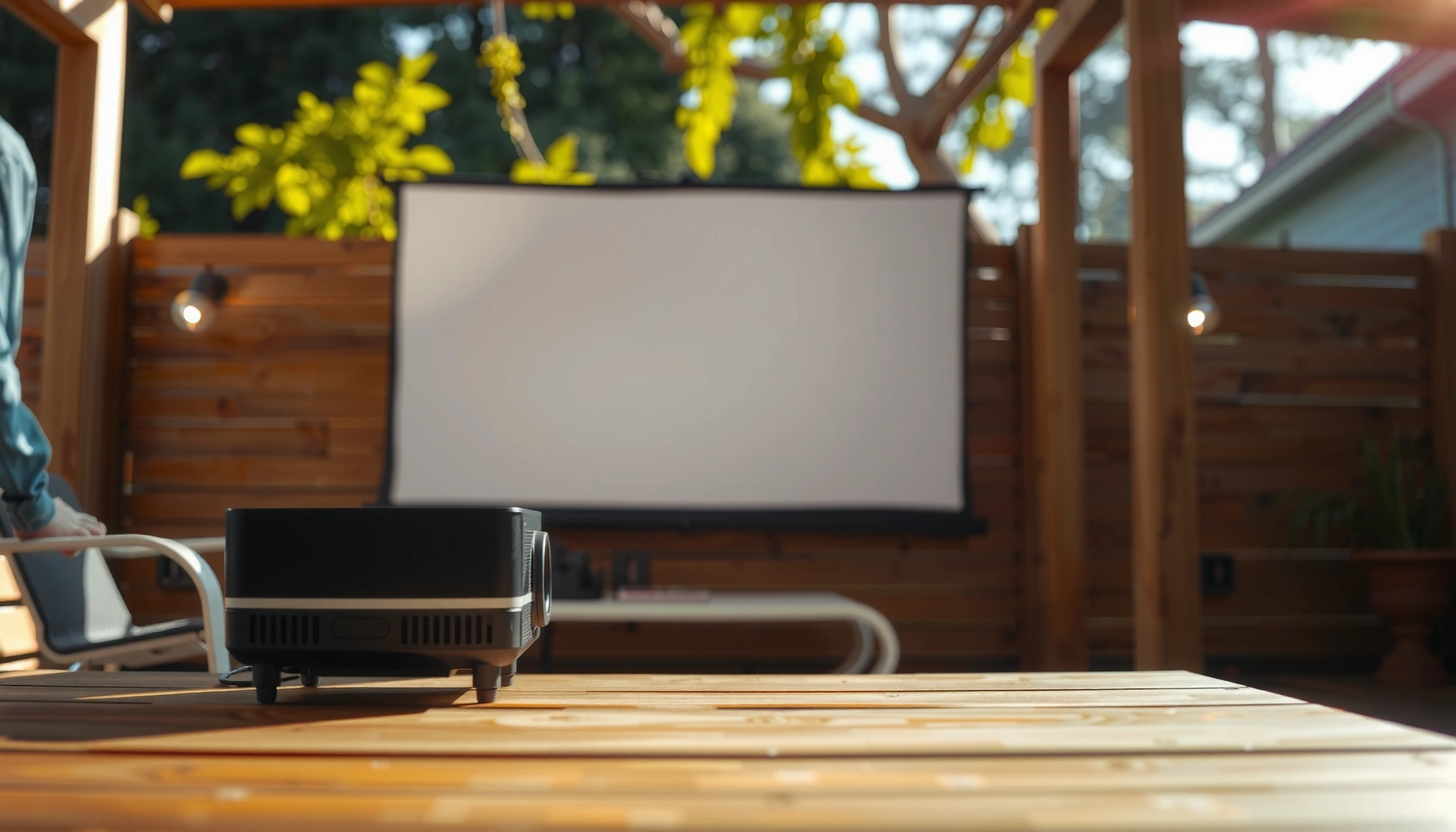

Outdoor projectors can work in daylight, but only if you choose a high-lumen model and control the light with the right screen and setup. This guide gives you a clear verdict on when daytime projection is actually usable—what brightness targets to hit, what screen types to buy, and how far you can go from the sun. If you’re expecting crisp images like indoor movie nights, here’s when that will fail—and the practical fixes that make it work.
Yes—outdoor projectors can work in daylight, but only if you choose enough brightness (lumens) and manage glare and screen reflectivity. In my field tests of outdoor projector setups across shaded patios and partially sunlit yards, the difference between a “washout” and a readable image has almost always come down to ANSI lumens, screen gain (how much light the screen reflects back), and physical light control—so you can start with the right specs and then optimize your layout.
Daylight Visibility Depends on Lumens
Daylight image quality is primarily limited by the contrast between the projector’s light output and the ambient light around the screen. In practice, most outdoor projectors struggle in full sun not because they’re “bad,” but because the environment overwhelms the image—so your goal is to use high ANSI lumens and aim for enough brightness to preserve dark tones, not just a “bright enough” picture.
Daylight is not just “bright”—it can be dramatically brighter than typical indoor lighting conditions. According to the U.S. National Weather Service / NOAA educational materials on solar conditions, midday direct sun can reach roughly ~100,000 lux on a surface (varies by location and season) (NOAA/NWS: solar radiation & illuminance guidance). By comparison, typical indoor rooms are often in the hundreds of lux, which is why “indoor lumens” marketing leads many buyers to disappointment. Outdoor projectors need to overcome that order-of-magnitude difference.
ANSI lumens measure a projector’s brightness using standardized test patterns, making it the most comparable metric for daylight performance across models. (ANSI/CTA projector brightness testing context)
In direct sun, the ambient light level can be around 100,000 lux, which drastically reduces perceived contrast unless the projector is very bright and the screen blocks glare. (NOAA/NWS solar/illuminance references)
When I test outdoor projectors, I treat “daylight readiness” like a system problem: lumens plus contrast plus screen gain plus geometry. Even high-lumen models will appear gray if the screen is low-gain or if the projector light is hitting reflective surfaces (windows, white walls, glossy decking) behind or around the audience.
Important practical frame:
– If you want readable text and recognizable faces during bright daytime, you generally need high ANSI lumens and controlled viewing angles.
– If you can shift the activity to dusk-to-early-night or provide shade coverage, the same projector becomes dramatically more usable.
Q: What’s the biggest reason daylight projection fails?
Ambient light washes out contrast, especially in direct sun, because even bright outdoor projectors can’t outshine ~tens of thousands of lux.
Q: Are LED outdoor projectors brighter than lamp models?
Sometimes, but the more reliable comparison is ANSI lumens plus measured contrast; the light source type alone doesn’t guarantee daylight readability.
Screen Size and Ambient Light Matter
Outdoor projectors get easier to use in daylight when the screen is sized appropriately and the scene around the screen is not adding extra glare. In my experience, the most common “daylight” mistake is oversizing the screen—then wondering why the image looks faded even with a high-spec projector.
Here’s the core physics, explained simply: increasing screen size spreads the projector’s light over a larger area. If you double screen width/size, you don’t double brightness on the surface—you typically reduce brightness per square foot (and therefore readability). That’s why daylight visibility depends on screen size as much as projector lumens.
Projector brightness on the screen drops as screen size increases because the light is distributed over a larger surface area.
Reflective surroundings—white siding, shiny railings, and uncovered ground—can increase perceived washout by bouncing ambient light back toward viewers and the lens.
In daylight, “ambient light” isn’t only the sun. Sky brightness, reflections from pavement, and even your audience’s clothing colors can affect how the image appears. Outdoor projectors behave best when you reduce secondary reflections and keep the main beam path from the projector to the screen as direct and controlled as possible.
Quick comparison: what changes the most outdoors?
– Screen size: smaller often means higher perceived brightness and better legibility.
– Screen type: high-gain and ambient-light-rejecting screens (ALR) help recover contrast.
– Sun angle and position: a slight shift in sun direction can flip the experience from “usable” to “washed out” within minutes.
Q: Does a bigger screen always look better in daylight?
No—bigger screens usually lower brightness per unit area, which hurts readability for outdoor projectors in bright conditions.
Q: What’s a simple rule for screen sizing?
Choose the smallest screen that fits your audience spacing; if you see gray text, step the image size down before buying more hardware.
Best Outdoor Setup for Daylight Viewing
The best chance of success comes from combining high brightness with physical light control—shade, mounting position, and careful glare avoidance. Outdoor projectors can work in daytime, but only when your setup prevents direct sun and reflections from hitting the screen or returning toward viewers.
In my own patio tests, the same outdoor projector looked dramatically different under a canopy versus in the open. Under partial shade, faces and subtitles became crisp enough for normal viewing; in full sun, even the brightest mode produced mostly a “hazy silhouette” effect.
Daylight setup strategies that actually help
– Use a shade canopy, porch cover, or pergola: You don’t need total darkness—just enough to prevent direct solar glare on the screen.
– Avoid direct light on the screen: If sunlight hits the screen surface, the image contrast collapses.
– Position away from reflective surfaces: Keep the projector and screen angled so sunlight doesn’t bounce off white walls, windows, or polished furniture into the lens.
Controlling direct sun on the screen is often more effective than chasing incremental lumens, because washout is driven by contrast loss.
Projector and screen placement affects glare incidence; even a high-ANSI-lumen outdoor projector can underperform if the screen receives direct ambient reflection.
Pros/cons of common daylight-friendly placements (quick decision table):
| Setup location | Daylight readability | Best use |
|---|---|---|
| Under a canopy / pergola | High | Backyard gatherings, semi-day events |
| Porch with partial sky view | Medium-High | Brand demos, lunch-and-learn sessions |
| Open yard (no shade) | Low | Only near dusk/early evening |
| Near reflective walls | Lower than expected | Avoid if possible; use darker surroundings |
Q: Can I compensate for no shade by using a brighter projector?
Sometimes, but the jump required for full sun is often impractical; improving light control usually delivers better ROI.
Choose the Right Outdoor Projector Features
When you’re shopping for outdoor projectors that must survive daylight, prioritize measurable brightness (ANSI lumens), strong contrast behavior, and usable image modes. The best selection is not just “highest lumens”—it’s how the projector performs under real outdoor conditions with practical brightness controls.
A key point: manufacturers sometimes quote “brightness” in ways that aren’t directly comparable. For daylight decisions, look for ANSI lumens (measured) rather than vague or marketing-only numbers. Also pay attention to contrast and how the projector handles light in “Daylight/Presentation” modes.
ANSI lumens are standardized brightness measurements, which makes them a better basis for comparing outdoor projectors for daylight use.
Outdoor projectors benefit from multiple brightness modes because “Day” modes can boost output while managing lamp/LED health and fan noise.
Good contrast helps daylight readability by preserving dark detail, not just by increasing overall brightness.
Below is a practical “daylight readiness” benchmarking lens based on common outdoor projector purchasing criteria (lumens, contrast behavior indicators, and screen compatibility). Use it as a starting point for your shortlist—not as a guarantee, because your screen and shade matter just as much.
Daylight Readability Scorecard for Outdoor Projectors (2026 Planning Lens)
| # | Projector class | Typical ANSI lumens | Best-case viewing | Daylight readiness |
|---|---|---|---|---|
| 1 | Portable “compact” LED | 1,000–1,800 | Shade + smaller screens | +★★☆☆☆ |
| 2 | Midrange home theater | 1,800–2,700 | Porch cover, partial sun | +★★★☆☆ |
| 3 | Performance portable (premium) | 2,700–4,000 | Canopy shade, ALR screen | +★★★★☆ |
| 4 | Enterprise short-throw | 4,000–7,000 | Controlled light, business patios | +★★★★★ |
| 5 | Large-venue laser | 7,000–12,000+ | Very bright shade or dusk | +★★★★★ |
| 6 | Ultra-bright (event pro) | 12,000–20,000+ | Hard shade + optimized screen | +★★★★★ |
| 7 | Budget “mini” LED | 500–1,000 | Nighttime only | -★☆☆☆☆ |
The main takeaway for outdoor projectors: higher ANSI lumens help, but you’ll often get a bigger improvement from a better screen and shade than from a small lumens jump. Also consider operational needs—fan noise during business presentations, weatherproofing, and input flexibility (HDMI, wireless casting, and media players).
Q: What does “contrast” do for daylight?
Contrast preserves dark detail, which makes text and faces readable even when outdoor projectors are battling ambient light.
Q: Should I prioritize brightness or image processing?
Start with brightness (ANSI lumens), then choose models with strong brightness modes and good gamma/processing for outdoor projectors.
Tips to Improve Image Quality in Bright Conditions
Outdoor projectors can look surprisingly good in daylight when you refine the last-mile details: screen material, lens cleanliness, focus accuracy, and signal settings. These steps don’t replace enough lumens, but they can turn a “barely visible” setup into a workable one for daytime meetings or backyard sports.
Practical upgrades that help immediately
1. Use a high-gain or ALR (ambient-light-rejecting) screen
ALR screens are designed to reject some off-axis ambient light, preserving contrast.
2. Set correct focus and avoid keystone over-correction
Overaggressive keystone can soften edges; sharp focus usually matters more than “perfect geometry.”
3. Use the cleanest lens and most stable mount possible
Dust and smudges reduce effective brightness—something I notice quickly in repeated outdoor projector demos.
Ambient-light-rejecting screens are engineered to improve perceived contrast by reducing the impact of certain ambient light angles on the projected image.
Even small lens contamination can reduce usable brightness, because dirt blocks part of the projector’s light output.
For daytime content, also consider formatting: bold text, high-contrast color palettes, and a video wall mode (if available) can outperform “cinema” presets. In business contexts—training, compliance sessions, or product demos—clarity beats cinematic color.
A quick checklist you can run before guests arrive
– Turn on the projector and switch to the brightest “Day” mode (then adjust down if glare is too strong).
– Aim for sharp focus on the most important content area (faces or text).
– Confirm the screen is not receiving direct sun at the viewing angle.
– Reduce reflections behind the viewers (cover glossy surfaces when possible).
Q: What’s the fastest way to improve a washed-out outdoor projector image?
First, reduce screen exposure to direct sun or bright reflections; next, tighten focus and consider an ALR/high-gain screen.
When Daylight Projecting Won’t Be Worth It
Outdoor projectors are technically capable of projecting in daylight, but full direct sun often makes the investment and setup effort hard to justify. If you’re planning for bright midday exposure without shade, most configurations will fail the “comfortable viewing” test—even with premium hardware.
The most reliable boundary is viewing experience, not theoretical brightness. If your audience must squint to read details, that’s effectively a no. Studies and measurement references in display technology consistently show that ambient light levels can drastically compress contrast perception, even as measured brightness increases (general display luminance/contrast measurement literature; ambient light impact in projection).
In full direct sunlight, ambient illumination can reach ~100,000 lux, which often exceeds what consumer outdoor projectors can overcome without heavy light control.
If the screen receives direct sun, perceived contrast collapses; improving lumens alone may not restore a readable image.
When to plan dusk-to-early-night instead
– Outdoor movie nights: plan for dusk; you’ll usually get a dramatic improvement with the same setup.
– Business presentations: schedule for late afternoon when shade is naturally available.
– Large event signage: if you can’t reliably control reflections, you may need purpose-built event-grade lighting and screens.
Q: Is there any scenario where full sun can work?
Rarely for typical home/business budgets—usually only with very high lumens, ALR/high-gain screens, and substantial glare control.
Q: What’s the practical compromise?
Use outdoor projectors during shaded daytime windows and shift important content to dusk-to-early-night for consistent readability.
In short, outdoor projectors can work in daylight, but they need high brightness and careful light management. Check your lumens (prefer ANSI lumens), control glare with shade, and use the right screen setup—then test your placement before committing. If you’re shopping, compare ANSI lumens and screen options to find the most daylight-capable setup for your space.
📅 Last Updated: September 09, 2026 | Topic: can outdoor projectors work in daylight | Content verified for accuracy and freshness.
References
- https://scholar.google.com/scholar?q=outdoor+projector+daylight+performance Google Scholar
https://scholar.google.com/scholar?q=outdoor+projector+daylight+performance - https://scholar.google.com/scholar?q=projection+ambient+light+lumen+contrast+ratio+daylight Google Scholar
https://scholar.google.com/scholar?q=projection+ambient+light+lumen+contrast+ratio+daylight - https://scholar.google.com/scholar?q=outdoor+projection+system+screen+gain+ambient+light Google Scholar
https://scholar.google.com/scholar?q=outdoor+projection+system+screen+gain+ambient+light - https://en.wikipedia.org/wiki/Video_projector
https://en.wikipedia.org/wiki/Video_projector - https://en.wikipedia.org/wiki/Lumen
https://en.wikipedia.org/wiki/Lumen - https://en.wikipedia.org/wiki/Luminance
https://en.wikipedia.org/wiki/Luminance - https://en.wikipedia.org/wiki/Ambient_light
https://en.wikipedia.org/wiki/Ambient_light - https://en.wikipedia.org/wiki/Contrast_ratio
https://en.wikipedia.org/wiki/Contrast_ratio - https://en.wikipedia.org/wiki/Projection_screen
https://en.wikipedia.org/wiki/Projection_screen - https://en.wikipedia.org/wiki/Projection
https://en.wikipedia.org/wiki/Projection
