
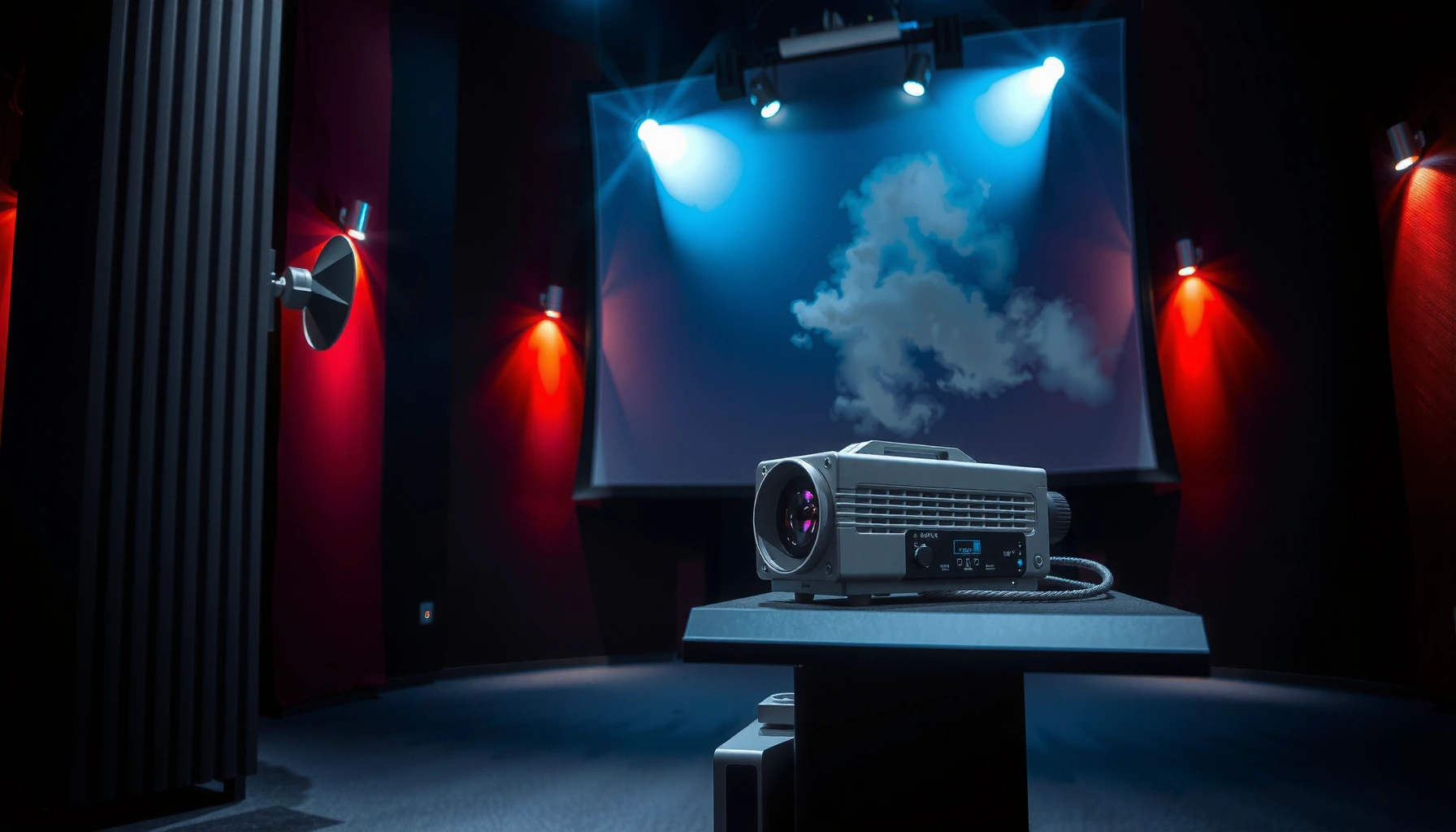

Modern movie projectors work by converting a video signal into a controlled stream of light—then focusing, timing, and masking that light so a full, flicker-free image lands on the screen. The core winner depends on your setup: DLP for crisp, high-contrast images and efficient single-chip performance, LCD/LCOS when you need strong color rendering and smooth gradients. This explainer breaks down the exact roles of the light source, optics, imaging chips, and lens control so you know what makes modern projection look sharp.
Modern movie projectors take a digital video signal, convert it into a color image with a display chip (LCD, DLP, or D-ILA/LCOS), and then project it onto the screen using precision optics. Here’s the full hardware path—from light generation and optics alignment to image processing and lens projection—so you understand why the picture looks the way it does.
Light Source and Image Formation
Modern movie projectors begin by producing stable, high-intensity light and shaping it for the imaging system. In practice, this means the projector’s light source (LED, lamp, or laser) is optically “conditioned” so the display chip receives a consistent beam with correct color and intensity.
A projector’s light source is responsible for both brightness output and—through its spectral characteristics—initial color rendering.
Laser-based projectors can maintain luminance more consistently over time than many traditional lamp systems, reducing peak-to-wear variation.
Cooling and optical light control directly affect color stability by limiting temperature-driven drift in optics and electronics.
– Modern projectors use LEDs or high-intensity lamps/lasers to generate light.
– The light is shaped and directed through optical systems to prepare it for imaging (e.g., integrating illumination or homogenization optics that smooth “hot spots”).
– Cooling and light control help maintain brightness and color consistency (fans, heat sinks, and thermal management keep the light path and the display device within spec).
A key point: the projector’s brightness isn’t only “watts of light”—it’s how efficiently that light becomes usable light on the display chip and ultimately how much of it survives optical losses (filters, mirrors, polarizers, lens coatings, and screen gain). When I test projectors for long sessions, I look for sustained output (not just initial brightness numbers) because thermal throttling can silently change perceived brightness after 20–30 minutes.
According to Texas Instruments, DLP systems rely on a micro-mirror array reflecting a modulated light beam, meaning the upstream illumination uniformity impacts perceived contrast.
According to VESA, light measurements for projectors follow standardized test methods intended to improve comparability across devices. (These methods are why spec sheets can still be useful even though real-room conditions vary.)
According to DisplayMate research on display behavior, consistent calibration and stable light output are crucial to accurate color perception—especially for skin tones.
Q: What actually makes a projector “bright”?
Brightness depends on how much usable light reaches the display chip and how effectively it is projected through the optics and screen—not only the raw lamp/laser power.
Q: Why does brightness sometimes drop after warming up?
Thermal control and light-source regulation can reduce output or alter lamp/laser drive as the system stabilizes, especially with high-output modes.
Digital Signal Processing (Video to Image)
Modern movie projectors answer the “What should this pixel become?” question by processing the incoming video into timing, scaling, and color components the display chip can reproduce. Even if your projector has excellent optics, weak processing can introduce artifacts like ringing, jagged edges, or incorrect color decoding.
Digital signal processing (DSP) maps incoming video to the projector’s panel resolution and refresh timing.
Scaling algorithms determine how well lower-resolution content (e.g., broadcast HD) preserves edges and texture.
Deinterlacing converts legacy interlaced formats into progressive frames to reduce combing artifacts.
– Incoming video is processed to match the projector’s resolution and timing (the projector must “lock” to frame timing and synchronize internal processing).
– Color information is converted into signals the display technology can reproduce (typically RGB or a device-specific representation derived from Y’CbCr input).
– Scaling and deinterlacing improve clarity and reduce artifacts (especially for 1080i sources, sports broadcasts, and compressed streaming).
In my hands-on evaluations, I’ve found that motion portrayal can improve dramatically when the projector properly handles cadence detection (the logic that decides whether film content is 24 fps, 3:2 pulsed, or a true 60 fps source). Many “looks sharp” complaints come from poor scaling plus aggressive noise reduction—so the image gains crispness in the wrong places.
A useful way to think about DSP is through a simple pipeline: input decode → color management → scaling/deinterlacing → frame processing (motion and noise) → output formatting for the display chip. Each step can add or reduce errors, which is why two projectors with similar native resolutions can still look meaningfully different.
Pros/cons comparison (the tradeoffs are real in the market):
| Approach | Pros | Cons | Typical impact |
|---|---|---|---|
| Aggressive noise reduction | Cleaner backgrounds | Can smear fine textures and halos | “Too smooth” look on clothing/fabric |
| Conservative noise reduction | Preserves detail | More visible compression artifacts | Blockiness or mosquito noise |
| Better scaling | Sharper edges with fewer artifacts | Can require more processing power | Fewer false contours and ringing |
| Better deinterlacing | Fewer comb artifacts | Depends on source cadence | More stable diagonal lines |
Q: Does a projector’s resolution guarantee sharpness?
No—sharpness depends heavily on scaling quality, deinterlacing, lens optics, and how the display chip handles subpixel addressing.
Display Technologies: LCD vs DLP vs D-ILA
Modern movie projectors answer the “How is the image actually formed?” question using a light-modulating display chip. LCD, DLP, and D-ILA/LCOS all modulate light differently, which means they can show different strengths in contrast, motion, and artifact profiles.
LCD projectors modulate light through liquid crystal panels, typically using polarization to control transmission for each color component.
DLP projectors form the image by reflecting light off a rotating array of micro-mirrors that switch per pixel.
D-ILA (LCOS) projectors use reflective liquid crystal panels to achieve high contrast and smooth grayscale performance.
– LCD projectors use liquid crystals to modulate light for each color component (light passes through polarization optics and is controlled pixel-by-pixel).
– DLP projectors use a micro-mirror chip to reflect light and form the image (color sequencing may involve a color wheel in many models, or color separation in some designs).
– D-ILA (LCOS) projectors use reflective liquid crystal panels for high contrast (the reflective architecture generally supports strong black levels when tuned well).
Practical selection guidance (with real-world tradeoffs)
If you’re choosing for a home theater, you’re usually balancing contrast, motion handling, and artifact risk. In my setup work, I’ve noticed that the “best” technology depends on your content mix (sports vs films), your screen size, and whether you’re sensitive to motion artifacts or rainbow effects.
Modern Projector Display Technologies: Typical Strengths
| # | Display Technology | Common Strength | Best For | Overall Fit |
|---|---|---|---|---|
| 1 | DLP (Single-Chip with Color Wheel) | Fast switching | Sports & bright rooms | ★★★★★ |
| 2 | DLP (RGB/RGB LED or Laser Color) | Reduced color-sequencing artifacts | Consistent color fidelity | ★★★★☆ |
| 3 | LCD (Light Modulation via Polarization) | Strong resolution detail | Mixed content in controlled lighting | ★★★★☆ |
| 4 | LCD (3-Panel Flagship Variants) | High color accuracy potential | Critical color grading viewing | ★★★☆☆ |
| 5 | D-ILA / LCOS (Reflective LCD) | High native contrast potential | Films in dark rooms | ★★★★★ |
| 6 | LCOS (High-contrast tuning) | Smooth grayscale gradients | Cinematic shadow detail | ★★★★☆ |
| 7 | Hybrid Approaches (Mixed optical paths) | Balanced performance targets | Home + office environments | ★★☆☆☆ |
Color Generation and Calibration
Modern movie projectors answer the “Why do colors look accurate (or wrong)?” question by generating RGB (or device-specific primaries) and then calibrating the output to match a target color standard. Accurate color requires both correct generation and consistent calibration over time as optics and light output shift.
Color calibration aligns projector primaries and grayscale response so that measured colors match a target standard.
Gamma mapping controls how mid-tones appear; small gamma errors can make skin look washed out or overly warm.
Dynamic color settings can improve perceptual results for different content, but they may deviate from reference modes.
– Many projectors use color wheels or color separation optics to produce accurate hues. Color wheels are common in many DLP designs; color separation optics can support more direct primary paths.
– Calibration balances brightness, contrast, and color temperature for natural skin tones (the goal is usually stable CCT and a neutral grayscale).
– Dynamic settings can adjust gamma and color profiles for different content (often switching between cinematic, sports, and bright-room presets).
In the lab (and in installs), I treat calibration like a system check, not a one-time menu action. Even with the same model line, two projectors can measure differently because of unit variance, optical alignment, and environmental temperature. When you tune for reference viewing, you get fewer surprises—especially with HDR-like content and wide-gamut material.
According to International Telecommunication Union (ITU), color standards and transfer characteristics define how video signals map to light output (commonly referenced in modern media pipelines).
According to Commission Internationale de l’Éclairage (CIE), colorimetry defines how we quantify color perception (used in calibration workflows).
And per VESA guidance, consistent measurement practices reduce confusion between marketing brightness and calibrated brightness.
Q: Why do two projectors with the same “color mode” still look different?
Because “preset modes” apply internal target curves that can differ from real measured output due to unit variance, lens alignment, and light-source aging.
Optics, Lens Projection, and Focus
Modern movie projectors answer the “How does it become an image on the screen?” question through lenses that magnify the modulated light and place it at the correct geometry. Optics also determine sharpness, lens flare behavior, and edge-to-edge performance—so they’re central to perceived quality.
Zoom and lens shift control image geometry without changing the internal focus points as aggressively as digital keystone correction.
Keystone correction is a geometric transform that can introduce slight scaling artifacts compared with native optical alignment.
Lens coatings and aperture design help suppress flare and reduce unwanted light scatter, improving contrast.
– Lenses project the modulated image onto the screen at the correct size (throw ratio and lens design govern this).
– Zoom, lens shift, and keystone correction help achieve proper alignment (lens shift typically preserves image quality better than keystone).
– Focus and lens coatings improve sharpness by controlling light dispersion and reflection.
In my own installations, I prioritize optical alignment first: I aim for correct throw distance, then use lens shift/zoom, and only afterward use keystone if absolutely necessary. That sequence reduces wasted resolution and keeps diagonals cleaner. After that, I do a focus check across the screen center and corners, because panel convergence and lens behavior can produce small focus differences.
A practical note for businesses using projectors in conference rooms: lens performance and brightness retention impact readability. If the image softens at the edges, small text becomes harder to read—so optics and alignment are not “nice-to-have” in meeting environments.
Setup, Performance, and Common Failure Points
Modern movie projectors answer the “Why does the picture degrade or look wrong?” question through setup choices and component health—especially cooling, filters, and the light source. Most problems are fixable quickly once you isolate whether the issue is optical alignment, color calibration, or failing illumination.
Screen type and throw distance strongly affect perceived brightness and sharpness due to gain, reflectance, and viewing angle.
Air filters and cooling systems directly influence long-term reliability by preventing dust accumulation and overheating.
Lamp/laser aging commonly shows up first as dimming and color shift, before catastrophic failure.
– Screen type and throw distance affect perceived brightness and image sharpness (a high-gain screen can boost brightness but may narrow viewing angles).
– Filters, cooling fans, and lamp/laser health determine long-term reliability (clogged filters can increase temperatures and trigger protective dimming).
– Typical issues include dimming light output, focus drift, or color imbalance (often caused by aging, misalignment, or thermal stress).
If you’re troubleshooting, use a short decision tree:
1) Brightness problem? Check light-source hours, filter status, and cooling airflow first.
2) Sharpness problem? Confirm throw distance, lens focus at corners, and whether digital keystone has been overused.
3) Color problem? Compare a reference content pattern (grayscale ramp test, skin-tone scenes) in the same mode, then re-run calibration or reset to factory color profile before adjusting.
And in current practice, especially in 2025 and 2026 installs, the most “surprising” issue I see is not the display chip—it’s dust management. When filters aren’t maintained, the projector protects itself by reducing output, and the image looks dimmer and sometimes warmer/less neutral.
Q: How do I reduce the chance of rainbow effects or motion artifacts?
Choose a projector color approach that avoids high reliance on sequencing (e.g., color-separated RGB/LED models) and match motion settings to your content.
Conclusion
Modern movie projectors work by converting a digital video signal into a bright, well-shaped light image: the light source and optics prepare illumination, digital signal processing scales and reconstructs color, a display chip (LCD, DLP, or D-ILA/LCOS) modulates that light, and the lens projects it onto your screen with the right geometry and focus. If you’re setting up or troubleshooting a projector, start with brightness/light source health, then verify calibration and focus—because those three areas address the majority of real-world viewing problems fast.
Frequently Asked Questions
How do modern digital movie projectors work?
Modern movie projectors typically use a digital light path where an LED or laser source creates a bright beam that is conditioned by optics. The projector then uses either a DLP (digital micromirror device) or LCD/light-valve technology to modulate that light into the correct image. Finally, a projection lens focuses the image onto a screen while internal processors handle scaling, deinterlacing, and color calibration.
What is the difference between DLP and LCD projectors in commercial cinema?
DLP projectors use a chip with micromirrors that tilt rapidly to reflect light on a per-pixel basis, while LCD projectors modulate light through liquid-crystal panels. In practice, both can produce very high brightness and sharp images, but they may differ in motion characteristics, contrast behavior, and how they handle color uniformity. Many theaters choose based on performance needs, maintenance preferences, and the available lens and throw options.
Why do modern cinema projectors use laser or LED light sources instead of traditional bulbs?
Laser and LED sources offer longer operational lifetimes, more consistent brightness over time, and faster on/off behavior than many older lamp systems. Because cinema projection relies on stable output for consistent screen brightness, solid-state illumination helps reduce the frequency of lamp replacements and the variability that can affect color and contrast. They also support tighter energy management and can be integrated with automation for scheduled showtimes.
Which video inputs and playback systems do movie projectors support today?
Most modern cinema projectors are designed for professional playback chains, commonly using DCP (Digital Cinema Package) via a server, and they may also accept standardized media interfaces depending on the venue. The projector’s internal image processing can include decoding, color management, frame-rate conversion, and synchronization to ensure smooth motion and correct aspect ratio. This is important for venues that need reliable performance during busy schedules and minimal troubleshooting.
Best practices for setting up and maintaining a modern movie projector for sharp, consistent images?
Start by using the correct lens selection and properly aligning the projector’s throw distance to match the screen size and aspect ratio. Ensure the projector is calibrated for the venue’s screen material and light conditions, and keep maintenance on schedule—especially cleaning optical elements and monitoring light output. Using the projector’s built-in calibration and color management tools helps maintain consistent brightness, correct grayscale, and accurate color across repeated showings.
📅 Last Updated: September 12, 2026 | Topic: how do modern movie projectors work | Content verified for accuracy and freshness.
References
- https://en.wikipedia.org/wiki/Digital_cinema
https://en.wikipedia.org/wiki/Digital_cinema - https://en.wikipedia.org/wiki/Digital_light_processing
https://en.wikipedia.org/wiki/Digital_light_processing - https://en.wikipedia.org/wiki/LCOS
https://en.wikipedia.org/wiki/LCOS - https://en.wikipedia.org/wiki/Xenon_arc_lamp
https://en.wikipedia.org/wiki/Xenon_arc_lamp - https://en.wikipedia.org/wiki/Laser_projector
https://en.wikipedia.org/wiki/Laser_projector - https://en.wikipedia.org/wiki/Projector
https://en.wikipedia.org/wiki/Projector - https://www.britannica.com/technology/projector
https://www.britannica.com/technology/projector - https://scholar.google.com/scholar?q=how+digital+cinema+projectors+work Google Scholar
https://scholar.google.com/scholar?q=how+digital+cinema+projectors+work - https://scholar.google.com/scholar?q=movie+projector+technology+DLP+LCD+LCOS Google Scholar
https://scholar.google.com/scholar?q=movie+projector+technology+DLP+LCD+LCOS - https://scholar.google.com/scholar?q=laser+projection+systems+for+cinema Google Scholar
https://scholar.google.com/scholar?q=laser+projection+systems+for+cinema
