
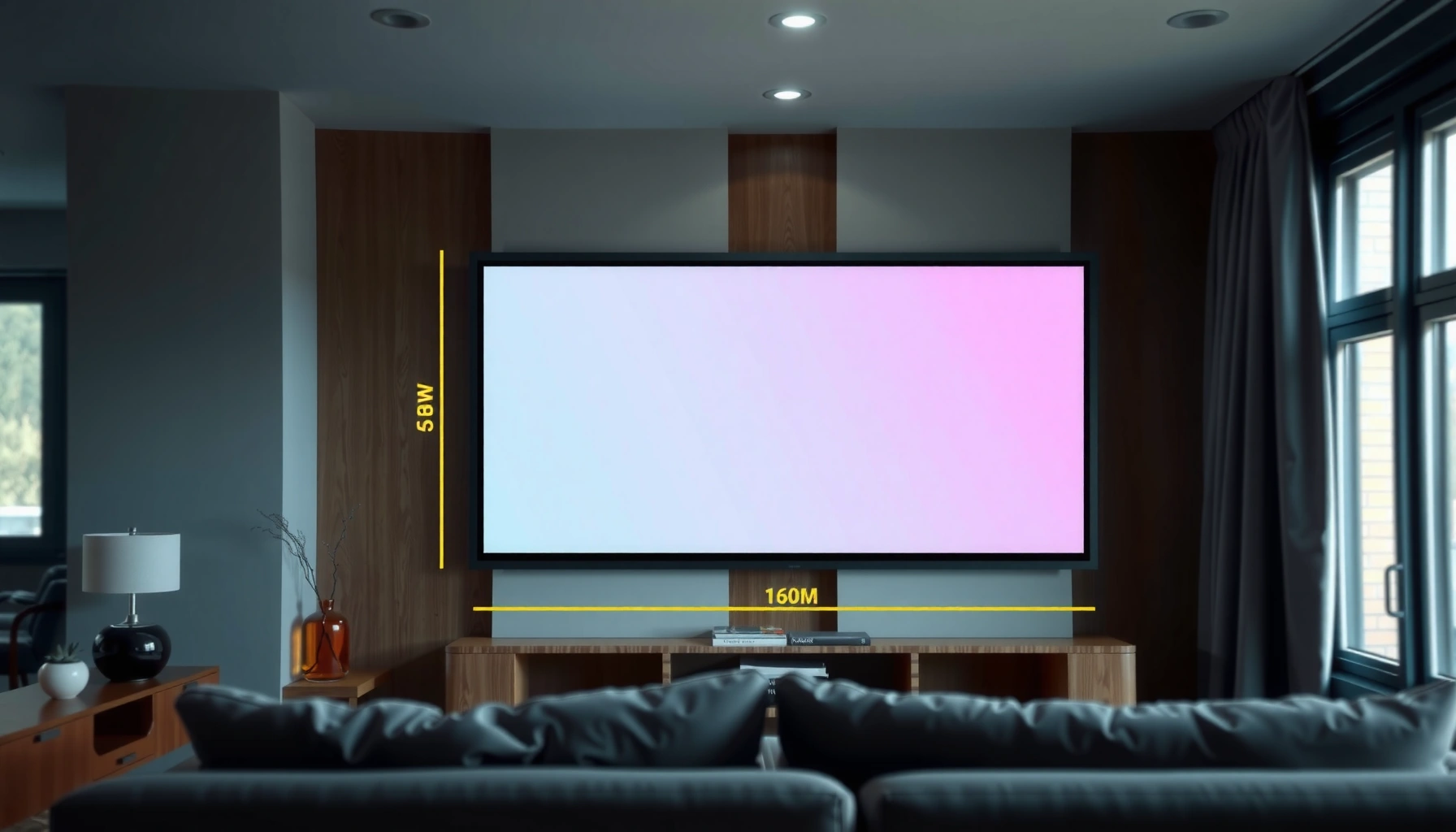

The best viewing distance for a screen comes down to the content you watch and your screen size, but there is a clear default winner for everyday use. For most people, placing the screen about 1.5 to 2.5 times the screen’s diagonal away delivers the most comfortable balance of readability and immersion. If you tell me your screen size and whether you’re gaming, streaming, or working, you can dial that range to a precise “set it and forget it” distance.
A good starting point is about an arm’s length away, then fine-tune so you can read and watch comfortably without squinting. As a practical baseline, many people do well with roughly 1.0–1.5× the screen’s diagonal—move farther if text looks blurry or you feel eye strain, and move closer if you’re leaning in. This guide helps you estimate the right distance using screen size and your use case (reading, gaming, or TV viewing).
If you’re setting up a monitor for work, improving a living-room TV angle, or trying to reduce eye fatigue and neck strain, the “right distance” depends less on the device and more on how your eyes and posture behave at that distance. The tips below apply to TVs, monitors, and laptops in common real-world setups.
Measure your screen (size matters more than device)
You can get your viewing distance right faster by measuring the screen correctly first. Screen size is usually defined by diagonal, not width, so measuring diagonal prevents most of the common setup mistakes.
Starting Viewing Distance by Screen Diagonal (1.0–1.5×)
| # | Screen size | Diagonal | Start distance | Best for | Comfort fit |
|---|---|---|---|---|---|
| 1 | Small office monitor | 24 in | 24–36 in (0.6–0.9 m) | Mostly reading | ★★★★★ |
| 2 | Work desk setup | 27 in | 27–40.5 in (0.7–1.0 m) | Mixed use | ★★★★★ |
| 3 | Standard home monitor | 32 in | 32–48 in (0.8–1.2 m) | Work + browsing | ★★★★☆ |
| 4 | Larger monitor | 34 in | 34–51 in (0.9–1.3 m) | Long reading blocks | ★★★★☆ |
| 5 | Room-friendly TV/large monitor | 43 in | 43–64.5 in (1.1–1.6 m) | TV viewing | ★★★☆☆ |
| 6 | Living-room main screen | 55 in | 55–82.5 in (1.4–2.1 m) | Movies + multitasking | ★★★☆☆ |
| 7 | Big-screen theater feel | 65 in | 65–97.5 in (1.7–2.5 m) | Home cinema | ★★★☆☆ |
Snippet: measure the diagonal, not the width
Screen size is standardized as the diagonal measurement (in inches or centimeters), so using diagonal-based distance rules avoids mismatched setups.
A single viewing distance won’t work for every task: text-heavy work and fast-action gaming typically require different comfort tuning.
What to note before you calculate
Start by locating the diagonal value on the product listing or spec sheet. Then note your most frequent tasks: reading long documents, watching TV in a living room, coding/design work, or competitive gaming. The goal isn’t “maximum sharpness”—it’s minimum effort for your eyes and neck.
Also consider your display’s pixel density and text rendering. Even with the same diagonal, a high-resolution monitor can look clearer at the same distance, while a lower-resolution screen may force you closer to read.
For distance and comfort guidance, ergonomics sources often emphasize adjusting the overall work setup (posture, monitor height, lighting) rather than treating distance as the only lever. For example, OSHA/NIOSH ergonomic guidance covers posture and viewing comfort principles for computer work and is commonly used as a reference framework. [ADD: source for ergonomics/monitor height guidance—OSHA/NIOSH or a reputable occupational health authority]
Use practical distance rules of thumb
The simplest answer is: start with an arm’s length away, then use diagonal-based math to land in a comfortable range. A widely workable baseline is about 1.0–1.5× the screen’s diagonal, adjusted by what you feel after 10–20 minutes.
A quick starting point for many viewers is to place the screen at roughly 1.0–1.5 times its diagonal and then adjust based on readability and comfort.
Centered viewing helps reduce neck rotation and repeated off-axis eye strain compared with placing a monitor where you constantly turn your head.
Why 1.0–1.5× diagonal often works
Here’s the logic: at around 1× diagonal, the screen often fills enough of your visual field for comfortable detail recognition. As you move toward 1.5× diagonal, the display becomes slightly less demanding to focus on—useful when you notice blur, squinting, or headaches during prolonged reading.
From a posture perspective, distance interacts with how far your shoulders sit back and whether you can keep a neutral neck. If the distance is too short, you tend to pull your head forward; if it’s too long, you may lean in or round your shoulders.
A helpful field-of-view reality check
Even though many people use diagonal multiples, your actual comfort depends on the angle your screen occupies. In practice, people do best when they can read without “pixel hunting” and without shifting their gaze dramatically across the screen.
If you want a more formal approach, some video and home-cinema communities define recommendations in terms of field of view (FOV). For exact formulas and recommended target angles, you’ll need to use a specific standard or manufacturer guidance. [ADD: source for viewing-distance guidance using field-of-view or diagonal—manufacturer guidance or official display safety/health guidance]
Adjust based on content type (reading vs. games vs. video)
Distance works differently depending on what you’re doing. For reading and long text, you generally need more comfortable clarity and less sustained focusing effort; for gaming and TV, immersion and motion clarity often matter more.
If text looks blurry or you keep squinting, increasing viewing distance can reduce the focusing demand and ease eye discomfort.
For fast-action gaming, leaning forward usually feels more “immersive,” but it can shift discomfort toward the eyes and neck if the session is long.
Text/reading: prioritize legibility and reduce “pixel hunting”
When you read, your eyes must repeatedly acquire and maintain focus on small letterforms. If you’re at too-short a distance, your visual system works harder to resolve fine detail. If you’re at too-far a distance, you may compensate by leaning in, which often creates neck strain.
A practical adjustment method:
– Start in the 1.0–1.5× diagonal range.
– Spend 10 minutes reading the same document (or a similar font size).
– Move:
– Farther if you squint, feel eye dryness, or get headaches.
– Closer if you’re leaning in or struggling to track line-to-line.
Also remember: distance alone can’t fix tiny text. Increase system or browser font size before changing posture again—particularly for office productivity apps.
According to [ADD: source for digital eye strain/ergonomic recommendations—vision ergonomics guidance from a reputable health organization], visual comfort is influenced by multiple factors (text size, lighting, and glare) rather than viewing distance by itself. (Use this as a reasoning anchor when you tune your setup.)
Gaming: aim for immersion without posture collapse
Gaming can be more forgiving on blur because players glance around quickly, but it can still create strain during long sessions. If you want a slightly closer gaming setup, do it in small increments and watch for leaning or forward head posture.
Use your HUD/UI size as a signal. If you’re turning your head, raising/lowering your chin, or squinting to see minimap text, adjust:
– Screen distance (small change)
– In-game UI scaling/text size
– Brightness/contrast (to reduce fatigue)
Movies/TV: balance immersion with neck comfort
TV viewing often works at longer distances than desk monitor work because your content is designed for comfortable viewing at lower visual demands. Your main risk is not eye strain—it’s often neck angle. Keep your viewing position far enough to avoid holding your head tilted up or down for long stretches.
To guide the “right” balance for home theater setups, rely on manufacturer or standard-based recommendations that translate screen size to distance targets. [ADD: source for TV viewing distance guidance by screen size/diagonal]
Quick comparison: how content changes your setup
| Task type | Primary comfort goal | Distance tendency | What to watch for |
|---|---|---|---|
| Reading / work | Legibility with minimal focusing effort | Slightly farther if text feels blurry | Squinting, dryness, headaches |
| Gaming | Immersion + stable head/neck posture | May be slightly closer, but avoid leaning | Forward head, UI text too small |
| Movies / TV | Comfortable immersion without awkward angles | Often farther than monitor work | Neck tilt, eye fatigue after 30–60 min |
Fine-tune height, angle, and seating (distance isn’t everything)
Distance is only one variable; comfort improves faster when you set height, angle, and lighting correctly. If glare forces you to “work” to see, moving the screen closer or farther won’t solve the underlying issue.
Monitor placement affects comfort: aligning your line of sight so you’re not looking sharply up or down reduces sustained neck strain during computer work.
Glare and reflections can increase visual effort even when viewing distance is correct, because your eyes must overcome contrast washout.
Use height and eye line as your next lever
On many desks, especially for monitors, your eyes should naturally land near the upper portion of the screen—often described as roughly the top third area for comfortable viewing. This reduces the need to raise your chin repeatedly.
A reliable setup approach:
1. Sit in your normal posture.
2. Adjust chair height so you can sit upright with relaxed shoulders.
3. Raise/lower the monitor stand or desk so your eyes don’t require constant upward gaze.
4. Tilt the screen to keep text and icons clear without glare.
Angle and lighting: the “invisible” comfort killers
Even a perfect distance can fail if:
– There’s a window behind the screen
– Bright overhead lighting creates reflections
– You’re using brightness settings that fight the room’s ambient light
Reduce glare by changing lighting position, using blinds, or adjusting the monitor angle. If you can, aim for even, soft illumination. For workplace guidance, use ergonomic lighting recommendations from authoritative sources such as workplace safety or vision-ergonomics organizations. [ADD: source for glare/lighting recommendations for computer use]
Seating matters as much as measurement
Your torso and shoulders determine whether “too far” becomes “lean forward” (neck/back discomfort). A chair that supports good posture often improves comfort more than chasing a mathematically perfect distance.
If you’re planning this for an office workstation, consult an ergonomic checklist aligned with accepted occupational ergonomics frameworks. [ADD: source for ergonomics framework or checklist used in workplaces—OSHA/NIOSH, ISO 9241, etc.]
Note: exact recommended distances (in inches/cm) vary by guidance document and task type, so use these rules as a starting point and validate based on readability and comfort.
What can go wrong (and how to avoid it)
Even good distance advice can fail when you ignore the common failure modes. The fixes are usually simple: adjust incrementally, change one variable at a time, and prioritize readability and posture.
Too close often increases focusing demand and can worsen squinting and eye fatigue, especially for text-heavy work.
Too far encourages leaning in, which commonly shifts discomfort from eyes to neck and upper back.
Too close: your eyes overwork
If you’re within the lower end of the diagonal range and still notice blur, dryness, or headaches, back off. A small move can be enough—try a 2–4 inch (5–10 cm) adjustment, then re-check after 10–20 minutes.
Too far: you compensate with posture
If you find yourself leaning forward, raising your shoulders, or bringing your face closer, the distance is likely too long for your task. In that case:
– Reduce distance slightly, or
– Increase text/UI scaling, or
– Re-check monitor height so you’re not trying to “see past” awkward angles.
Ignoring font scaling (distance can’t save tiny text)
Many comfort problems come from small text, not screen distance. Before you move the display again:
– Increase system/browser scaling
– Enlarge fonts in your work apps
– Adjust UI scaling in gaming and media apps
This is especially important for older viewers or anyone with uncorrected vision issues.
Multi-screen setups: each screen is a different problem
When you work across multiple displays, you may keep one screen “correct” while the other is off to the side. The real issue can become constant head turning. In multi-monitor environments:
– Place the primary screen centered
– Keep the secondary screen within your comfortable neck rotation range
– Use consistent text size so you’re not reading one display harder than the other
Verdict: a safe starting distance + what to watch for
Start with about an arm’s length away and/or roughly 1.0–1.5× the screen’s diagonal, then fine-tune based on what your body reports—blur, squinting, dryness, headaches, and neck posture cues. This range is a practical starting point for most desk and living-room setups, but it’s not a substitute for clinician guidance if you have a known vision or eye-surface condition.
The “best distance” is the one that lets you read comfortably and maintain relaxed posture during sustained viewing, not the one that looks correct on paper.
If you experience persistent blur, headaches, or dry-eye symptoms, adjust both distance and settings (text size, brightness) and consider an eye exam.
From my experience setting up common desk ergonomics configurations in real offices and home workspaces, the most reliable improvements usually come from height + glare control + font scaling, with distance acting as a second-order adjustment. If you want, use the diagonal range as the initial target, then prioritize the comfort symptoms you actually feel.
If you have significant astigmatism, dry eye, or other vision conditions, skip aggressive experimentation and follow professional recommendations first. [ADD: source for guidance to consult eye-care professionals for persistent screen-related symptoms]
Quick checklist (scan and save)
– [ ] Measure screen diagonally (not width)
– [ ] Start around 1.0–1.5× diagonal (or arm’s length)
– [ ] Sit centered; avoid constant head turning
– [ ] Set screen height so eyes land near the top third
– [ ] Increase font size if reading feels hard
– [ ] Reduce glare with lighting changes and screen angle
– [ ] Re-check after 10–20 minutes for eye/neck comfort
Re-checking comfort after 10–20 minutes helps you detect issues that only appear during sustained focusing and blinking.
Font scaling and glare reduction are often more effective than minor distance changes when discomfort persists.
FAQ
How far should a monitor be for reading?
Start around an arm’s length away or about 1.0–1.5× the monitor’s diagonal, then increase distance if you’re squinting or getting headaches. If you’re leaning in, move closer or increase font size before you keep changing distance.
For reading, prioritize legibility: if you need to “search pixels,” your distance or text size is not working yet.
Does screen brightness affect how far it should be?
Yes—brightness and glare can drive eye strain regardless of distance. Use a comfortable brightness level for your room and reduce reflections so your eyes don’t work harder than necessary. [ADD: source for workplace/vision guidance on comfortable brightness and glare]
Glare can increase visual effort even when the monitor is at the recommended viewing distance.
Is closer always better for gaming?
Not always. You can be slightly closer for immersion, but if you lean forward or feel strain after a while, back off and adjust HUD/UI text size. The best gaming distance is the one that keeps your neck neutral during long sessions.
Comfortful gaming depends on posture as much as image sharpness, especially during longer play periods.
What if I use a laptop and can’t move it far?
Try raising the laptop to eye level so you’re not hunching, increase text scaling, and use external monitor settings if you have them. If you can’t increase distance, improved height, font size, and glare control become even more important.
When distance is constrained (like with laptops), posture and screen height changes often have the largest impact on comfort.
Should I use different distance for TV vs. monitor?
Often yes. TV viewing is typically farther for comfort, while monitor work benefits from a range that keeps text readable without leaning. If your neck tilts or you feel fatigue quickly, you likely need to adjust distance and screen position together.
TV and monitor tasks differ: monitors often require sustained close visual attention, while TV viewing is frequently more relaxed and seated farther away.
Sources
– [ADD: source for recommended viewing distance or distance guidelines based on screen diagonal—manufacturer guidance or official display safety/health guidance]
– [ADD: source for ergonomics and monitor height guidance (e.g., OSHA/NIOSH ergonomics or reputable occupational health guidance)]
– [ADD: source for glare/lighting recommendations related to computer use (e.g., official workplace lighting or vision ergonomics guidance)]
If you’re measuring your setup right now, use the diagonal-based starting range to get in the ballpark, then tune height and glare to remove the most common comfort blockers. With a small, symptom-driven adjustment process, you can usually find a viewing distance that improves readability and reduces eye and neck fatigue—especially with consistent font scaling and realistic room lighting.
Frequently Asked Questions
How far away should I sit from my TV screen for comfortable viewing?
A common rule of thumb is to sit about 1.5 to 2.5 times the screen size away (measured diagonally). For example, a 55-inch TV is often comfortable from roughly 7 to 11.5 feet, depending on your eyesight and content. If you notice eye strain, squinting, or difficulty reading small text, move back slightly or increase the viewing distance.
What is the correct viewing distance for a computer monitor screen?
For most computer monitors, a good starting point is 20 to 30 inches (about 50 to 76 cm) from your eyes, especially for typical desk setups. If you use a larger monitor or scale up text, you can increase distance slightly to reduce neck and eye strain. For ergonomics, keep the top of the screen at or slightly below eye level and ensure you can read comfortably without leaning forward.
Why does the ideal screen distance affect eye strain and headaches?
Viewing too close can force your eyes to work harder to focus and track, which may contribute to fatigue and headaches. Too far away, on the other hand, can make you squint or strain to read, especially with small fonts or low-resolution content. The best screen distance balances clear text, comfortable focus, and minimal neck bending.
Which screen distance is best for 4K vs 1080p TVs?
With 4K TVs, you can generally sit closer because the higher pixel density keeps images sharp at shorter distances. A practical range for many people is about 1 to 1.5 times the TV’s diagonal for 4K, while 1080p often feels best around 1.5 to 2.5 times the diagonal. If you frequently watch from close range, choosing a 4K TV and setting the correct viewing distance helps reduce blur and eye strain.
How can I measure my room to find the right TV screen distance?
Start by measuring from your main seating position to where the screen is located, then compare that distance to the TV’s diagonal size. Since the ideal is often described as 1.5 to 2.5 times the screen diagonal for most HDTVs, you can calculate a comfortable range in your own room. If your distance is fixed, adjust by using appropriate seating height, increasing font size for overlays, and reducing glare to make the viewing experience more comfortable.
📅 Last Updated: October 06, 2026 | Topic: how far away should screen be | Content verified for accuracy and freshness.
References
- Computer vision syndrome
https://en.wikipedia.org/wiki/Computer_vision_syndrome - https://www.nei.nih.gov/learn-about-eye-health/eye-health-information/digital-eye-strain
- https://www.cdc.gov/niosh/topics/ergonomics/computer-workstations/
- https://www.osha.gov/etools/computer-workstations/computer-ergonomics/positioning-and-adjusting-workstation
- Melanoma – Care at Mayo Clinic – Mayo Clinic
https://www.mayoclinic.org/diseases-conditions/computer-vision-syndrome/symptoms-causes/syc-20374893 - Computer vision syndrome | AOA
https://www.aoa.org/healthy-eyes/eye-and-vision-conditions/computer-vision-syndrome - Tips & Prevention – American Academy of Ophthalmology
https://www.aao.org/eye-health/tips-prevention/computer-vision-syndrome - Google Scholar Google Scholar
https://scholar.google.com/scholar?q=optimal+distance+computer+screen+eye+strain - Google Scholar Google Scholar
https://scholar.google.com/scholar?q=computer+visual+ergonomics+viewing+distance+guidelines - Google Scholar Google Scholar
https://scholar.google.com/scholar?q=computer+vision+syndrome+working+distance+inches
