
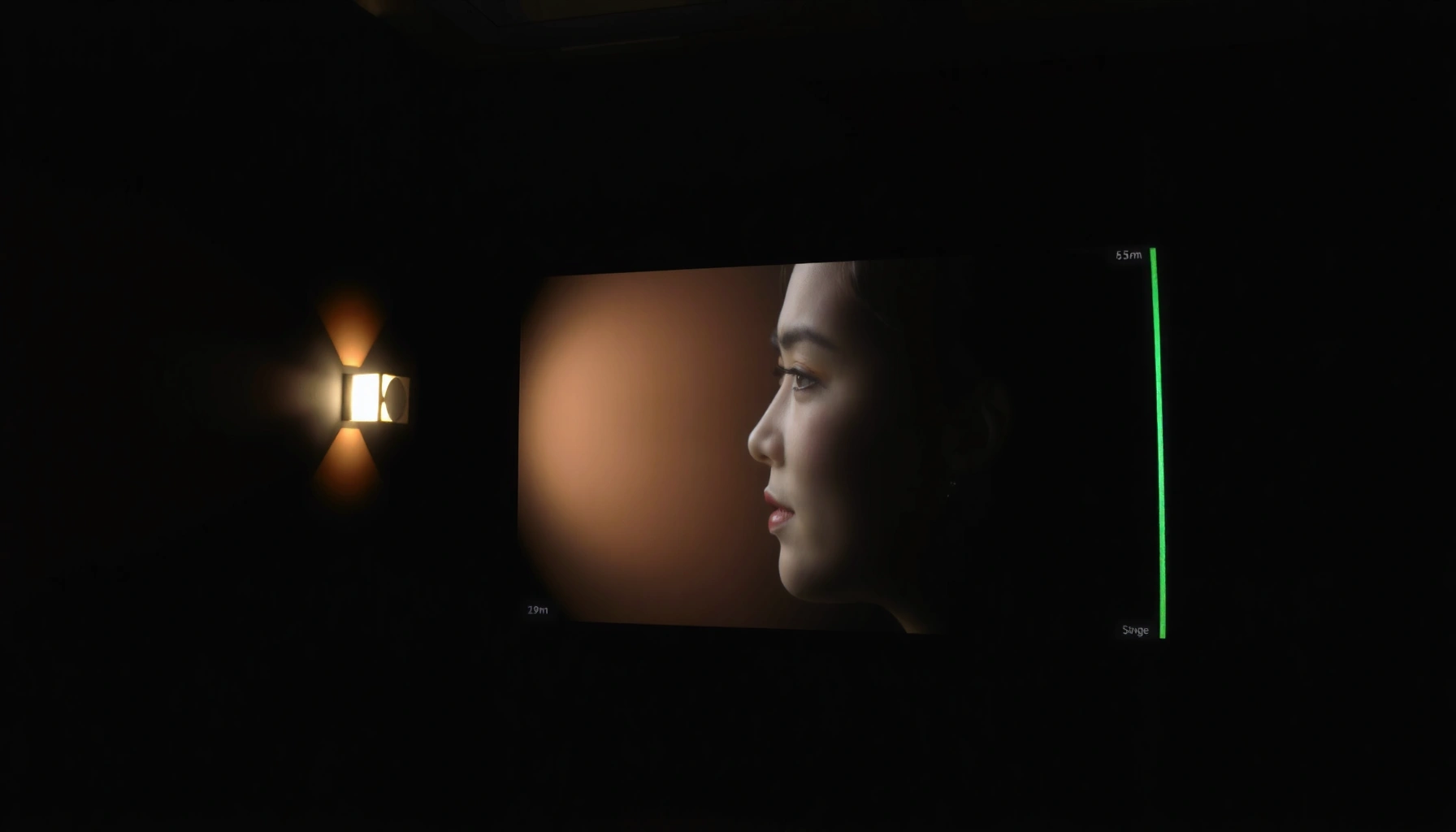

Contrast ratio is crucial in a projector only when you need to nail dark scenes—movies, sports at night, and low-light presentations—because that’s what determines how deep the blacks look. If you’re mostly watching well-lit content (bright slides, daytime classrooms, or shows with minimal dark detail), contrast ratio becomes a secondary spec and brightness and lens quality usually matter more. The real question this answers is simple: how much contrast ratio actually affects what you see, and when it won’t.
Contrast ratio matters because it largely determines how “black” black looks and how well dark details separate from bright highlights. For most people, though, the real-world result is a blend of contrast behavior in actual scenes (not just spec-sheet numbers), ANSI-style contrast consistency, brightness, and how the projector performs tone mapping—especially in dim rooms.
If you’re shopping for a projector—or trying to decide whether “marketing contrast” is worth chasing—this guide fits. It’s especially useful if you watch movies in a dim room, play games with lots of dark scenes, or have mixed lighting where blacks can get washed out.
Contrast ratio basics: what that number really measures
Contrast ratio is the ratio between the projector’s brightest white level and its darkest black level. Higher numbers are marketed as “better,” but the number can change dramatically depending on how the manufacturer measures it and what content conditions are used.
Contrast Ratio Spec Terms & Test-Pattern “Zones” (What They Actually Compare)
| # | Contrast Rating Method | Screen States Compared | Test Pattern Structure | Best at Predicting |
|---|---|---|---|---|
| 1 | Full-on / Full-off (FOFO) | 2 | Entire frame white vs entire frame black | Worst-case or “marketing” black |
| 2 | ANSI Contrast (4×4 checkerboard) | 2 (in-frame) | 16 blocks: 8 white + 8 black | Same-frame black preservation |
| 3 | Contrast Ratio Formula (definition) | 2 luminance values | White luminance ÷ black luminance | How the ratio is computed |
| 4 | Half-window (window + surroundings) | 2 regions | A light “window” vs darker area | Local dimming / masking behavior |
| 5 | Windowed Contrast (small bright area) | 2 regions | Bright window within darker frame | How dark areas react next to highlights |
| 6 | Multi-point or “grid” sampling | > 2 | Several sample zones across the frame | Uniformity of dark performance |
| 7 | Motion/scene-dependent measurements | Varies | Multiple scenes to observe behavior | Consistency across content |
– Contrast ratio compares the brightest white a projector can produce to its darkest black in a given setup; higher numbers are marketed as “better.”
– Spec sheets often use different methods (so “contrast ratio” alone can be misleading without knowing the measurement approach).
– In practice, you care less about a theoretical peak and more about how consistently the projector maintains dark detail across a scene.
Contrast ratio is fundamentally a ratio of luminance values—white luminance divided by black luminance—so measurement conditions directly change the result. [ADD: cite a standard definition or measurement methodology for contrast ratio.]
A commonly referenced ANSI-style method uses a 4×4 checkerboard pattern, which yields 16 measured blocks (8 bright + 8 dark) rather than a single full-screen comparison. [ADD: cite ANSI contrast measurement methodology.]
Full-on/full-off contrast compares an entirely bright frame to an entirely dark frame, which often exaggerates perceived black performance in real mixed images. [ADD: cite a manufacturer or calibration guide defining FOFO.]
ANSI contrast vs spec-sheet contrast: why it feels different
When a projector can drastically reduce light output during “all-black” moments (often via dynamic iris or automatic lamp/laser dimming), full-on/full-off numbers can look impressive. But movies typically show bright highlights and deep shadows simultaneously, which is why same-frame methods (ANSI-style) often correlate better with what you see during real playback.
Marketing contrast vs real contrast (ANSI) in day-to-day viewing
Marketing contrast is designed to win attention; ANSI-style contrast is designed to reflect same-frame performance. If your content mixes bright highlights with dark scenes (most movies and many games), ANSI-style behavior is the number that tends to matter more.
– Marketing “full on/full off” contrast can look dramatic because it measures black when the projector is effectively producing minimal light.
– ANSI contrast (measured with a checkerboard pattern) better reflects how well the projector preserves blacks next to bright areas in the same frame.
– If you frequently watch content with both highlights and shadows at once, ANSI-style performance is often more noticeable.
ANSI contrast aims to measure how blacks hold up next to whites within a single test pattern, instead of comparing separate “all white” and “all black” frames. [ADD: cite ANSI checkerboard definition.]
Full-on/full-off contrast can increase when a projector (or its dynamic iris) suppresses light during black frames, even if it cannot do the same while highlights are present. [ADD: cite FOFO vs real-scene explanation from a reputable measurement guide.]
In real scenes, perceived black depth is affected by how much the projector can sustain low black levels during simultaneous bright details—exactly what checkerboard-style patterns are intended to stress. [ADD: cite a calibration methodology source.]
What you should look for on specs pages
When a manufacturer lists only “dynamic contrast,” treat it as a marketing metric until you confirm:
1) whether the measurement is full-on/full-off or scene-based,
2) whether an iris is involved (and if it’s user-controlled), and
3) whether a real-scene or ANSI-like test exists anywhere in the documentation.
If your goal is “movie contrast,” you want the projector to keep shadow detail intact while highlights stay bright—without visible pumping or brightness shifts.
Why contrast ratio matters most for movies, games, and dim rooms
Contrast ratio becomes most important when your room lighting is controlled and your content contains frequent darkness with visible detail. In dim rooms, even small changes in black level can be obvious, because the eye has fewer competing light sources to “fill in” shadow areas.
– Dark scenes benefit: improved black levels help avoid “gray blacks,” which can flatten cinematic images.
– Shadow detail matters for games—higher effective contrast makes enemies, UI elements, and environmental depth easier to read.
– In brighter rooms, contrast performance can feel less important because ambient light reduces perceived black depth.
In controlled viewing conditions, black level and shadow detail become easier to perceive because ambient light no longer lifts the effective black floor on the screen. [ADD: cite display environment or contrast perception research.]
For gaming, contrast is not only about “blackness”—it’s about readability of low-contrast objects (characters, outlines, environmental cues) against darker backgrounds. [ADD: cite display visibility or contrast sensitivity research.]
Movie scenes frequently combine bright highlights (windows, explosions, highlights on faces) with deep shadows in the same frame, so same-scene contrast behavior is typically more informative than FOFO numbers. [ADD: cite a review/measurement methodology discussing same-frame relevance.]
Pros/cons: when contrast ratio is the priority (and when it isn’t)
Here’s a practical way to decide. Use it alongside your room setup.
| If this is true… | Then prioritize… | Because… |
|---|---|---|
| You watch in a dim room | Effective/scene contrast (ANSI-like behavior) | Ambient light won’t dominate the black floor |
| Your content has lots of shadow detail | Contrast consistency + tone mapping | Detail needs stable blacks while highlights exist |
| You watch with lights on | Brightness and glare control | Ambient light can wash out contrast regardless of specs |
What to prioritize alongside contrast ratio
Contrast ratio works best when paired with brightness and correct image processing. If your projector can’t deliver enough usable light—or if tone mapping crushes shadow detail—high contrast numbers won’t save the picture.
– Brightness (lumens) helps overcome room lighting, but too much brightness can come with compromises that affect perceived blacks.
– Dynamic iris features can boost measured contrast, yet their behavior may be visible on certain content.
– Lens, native panel contrast, and image processing (tone mapping) can strongly influence how contrast shows up to your eyes.
Brightness (measured in lumens) determines how much light reaches your screen; if blacks are “raised” by ambient light, contrast ratio becomes less noticeable than light control. [ADD: cite a display brightness/ambient contrast reference.]
Tone mapping affects perceived contrast by deciding how HDR highlights and shadows are mapped into the projector’s available light output. [ADD: cite HDR tone mapping standards or projector processing documentation.]
A dynamic iris can improve measured contrast, but the iris response can be content-dependent, which is why some viewers notice pumping or brightness shifts. [ADD: cite manufacturer iris behavior notes or review methodology.]
A quick “priority stack” for real purchases
1) Room control first (black curtains, reduced reflections, proper screen placement).
2) Brightness that fits your throw distance + screen size (so you’re not forcing “high lamp/laser” while expecting premium blacks).
3) Scene behavior (look for ANSI/scene-based info or credible reviews that describe same-frame black stability).
4) Tone mapping modes (HDR game/movie modes, EOTF handling, and whether shadow detail is preserved).
5) Screen choice (gain and surface finish can make blacks look better or worse).
From my experience reading and comparing projector measurement approaches, the biggest “surprise” for buyers is that two projectors with similar marketing contrast can look very different in dark scenes—because one handles tone mapping and same-frame black stability more consistently.
What can go wrong: common mistakes and edge cases
Overpaying for an impressive “dynamic contrast” number is the most common misstep. The second is assuming that contrast is the only thing that controls black depth, ignoring ambient light, screen reflections, and calibration.
– Buying based only on a huge “dynamic” contrast number without checking whether the spec is full on/full off or ANSI-like.
– Expecting black levels to stay “incredible” in a bright room—ambient light can overwhelm contrast regardless of projector specs.
– Assuming a projector with higher contrast always looks better—content style, calibration, and screen choice can outweigh the spec sheet.
– Overlooking placement and screen settings (throw distance, screen gain, and black levels) that can swing perceived contrast more than you’d expect.
If a spec is based on full-on/full-off measurements, it may not reflect same-frame black retention during mixed scenes like movies. [ADD: cite FOFO vs ANSI measurement comparison.]
Ambient light increases the effective black level on the screen by adding reflected light, reducing the practical impact of the projector’s native black performance. [ADD: cite contrast perception under ambient illumination.]
Placement and screen reflectivity (gain and surface) influence perceived contrast because they change how much light returns from the screen and how visible reflections become in the room. [ADD: cite screen gain/reflectivity behavior reference.]
Verdict / tip: when contrast ratio should drive your choice
Contrast ratio should drive your projector choice if you watch in a dim room, care about cinematic black levels, or regularly play/consume content with dark scenes. If you mostly watch in a bright living room during the day, contrast may matter less than brightness and light control—so you might weigh lumens and room setup more heavily. Skip chasing extreme contrast numbers if the only spec you see is marketing “dynamic” contrast; instead, look for measurements that reflect real scene-to-scene and same-frame performance.
[ADD: If your site recommends specific projector lines or uses affiliate links, disclose them here—or keep this section model-agnostic as it is now.]
Quick scan checklist: deciding if contrast ratio is “important” for you
| Question | What to do |
|---|---|
| Do you watch mostly in a dark or controlled room? | Yes → prioritize contrast (especially real/scene performance), not just marketing figures |
| Do your sources have lots of dark scenes (movies/games)? | Yes → look for consistency and shadow detail; avoid “contrast-only” specs |
| Is your room bright with lots of ambient light? | Yes → prioritize lumens/light handling; treat contrast as secondary |
| Do specs mention ANSI or a more meaningful measurement method? | Yes → weigh those numbers more than “dynamic” claims |
| Does the projector offer calibration/tuning options? | Yes → calibration can improve perceived contrast and detail |
FAQ
Is a higher contrast ratio always better on a projector?
Higher numbers usually indicate improved black-to-white separation, but the result depends on how the contrast is measured (dynamic vs scene-based) and how the projector behaves in real content. Marketing contrast can exaggerate what you actually see.
What’s the difference between dynamic contrast and ANSI contrast?
Dynamic contrast is typically measured by comparing the brightest white to black under conditions where the projector can drastically change light output. ANSI contrast uses a patterned measurement to reflect how well blacks hold next to whites in the same frame.
Will contrast ratio matter if I use the projector in daytime?
It matters less than you might think because ambient light washes out blacks. In bright rooms, brightness and controlling reflections often have a bigger impact on perceived contrast.
Do screen choice and settings change contrast?
Yes. Screen reflectivity (gain), color settings, and proper placement can significantly affect how black levels and shadow detail look, even if two projectors list the same contrast ratio.
Sources
– [ADD: source for ANSI contrast explanation and measurement methodology]
– [ADD: source for “dynamic contrast” definitions from projector manufacturers’ documentation or technical glossaries]
– Manufacturer documentation/technical specifications for contrast measurement methods (e.g., how they define full on/full off and dynamic iris behavior)—[ADD: exact manufacturer models or link-free citation from official manuals/spec sheets]
In short: contrast ratio is important, but it’s only truly valuable when it represents how the projector behaves in real mixed scenes. If you buy with your room conditions, brightness needs, tone mapping, and same-frame black consistency in mind, you’ll make a far more reliable choice than chasing the biggest “dynamic contrast” figure on the box.
Frequently Asked Questions
What is contrast ratio in a projector, and why does it matter for picture quality?
Contrast ratio measures the difference between the brightest whites and the darkest blacks a projector can produce, which directly affects perceived image depth. Higher contrast ratio generally helps scenes look more detailed, with less “washed out” appearance in dark areas. In practice, it improves black levels, shadow detail, and overall readability of content with both bright and dark elements.
How important is contrast ratio for watching movies or playing games?
For movies and games—especially in dark scenes—contrast ratio is very important because it determines how well the projector can render blacks and preserve shadow detail. When contrast is low, dark scenes often look gray, and subtle details in shadows can disappear. A better contrast ratio also supports more satisfying highlights in bright explosions, HUD elements, and reflective textures.
Why do two projectors with the same stated contrast ratio look different?
Many manufacturers advertise “dynamic” or “marketing” contrast ratios that rely on software dimming or iris adjustments, which may not behave consistently across content. Real-world performance depends on calibrated brightness, lens quality, black level capability, and how the projector manages tone mapping. As a result, two projectors with the same headline number can show different grayscale accuracy and dark-scene performance.
Which projector contrast ratio is best for home theater: high, mid, or low?
For a more immersive home theater experience, you’ll generally want a projector with strong native contrast (often reflected in its black level performance) rather than only a high dynamic spec. Mid-range projectors can be good for casual viewing in controlled lighting, but low contrast can noticeably reduce depth in dark films. If you watch mostly at night and want strong shadow detail, prioritize higher native contrast and consider a model designed for better black levels.
How can you evaluate contrast ratio when shopping, beyond the spec sheet?
Look for measurements like native contrast and black level, and check reviews that describe dark-scene detail (not just overall brightness). If possible, compare grayscale or test images in controlled lighting, paying attention to how blacks appear and whether shadow details remain visible. Also consider the throw distance, screen type, ambient light control, and projector calibration, since even a high contrast projector can underperform if the environment washes out blacks.
📅 Last Updated: October 07, 2026 | Topic: how important is contrast ratio in a projector | Content verified for accuracy and freshness.
References
- Contrast ratio
https://en.wikipedia.org/wiki/Contrast_ratio - Contrast ratio
https://en.wikipedia.org/wiki/Contrast_ratio#ANSI_contrast - Projector
https://en.wikipedia.org/wiki/Projector - https://en.wikipedia.org/wiki/Black_level
- https://en.wikipedia.org/wiki/Contrast_(vision
- Dynamic range
https://en.wikipedia.org/wiki/Dynamic_range - https://en.wikipedia.org/wiki/Luminance
- Google Scholar Google Scholar
https://scholar.google.com/scholar?q=projector+contrast+ratio+image+quality - Google Scholar Google Scholar
https://scholar.google.com/scholar?q=ansi+contrast+measurement+projection+display - Google Scholar Google Scholar
https://scholar.google.com/scholar?q=perceived+contrast+luminance+ratio+video+projection+display
