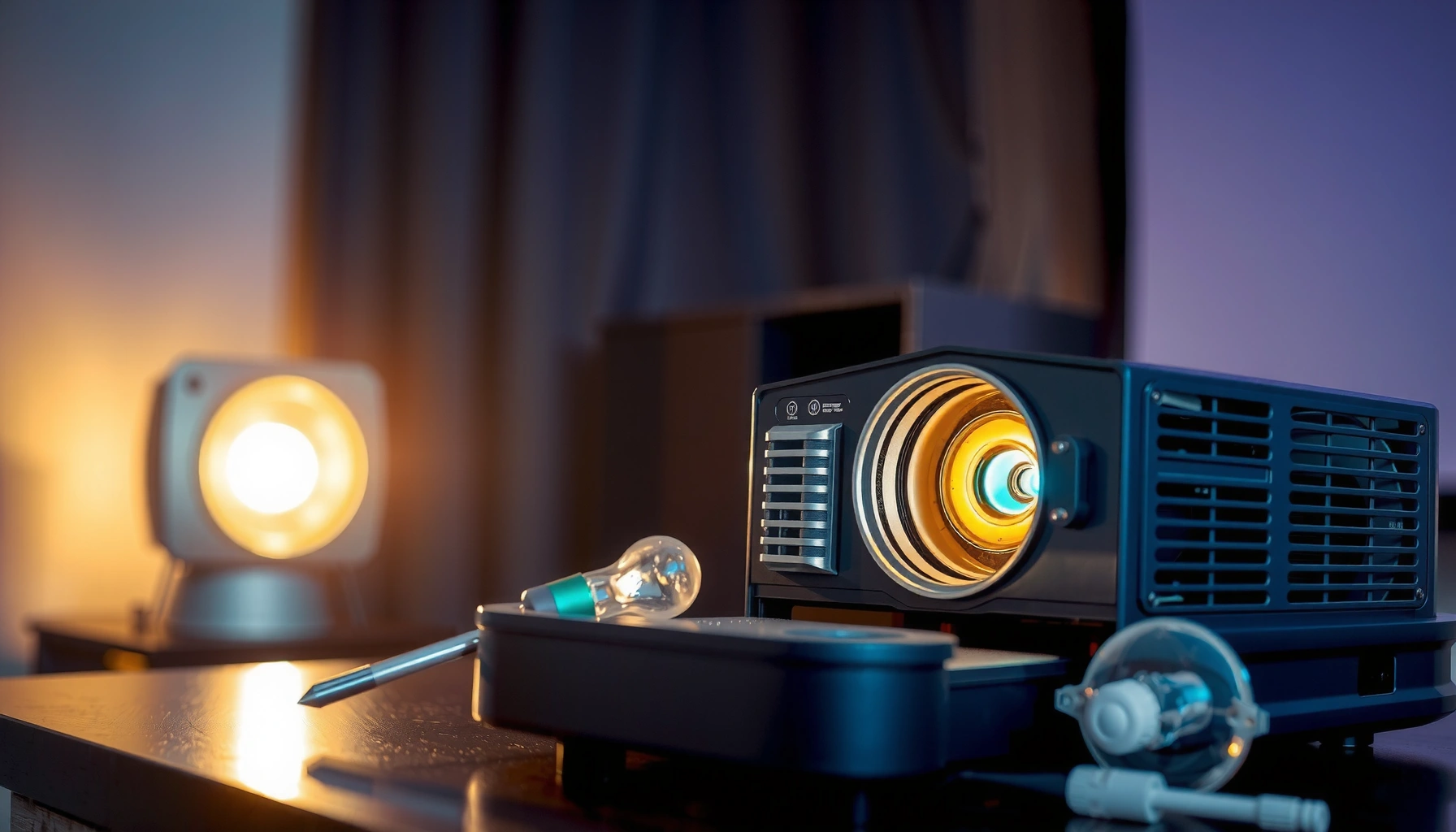
Replacing a projector bulb typically costs about $100–$300 for most home models, with the price rising when you need an original manufacturer lamp. This guide answers the real question—how much to replace a projector bulb—by breaking down the key pricing factors, including lamp type, projector brand, and whether installation is required. You’ll also get quick guidance on when a bulb swap is worth it versus when repairs or a replacement projector make more sense.
Replacing a projector bulb typically costs about $100–$300 for the replacement bulb, plus labor if you don’t DIY (often another $50–$150 depending on the service). The exact total depends on your projector model, whether it uses a standard bulb vs. an LED/light source, and if you need a whole lamp module or just the bulb. If you’re budgeting ahead, the most important step is making sure you buy the correct lamp module for your exact projector—compatibility often matters more than “getting a cheap bulb.”
If you’re using a projector regularly (home theater, classroom, office, or recurring presentations), you’ll eventually see dimming, color shifts, or “lamp life” warnings. In 2024–2026, replacement costs remain fairly consistent, but pricing swings based on whether you need an OEM part, a compatible lamp, or a full light engine module.
Check Your Projector Model First (Price Depends on Compatibility)
Yes—before you even price-shop, you should confirm your exact projector model because compatibility determines whether you’re buying the right lamp (and whether it will work correctly). The same “bulb” description can hide different lamp designs, connectors, and wattages across models, so matching the correct lamp module is the difference between a smooth swap and a second repair trip.
The projector model number printed on the chassis label is the key input for finding the correct lamp module part number.
Some projectors that look “lamp-based” still require a specific lamp module assembly rather than a standalone bulb.
LED and laser projectors generally do not use a traditional replaceable “bulb,” so bulb pricing won’t apply.
Start with the exact projector model number (often on the back or underside label). Then, check your current lamp module label (if accessible) because many manufacturers publish replacements using a lamp module part number rather than only a generic bulb type.
Here’s how compatibility affects cost:
– Lamp module required vs. bulb-only: Many common “lamp replacement” jobs involve replacing a complete lamp housing/module (reflector + bulb + wiring/contacts in one unit). In those cases, you’ll pay lamp-module pricing even if a listing calls it a “bulb.”
– Wattage and optical design: Even if a bulb “fits,” the projector’s lamp driver and optical requirements may not match, which can lead to dim output or repeated shutdowns.
– Lamp vs. light-source type: If your projector uses LED or laser, there isn’t a standard halogen/UHP “bulb” to replace—your next-cost item may be an entire light engine service (often higher cost and less user-serviceable).
As of recent years, lamp life is a major pricing driver because you’re paying for replacement frequency. For instance, many UHP (ultra-high-pressure) projector lamps are commonly rated around 2,000–4,000 hours depending on mode and conditions (Eco vs. Normal), and manufacturer documentation typically frames light-source life as “up to” values rather than guarantees. [ADD: source for typical UHP projector lamp rated hours range from a major lamp manufacturer or projector manufacturer]
If you want a practical “budget first” rule: if your projector is truly lamp-based, replacement tends to land in the $100–$300 bulb/module window, but if you mis-identify the model and order the wrong lamp assembly, the cost can effectively double.
Typical Price Ranges for Projector Bulb Replacement
The typical total for a projector bulb replacement is usually $150–$450, depending on the replacement part and whether you pay for labor. The bulb/module itself often runs $100–$300, and labor commonly adds $50–$150 when you don’t DIY.
A common real-world budgeting range for lamp/module replacements is roughly $100–$300 for the part plus $50–$150 for labor.
Technician labor costs vary more by “access difficulty” (lamp compartment design) than by the lamp’s wattage.
Where a lamp module is required, listings priced as “bulb only” may still be marketed or priced differently by reseller bundles.
What’s included in “bulb replacement” pricing?
When people say “replace the bulb,” they may mean different things:
1. Bulb/lamp module part only (DIY order):
– Often $100–$300 depending on brand/OEM vs. compatible listings.
2. Part + labor (service shop install):
– Often + $50–$150 for labor (again, varies by region and access).
In addition to sticker price, think about downtime and secondary issues:
– Some shops charge a diagnostic fee if they see repeated shutdowns or temperature warnings.
– If the projector has fan/thermal problems, replacing the lamp alone may not fix symptoms—meaning you still pay labor plus the lamp.
OEM vs. compatible pricing (what you’re likely to see)
Retail pricing commonly diverges based on whether the seller offers:
– OEM (manufacturer) parts
– Compatible (third-party) lamp modules
According to manufacturer documentation for projector lamps and lamp modules, warranties and performance expectations can differ between OEM and compatible supplies. [ADD: source for warranty/performance differences from at least one projector manufacturer’s lamp warranty policy]
A fast reality check: lamp hours and replacement timing
Many lamp-based models track lamp hours and display warnings. When you see “lamp life” warnings, you’re usually seeing remaining hours—not necessarily an immediate failure date. Still, dimming can start before the projector shuts down, especially when cooling airflow is restricted by dust. [ADD: source for projector lamp degradation and cooling-related lamp lifespan guidance from a projector manufacturer]
To make these pricing dynamics easier to visualize, use this quick budgeting snapshot.
📊 DATA
Estimated Lamp/Light-Source Replacement Cost & Typical Service Life (US retail, 2024–2026)
#
Projector Light Source Type
Typical Replacement Part Cost
Typical Service Life
Maintenance Complexity
1
UHP lamp (common home/office)
$120–$280
2,000–4,000 hrs
Low–Moderate
2
Lamp module bundle (OEM-style assembly)
$180–$350
2,000–4,000 hrs
Moderate
3
UHP lamp (high-brightness/large venue)
$250–$600
1,500–3,500 hrs
Moderate
4
Compatible lamp module (third-party)
$90–$220
Up to ~2,000–4,000 hrs*
Low–Moderate
5
LED light source (consumer/business)
$250–$900†
20,000–30,000 hrs
Low
6
Laser light source (premium/short-throw)
$800–$2,000†
20,000–30,000 hrs
High (service-led)
7
Complete lamp/light engine (when required)
$300–$1,200
Varies by model
High
* Compatible lamp lifespan varies by vendor specs. † LED/laser “replacement cost” often reflects service/module pricing rather than a simple bulb swap.
Notes: The table is an estimation for budgeting and varies widely by model, region, and availability. For your projector’s exact light-source type and rated lamp life, confirm in the user manual or manufacturer spec sheet. [ADD: source for how manufacturers report lamp hours and light-source life]
OEM vs Compatible Bulbs: What Changes Besides the Price?
Choosing between OEM and compatible bulbs usually comes down to risk tolerance and warranty/return terms, not just upfront cost. OEM replacements tend to offer the most predictable fit and performance, while compatible options can reduce cost but may come with different lifespan and coverage.
OEM lamp modules are designed to match the projector’s optical and electrical specifications, which is why fit is typically the most consistent.
Compatible lamp modules can be lower-cost, but their warranty terms and measured output may differ by vendor.
If you’re out of warranty, you still want exact lamp/module compatibility to avoid installation and shutdown issues.
What OEM typically changes
OEM (original manufacturer) replacements often provide:
– Consistent brightness expectations for your projector’s lamp mode
In practice, OEM can be worth it when the projector is used in mission-critical settings (classrooms, conference rooms) where downtime costs more than parts.
If your projector’s symptoms are more than “lamp is dim,” also consider that the real problem might be dust buildup, a failing fan, or a thermal sensor. A new lamp can look “fine” briefly, but repeated overheating can still shut the projector down.
What Can Go Wrong (And What to Avoid)
A projector “bulb replacement” can turn into a costly repair mainly when the issue is misdiagnosed or the wrong lamp module is installed. The safest path is to confirm light-source type, match the exact lamp/module part number, and address thermal or shutdown symptoms before assuming the lamp is the only culprit.
Replacing only the lamp does not address fan, dust, or thermal sensor faults that can trigger repeated shutdowns.
Projector lamp housings can be physically similar while still being electrically or mechanically incompatible across models.
Many projector models require resetting lamp hours after replacement; skipping this can keep warnings active.
Mistake #1: Buying the wrong lamp module
Even if the listing photo looks close, small differences can matter:
– Different bulb wattage
– Different connector/pinout
– Different lamp housing design
Avoid this by using the model number and the lamp/module part number (from the manual or the label on the current lamp module).
Mistake #2: Ignoring repeated temperature or shutdown errors
If your projector:
– Shuts down shortly after turning on
– Shows persistent “temperature” or “fan” warnings
– Has loud fan behavior or airflow issues
…then the lamp may be blamed incorrectly. In those cases, a lamp swap might not solve the underlying thermal problem. [ADD: source for manufacturer troubleshooting guidance on temperature/fan warnings]
Mistake #3: Skipping cooling/handling steps
Lamp modules can be sensitive. Improper handling can damage the module or lead to incomplete seating in the compartment. Follow the safety steps in your manual (power down, allow cooling, and avoid touching sensitive surfaces when instructed).
Mistake #4: Not resetting lamp hours (when required)
Many projectors track lamp runtime and require a lamp hours reset after installing a new module. If you don’t reset:
– Warnings may persist
– The projector may log incorrect usage behavior
Reset steps vary by brand/model, so use your specific manual. [ADD: source for how projector manufacturers describe lamp hours reset procedures]
Verdict: Is It Worth Replacing the Bulb Yourself?
Yes—DIY lamp replacement is often worth it when your projector is truly lamp-based and the manual procedure is straightforward, because it avoids labor costs. However, if you’re seeing broader failures (fan/thermal problems, repeated shutdowns, inaccessible lamp compartments, or a non-lamp light source), a service center may save you from paying twice.
If the projector uses a standard lamp module, DIY replacement is often the lowest-cost option because labor is the controllable variable.
If temperature/fan warnings are present, replacing the lamp alone can mask a deeper thermal fault.
If your projector uses LED or laser light sources, “bulb replacement” DIY may not apply in the same way.
The decision in plain terms
– DIY is usually smart when:
– You have a lamp-based projector
– You can identify the exact lamp/module part number
– The manual provides clear lamp access and reset steps
– Professional service is usually smarter when:
– You’re uncomfortable opening the case or handling the module
– The projector uses LED/laser and needs service-level component work
– The projector is in a sensitive uptime environment where downtime is expensive
Downsides to know upfront
Even when DIY goes well, the biggest risk is compatibility: ordering a wrong or marginal compatible module can lead to:
– Reduced brightness
– Persistent warnings
– Additional service attempts
If you’re not sure your projector is truly lamp-based, stop and verify first—this is the one “check” that prevents most expensive misbuys.
Quick Checklist / Budget Saver
– Confirm exact projector model number
– Identify the correct lamp module part number
– Decide OEM vs compatible (check warranty/returns)
– Budget: lamp/module $[ADD: your model’s confirmed price] + potential labor $[ADD: local service estimate]
– Plan to reset lamp hours if your model requires it
– If you see temperature/fan errors, troubleshoot or service first (don’t assume it’s “just the bulb”)
A precise model-to-lamp-module match reduces the risk of returns and avoids “it fits but won’t perform” outcomes.
FAQ
How do I find the right projector bulb replacement?
Use the projector model number and/or the lamp part number listed in your projector manual or on the current lamp module label. Then match that against the exact replacement listing for compatibility, not just similar-looking lamps.
For lamp-based projectors, the most reliable match comes from the manufacturer’s lamp/module part number for your specific projector model.
Does projector labor cost vary a lot?
Yes. Labor pricing depends on your location, service shop policies, and how long it takes to access the lamp compartment. Even within similar regions, “easy access” models generally cost less than units with deeper internal access. [ADD: source for typical service shop pricing or labor rate ranges in your region]
Should I replace the bulb when I first see a warning?
A lamp-life warning often means the lamp is nearing end-of-life, but dimming or overheating symptoms can mean the lamp has been degrading faster than expected. Follow your projector’s on-screen message instructions and manual guidance before concluding the lamp is the only issue.
Are compatible bulbs a bad idea?
They’re not automatically bad, but you must verify compatibility and warranty/return terms. If the compatible option has limited returns, the “cheaper” part can become expensive if output or reliability is not what you expected.
Before installing a compatible lamp, review return and “installed-not-returnable” terms—this determines whether cost savings are real.
Sources
– [ADD: manufacturer projector user manual for your exact model (lamp replacement + lamp hours reset procedure)]
– [ADD: projector manufacturer support page or spec sheet for replacement lamp/module compatibility]
– [ADD: OEM warranty/returns policy page you plan to reference for OEM vs compatible guidance]
– [ADD: primary source for typical UHP projector lamp rated hours range (major lamp manufacturer or projector manufacturer documentation)]
– [ADD: primary source for troubleshooting temperature/fan warnings and whether lamp replacement alone addresses them (manufacturer documentation)]
Replacing a projector bulb is usually a manageable maintenance cost—often $100–$300 for the lamp/module plus $50–$150 for labor if you don’t DIY—but the real determinant is compatibility and whether the lamp is actually the root cause. If you match the exact model and lamp part number, plan for lamp-hours reset, and treat temperature/fan warnings as a separate issue, you’ll avoid the most common failure modes that turn a simple bulb swap into a bigger repair.
Frequently Asked Questions
What is the average cost to replace a projector bulb?
The average cost to replace a projector bulb typically ranges from $100 to $400 for the bulb itself, depending on the projector brand and model. If you hire a technician, installation labor can add roughly $50 to $150, and some vendors also bundle shipping or a warranty. Always verify the bulb type (UHP/LED/Laser) because costs vary significantly, especially for high-brightness or replacement OEM lamps.
How much does labor cost to replace a projector bulb?
Labor costs for projector bulb replacement commonly fall between $50 and $150, depending on your location and service provider. Many retailers offer installation when you purchase a replacement projector lamp, which can reduce the overall projector bulb replacement cost. If your projector model is accessible and you’re comfortable with basic maintenance, DIY replacement can save labor charges, but you should still follow safety precautions.
Which projector bulbs are the most expensive to replace and why?
Bulbs for certain high-end home theater and business projectors can be among the most expensive because they often use higher-wattage UHP lamps and specialized housings. OEM replacement projector bulbs usually cost more than compatible alternatives, but they’re designed to match brightness, fit, and lifespan. Replacement can also be pricier when the projector lamp assembly requires extra parts or when the model is older and parts are harder to source.
Best way to estimate how much it will cost to replace your projector bulb?
To estimate your projector bulb replacement cost, start by identifying your exact projector model number and checking the lamp/bulb replacement listing for that specific device. Compare pricing for OEM vs compatible projector lamp replacements and include any shipping, taxes, and disposal fees. If you’re using a technician, add labor and ask whether they charge diagnostic fees or provide a warranty on parts and service.
Why does the price of replacement projector bulbs vary so much?
Replacement projector bulb prices vary because of differences in manufacturer, bulb technology, and rated lamp life. OEM bulbs typically cost more due to stricter quality control and guaranteed compatibility, while third-party bulbs can be cheaper but may offer different performance or shorter lifespans. Sales, availability, and whether you need a full lamp module (housing + bulb + fittings) can also impact the total projector bulb replacement cost.
📅 Last Updated: October 08, 2026 | Topic: how much to replace projector bulb | Content verified for accuracy and freshness.