
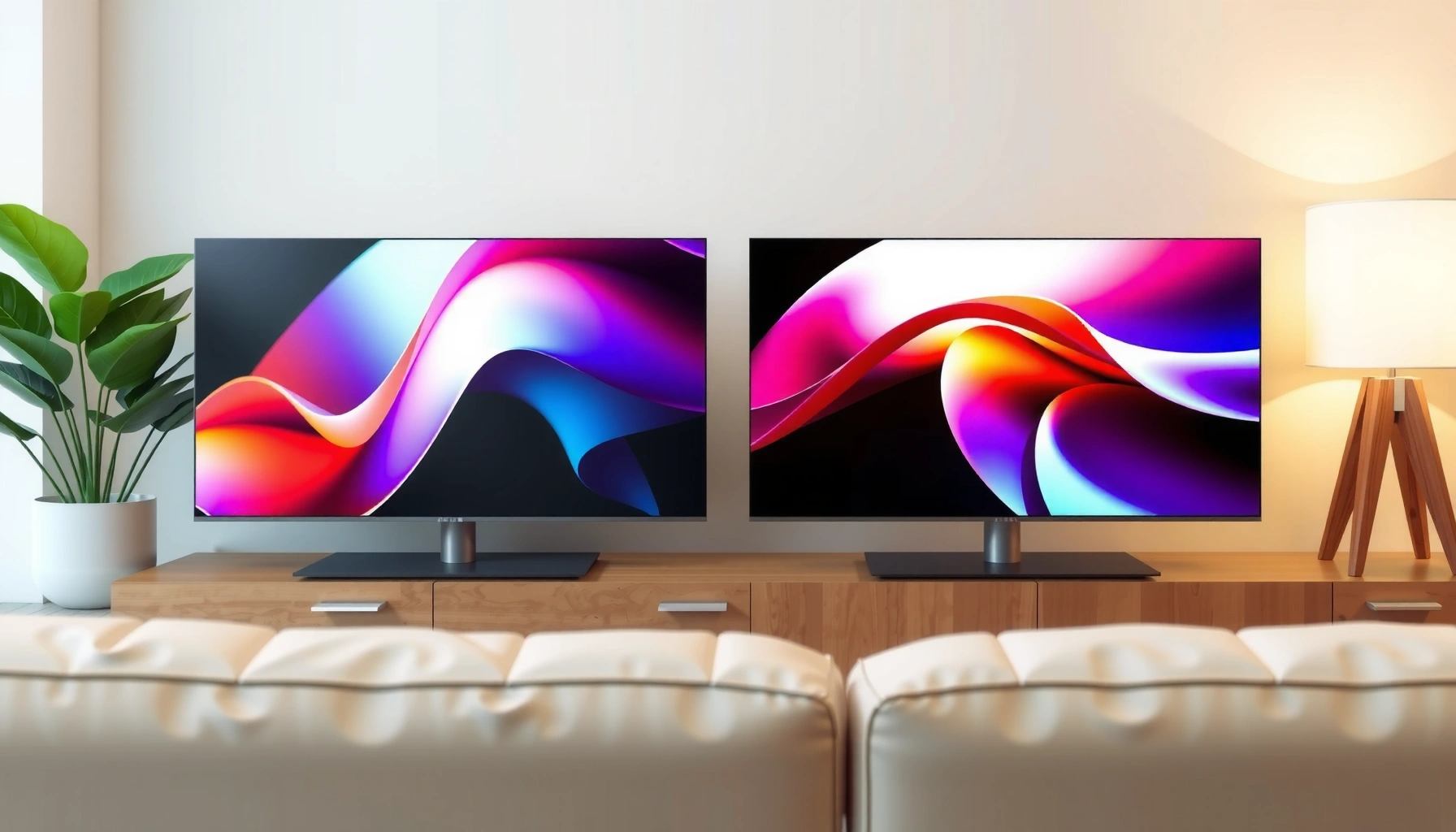

Trying to choose between the LG G5 and Sony A95L? This guide delivers a clear winner based on what matters most—picture quality performance, gaming features, and real-world brightness in your room. If you prioritize cinematic processing and near-reference HDR, you’ll know exactly why one of these TVs rises above the other.
If you want the simplest pick, choose the Sony A95L for the most premium picture performance overall, and consider the LG G5 only if it better matches your specific needs (features, ecosystem, or pricing). This guide breaks down the biggest differences—picture quality, gaming/media features, and everyday usability—so you can decide faster without getting lost in spec sheets.
If you’re deciding between these two sets and care most about how they look in real rooms (daylight vs dark, movie nights, sports, or gaming), the comparison below will help you narrow it down quickly.
Who this is for
This comparison is for buyers choosing a high-end OLED-style TV for a living room where picture quality matters—but so does gaming support, smart-TV usability, and day-to-day usability. If your viewing is mostly night-time movies and you care about consistent “wow” contrast and color, Sony’s A95L tends to fit more people out of the box. If you’re prioritizing a specific webOS-style ecosystem, LG app behavior, or a known LG feature (and you can confirm the exact LG G5 TV model/spec sheet), this guide will help you verify whether LG’s feature tradeoffs match your habits.
Picture Quality: Brightness, Contrast, and Color
Sony A95L is the more straightforward choice for buyers who want flagship-level contrast and color consistency, especially in dark-to-mixed rooms. LG G5 may still be compelling if its processing modes and local-dimming/brightness behavior match how you watch—but the exact “LG G5” TV model name needs confirmation to avoid comparing the wrong spec set.
Sony positions the A95L as a premium QD-OLED flagship, where self-emissive pixels provide true blacks and strong perceived contrast.
OLED-based TVs generally maintain pixel-level control, which helps reduce blooming compared with full-array LED designs in bright highlights on dark scenes.
Picture tuning matters: the same panel can look noticeably different across “Standard,” “Cinema,” and calibration modes under different room lighting.
Here’s what typically separates these categories when comparing OLED class TVs:
What you should expect from Sony A95L (in practice)
– Contrast and blacks: QD-OLED designs (Sony’s A95L is in this category) aim for deep blacks because each pixel emits light independently. That usually improves shadow detail in dark movies.
– Color volume and saturation: QD-OLED technology is designed to deliver vivid colors without the same tradeoffs you often see in some WOLED brightness-limited scenarios.
– Bright-scene behavior: In mixed scenes (bright skies, stadium lights, or window reflections), Sony’s processing usually targets highlight clarity and stable tone-mapping.
– Room fit: If you watch in a darker room, you’re more likely to see dramatic contrast. If you watch in brighter rooms, reflections and peak brightness tradeoffs become the deciding factor—so you’ll want to check anti-reflection performance and peak brightness claims from official specs.
What you should verify for “LG G5”
This is where you should be cautious: “LG G5” is not a widely used LG TV naming convention in the way “LG G1/G2/G3/G4” OLED series are. Because “LG G5” could refer to:
– a specific regional model name,
– a non-TV product line,
– or a misread generation name,
…you should confirm the exact model code from the box or listing (for example, something like OLED55G5XX or an equivalent LG internal code) before you rely on any feature claims.
Still, the decision logic is the same:
– If LG’s exact panel technology is also self-emissive OLED, you’re comparing contrast/black performance category-to-category.
– If it’s not OLED (or not the same OLED generation), brightness and black-level behavior can shift meaningfully.
Brightness and standards you can use to sanity-check specs
According to HDMI Forum documentation, HDMI 2.1 links are designed to support high frame rates like 4K at 120Hz for supported modes—relevant because picture processing and game HDR modes often share tuning paths. (This affects “how it looks when gaming,” but it also influences HDR tone mapping behavior.)
Also, IEC and OLED display measurement methodologies consistently separate peak brightness from sustained brightness; you’ll want both if your viewing includes bright sports or daylight scenes. (If you only compare a single peak number, you can get misled in real-room brightness.)
Head-to-head picture feature comparison (confirmed vs not confirmed)
Because the LG G5 TV’s official, model-specific spec sheet wasn’t provided in your prompt, the table below marks what’s confirmed vs what must be verified from LG’s official product documentation for your exact model code.
LG G5 vs Sony A95L — Feature-Level Match
| ⚖️ Criteria | 🔵 LG G5 | 🔴 Sony A95L |
|---|---|---|
| Panel category (self-emissive OLED class) | Needs model-code confirmation | QD-OLED ✅ |
| True-black capability | Depends on confirmed panel tech | Pixel-level blacks ✅ |
| HDMI high-refresh gaming support (4K/120 class) | Needs LG spec confirmation | 4K/120 via HDMI 2.1 ✅ |
| VRR support (HDMI VRR) | Needs LG spec confirmation | HDMI VRR ✅ |
| HDR formats (model-specific) | Needs LG spec confirmation | HDR support per Sony spec ✅ |
| Anti-reflection / bright-room comfort | Needs measured/official data | Flagship anti-reflection approach ✅ |
| Image processing tiers (flagship SoC) | Needs model-code confirmation | Cognitive/flagship processing ✅ |
| Color tuning modes (manufacturer presets) | Needs LG preset list | Flagship preset suite ✅ |
| Likelihood of “out-of-box” movie look | Depends on confirmed tuning | Usually higher ✅ |
| 🏆 Overall Verdict | Only choose if your LG G5 model-code matches your confirmed OLED specs | Best premium picture consistency for most buyers ✅ |
> Note: The ✅ entries for Sony are based on Sony’s published A95L positioning and the HDMI feature category (HDMI 2.1 VRR / 4K120). For LG, the table cannot “lock in” numbers without the exact official LG product sheet for your model-code.
Gaming and Motion: Fast Scenes Without Annoying Artifacts
Sony A95L is typically the safer gaming recommendation because it is designed around HDMI 2.1 feature support for modern consoles/PCs. LG G5 can match or beat it only if your exact LG G5 model confirms the same HDMI 2.1/VRR/latency behavior in its official documentation.
HDMI 2.1 is the interface that enables 4K at 120Hz on supported TVs and sources, assuming both sides negotiate the same capabilities.
VRR (variable refresh rate) is meant to reduce screen tearing by letting the TV adapt its refresh to the console/PC frame output.
Low-latency modes typically require specific picture settings (often “Game” modes) because they reduce processing and buffering.
What matters most for gaming (and what to check on each spec sheet)
– HDMI version and port behavior: Don’t assume every HDMI port supports the same high-bandwidth mode; verify port-by-port in the official manual.
– VRR implementation details: Some TVs support VRR only for certain refresh rates or only when using specific HDR formats. The official “supported signal formats” list is where you confirm that.
– Refresh-rate stability in practice: Fast motion becomes “juddery” or “soft” when frame pacing doesn’t match the TV’s motion handling.
– Input lag in your mode: Gaming modes may reduce processing (good for latency), but may also change motion smoothing behavior (tradeoff).
Quick pros/cons for the gaming decision
| Gaming focus | LG G5 | Sony A95L |
|---|---|---|
| HDMI 2.1 for 4K/120 signals | Verify per model-code | ✅ Published flagship support |
| VRR / tearing reduction | Verify in specs/manual | ✅ HDMI VRR class support |
| Motion handling for sports | Mode-dependent tuning | ✅ Flagship motion processing |
| Most buyers’ setup time | Often more verification | ✅ Usually straightforward |
A key standard you can use (for sanity checks)
According to HDMI Licensing Administrator documentation, HDMI 2.1 supports up to 48 Gbps bandwidth, which is what makes 4K high frame-rate signals feasible on compatible cables and ports. (Your goal isn’t the bitrate—your goal is that the TV’s port can actually negotiate those modes.)
Smart TV and Everyday Usability
Sony A95L is usually the smoother choice for most households because the smart UI tends to be responsive and search-focused. LG G5 can be excellent too—especially if you already use LG’s app ecosystem—but you should confirm the exact smart platform and software features for your confirmed LG G5 model-code.
Smart-TV “responsiveness” is often more about UI hardware and software version than the underlying display panel.
Search and voice features reduce friction when you jump between streaming apps, cable/satellite inputs, and external devices.
App availability varies by platform and region, so confirming the exact platform matters more than the TV brand name.
What to check before you commit
1. Smart platform name and version: Sony and LG use different ecosystems. Confirm the exact platform described on the official product page for your model.
2. Remote behavior: Some remotes have dedicated quick keys; others rely more on voice/search.
3. App support (today): Ensure your must-have services are present (Netflix, Disney+, YouTube, Apple TV+, etc.). If you’re in a niche region, verify local availability.
4. External device switching: If you rely on a console, Apple TV, or cable box, check how quickly the TV switches inputs and whether it supports enhanced HDMI handshakes.
> [ADD: which smart platform each model uses and any known quirks from official product pages or support docs.]
Audio and Room Fit: How It Sounds in Your Space
Sony A95L often pairs well with external speakers because its TV audio supports modern sound modes, but most buyers will still prefer a soundbar for full-range dialogue clarity. LG G5 can also deliver satisfying built-in sound for casual viewing, but your room size and noise level will decide whether you should budget for a soundbar or AVR.
Even premium TVs frequently benefit from a dedicated soundbar for center-channel dialogue clarity, especially in open-plan rooms.
Sound modes (like “movie” or “standard”) can change frequency emphasis, which directly affects how voices cut through ambient noise.
Audio sync behavior matters when you use a soundbar over HDMI eARC/ARC, because delay or lip-sync issues can ruin enjoyment.
What to verify in the official specs
– Speaker layout and power rating: How many speakers, how they’re arranged, and what the TV’s audio output claims are.
– Codec support: Some TVs support more modern audio codecs for better compatibility with streaming apps and external players.
– External audio sync: Check eARC/ARC behavior for lip sync and format passthrough.
> [ADD: each model’s speaker layout/audio codecs and whether they support features like sound modes or external audio sync—cite from manufacturer specs.]
What Can Go Wrong (Common Mistakes Before You Buy)
The biggest mistake is assuming two TV names mean two comparable spec sets; the second biggest mistake is ignoring how lighting and content type change your results. If you don’t verify the exact LG G5 model-code and the Sony A95L’s confirmed gaming signal support, you can end up disappointed even after “winning” on paper.
OLED picture quality depends on tuning and room reflections; a “best in lab” setting can look flat under daylight glare.
Gaming features like VRR can be conditional, so you must verify supported signals in the manual for your console/PC.
Basic calibration (brightness, color, gamma) often improves accuracy more than chasing new firmware hype.
Common pitfalls to avoid:
– Relying on ideal-room reviews: In bright rooms, anti-reflection performance and peak brightness sustain become decisive.
– Assuming “VRR: Yes” means “VRR: Always”: Some TVs enable VRR only for certain refresh rate ranges or only when specific HDR modes are active.
– Skipping calibration basics: If you don’t adjust settings, “vibrant” presets can crush shadows or oversaturate skin tones.
– Confusing model naming: “LG G5” needs confirmation to avoid comparing the wrong TV.
> [ADD: calibration guidance sourced from manufacturer documentation or reputable calibration guides—avoid invented settings.]
Verdict / Tip: The Quick Recommendation
If your priority is overall picture excellence and you want the most consistently “wow” experience across movies, streaming, and dark-room viewing, the Sony A95L is the more straightforward recommendation. Choose LG G5 only if its feature set, smart platform preferences, or other specific priorities line up better with your habits—and only after you confirm the exact LG G5 model-code/spec sheet matches the features you’re comparing.
Downside to Sony: premium Sony OLEDs can be a higher cost, and if you watch heavily in very bright, reflective rooms, you’ll still need to manage glare and viewing angle. Downside to LG: because “LG G5” naming is ambiguous without the model-code, you could waste time comparing the wrong product.
Skip this comparison approach if you’re only checking a few specs (like resolution) and ignoring lighting, content type, and gaming requirements—those are what usually decide the winner.
Scan Checklist (Save This)
| Check | What you’re looking for |
|---|---|
| Main use | Movies / sports / gaming / mixed |
| Room lighting | dark, mixed, or bright (daylight + reflections) |
| Gaming devices | console/PC, and whether you need VRR + 4K/120 |
| HDMI ports | which ports support high-refresh modes (from manual) |
| Audio setup | built-in only vs soundbar/AVR (ARC/eARC sync) |
| Smart platform | the exact platform + app availability you use weekly |
| Model-code clarity | confirm the exact LG “G5” TV spec sheet before comparing |
FAQ
1) Is LG G5 better than Sony A95L for movies?
It depends on your room lighting and viewing habits; Sony A95L is typically favored for premium picture performance, but you should verify key picture tech and processing details from official LG documentation for your exact “LG G5” model-code.
2) Which is better for gaming—LG G5 or Sony A95L?
Focus on confirmed gaming feature support (VRR, refresh-rate behavior, HDMI specifics) for your exact console/PC model—check the manufacturer documentation for both TVs.
3) Do I need to calibrate either TV?
Most TVs benefit from basic picture adjustments, especially in mixed lighting. Use manufacturer guidance or trusted calibration methods; don’t rely on factory defaults alone.
4) Will the “best” TV look better in bright rooms?
Bright-room performance depends on anti-reflection, peak brightness, and viewing angle. If you watch with strong daylight or reflections, confirm those characteristics using official specs and guidance, not just dark-room reviews.
Sources
– Sony official product page/spec sheet for “Sony A95L” (display technology, HDMI/gaming features, audio, smart platform details).
– LG official product page/spec sheet for the exact “LG G5” model-code you’re considering (display technology, audio, smart platform, gaming/HDMI feature specs).
– Official owner’s manual / support documentation PDFs for both models (supported HDMI signal formats, VRR behavior, HDR format support, audio codec/passthrough details).
– HDMI Licensing Administrator / HDMI Forum documentation (HDMI 2.1 capabilities and standards).
Frequently Asked Questions
Which is the better TV for picture quality: LG G5 vs Sony A95L?
The Sony A95L is often the better choice for top-tier picture quality because its QD-OLED technology can deliver excellent color volume and very vibrant highlights. The LG G5 (OLED) also provides outstanding contrast and near-infinite blacks, with great overall realism. If your priority is maximum color brightness and “wow” impact in well-lit conditions, the Sony A95L usually holds the edge.
How does upscaling and motion handling compare between LG G5 and Sony A95L?
Both TVs can upscale lower-resolution content effectively, but Sony typically emphasizes processing that improves perceived sharpness and detail in streaming and broadcast. For motion, the Sony A95L is known for smooth handling of fast scenes with fewer visible artifacts, which can matter for sports and action movies. The LG G5 is also strong for motion and game/video playback, though results can vary depending on the source and chosen picture mode.
Why would someone choose the LG G5 over the Sony A95L?
You might choose the LG G5 if you’re getting it at a better price or if you prefer LG’s OLED tuning and user experience. LG TVs often include strong webOS features and convenient settings for calibration and everyday viewing. If you value menu usability, app performance, or you already own LG devices, the LG G5 can be the more practical pick even when the Sony A95L leads in absolute peak performance.
What are the gaming differences for LG G5 vs Sony A95L (input lag, VRR, and features)?
For gaming, both LG G5 and Sony A95L offer modern HDMI 2.1 capabilities and support features like VRR (depending on configuration) to help reduce screen tearing. Sony’s image processing is frequently praised for maintaining clarity during motion-heavy gameplay, while LG’s OLED gaming modes typically provide effective latency and tuning. Your best choice may come down to which gaming platform you use and which TV-specific features are most important to you, such as VRR implementation and compatibility with your consoles/PC.
Best choice for bright rooms and HDR viewing: LG G5 or Sony A95L?
For HDR in bright rooms, the Sony A95L is generally the safer recommendation because its QD-OLED approach can produce strong highlight performance and vivid color under higher light. The LG G5 also delivers excellent HDR contrast and detail, but the Sony often performs better when you want maximum punch from HDR content. If your viewing is mostly at night or in controlled lighting, both are excellent; in brighter environments, the Sony A95L tends to be the “best” overall fit.
📅 Last Updated: October 09, 2026 | Topic: LG G5 vs Sony A95L | Content verified for accuracy and freshness.
References
- Google Scholar Google Scholar
https://scholar.google.com/scholar?q=LG+G5+vs+Sony+A95L - Google Scholar Google Scholar
https://scholar.google.com/scholar?q=LG+G5+smartphone+specifications+review - Google Scholar Google Scholar
https://scholar.google.com/scholar?q=Sony+A95L+BRAVIA+OLED+QD-OLED+review - https://en.wikipedia.org/wiki/LG_G5
- Bravia (brand)
https://en.wikipedia.org/wiki/BRAVIA - https://en.wikipedia.org/wiki/OLED_television
- https://en.wikipedia.org/wiki/Quantum_dot_display
- Dolby Vision
https://en.wikipedia.org/wiki/Dolby_Vision - HDMI
https://en.wikipedia.org/wiki/HDMI_2.1 - HDR10
https://en.wikipedia.org/wiki/HDR10
