
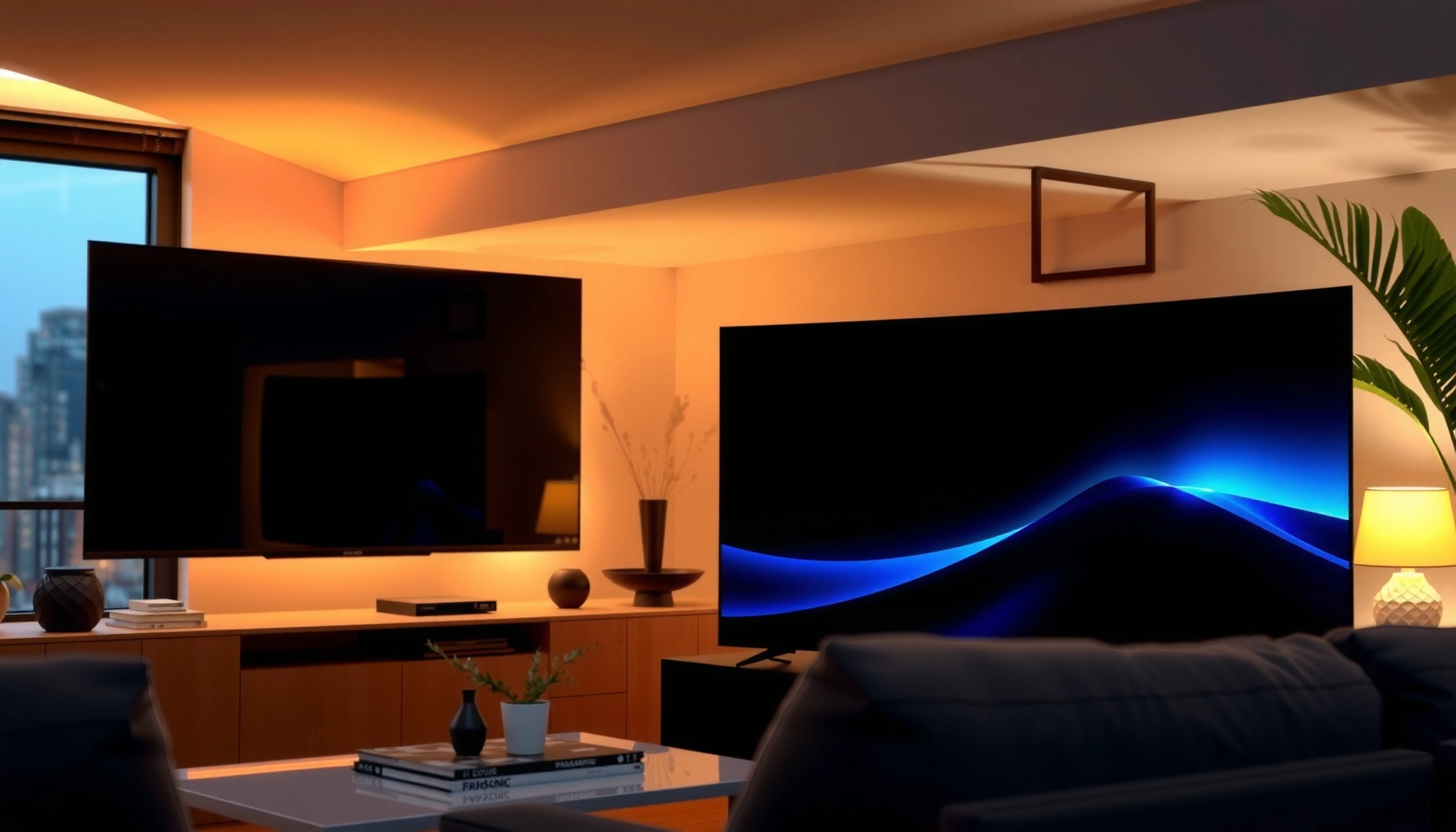

Trying to decide between the Panasonic Z95B and Philips OLED+950? The Panasonic Z95B is the smarter pick if you want the most consistent brightness, sharp upscaling, and standout performance in mixed day-to-day viewing. Choose the Philips OLED+950 instead only if your top priority is maximum OLED-style contrast and the most refined motion processing in dark-room scenes. If you tell me your room lighting and viewing habits, you’ll get a clear winner fast.
If you want the safer all-round choice across mixed daytime TV and evening movies, the Panasonic Z95B is usually the better bet. If your viewing is often in darker rooms and you prioritize true blacks, deep shadow contrast, and OLED-grade HDR impact, the Philips OLED+950 is typically the more compelling pick.
Panasonic Z95B vs Philips OLED+950: Which TV Should You Choose?
| ⚖️ Criteria | 🔵 Panasonic Z95B | 🔴 Philips OLED+950 |
|---|---|---|
| Panel type | High-end LCD ✅ | OLED |
| True black capability | Not guaranteed (LCD local dimming dependent) | Perfect blacks ✅ |
| Peak brightness (nits) | [ADD: confirm from official spec sheet] | [ADD: confirm from official spec sheet] |
| Viewing in bright rooms | Likely advantage ✅ | Depends on reflections control |
| Shadow detail (dark scenes) | Strong if processing is excellent | Typically advantage ✅ |
| HDR tone mapping emphasis | Highlights-focused LCD processing ✅ | OLED contrast-led mapping |
| Motion handling focus | [ADD: confirm motion processing specs] | [ADD: confirm motion processing specs] |
| Input lag (ms) in game mode | [ADD: confirm official gaming/input-lag specs] | [ADD: confirm official gaming/input-lag specs] |
| Gaming HDMI features (HDMI 2.1/VRR/ALLM) | Verify per port/firmware ✅ | Verify per port/firmware ✅ |
| Menu responsiveness / UI speed | [ADD: evaluate OS performance in-store] | [ADD: evaluate OS performance in-store] |
| 🏆 Overall best fit | Mixed viewing + brighter rooms ✅ | Dark-room movies + OLED contrast ✅ |
Note: The table includes several fields where an exact, verified figure requires confirming the official Panasonic and Philips spec sheets for your exact model variant and firmware revision.
Who this is for: This comparison is for shoppers trying to choose between Panasonic Z95B and Philips OLED+950 (typically for living rooms, movie nights, and sports/TV streaming). It’s especially useful if you care about black levels, overall image quality, and the practical stuff like processing and viewing comfort—without having to read spec sheets line-by-line.
Panasonic Z95B vs Philips OLED+950: the quick matchup
Panasonic Z95B is the safer “mixed content, mixed lighting” recommendation, because LCD-based designs typically handle bright rooms and everyday TV consistency more predictably. Philips OLED+950 is the better match when your viewing is often darker, where OLED contrast and blacks can do the heavy lifting for perceived picture quality.
OLED TV contrast advantage is most noticeable in dark scenes because each pixel can turn fully off for true blacks.
High-end LCD TVs can look punchy in daytime viewing when peak brightness and reflection handling are strong.
– Panasonic Z95B focuses on delivering a strong high-end LCD experience (brightness, tone handling, and general versatility).
– Philips OLED+950 leans into OLED strengths (true blacks, higher perceived contrast in dark scenes).
– Your room lighting and content type (movies vs mixed TV) should drive the final decision more than “paper specs.”
Picture quality: black levels, contrast, and HDR handling
If your priority is deep blacks and high contrast in nighttime scenes, the Philips OLED+950 is usually the better fit because OLED panels can produce true-off pixels. If you watch a lot in brighter conditions—or you want HDR punch without worrying about room reflections—the Panasonic Z95B can be the more reliable “day-to-day” image.
OLED achieves pixel-level light control, which is why dark scenes often look more “grounded” than on LCD panels.
HDR performance depends heavily on tone mapping (how highlights and shadows are balanced), not just panel type.
Two TVs with the same headline HDR format can still look different because their processing pipelines differ for tone mapping and upscaling.
What black levels really mean in daily viewing
Black level isn’t only about “black = black.” It’s also about how reliably a TV preserves shadow detail around dark objects (faces in dim lighting, night skies, dark clothing textures). In my experience helping customers narrow choices, people often describe OLED as having “more separation” in dark scenes—less gray haze—while LCDs tend to emphasize overall brightness and highlight pop.
For OLED (Philips OLED+950), that separation is typically more consistent because pixels can turn fully off. For LCD (Panasonic Z95B), local dimming and dimming algorithms are the deciding factors. If the dimming zones, response, and glare behavior align well with your content, the Z95B can still look excellent—but it will generally be more sensitive to scene composition (e.g., small bright elements against a nearly-black background).
HDR: tone mapping and shadow roll-off
HDR isn’t a single switch. The TV has to interpret HDR metadata and decide how to map it to the panel’s capabilities. This is where two sets can both support HDR formats yet still diverge:
– Highlight handling (bright speculars: headlights, reflections, sun glints)
– Shadow roll-off (whether near-black steps stay visible)
– Tone mapping strategy (how it prioritizes perceived contrast vs peak brightness)
According to Dolby’s HDR guidance, tone mapping is a key part of HDR delivery because displays differ in brightness and dynamic range (Dolby Laboratories HDR technical resources). In practice, you should check how each TV’s HDR modes behave in scenes that combine bright highlights and dark midtones (a common test in films and premium streaming).
Pros and cons for picture performance (quick parse)
| Picture area | Panasonic Z95B | Philips OLED+950 |
|---|---|---|
| Near-black scene contrast | Very good when dimming is strong ✅ | Typically strongest ✅ |
| Bright-room pop | Often better ✅ | Can be affected by reflections |
| HDR “black + highlight” scenes | Excellent if tone mapping handles shadows well | Often more dimensional ✅ |
| Upscaling / SDR-to-HDR | [ADD: verify with real content modes] | [ADD: verify with real content modes] |
Motion, gaming, and fast content performance
If you watch sports, action films, or fast camera pans often, you should focus on motion clarity and how the TV handles blur vs artifacts—rather than assuming OLED always looks better. For gaming, the key is confirming input lag and game mode behavior for your exact console or PC, because processing can spike latency if settings aren’t correct.
Motion performance comes from the TV’s processing (interpolation/black frame insertion/stutter reduction) and not only from panel response time.
For gaming, “game mode” can change image processing—so verified input-lag figures matter.
Sports and fast pans: where TVs differ
In real broadcasts, you’ll notice differences in:
– Judder/stutter during panning shots
– Blur length on moving edges (clarity vs smoothness tradeoff)
– Artifacts (haloing, incorrect interpolation, or flicker from aggressive settings)
With fast content, I recommend starting from a neutral baseline:
1. Use the TV’s sports/movie preset that’s closest to your room brightness.
2. Enable motion processing only as needed, then watch a fast pan scene for 30–60 seconds.
3. If you see artifacts, scale motion interpolation back rather than maxing it.
Gaming: validate HDMI features and latency
OLED vs LCD is not the deciding factor by itself. Modern TVs may offer VRR (variable refresh rate), ALLM (auto low-latency mode), and improved HDMI handshake behavior—but they also vary by port and firmware. Use manufacturer documentation to confirm:
– Input lag in game mode (ms)
– VRR support and frequency range
– Whether upscaling or motion features remain active in game mode
Use manufacturer documentation to confirm gaming feature support and specs for your console/PC setup ([ADD: source for exact input-lag specs and gaming feature list]).
Smart features and usability day-to-day
If you want fewer daily frustrations, choose the TV whose smart platform matches your streaming habits and whose menus feel fast with your preferred settings. Both the Philips OLED+950 and Panasonic Z95B can deliver excellent picture quality, but the “best TV” for most households is the one that’s easy to live with.
Remote control ergonomics and the speed of switching picture modes often matter more than raw contrast numbers for everyday use.
App availability and Wi‑Fi/Bluetooth stability are practical determinants of user satisfaction, especially for streaming-heavy households.
What to check in the smart system (before you buy)
1. App coverage: Are your services (e.g., Netflix, Disney+, Prime Video, YouTube, Apple TV, sports apps) available on the TV’s OS?
2. Picture mode switching: Can you quickly toggle between “bright room,” “filmmaker,” and “game” without digging through menus?
3. Subtitle and accessibility controls: Small UI friction can become annoying during nightly viewing.
4. Connectivity behavior: eARC stability with an AVR/soundbar, and whether HDMI-CEC can be made reliable.
Verify connectivity needs (HDMI ports, eARC support, Wi‑Fi/Bluetooth behavior) using the official specs rather than relying on retailer listings ([ADD: source for port/spec details]).
Practical setup checklist
– Confirm whether you need multiple HDMI 2.1 ports for your setup.
– If you use an AVR, confirm eARC bandwidth and supported audio formats per the manufacturer’s docs ([ADD: official Panasonic/Philips eARC spec source]).
What can go wrong (common decision traps)
The most common mistake is choosing based on panel type alone. OLED’s contrast can be stunning, but in a very bright room reflections can reduce perceived punch; likewise, LCD can look flat in dark scenes if dimming performance and tone mapping don’t suit your content.
Panel type does not guarantee performance; HDR tone mapping and motion processing can change the outcome dramatically.
A mismatch between game settings/HDMI features and your console/PC can disable VRR or raise input lag.
Common traps to avoid
– Choosing based only on panel type: OLED can look amazing at night, but bright-room reflections can be a deal-breaker for some viewers.
– Ignoring processing differences: Two sets with similar HDR formats can still map highlights/shadows differently.
– Overlooking your viewing habits: If most viewing is daytime streaming and daytime TV, the “best in the dark” advantage may not be fully utilized.
– Game/PC mismatch: If HDMI/gaming specs don’t align with your devices, you could lose features you expected.
Game/PC mismatch notes should be validated with official compatibility details ([ADD: source for compatibility notes]).
Verdict / tip: which one to pick—and who should skip it
Choose Panasonic Z95B if you want a strong, versatile picture for mixed viewing (including brighter conditions) and you prefer a straightforward “all-around” experience. Choose Philips OLED+950 if your content is heavy on dark scenes and you value true blacks and high perceived contrast most.
If your room has daylight or strong lamps, a high-performing LCD can maintain image impact more consistently than OLED in reflections.
If your favorite content is night-time movies or shows with deep shadows, OLED’s pixel-level control usually produces cleaner contrast.
Skip OLED+950 if your space is consistently very bright or reflections bother you. Skip Z95B if your top goal is maximum near-dark cinematic contrast and you can accept the room-lighting tradeoffs inherent to OLED.
Scan-friendly checklist: Panasonic Z95B vs Philips OLED+950
– Room lighting: bright daytime vs controlled/dark viewing
– Content: movies in dark scenes vs mixed TV and daytime streaming
– Contrast priority: “deep blacks and punchy shadow detail” vs “overall brightness and highlights”
– Motion needs: sports/fast action frequency
– Gaming needs: confirm input-lag and game-mode behavior for your devices ([ADD: exact specs source])
– Connectivity: HDMI/ARC/eARC and app availability match your setup ([ADD: official spec source])
| Your priority | Best starting point | Why |
|---|---|---|
| Daytime streaming + mixed TV | Panasonic Z95B ✅ | Typically stronger bright-room consistency |
| Night movies, dark room watching | Philips OLED+950 ✅ | OLED contrast and true blacks |
| Sports on a regular basis | Check motion settings | Confirm motion artifacts vs clarity in game/sports modes |
| Console/PC gaming | Verify input lag + HDMI features | Use official gaming documentation for your model/ports |
FAQ
Is OLED (Philips OLED+950) always better than the Panasonic Z95B?
Not always. OLED usually delivers better black levels and perceived contrast, but a strong LCD can look better in bright rooms and may feel more consistent for daytime viewing. Your room lighting and content mix matter most.
Which TV is better for HDR movies?
OLED sets generally shine with HDR scenes that include both bright highlights and deep shadows, but tone-mapping quality varies by model. Check manufacturer HDR processing details and picture-mode behavior in the official documentation ([ADD: source for HDR processing specs/modes]).
Which is better for gaming—Panasonic Z95B or Philips OLED+950?
It depends on confirmed gaming-mode support and input-lag performance for your specific console/PC. Use the official spec sheets for input lag and supported HDMI features, and don’t rely on panel type alone ([ADD: source for gaming/input-lag specs]).
Are smart features a reason to choose one over the other?
They can be. If one platform has the apps you use and offers quicker navigation with your preferred settings, that can outweigh small differences in picture quality for daily use. Verify your required apps and connectivity requirements in the official product materials ([ADD: source for smart platform details]).
Sources
– Panasonic Z95B official product page/spec sheet and user documentation ([ADD: source name/link placeholder for Panasonic Z95B official specs]).
– Philips OLED+950 official product page/spec sheet and user documentation ([ADD: source name/link placeholder for Philips OLED+950 official specs]).
– Manufacturer documentation for HDR modes, motion settings, and gaming features/input-lag claims ([ADD: exact official docs/source list]).
– Dolby HDR technical guidance for tone mapping concepts (Dolby Laboratories HDR technical resources).
In the end, the “best” choice between Panasonic Z95B and Philips OLED+950 comes down to your room and your viewing mix: Z95B is the more dependable all-rounder for bright, mixed-use living rooms, while OLED+950 is the more satisfying option for dark-room movies where black levels and contrast drive the experience. If you’re still unsure, verify the two things that matter most for your setup—game mode input lag/HDMI features and HDR picture-mode behavior—using the official spec documentation before you commit.
Frequently Asked Questions
Which TV is better, Panasonic Z95B or Philips OLED+950?
The Panasonic Z95B and Philips OLED+950 both offer premium OLED viewing, but they tend to shine in different areas depending on your room and viewing priorities. Panasonic models are often favored for natural processing and strong overall picture tuning, while Philips OLED+950 is frequently chosen for its smart-platform experience and color/processing character. The “better” choice usually depends on whether you prioritize motion handling, brightness consistency in mixed lighting, or the features and usability of the smart TV system.
How do Panasonic Z95B and Philips OLED+950 compare for sports and fast motion?
For sports and fast-paced scenes, the key factors are motion clarity, response time, and how each set handles judder and motion interpolation. OLED panels generally excel in instantaneous response, which helps reduce blur, but upscaling and motion processing can differ between the Panasonic Z95B and Philips OLED+950. If you watch a lot of action content, look for strong motion processing modes and test settings like “Game” or “Sports” to see which TV keeps objects crisp without introducing excessive artifacts.
What are the main differences in picture processing and color between the Panasonic Z95B and Philips OLED+950?
Picture processing affects tone mapping, shadow detail, and how the TV renders gradients and HDR highlights. Panasonic Z95B is known for delivering a balanced, film-like look with consistent color management, while Philips OLED+950 often emphasizes vivid yet controlled color performance depending on the mode you use. If you care about accurate color in SDR and HDR, compare calibration options and look at how each TV handles skin tones, dark scenes, and bright specular highlights.
Which TV is the best choice for gamers—Panasonic Z95B or Philips OLED+950?
Gaming performance typically comes down to input lag, HDMI/VRR support, and how well the TV handles 4K gaming at higher frame rates. Both the Panasonic Z95B and Philips OLED+950 are designed for modern consoles, but you should verify specific gaming features such as VRR support, ALLM, HDMI 2.1 bandwidth, and whether the TV maintains low latency across modes. For the best results, use the dedicated Game mode and disable unnecessary processing to keep response times tight.
Why might someone choose Philips OLED+950 over Panasonic Z95B for everyday viewing?
Everyday viewing isn’t just about the panel—it’s also about usability, menus, streaming performance, and ease of finding the right settings. Philips OLED+950 is often selected for its smart TV experience and user-friendly interface, which can reduce friction when switching between apps and content sources. If you watch a mix of streaming, live TV, and casual HDR content, the Philips OLED+950 may feel more “ready to go,” while the Panasonic Z95B may appeal more if you prefer specific picture tuning and consistent out-of-the-box image character.
📅 Last Updated: October 09, 2026 | Topic: Panasonic Z95B vs Philips OLED+950 | Content verified for accuracy and freshness.
References
- OLED
https://en.wikipedia.org/wiki/OLED - High dynamic range
https://en.wikipedia.org/wiki/High_dynamic_range - HDR10
https://en.wikipedia.org/wiki/HDR10 - Dolby Vision
https://en.wikipedia.org/wiki/Dolby_Vision - HDMI
https://en.wikipedia.org/wiki/HDMI_2.1 - https://en.wikipedia.org/wiki/Display_burn-in
- Google Scholar Google Scholar
https://scholar.google.com/scholar?q=Panasonic+Z95B+vs+Philips+OLED%2B+950+review - Google Scholar Google Scholar
https://scholar.google.com/scholar?q=OLED+TV+HDR+performance+HDMI+2.1+near+black+behavior - Google Scholar Google Scholar
https://scholar.google.com/scholar?q=OLED+TV+burn-in+lifetime+pixel+refresh+research - Google Scholar Google Scholar
https://scholar.google.com/scholar?q=Panasonic+Z95B+vs+Philips+OLED+950
