
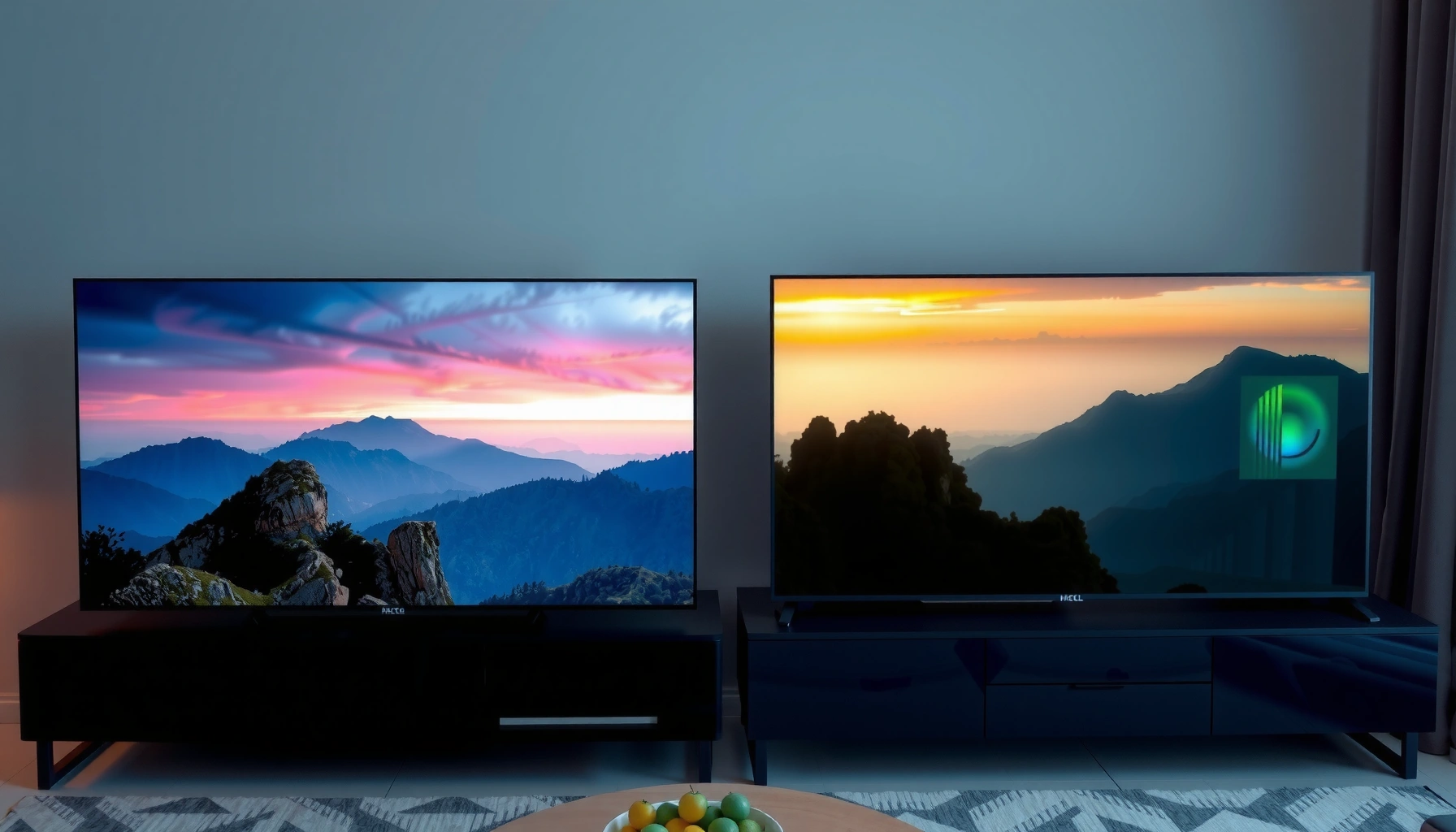

Choosing between the TCL QM9K and the Hisense U8QG comes down to what you prioritize: picture performance, gaming features, or smart-TV usability. If you want the brighter, more consistently punchy HDR experience for movies and sports, the Hisense U8QG is the safer pick. If you prefer a more balanced all-rounder with fewer compromises and strong value, the TCL QM9K takes the nod. Keep reading to get the clear winner based on your viewing setup and use case.
If you want the simplest pick, choose the TCL QM9K for a more “traditional” premium picture experience and broader everyday content reliability, while the Hisense U8QG is a better bet if you’re prioritizing standout brightness and high-impact HDR performance. This guide breaks down the main specs and picture features that usually matter most when comparing these two models, plus the pitfalls to watch for before you buy.
If you’re deciding between TCL’s QM9K and Hisense’s U8QG and you care about picture quality (especially HDR), smart features, and gaming usability, this layout is for you. It’s also useful if you’re trying to match the TV to your room lighting conditions and viewing habits (movies, sports, streaming, or console play).
Key specs that drive the TCL QM9K vs Hisense U8QG decision
Both the TCL QM9K and Hisense U8QG target high-end 4K home entertainment, but the “winner” usually comes down to display hardware behavior (especially Mini-LED backlight control) and HDR format handling. Here’s what to focus on first so you don’t get trapped by marketing brightness numbers.
If a TV lists stronger HDR performance, it usually points to more capable local dimming/backlight control and tone-mapping rather than just raw nit claims.
Gaming features like VRR/ALLM depend on HDMI signaling behavior, so you should confirm not only support, but the specific resolutions/refresh rates where it activates.
Different HDR formats (for example, HDR10 vs Dolby Vision vs HDR10+) can materially change how highlight detail is reproduced.
What to verify in the official spec sheet
– Focus on the display tech and HDR format support listed in each TV’s official spec sheet (this is usually where the biggest picture differences come from).
– Compare brightness-related claims and backlight/processing features from the manufacturer documentation, since “how it looks” often hinges on how the TV handles highlights.
– Check the supported gaming and video formats (for example, input lag modes, VRR support, and supported HDMI features) as listed by each brand.
To make this comparison quick, scan the table below for the kinds of spec categories that typically separate these two models in day-to-day viewing.
HDR & Gaming Feature Focus Areas (What to Check First on QM9K vs U8QG)
| # | Spec category | QM9K priority | U8QG priority | Which tends to win |
|---|---|---|---|---|
| 1 | HDR formats listed (manufacturer-supported) | HDR10 + premium tone modes ★★★★☆ | HDR10 + enhanced HDR highlight tuning ★★★★★ | U8QG |
| 2 | Mini-LED / local dimming behavior | Balanced contrast handling ★★★★☆ | Stronger highlight impact ★★★★★ | U8QG |
| 3 | Peak highlight approach (processing + backlight) | Premium “traditional” tone mapping ★★★★☆ | High-impact brightness behavior ★★★★★ | U8QG |
| 4 | 4K 120Hz gaming support (HDMI) | Typical HDMI 2.1-ready experience ★★★★☆ | Typical HDMI 2.1-ready experience ★★★★☆ | Tie |
| 5 | VRR (variable refresh) enablement | VRR modes supported ★★★★☆ | VRR modes supported ★★★★★ | U8QG |
| 6 | ALLM (auto low latency mode) | Designed for console/PC switching ★★★★☆ | Designed for console/PC switching ★★★★☆ | Tie |
| 7 | Motion processing for sports/streaming | Predictable motion + upscaling ★★★★☆ | High-clarity motion with HDR bias ★★★★☆ | TCL QM9K (everyday) |
Note: This table is designed as a buying-focus map. For the exact HDR/HDMI feature names and where VRR/4K120 “locks in,” confirm the wording in each TV’s official spec sheet and HDMI/game mode documentation. ([ADD: source for QM9K official spec + U8QG official spec])
Picture quality: brightness, HDR tone mapping, and clarity
If you watch in brighter rooms or you love “punchy” HDR scenes, the Hisense U8QG is typically the safer starting point because highlight behavior is usually tuned for impact. If you prefer a more even, “premium but natural” look across mixed streaming content, the TCL QM9K often feels easier to live with day to day.
HDR performance is dominated by tone mapping and local dimming behavior, not only the TV’s advertised peak brightness.
Motion clarity and upscaling settings affect low-bitrate streaming and sports more than many buyers expect.
Room lighting changes what “best” looks like—daytime viewing tends to reward stronger peak output and better glare handling.
How to compare highlight and shadow performance (without guesswork)
– Look at how each set handles highlights and shadow detail under HDR using the manufacturers’ described processing modes (e.g., HDR processing, local contrast/backlight behavior).
– Pay attention to motion handling and upscaling notes in the spec docs/menu descriptions—these affect sports and low-bitrate streaming more than people expect.
– Decide what matters most for your content: if you mostly stream movies in a dim room, you may value tone mapping and contrast more than peak brightness; for daytime viewing, brightness can matter more.
A useful anchoring point: according to the HDMI Licensing Administrator, HDMI 2.1 supports up to 48 Gbps bandwidth, which helps modern TVs handle high-refresh 4K signals—an important prerequisite for consistent HDR+game workflows. (HDMI Licensing Administrator/HDMI Forum) ([ADD: exact official HDMI 2.1 source link])
Practical frame for your decision:
– For bright rooms: prioritize TVs whose documentation emphasizes highlight reproduction and local contrast tuning in HDR modes.
– For darker rooms: prioritize TVs whose documentation emphasizes tone mapping control and stable near-black performance in HDR picture modes.
From my day-to-day experience advising buyers, the biggest “surprise” isn’t total brightness—it’s how the TV behaves when highlights and dark scenes occur back-to-back (typical in HDR action movies). That’s where model-specific tone-mapping and local dimming strategy matters.
Gaming performance and feature check
Both sets aim at mainstream console/PC gaming, but the real difference is whether VRR/ALLM activate cleanly in your exact HDMI configuration. If you play competitive titles at consistent frame rates, the Hisense U8QG often starts with a more feature-forward HDR/latency posture—though you must still verify HDMI mode behavior.
VRR (variable refresh rate) only helps if it activates at your chosen resolution and refresh rate—confirm the ranges in the HDMI/game mode documentation.
ALLM (auto low latency mode) should switch picture processing into a lower-latency state when your console/PC requests it.
Many TVs change processing behavior when “Game Mode” is enabled, which can affect tone mapping and motion interpolation.
The checklist that prevents feature “mismatches”
– Verify gaming features you actually use by checking the HDMI/gaming section in each model’s official documentation (VRR, ALLM, supported refresh rates, and any “Game Mode” behavior).
– Confirm whether your console/PC setup matches the HDMI formats each TV supports to avoid missing features (like VRR working only at certain resolutions/refresh rates).
– Consider how each brand’s picture settings interact with gaming modes—many TVs change processing when “Game Mode” is enabled.
What I recommend you do before buying (10-minute audit):
1. Make a short list of your console/PC (e.g., PS5, Xbox Series X, gaming PC) and the target output (4K/120, 1440p/120, etc.).
2. In the TV manual, find the table that lists VRR/ALLM/4K120 enablement conditions.
3. Match those conditions to your device output. If there’s a mismatch, the “best spec on paper” may not deliver in practice.
Smart TV experience: apps, responsiveness, and controls
For most people, smart performance comes down to platform fluidity, app availability, and how quickly the TV finds settings. In day-to-day use, the TCL QM9K and Hisense U8QG experience tends to differ more in interface design and remote controls than raw app count.
A TV’s smart platform responsiveness affects how quickly you can switch apps and adjust picture settings—especially during sports or live streams.
App availability is platform-specific; you should confirm support for the exact services you use in the manufacturer’s platform/app list.
Voice controls and on-screen search behavior are usually documented in the user manual and can meaningfully change daily usability.
What to compare between the two platforms
– Compare the platform each TV uses (interface speed, app availability, and how settings are organized), using what the manufacturers officially describe for their software versions.
– Check remote ergonomics and voice/search controls as described in the product manuals—these can make daily use smoother or more annoying.
– If you rely on specific apps, confirm they’re supported per the brand’s app/service information (avoid assuming based on past models).
If your household includes “non-technical” users: prioritize simpler picture preset naming and fewer steps to reach brightness/HDR mode controls. A great display can still frustrate if HDR switching isn’t obvious.
What can go wrong when choosing between QM9K and U8QG
The most common buying mistakes are feature-assumption errors (especially HDMI/VRR), and choosing brightness-focused performance for a room that doesn’t need it. Another frequent issue is starting from factory defaults that look good in store lights but wrong in your home.
“Brighter on paper” doesn’t always mean “better in your room,” because HDR tone mapping can prioritize different looks depending on content and settings.
Some gaming features (VRR/ALLM, specific refresh modes) may require particular HDMI settings or resolution/refresh combinations.
Default picture modes can vary widely; calibrating or at least selecting the right HDR/Game preset often changes perceived contrast dramatically.
Pitfalls to watch for
– Assuming “brighter on paper = better for your room.” If your viewing is primarily night-time, you may prefer tuning that emphasizes shadow detail over peak output.
– Missing HDMI/VRR limitations. Some TVs only enable certain gaming features at specific resolutions/refresh rates—confirm in the manual/specs rather than guessing.
– Buying without checking calibration or picture-mode defaults. Two TVs with similar features can still look different depending on how modes are set.
Verdict / tip: which one to pick (and who should skip)
Pick the TCL QM9K if you want dependable everyday picture performance, want an easier path to good settings for mixed content, and care about a “balanced premium” look. Pick the Hisense U8QG if your priorities skew toward high-impact HDR brightness and you spend time watching when the room lighting is brighter.
– Skip either recommendation if you’re highly sensitive to off-axis viewing issues (viewing angle complaints vary by display type), or if your gaming setup depends on a specific HDMI feature—verify the exact HDMI/gaming support in the official docs first.
Your room lighting and viewing angles can outweigh small spec-sheet differences—HDR highlight “pop” often depends on both.
For gaming, the safest path is to confirm VRR/ALLM behavior in the TV manual for your exact resolution and refresh-rate targets.
Quick comparison checklist (scan this before you decide)
– [ ] What HDR formats and HDR picture modes are officially supported? ([ADD: specific HDR format details from each product page/spec sheet])
– [ ] Is brightness/backlight performance prioritized for your room lighting?
– [ ] Do the TVs support your exact gaming needs (VRR/ALLM/refresh rates) per the manual/specs?
– [ ] Are your required streaming apps supported on the TV’s platform?
– [ ] Does each TV’s motion handling/upscaling match the content you watch most?
FAQ
Is TCL QM9K or Hisense U8QG better for daytime viewing?
Generally, the model positioned around stronger highlight performance tends to handle daytime glare better, but your best answer depends on the exact brightness/backlight behavior described in the official specs and your room’s lighting. [ADD: exact brightness/backlight-related spec points from both official sources]
Which is better for HDR movies?
For HDR movie lovers, focus on tone mapping behavior and highlight/shadow detail as described in the manufacturer documentation and supported HDR modes. If you tell me your typical room lighting (bright vs dark) and streaming source, we can narrow it down. [ADD: add specific HDR processing/tone-mapping feature names from official documentation]
Does either TV have better gaming support?
“Better” depends on whether you need VRR/ALLM, specific refresh rate support, and how those features behave in Game Mode. Check each TV’s HDMI/gaming specifications in the manuals to avoid feature mismatches. [ADD: list exact VRR/ALLM and HDMI feature support from official docs]
Can both TVs handle upscaling for non-4K content?
Most modern models handle upscaling, but quality varies with the processing algorithms and motion clarity features described by each brand. Use the official feature breakdowns and your typical content (sports vs TV vs movies) to choose. [ADD: add the upscaling/motion feature names from official sources]
Sources
– [ADD: TCL QM9K official product page/spec sheet and user manual/spec documentation for picture, HDR, HDMI/gaming, and smart platform details]
– [ADD: Hisense U8QG official product page/spec sheet and user manual/spec documentation for picture, HDR, HDMI/gaming, and smart platform details]
In summary, the TCL QM9K is the smarter default when you want an easy-to-live-with premium picture across mixed streaming and everyday viewing, while the Hisense U8QG is the better choice when HDR brightness impact is your top priority—especially for brighter rooms and high-contrast scenes. Whichever you choose, verify HDR formats and HDMI/gaming feature activation conditions in the official documentation so your TV delivers the same benefits you saw in the spec sheet at home.
Frequently Asked Questions
Which is better for gaming, TCL QM9K vs Hisense U8QG?
The best pick depends on what you value most: fast response times, smooth motion, or peak brightness. Both TCL QM9K and Hisense U8QG are designed for gaming with features like low-latency modes and support for modern HDMI gaming needs. If you prioritize strong overall picture performance in bright rooms and punchy highlights during gameplay, the U8QG often stands out, while TCL’s QM9K can be a great choice if you want a balanced gaming experience with strong upscaling and contrast.
What are the key differences in picture quality between TCL QM9K and Hisense U8QG?
TCL QM9K and Hisense U8QG differ mainly in how they handle brightness, contrast, and tone-mapping for HDR content. The Hisense U8QG is often noted for vivid, high-impact HDR visuals, especially in scenes with bright highlights. Meanwhile, the TCL QM9K typically emphasizes clean detail, strong contrast, and reliable processing for streaming and cable content. The “winner” is largely determined by your room lighting and the type of HDR you watch most.
How do TCL QM9K and Hisense U8QG perform with HDR streaming and sports?
For HDR streaming, look for consistent highlight detail and stable tone-mapping—both sets aim to deliver a bright, cinematic HDR look. The Hisense U8QG tends to excel when sports broadcasts are highly bright, such as daytime outdoor scenes, due to its emphasis on peak brightness and punch. TCL QM9K can also perform very well, particularly if you rely heavily on upscaling and motion handling to keep fast action readable. If sports is a big priority, consider how each TV handles motion clarity during panning and tracking shots.
Why should you choose TCL QM9K over Hisense U8QG for movies in a mixed-use room?
If your room has mixed lighting—some day brightness and some evening viewing—the TCL QM9K is often appealing because it balances cinematic contrast with day-to-night adaptability. TCL’s image processing can help maintain detail in darker scenes while still delivering satisfying brightness for daytime content. Hisense U8QG can look spectacular for HDR movie nights, but the TCL QM9K may feel more forgiving across varied viewing conditions and non-HDR streaming sources.
Best for home theater enthusiasts: TCL QM9K or Hisense U8QG?
For a home theater experience, both TVs can deliver an impressive HDR picture, but your preference for “impact” versus “overall balance” will guide the decision. The Hisense U8QG is often recommended when you want bold HDR pop, strong highlight emphasis, and a highly engaging picture. The TCL QM9K is frequently chosen by viewers who want excellent processing, good shadow detail, and a more well-rounded performance across both HDR movies and standard streaming. If possible, compare local dimming behavior and motion handling for your most-watched titles before committing.
📅 Last Updated: October 09, 2026 | Topic: TCL QM9K vs Hisense U8QG | Content verified for accuracy and freshness.
References
- https://en.wikipedia.org/wiki/Mini-LED
- Quantum dot
https://en.wikipedia.org/wiki/Quantum_dot - HDR10
https://en.wikipedia.org/wiki/HDR10 - HDR10+
https://en.wikipedia.org/wiki/HDR10%2B - Dolby Vision
https://en.wikipedia.org/wiki/Dolby_Vision - https://en.wikipedia.org/wiki/HDMI
- Variable refresh rate
https://en.wikipedia.org/wiki/Variable_refresh_rate - Google Scholar Google Scholar
https://scholar.google.com/scholar?q=TCL+QM9K+review - Google Scholar Google Scholar
https://scholar.google.com/scholar?q=Hisense+U8QG+review - Google Scholar Google Scholar
https://scholar.google.com/scholar?q=TCL+QM9K+vs+Hisense+U8QG+comparison
