
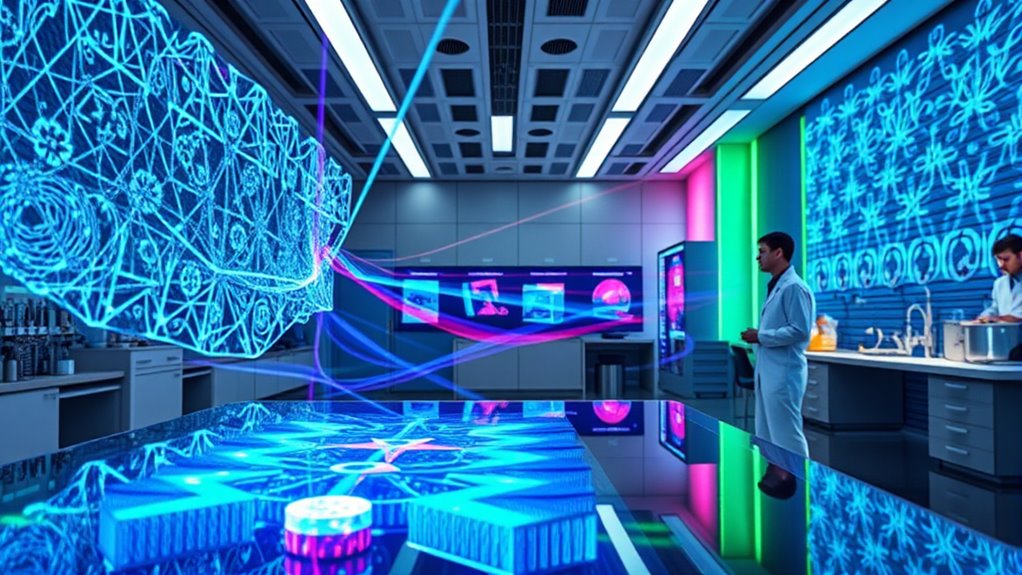

Metamaterials play an essential role in future holographic displays by providing enhanced control over light propagation, which improves resolution and depth perception. Their engineered structures enable the reduction of distortion, resulting in clearer and more vivid holograms. This innovative technology blends seamlessly with traditional imaging principles, transforming user experiences in various applications. As advancements continue to evolve, you’ll discover even more exciting possibilities in the domain of holography and consumer electronics.
Understanding Metamaterials: A Brief Overview
Metamaterials represent a groundbreaking class of materials engineered to manipulate electromagnetic waves in ways that natural materials cannot. You’ll find several metamaterial types, including photonic, acoustic, and electromagnetic variants, each designed for specific applications. These engineered structures exhibit unique properties, such as negative refractive index and cloaking abilities, which open up innovative possibilities. In telecommunications, metamaterials enhance signal transmission and reduce losses, while in imaging, they improve resolution beyond conventional limits. Their potential in sensor technology is equally compelling, allowing for unprecedented sensitivity and accuracy. By understanding these metamaterial applications, you can appreciate how they’re poised to redefine various technological sectors, offering you a glimpse into a future where freedom of design and functionality converge seamlessly.
The Science Behind Holography
Although holography might seem like a purely visual phenomenon, its foundation lies in the intricate interplay of light and interference patterns. When you project coherent light onto an object, it reflects and diffracts, creating a unique interference pattern. This pattern is captured, allowing for the reconstruction of a three-dimensional image. In quantum holography, the principles of quantum mechanics come into play, enhancing the resolution and depth of holographic images. Meanwhile, digital holography leverages computational algorithms to manipulate these patterns, enabling quicker and more versatile image processing. By understanding these key concepts, you can appreciate how holography transcends mere visuals, opening doors to advanced applications in displays and imaging technologies, ultimately granting you greater freedom in visual experiences.
How Metamaterials Enhance Holographic Displays
As holographic displays endeavor for more realistic and immersive experiences, the integration of metamaterials offers groundbreaking enhancements. Metamaterial applications redefine how light interacts with displays, allowing for unprecedented control over optical properties. These engineered materials manipulate electromagnetic waves, enabling holographic enhancements that improve resolution and depth perception. By tailoring the refractive index at a microscopic level, metamaterials can create vivid, lifelike images that engage viewers more effectively. Additionally, their ability to reduce distortion and optimize light propagation means you’ll experience clearer and more precise holograms. This technological synergy between holography and metamaterials paves the way for future advancements, making it essential for developers to explore these innovations for enhanced visual experiences.
Advantages of Metamaterials in Visual Technology
While the potential of visual technology continues to expand, the advantages of integrating metamaterials stand out noticeably. Metamaterials offer numerous benefits that greatly enhance visual experiences. They enable precise control over light manipulation, leading to improved resolution and clarity. You’ll appreciate the ability to create dynamic images and holograms with greater depth and realism. Additionally, these materials can reduce the scale and weight of devices, offering design freedom in various applications.
| Metamaterials Benefits | Visual Enhancement | Impact on Technology |
|---|---|---|
| Improved Resolution | Enhanced Depth | Lightweight Designs |
| Dynamic Image Creation | Realistic Holograms | Versatile Applications |
| Controlled Light | Greater Clarity | Compact Devices |
| Design Freedom | Immersive Experience | Innovative Solutions |
Current Challenges in Metamaterial Research
In your exploration of metamaterials, you’ll encounter significant challenges, particularly regarding fabrication techniques and the variability of material properties. These limitations can hinder consistency and scalability in developing effective holographic displays. Addressing these issues is essential for advancing the practical applications of metamaterials in visual technology.
Fabrication Techniques Limitations
Metamaterials, despite their promising applications in holographic displays, face significant challenges in fabrication techniques that hinder their practical implementation. You’ll find that these fabrication challenges stem from the complexity of creating materials with precise structures at microscopic scales. Current techniques often involve intricate processes that increase manufacturing costs, limiting accessibility for widespread use. Furthermore, the need for high-quality, defect-free materials adds layers of difficulty, as even minor imperfections can drastically affect performance. As you explore potential solutions, consider the balance between innovative fabrication methods and the economic feasibility of scaling these processes for commercial applications. Overcoming these limitations will be essential for advancing the integration of metamaterials in future holographic technologies.
Material Property Variability
As researchers explore the domain of metamaterials, they encounter significant challenges related to material property variability, which can undermine the anticipated performance of holographic displays. This variability affects several vital aspects:
- Optical Properties: Inconsistencies can lead to unpredictable light manipulation.
- Design Flexibility: Variability restricts the ability to tailor materials for specific applications.
- Structural Robustness: Fluctuations in material properties might compromise durability and reliability.
- Performance Optimization: Achieving peak performance becomes difficult with inconsistent material characteristics.
These challenges necessitate innovative solutions to enhance fabrication processes, ensuring application diversity and scalability potential. Addressing material variability is essential for revealing the full capabilities of metamaterials in creating high-performance holographic displays.
The Future of Holography: Potential Applications
While many technologies continue to evolve, holography stands out due to its potential to transform various industries. Imagine using augmented reality for immersive education tools that enhance learning experiences, or employing holographic medical imaging to provide precise diagnostics. Interactive gaming could reach new heights, creating fully immersive environments that engage users in unprecedented ways. In urban planning, 3D mapping could revolutionize how you visualize projects, while advertising displays could captivate audiences with dynamic, eye-catching presentations. Virtual conferences would benefit from enhanced interactions, fostering collaboration regardless of geographical barriers. Ultimately, art installations could transcend traditional boundaries, offering viewers a unique, interactive experience. As you can see, the future of holography holds immense promise across diverse applications.
Metamaterials vs. Traditional Display Technologies
When comparing metamaterials to traditional display technologies, you’ll notice significant differences in light manipulation capabilities. Metamaterials offer enhanced control over light, enabling more precise holographic effects. Additionally, their compact design allows for thinner, lighter displays, presenting clear advantages over conventional systems.
Enhanced Light Manipulation
Although traditional display technologies have made significant strides in visual fidelity, they often fall short regarding light manipulation capabilities. Metamaterials revolutionize this space by enabling advanced features that traditional displays can’t achieve. Here are some critical advantages:
- Light Waveguides: They guide light with minimal loss, enhancing image clarity.
- Optical Filtering: Metamaterials allow for precise filtering of wavelengths, improving color accuracy.
- Tailored Refraction: Adjusting light paths at will creates more realistic depth in holography.
- Dynamic Control: They enable real-time adjustments to light properties, offering flexibility in display settings.
These enhanced manipulation capabilities open doors to unprecedented experiences in holographic displays, empowering users with superior visual freedom.
Compact Design Advantages
Metamaterials offer significant compact design advantages over traditional display technologies, primarily due to their unique structural properties. Unlike conventional displays, which often require bulky components and extensive spatial arrangements, metamaterials can manipulate light at sub-wavelength scales. This leads to enhanced space efficiency, allowing for thinner, lighter, and more versatile display configurations. You’ll find that these innovations enable holographic displays to be integrated into various environments without the constraints posed by traditional designs. The reduced footprint not only conserves physical space but also enhances aesthetic appeal, aligning with modern demands for minimalistic technology. Ultimately, adopting metamaterials in displays empowers you to embrace a future where functionality meets elegance, liberating design possibilities previously constrained by conventional methods.
Key Players and Innovations in the Field
Several key players are driving innovation in the field of metamaterials for holographic displays, each contributing unique advancements that push the boundaries of this technology. You’ll find that recent innovations from these entities are pivotal:
- Nanoscale Fabrication: Developing advanced techniques for creating metamaterials with unprecedented precision.
- Adaptive Optics: Implementing dynamic systems that adjust in real-time for enhanced display quality.
- Integration with AI: Utilizing artificial intelligence to optimize holographic rendering processes.
- Sustainable Materials: Focusing on eco-friendly alternatives that maintain performance while reducing environmental impact.
These innovations are essential, shaping the future of holographic displays and expanding your horizons in visual technology. By understanding these key players, you can appreciate the rapid advancements in this fascinating field.
The Impact of Metamaterials on Consumer Electronics
The integration of metamaterials in consumer electronics is revolutionizing the way devices interact with light and sound, enhancing performance and functionality. This innovation shifts consumer behavior, influencing market trends as manufacturers adopt metamaterials for improved user experiences. The competitive landscape is evolving, with brands leveraging advanced pricing strategies and marketing strategies to highlight their metamaterial-enhanced products.
| Aspect | Impact on Consumer Electronics | Example |
|---|---|---|
| Product Integration | Seamless incorporation of new tech | Smartphones with AR features |
| Technology Adoption | Faster acceptance and usage | Wearables with enhanced sensors |
| User Experience | Enhanced visual/audio quality | TVs with superior image clarity |
| Market Trends | Shift towards immersive tech | Demand for holographic displays |
| Brand Influence | Increased loyalty through innovation | Companies like Apple and Samsung |
This cycle of innovation drives future developments in the industry.
Frequently Asked Questions
How Do Metamaterials Differ From Conventional Materials?
Metamaterials possess unique properties that manipulate electromagnetic waves, unlike conventional materials used in standard applications. You’ll find metamaterials enabling functionalities that simply aren’t possible with traditional materials, offering unprecedented capabilities in various technological advancements.
Can Metamaterials Be Used in Wearable Technology?
Yes, metamaterials can enhance wearable applications by integrating with smart textiles. Their unique properties allow for better signal manipulation, improving functionality and comfort, leading to innovative designs that elevate user experience in everyday wearable technology.
What Is the Cost Comparison Between Metamaterial and Traditional Displays?
When performing a cost analysis, you’ll find metamaterials often present higher initial costs compared to traditional displays. However, pricing trends suggest long-term savings due to enhanced functionality and reduced manufacturing complexities, ultimately offering value.
Are There Any Health Concerns With Holographic Displays?
When considering holographic displays, you’re right to think about potential health risks. Visual safety’s essential; prolonged exposure might lead to eye strain or discomfort. It’s important to evaluate usage patterns for ideal viewing conditions.
How Quickly Can Metamaterial Technology Evolve?
You’ll find metamaterial technology evolving rapidly, driven by technology trends and research advancements. As breakthroughs emerge, the pace of innovation may surprise you, positioning us closer to revolutionary applications in various fields, promising limitless possibilities ahead.
