
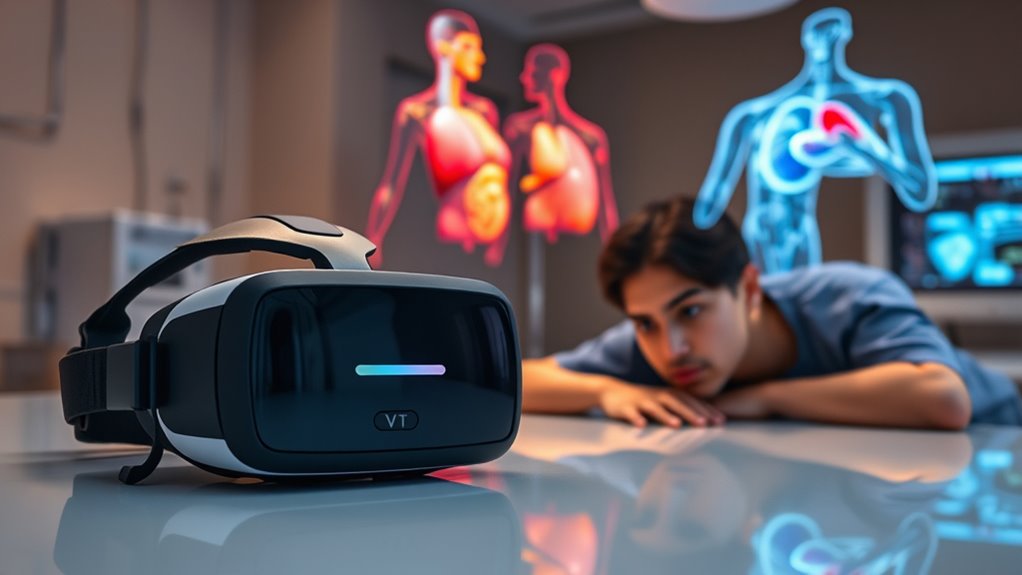

VR displays are improving for medical training by incorporating advanced graphics that create immersive, photorealistic environments. These enhancements provide realistic simulations for practicing complex procedures, thereby boosting skill acquisition without the risks associated with live patients. With the addition of ambient sounds and interactive patient scenarios, learning becomes more engaging and effective. This evolution in VR technology promises not only to enhance learning outcomes but also to guarantee better preparation for real-world medical challenges ahead.
The Evolution of VR Technology in Medical Training
As the field of medical training has advanced, so too has the integration of virtual reality (VR) technology, transforming how healthcare professionals acquire essential skills. Historical advancements in VR began with rudimentary simulations, which have since evolved into immersive environments that mimic real-life scenarios. Compared to traditional training methods, VR offers unparalleled opportunities for hands-on experience without the risks associated with live procedures. You can practice techniques repeatedly, refining your skills in a controlled setting. Additionally, technology comparisons reveal that VR not only enhances knowledge retention but also fosters confidence in clinical decision-making. With ongoing innovations, the future of VR in medical training promises to further revolutionize how you learn and practice, granting you the freedom to explore complex medical situations effectively.
Enhanced Realism Through Advanced Graphics
While traditional training methods often lack the depth of realism needed for effective learning, advanced graphics in VR technology have greatly enhanced the immersive experience for medical trainees. With photorealistic visuals, these environments simulate real-world scenarios, allowing you to practice procedures in a safe space. This level of detail not only aids in skill acquisition but also helps you develop critical decision-making abilities under pressure. The incorporation of ambient sounds and realistic patient interactions further deepens the immersion, fostering a more engaging learning atmosphere. As a result, you’ll find yourself better prepared for actual medical situations, bridging the gap between theory and practice. Enhanced graphics in VR truly revolutionize how you approach medical training, enhancing both confidence and competence.
Interactive Learning Experiences
Interactive learning experiences in VR are transforming medical training by providing a hands-on approach that traditional methods can’t match. With immersive scenarios, you can engage in realistic simulations that replicate complex medical situations. This not only enhances your understanding but also boosts retention of critical information. Through gamified learning, you can tackle challenges, earn rewards, and progress at your own pace, making the educational process enjoyable and effective. Unlike passive learning, these interactive experiences allow you to actively participate, honing your skills in a safe environment. The ability to manipulate virtual tools and interact with lifelike patient models guarantees you’re better prepared for real-world applications. Ultimately, VR empowers you to take control of your medical education, fostering both confidence and competence.
Safe Simulation Environments for Skill Practice
Safe simulation environments in VR offer a unique platform for medical practitioners to refine their skills without the risks associated with real-life procedures. By immersing yourself in virtual reality, you can experience realistic scenarios that mimic the complexities of actual patient interactions. This technology facilitates skill acquisition by allowing you to practice repeatedly, honing your techniques in a controlled environment. You can make mistakes and learn from them without jeopardizing patient safety or outcomes. The immediate feedback provided during these simulations accelerates your learning process, enabling you to build confidence and competence. Overall, VR simulations serve as an invaluable tool for developing essential medical skills, ensuring you’re better prepared for real-world challenges when they arise.
Accessibility and Affordability of VR Systems
As the demand for VR technology in medical training grows, ensuring that these systems are accessible and affordable becomes essential. You need to evaluate how virtual accessibility can transform educational opportunities. High costs have often limited access, but advancements are leading to cost-effective solutions that democratize this technology. By utilizing scalable platforms and open-source software, institutions can reduce expenses while maintaining quality training. Additionally, companies are developing entry-level VR devices that offer essential features without a hefty price tag. As affordability increases, more medical professionals can engage with immersive training experiences, ultimately enhancing their skills. Emphasizing virtual accessibility not only fosters innovation but also empowers a broader range of practitioners to benefit from cutting-edge medical education.
Impact on Patient Outcomes and Safety
While the integration of VR technology into medical training is still evolving, its potential to enhance patient outcomes and safety is becoming increasingly evident. By simulating real-life scenarios, VR allows healthcare professionals to practice complex procedures without risk to patients. This immersive training fosters a deeper understanding of anatomy and enhances procedural skills, leading to significant outcome improvement. You can observe how trainees develop better decision-making abilities and teamwork in high-pressure situations, translating directly to safer patient care. Additionally, consistent exposure to varied clinical scenarios equips practitioners with the confidence to handle unexpected challenges, ultimately prioritizing patient safety. As VR continues to advance, its role in shaping competent and prepared medical professionals will be essential in improving overall healthcare quality.
Future Trends in VR for Medical Education
As you look toward the future of VR in medical education, you’ll notice trends focusing on enhanced realism in simulations, which can greatly improve learning outcomes. The integration of AI into training programs is set to personalize education and adapt to individual learning paces. Additionally, advancements in technology promise increased accessibility and reduced costs, making VR training more widely available.
Enhanced Realism in Simulations
How can enhanced realism in virtual reality (VR) simulations elevate medical training? By integrating high-fidelity graphics and tactile feedback, VR can create immersive scenarios that mimic real-life medical situations with astonishing accuracy. You can explore virtual anatomy in ways that traditional methods simply can’t match, allowing for a deeper understanding of human physiology. This level of realism fosters critical thinking and decision-making skills under pressure, vital for any healthcare professional. In addition, lifelike patient interactions help you develop empathy and communication skills essential for patient care. As technology advances, expect even more sophisticated simulations that replicate complex medical environments, ultimately transforming how you learn and prepare for real-world medical challenges. Enhanced realism is paving the way for a more effective and engaging educational experience.
AI Integration for Training
With the rapid advancement of artificial intelligence (AI), the integration of this technology into virtual reality (VR) medical training is poised to revolutionize educational methodologies. AI-driven simulations enable you to engage in highly realistic scenarios, providing an immersive experience that adapts to your unique learning style. This personalization guarantees that you can focus on areas needing improvement while honing your skills in a safe environment. Additionally, AI can analyze your performance in real-time, offering immediate feedback that enhances your learning outcomes. As these technologies evolve, you’re likely to see a more tailored educational experience, pushing the boundaries of traditional medical training and preparing you for real-world challenges with greater efficacy.
Accessibility and Cost Reduction
While the potential of VR in medical training is significant, its accessibility and cost reduction are fundamental for widespread adoption. You’ll find that advancements in VR technology enable remote training, allowing educators and students to connect regardless of location. This flexibility breaks down geographical barriers and enhances learning opportunities. Furthermore, as VR systems become more cost-effective, budget-friendly solutions are emerging, making it feasible for institutions with limited resources. This democratization of technology allows more medical professionals to gain essential hands-on experience without incurring high expenses. As these trends continue, you can expect VR to play an increasingly important role in medical education, fostering a new generation of skilled practitioners ready to meet the challenges of modern healthcare.
Frequently Asked Questions
What Types of Medical Procedures Can Be Practiced Using VR Training?
In the domain of medical training, you can immerse yourself in surgical simulations, honing skills in procedures like laparoscopies and orthopedic surgeries. Engaging in patient interactions within VR enhances your ability to communicate and respond effectively in real-life scenarios.
How Long Does It Typically Take to Complete VR Medical Training Programs?
Typically, VR medical training programs range from a few days to several weeks, depending on complexity. You should manage your duration expectations to guarantee training effectiveness while mastering essential skills in a flexible learning environment.
Are There Any Certifications Available for VR Medical Training Completion?
Yes, there are certification programs available for VR medical training completion. These programs guarantee you meet training standards, validating your skills and knowledge, which can enhance your career opportunities in the medical field.
Can VR Training Be Customized for Specific Medical Specialties?
Imagine tailoring a virtual landscape to your specialty’s nuances; VR training allows personalized learning through specialty specific simulations. This customization empowers you to hone skills, fostering a deeper understanding essential for your medical practice.
What Are the Main Challenges Faced in Implementing VR in Medical Training?
You’ll face cost barriers and technology integration issues when implementing VR in medical training. These challenges can hinder access and effectiveness, requiring careful planning and investment to guarantee a successful changeover into immersive learning environments.
