
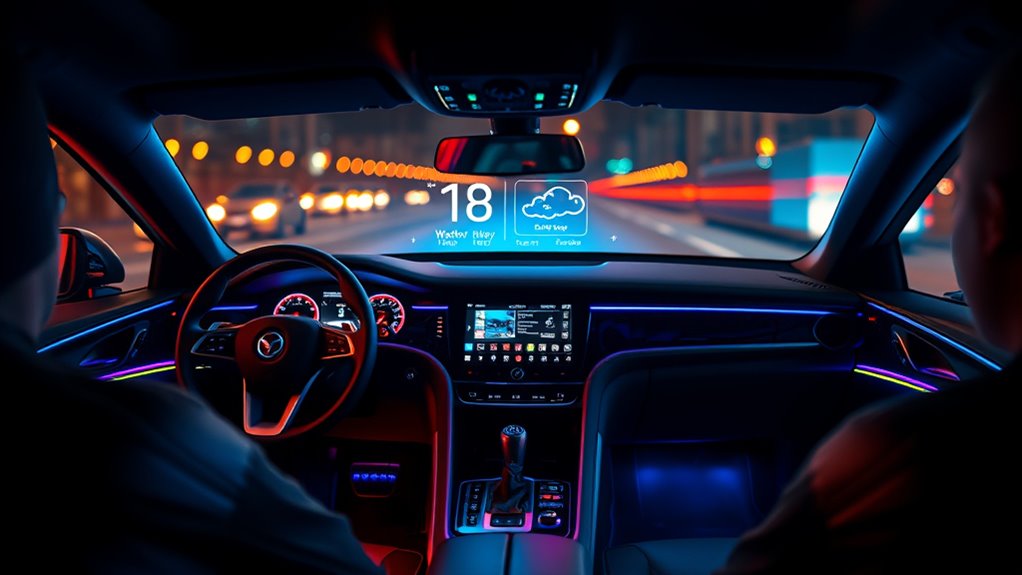

AI plays an important role in personalizing vehicle displays by analyzing your driving patterns and preferences. It tailors interfaces to enhance your experience, making vital information more accessible. AI adapts navigation and infotainment systems to align with your habits, offering routes and entertainment based on what you like. With real-time adjustments, it guarantees that your driving environment is always optimized for comfort and safety. There’s so much more about how AI shapes your journeys ahead!
Understanding Vehicle Display Personalization
Vehicle display personalization is rapidly transforming the way you interact with your car’s interface. This evolution aims to enhance driver engagement by tailoring the display aesthetics to your preferences. Imagine stepping into a vehicle where the dashboard lights up with your favorite colors, and essential information is presented intuitively. Customizing your display not only makes driving more enjoyable but also empowers you to focus on what matters most. As you navigate through your day, having a personalized interface enhances your sense of freedom, allowing you to connect deeply with your vehicle. This shift reflects a broader trend towards user-centric design, where technology adapts to you, creating a seamless blend of functionality and style that elevates your driving experience.
The Role of AI in Analyzing Driver Behavior
AI plays an essential role in monitoring your driving patterns, providing insights into your habits and preferences. By analyzing data from your driving behavior, it can predict what features and information you’ll find most useful. This not only enhances your driving experience but also makes your vehicle’s display more intuitive and personalized.
Monitoring Driving Patterns
As you navigate the roads, your driving patterns reveal much about your habits and preferences, making it essential for modern vehicles to understand these behaviors. AI plays a significant role in this process, enhancing driver engagement and providing valuable behavioral insights. Here are three ways AI monitors your driving patterns:
- Speed and Acceleration: It tracks how you accelerate and brake, helping tailor feedback for smoother driving.
- Route Preferences: AI analyzes your frequently taken routes, personalizing navigation suggestions based on your habits.
- Time of Day: By observing when you drive, AI can adapt vehicle displays to suit your mood and energy levels.
These insights not only improve your driving experience but also empower you to make informed choices on the road.
Predicting Driver Preferences
Understanding your preferences is key to enhancing the driving experience, and advanced technology makes this possible. AI analyzes driver demographics and preference trends, allowing it to predict what you’ll enjoy most on the road. For instance, it can learn your favorite music genres or preferred climate settings based on past behavior, tailoring the display to suit your needs. By tracking your habits, AI can suggest ideal routes or even adjust vehicle settings to create a more personalized atmosphere. This level of customization not only enhances comfort but also empowers you to drive with greater ease. Ultimately, embracing AI in vehicle personalization means you can enjoy a driving experience that truly reflects your unique style and preferences.
Real-Time Adaptation of Display Elements
While you’re driving, the ability of a vehicle’s display to adapt in real-time can greatly enhance your experience and safety. A responsive user interface guarantees that important information is always at your fingertips, adjusting to your needs as they change. Here are three key benefits of real-time display adaptation:
- Contextual Awareness: Displays can highlight relevant data based on your driving conditions, like weather updates or traffic alerts.
- Personalized Notifications: You’ll receive timely reminders tailored to your preferences, guaranteeing you never miss important events.
- Dynamic Layouts: The interface can reorganize itself, prioritizing information that matters most during different driving scenarios.
Customizing Navigation Interfaces
When it comes to customizing navigation interfaces, user preference algorithms play an essential role in tailoring your experience on the road. These algorithms can adjust routes dynamically based on your driving habits and preferences, ensuring the most efficient journey. Plus, integrating voice commands makes navigation even more intuitive, allowing you to focus on driving while your system responds to your needs.
User Preference Algorithms
As you navigate through various environments, user preference algorithms play an essential role in customizing navigation interfaces to suit your individual needs. These algorithms harness user feedback and data collection to create a personalized experience that resonates with your driving style. Here are three key aspects they consider:
- Frequent Routes: The algorithm learns which paths you take often, optimizing future navigation.
- Preferred Stops: It remembers your favorite stops, making it easier to plan pit stops along your journey.
- Driving Habits: The system adapts based on how you drive, whether you prefer scenic routes or the fastest options.
Dynamic Route Adjustments
Building on user preference algorithms, dynamic route adjustments take personalization a step further by responding in real-time to changing conditions. Imagine driving a vehicle that adapts its navigation interface based on traffic, weather, or your preferences. With route optimization techniques, these adaptive navigation systems can suggest alternative routes, helping you avoid delays and maximize your freedom on the road. If an accident occurs ahead, the system instantly recalibrates, presenting you with the best options. You’ll appreciate how it learns your habits, offering personalized shortcuts and scenic routes alike. This seamless integration of AI not only enhances your driving experience but also empowers you to navigate life on your terms, making every journey more enjoyable and efficient.
Voice Command Integration
How can voice command integration revolutionize your driving experience? Imagine steering without taking your hands off the wheel or your eyes off the road. With AI-driven voice commands, you can enjoy a seamless journey. Here are three key benefits:
- Enhanced Voice Command Accuracy: Your commands get interpreted with precision, minimizing misunderstandings and distractions.
- User Feedback Integration: The system learns from your preferences, adapting over time to provide a more personalized experience.
- Real-time Navigation Adjustments: Instantly update routes or find nearby points of interest, all through simple vocal cues.
Personalizing Infotainment Systems
While driving, you likely want your infotainment system to cater to your preferences seamlessly. AI plays a vital role in achieving effective infotainment customization, adapting to your habits and choices. Imagine a user interface design that intuitively suggests your favorite playlists or routes based on your previous activities. With AI, your system learns over time, ensuring it evolves to meet your needs without any extra effort on your part. This personalization enhances your driving experience, giving you the freedom to focus on the road while enjoying tailored entertainment and information. The combination of advanced algorithms and user-friendly designs makes your vehicle’s infotainment system not just a tool, but a companion that understands and aligns with your lifestyle.
Enhancing Safety Features Through AI
As AI technology continues to evolve, its integration into vehicle safety features is becoming increasingly sophisticated, offering drivers enhanced protection on the road. By leveraging advanced algorithms, AI enhances safety through:
- Collision Avoidance: Real-time data analysis helps anticipate potential hazards, allowing your vehicle to react before an accident occurs.
- Driver Assistance: Features like adaptive cruise control and lane-keeping assist guarantee you’re supported during your drive, making long trips safer and less stressful.
- Predictive Analytics: AI can analyze driving patterns, alerting you to risky behaviors and suggesting improvements to boost overall safety.
With these innovations, you’re not just driving; you’re experiencing a smarter, more responsive vehicle that prioritizes your safety and freedom on the road. Embracing these technologies is a step toward a more secure driving experience.
Voice Recognition and Natural Language Processing
The advancements in AI safety features naturally extend to the domain of voice recognition and natural language processing (NLP), transforming how you interact with your vehicle. With improved voice command accuracy, your requests are understood with remarkable precision, making your driving experience more seamless. Contextual understanding means your vehicle can grasp the nuances of your commands, whether you’re asking for directions or changing the music.
Here’s a quick overview of voice recognition capabilities:
| Feature | Benefit | Importance |
|---|---|---|
| Voice Command Accuracy | Reduces misunderstandings | Enhances safety |
| Contextual Understanding | Tailors responses to context | Increases convenience |
| Adaptive Learning | Learns your preferences | Personalizes experience |
This technology empowers you, allowing for a more intuitive and enjoyable journey.
User Profiles and Preferences Management
Incorporating user profiles and preferences management into vehicle displays revolutionizes how you experience your ride. By customizing your driving environment, you can enjoy a more personalized journey. Here are three key benefits of user profiles and preferences settings:
- Tailored Interfaces: Your dashboard adapts to your unique style, showcasing the information that matters most to you.
- Convenient Accessibility: With a quick login, you can access your saved settings, ensuring your favorite features are always at your fingertips.
- Enhanced Safety: By prioritizing essential alerts and navigation preferences, user profiles help keep your focus on the road.
Embracing this technology not only enhances comfort but also gives you the freedom to drive the way you want, making every trip uniquely yours.
The Future of AI-Driven Vehicle Displays
With user profiles already enhancing your driving experience, the future of AI-driven vehicle displays promises to take personalization to new heights. AI advancements in display technology will create personalized interfaces that adapt to your preferences, making every drive uniquely tailored. As automotive trends shift toward smart vehicles, machine learning will continuously analyze your behavior, enhancing user experience and driver engagement. Future innovations might even allow displays to predict your needs based on contextual data, providing real-time assistance. However, as these technologies evolve, ensuring data privacy will be essential. Balancing personalization with security will define the next generation of vehicle displays, empowering you to enjoy a customized journey without compromising your freedom.
Frequently Asked Questions
How Does AI Learn Individual Driver Preferences Over Time?
AI learns individual driver preferences by analyzing driver behavior and employing preference modeling. It observes patterns in your driving habits, adjusts settings accordingly, and continually refines its understanding to create a more personalized experience for you.
Can Vehicle Displays Adapt for Multiple Drivers in One Vehicle?
Like a chameleon adapting to its surroundings, vehicle displays can switch between driver profiles, customizing display settings for each user. This guarantees every driver enjoys a personalized experience, enhancing comfort and freedom on the road.
What Data Is Collected for Ai-Based Personalization?
For AI-based personalization, data collected includes driver behavior and usage patterns. This helps create a customized experience, allowing you to enjoy tailored features that enhance your driving freedom and comfort, making every journey uniquely yours.
Are There Privacy Concerns With AI in Vehicle Display Systems?
Imagine a world where your car’s dashboard knows you better than your best mate. With AI, data security and user consent are essential; without them, privacy concerns could jeopardize your freedom and trust in technology.
How Can AI Improve Accessibility for Disabled Drivers?
AI can enhance accessibility for disabled drivers by integrating voice recognition for hands-free control and tactile feedback systems to guarantee intuitive navigation. These technologies empower you to drive with confidence and independence, breaking down barriers.
