
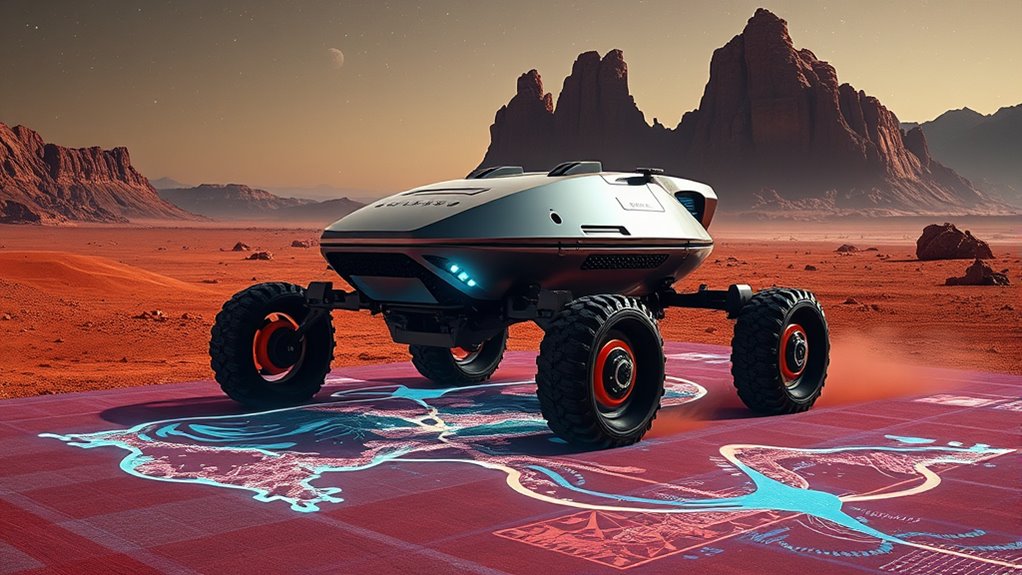

Smart displays improve space rover navigation by integrating real-time data and streamlining communication with mission control. They enhance user interfaces, allowing for intuitive interactions that reduce cognitive load during missions. With clearer visualizations, you can quickly assess environmental data, identify hazards, and make informed decisions. Additionally, smart displays support rapid data transmission, ensuring timely decision-making. By understanding these features, you'll uncover how emerging technologies continue to revolutionize rover navigation beyond current capabilities.
The Role of Real-Time Data in Rover Navigation
As rover missions increasingly rely on advanced technologies, the importance of real-time data in navigation becomes evident. You need to understand that effective sensor integration plays a critical role in gathering and processing data from various sources. This integration allows the rover to monitor its surroundings accurately and make dynamic adjustments in response to changing conditions. For example, when encountering unexpected terrain, the rover can instantly recalibrate its path by analyzing data from LIDAR, cameras, and accelerometers. This capability guarantees ideal navigation, enhancing mission success and safety. Additionally, real-time data facilitates swift decision-making, which is essential for autonomous operations on distant planets. Ultimately, leveraging real-time data empowers you to navigate with precision and adaptability in challenging environments.
Enhancing Communication With Mission Control
While effective navigation is essential for rover missions, enhancing communication with mission control is equally important for ensuring mission success. Smart displays facilitate this by streamlining communication protocols, which are crucial for real-time mission updates. Here's how they contribute:
- Clarity: Enhanced visuals reduce misunderstandings, ensuring mission-critical information is conveyed accurately.
- Responsiveness: Quick data transmission allows for timely decision-making, adapting to unexpected challenges.
- Engagement: Interactive interfaces keep the team involved, fostering a sense of shared purpose and connection.
Intuitive User Interfaces for Smooth Operation
When operating a space rover, enhanced visual displays are essential for real-time decision-making. You'll find that simplified control systems allow for more intuitive interactions, reducing the cognitive load on operators. This combination guarantees smoother operations and minimizes the risk of errors during critical missions.
Enhanced Visual Displays
Enhanced visual displays revolutionize the way users interact with complex systems, particularly in high-stakes environments like space exploration. These advanced interfaces enhance user experience by providing intuitive, interactive mapping that simplifies wayfinding and decision-making. You'll feel empowered when you can:
- Visualize terrain in real-time, reducing uncertainty.
- Access critical data at a glance, minimizing cognitive load.
- Engage with dynamic controls that adapt to your needs, ensuring fluid operation.
Such enhancements not only alleviate the stress of maneuvering through unknown worlds but also foster a sense of freedom in exploration. By leveraging these visual tools, you can focus on mission objectives, knowing that the technology supports your every move, allowing you to transcend the limits of traditional navigation methods.
Simplified Control Systems
As complex systems become increasingly integral to space navigation, the design of simplified control systems emerges as a critical factor in ensuring user efficiency and confidence. By integrating sensors effectively, you can streamline operations, allowing for more intuitive interactions. These systems utilize real-time user feedback to adapt controls, ensuring that your commands translate seamlessly into actions. This not only minimizes cognitive load but also enhances decision-making capabilities in high-stakes environments. When you engage with a smart display, the clarity of the interface allows you to focus on exploration rather than the mechanics of navigation. Ultimately, a well-designed control system empowers you, offering both freedom of movement and precision in executing complex tasks.
Visualizing Environmental Data for Better Decision-Making
While effective decision-making often hinges on accurate data interpretation, visualizing environmental data can greatly enhance your understanding of complex variables. By employing smart displays, you can utilize environmental mapping and data overlays to make informed choices. Here are three key benefits:
- Clarity: Visual representation simplifies intricate data sets, allowing you to grasp essential information quickly.
- Context: Environmental mapping provides situational awareness, helping you recognize potential hazards and opportunities in real-time.
- Efficiency: Data overlays streamline your decision-making process, reducing the time spent analyzing raw data.
With these tools at your disposal, you can navigate the complexities of space environments with greater confidence and autonomy, ultimately empowering your exploration efforts.
The Impact of Smart Displays on Autonomous Navigation
How can smart displays revolutionize autonomous navigation in challenging environments? By leveraging sensor integration and machine learning, smart displays provide real-time data visualization, enhancing decision-making. This capability enables rovers to adapt swiftly to unpredictable terrains.
| Feature | Benefit |
|---|---|
| Sensor Integration | Combines data from multiple sources for accurate situational awareness. |
| Machine Learning | Enables predictive analytics for route optimization. |
| Real-time Feedback | Adjusts navigation strategies based on immediate environmental changes. |
These advancements empower rovers to navigate autonomously, reducing reliance on human operators. As you can see, smart displays transform data into actionable insights, fostering greater autonomy in exploration missions. The result? Increased efficiency and adaptability in extreme conditions.
Future Innovations in Rover Navigation Technology
With advancements in artificial intelligence and sensor technology, future innovations in rover navigation are poised to redefine exploration capabilities. You can expect significant enhancements through:
- Machine Learning Algorithms – These will enable rovers to learn from their environment, adapting in real-time to unforeseen challenges.
- Advanced Sensor Integration – By combining data from various sensors, rovers will achieve unparalleled accuracy in terrain assessment and obstacle avoidance.
- Autonomous Decision-Making – Future rovers will possess the freedom to make complex navigation choices independently, reducing reliance on Earth-based commands.
These innovations not only promise to enhance the efficiency of rover missions but also empower humanity's quest for knowledge beyond our planet. Embracing these technologies will ultimately facilitate a more profound exploration of uncharted territories.
Frequently Asked Questions
How Do Smart Displays Differ From Traditional Navigation Systems?
Smart displays enhance navigation by integrating sensors for real-time data and offering intuitive user interfaces. Unlike traditional systems, they enable you to interact dynamically, improving your decision-making and situational awareness during complex maneuvers.
What Are the Potential Risks of Using Smart Displays in Space Rovers?
Using smart displays in space rovers poses risks like display malfunctions, which can hinder navigation. Additionally, data overload might overwhelm the system, impairing decision-making and compromising mission success, ultimately restricting your operational freedom in challenging environments.
Can Smart Displays Be Used in Other Space Missions Beyond Rovers?
Yes, smart displays can enhance satellite navigation and planetary exploration missions. They're capable of processing real-time data, improving decision-making, and increasing operational efficiency, thereby making them invaluable for various space missions beyond rovers.
How Do Smart Displays Handle Data From Multiple Sensors Simultaneously?
Smart displays utilize sensor fusion to aggregate data from multiple sources, enhancing accuracy. Through effective data visualization, you can analyze information in real-time, allowing for informed decisions without overwhelming complexity, ultimately fostering operational freedom in navigation.
What Training Do Operators Need to Effectively Use Smart Displays?
To effectively use smart displays, operators need thorough education on system functionalities and data interpretation. Display familiarity enhances efficiency, ensuring they can swiftly analyze information, adapt to changes, and make informed decisions in high-stakes environments.
