
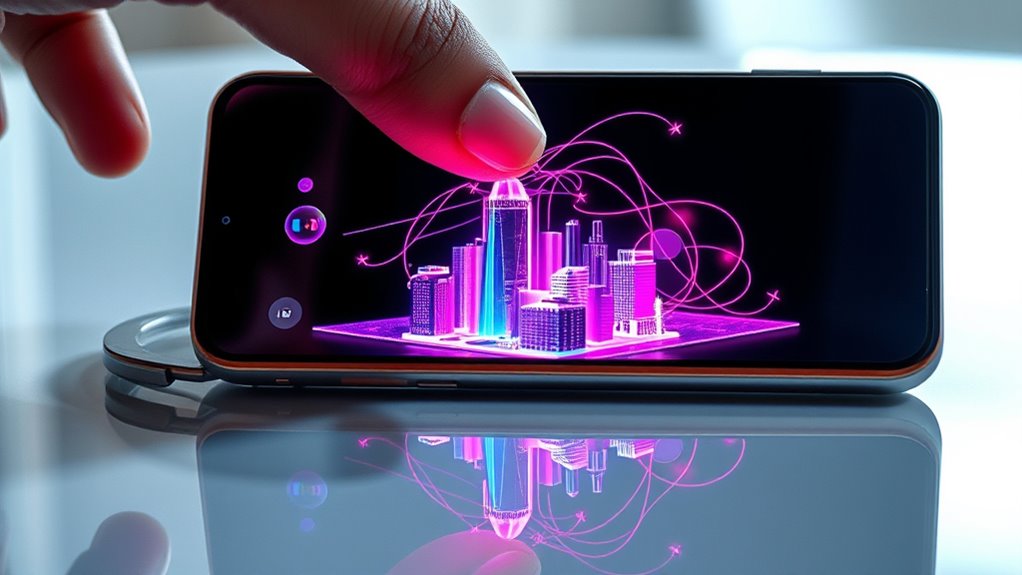

3D holographic displays in smartphones work by manipulating light to create immersive visuals. These displays utilize advanced technologies like OLED and MicroLED to produce vibrant colors and depth. By capturing light fields, holography allows you to view images from different angles, enhancing your experience. Interactive features let you engage with the content using gestures. This exciting fusion of science and technology promises to transform how you interact with your device, and there’s so much more to explore!
Understanding Holography: The Basics
Holography might seem like magic, but it’s grounded in the principles of physics and light. At its core, holography captures light fields to create three-dimensional images. You’re not just seeing a flat picture; instead, you’re experiencing depth and perspective. Understanding the historical context is essential too. Developed in the 1940s by physicist Dennis Gabor, holography initially served scientific purposes, but it’s since evolved into a fascinating art form and a powerful technology. The holographic principles involve interference patterns, where light waves interact to form images that retain depth, allowing you to view them from different angles. Embracing these concepts opens up a world of possibilities, empowering you to appreciate how reality can intertwine with technology in stunning ways.
The Science of Light Manipulation
While you might think of light as something that simply illuminates the world around you, it’s actually a powerful tool for creating stunning visual experiences. Understanding light diffraction is key to manipulating how we perceive images. When light waves encounter obstacles or openings, they bend and spread, creating intricate patterns. This bending can produce optical illusions that trick your brain into seeing depth and dimension where there is none. By harnessing these principles, 3D holographic displays can create vivid images that seem to float in mid-air, enchanting your senses. The combination of precise light manipulation and innovative technology allows you to experience visuals in a way that feels almost magical, blurring the lines between reality and imagination.
Key Components of 3D Holographic Displays
To truly understand 3D holographic displays, you need to look at their key components. You’ll find that display technologies, light manipulation techniques, and sensor integration methods all play vital roles in creating those stunning visuals. Each element contributes to the overall experience, making it essential to grasp how they work together.
Display Technologies Overview
As technology continues to evolve, understanding the key components of 3D holographic displays becomes essential for anyone interested in this cutting-edge field. You’ll find that various display technologies play an important role, including OLED technology and LCD advancements, which enhance color accuracy and viewing angles. MicroLED innovations are also paving the way for better pixel density and display resolution. Additionally, screen refresh rates and power consumption are critical factors in ensuring a smooth user experience. Here’s a quick overview of these components:
| Component | Importance |
|---|---|
| OLED Technology | Excellent color accuracy |
| LCD Advancements | Improved viewing angles |
| MicroLED Innovations | Higher pixel density |
| Display Resolution | Clarity of images |
| Power Consumption | Efficiency in usage |
Light Manipulation Techniques
Understanding how light manipulation techniques work is essential for grasping the intricacies of 3D holographic displays. These displays utilize a light field to create stunning optical illusions, enhancing your visual perception. By projecting images from different angles, they offer depth cues that make the content feel tangible. Holographic interfaces rely on advanced algorithms to manipulate light, providing interactive displays that respond to your movements. This technology is a breakthrough in augmented reality, allowing for spatial visualization in ways traditional screens can’t achieve. As you engage with these displays, you’re not just observing but experiencing a new dimension of information, blurring the lines between reality and digital worlds. Embrace the freedom of innovation as you explore these enthralling visual experiences!
Sensor Integration Methods
While exploring the world of 3D holographic displays, you’ll quickly realize that sensor integration methods play an essential role in their functionality. Various sensor types, like accelerometers and depth sensors, help capture user interaction, creating an immersive experience. However, integration challenges arise when combining these sensors with the display technology, requiring precise data processing to guarantee smooth performance. Efficient algorithms are significant for interpreting the input from different sensors and translating it into real-time holographic visuals. By overcoming these challenges, developers can enhance user interaction, allowing you to engage with holograms naturally. Ultimately, effective sensor integration transforms how you experience augmented reality, making it not just a possibility but a reality in your smartphone.
Types of Holographic Display Technologies
Holographic display technologies come in various forms, each offering unique advantages and applications. You might encounter digital holography techniques, which capture and reproduce light fields to create stunning 3D images. These displays can be passive, requiring no special glasses, or active, enabling more immersive experiences. Interactive holographic interfaces enhance user engagement, allowing you to manipulate 3D objects with gestures. Examples include touchscreen holograms and projections that respond to your movements. Another fascinating option is the use of light field displays, which create depth by simulating how light travels in real space. As advancements continue, these technologies promise to revolutionize how you interact with digital content, granting you a more liberated and immersive experience in your smartphone.
Advanced Optics: Creating Depth and Dimension
Advanced optics play an essential role in creating the depth and dimension that make holographic displays truly fascinating. With the right optical techniques, these displays enhance your depth perception, providing an immersive visual experience. Here are three key components that contribute to visual realism:
- Parallax: This effect allows your eyes to see different images depending on your viewing angle, creating a sense of depth.
- Light Field Technology: By manipulating light rays, it simulates how you would perceive objects in the real world, enhancing realism.
- Spatial Resolution: Higher resolution improves the clarity of holograms, making them appear more lifelike and detailed.
Displaying Color: The Role of Wavelengths
When it comes to holographic displays, understanding color wavelengths is essential. Each color you see is a result of specific light wavelengths interacting with the holographic medium. By exploring how these wavelengths work, you’ll gain insight into the vibrant visuals that make holography so enthralling.
Understanding Color Wavelengths
Color is a fascinating phenomenon rooted in the wavelengths of light, and understanding these wavelengths is vital for creating realistic 3D holographic displays. Your color perception relies on how these wavelengths interact with your eyes and brain, allowing you to experience the vibrant world around you. The wavelength spectrum ranges from short wavelengths, like violet, to long wavelengths, like red. Here are three key aspects to take into account:
- Wavelength Range: Visible light falls between 380 to 750 nanometers, influencing how we perceive various colors.
- Color Mixing: Different wavelengths combine to create a full palette, enhancing depth in holographic displays.
- Emotional Impact: Colors evoke feelings, making accurate representation critical for immersive experiences.
Understanding this foundation helps appreciate holographic technology’s artistry and science.
Holography and Light Interaction
Holography relies heavily on the interaction of light and the precise manipulation of wavelengths to create stunning three-dimensional images. By understanding holographic principles, you can appreciate how different wavelengths of light behave to produce color. Each color corresponds to a specific wavelength; shorter wavelengths create blues and violets, while longer wavelengths yield reds and oranges. When light interacts with holographic materials, it can bend, reflect, and interfere, generating the rich depth and detail you see. This intricate dance of light behavior allows for a dynamic viewing experience, making images appear more lifelike. As you explore these displays, you’ll find that mastering light’s properties is key to revealing the full potential of holographic technology in your smartphone.
Challenges in 3D Holographic Display Implementation
Although 3D holographic displays promise to revolutionize visual technology, several challenges hinder their widespread implementation. You might encounter key obstacles that affect both producers and consumers. Here are three major challenges:
- Cost Limitations: The materials and technology required for high-quality holography can be expensive, making it difficult for manufacturers to offer affordable products.
- Technological Constraints: Current display technologies often struggle to produce the necessary resolution and brightness for effective holographic images, limiting user experience.
- User Adaptation: Many users are still unfamiliar with holographic interfaces, which may require significant adjustments in how they interact with their devices.
Addressing these challenges is essential for bringing 3D holographic displays to the mainstream market.
Future Applications Beyond Smartphones
As the technology behind 3D holographic displays continues to evolve, their potential applications extend far beyond smartphones. Imagine using augmented reality to enhance your interactive gaming experiences, immersing yourself in lifelike environments. In education, these displays could serve as powerful tools, making complex concepts easier to grasp. Medical imaging could be revolutionized, offering doctors clearer insights into patient anatomy. Advertising solutions will gain a new dimension, enthralling audiences with stunning visuals. Architectural visualization will allow clients to walk through designs before they’re built. Remote collaboration could become seamless, connecting teams like never before. Moreover, artistic expression and virtual tourism will flourish, providing new avenues for creativity and exploration. The future’s bright, and the possibilities are endless!
The Impact of 3D Holography on User Experience
There’s something truly enchanting about 3D holography that transforms user experience in ways we’re only beginning to understand. With this technology, the potential for user experience enhancement is staggering. You can expect:
- Immersive Interactions: Enjoy augmented reality applications that pull you into dynamic environments, making activities like gaming and learning more engaging.
- Intuitive Navigation: Navigate through personalized content with ease, as holograms simplify complex information, enhancing educational tools and artistic expression.
- Social Sharing: Experience virtual collaboration like never before, allowing you to share your creations and experiences fluidly with friends.
As 3D holography evolves, expect your interactions to become more profound, making your digital life not just functional but also creatively enriching.
Frequently Asked Questions
How Do Holographic Displays Compare to Traditional 2D Screens?
Did you know that 3D holographic displays can enhance depth perception by up to 30%? While 2D limitations restrict your viewing experience, holographic advantages offer immersive visuals, transforming how you interact with digital content. It’s revolutionary!
Are 3D Holographic Displays Energy-Efficient for Smartphones?
You might wonder if 3D holographic displays are energy-efficient. Compared to traditional display technology, they can reduce energy consumption, offering stunning visuals while potentially extending your smartphone’s battery life, providing more freedom for your daily activities.
Can Holographic Displays Be Used in Outdoor Environments?
Imagine a canvas under the sun—holographic displays face similar outdoor visibility challenges. While they can work outside, environmental challenges like sunlight interference can hinder clarity. Adjustments are needed for ideal viewing in bright conditions.
Is There a Risk of Eye Strain With Holographic Displays?
Yes, there’s a risk of eye strain with holographic displays, especially if you’re using them for long periods. Prioritizing eye comfort and using advanced display technology can help minimize discomfort and enhance your viewing experience.
How Do Holographic Displays Affect Smartphone Battery Life?
Holographic displays can consume up to 30% more battery than traditional screens. Effective power management is essential, as it helps mitigate battery consumption, ensuring your smartphone lasts longer while enjoying the immersive experience these displays offer.
