
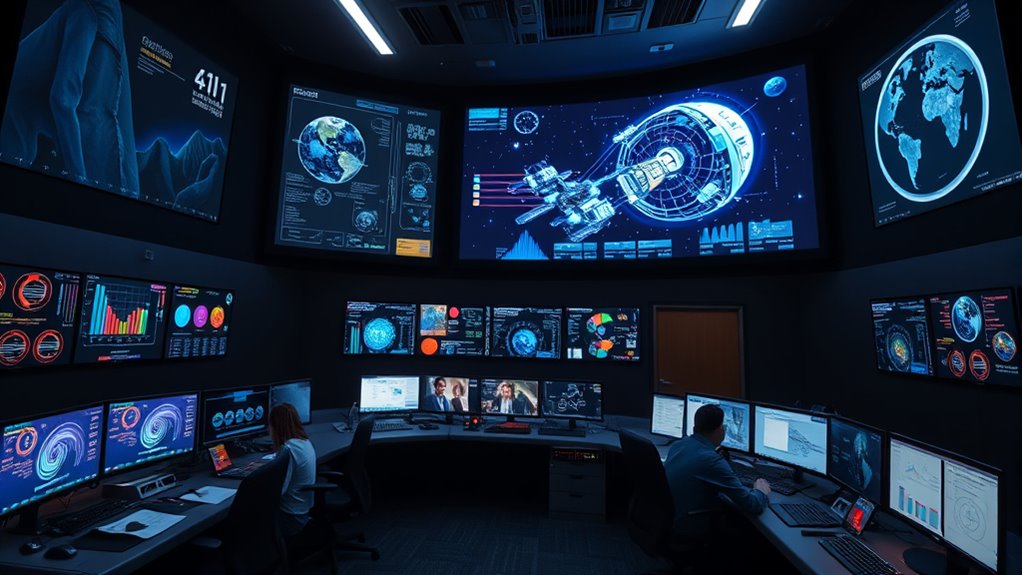

AI-powered displays greatly enhance mission control operations by integrating real-time data analysis and improving situational awareness. These systems leverage advanced algorithms to visualize complex datasets, facilitating quick decision-making. Predictive analytics inform you of potential challenges, while streamlined information flow fosters collaboration among team members. Customizable dashboards guarantee efficient user interaction, maximizing responses to evolving scenarios. To understand the challenges and future potential of AI displays, consider exploring the details on their integration and impact.
The Role of AI in Mission Control Operations
As mission control operations evolve, the integration of AI technologies is proving essential in enhancing decision-making processes. You'll find that AI ethics plays a pivotal role in ensuring operational transparency and data security. This means implementing robust frameworks that minimize algorithm bias while promoting human-AI collaboration. It's vital to prioritize user training, equipping personnel with the skills needed to leverage AI effectively. As technology adoption accelerates, ensuring system reliability becomes a priority, allowing you to trust AI-driven insights without hesitation. This synergy between human intuition and AI capabilities can lead to more informed decisions and optimized operations, fostering an environment where autonomy thrives. Embracing these advancements allows you to harness the full potential of AI in mission control.
Enhancing Situational Awareness With Ai-Powered Displays
AI-powered displays are revolutionizing how mission control personnel perceive and respond to dynamic situations. By integrating advanced algorithms, these displays enhance contextual awareness, allowing you to quickly grasp and interpret complex data streams. Adaptive interfaces tailor information presentation to your specific needs, ensuring that critical alerts and updates are prioritized. This ability to customize the visual output means you can focus on what's most relevant, minimizing cognitive overload. Additionally, as conditions evolve, the displays adapt in real-time, providing a seamless flow of information that keeps you informed and agile. With AI, you're not just reacting; you're anticipating changes, empowering you to make informed decisions that enhance operational effectiveness and mission success.
Real-Time Data Analysis for Informed Decision Making
In mission control, real-time data analysis is essential for informed decision making. By leveraging instant data visualization and integrating predictive analytics, you can enhance situational awareness and respond effectively to dynamic situations. This capability not only streamlines operations but also empowers you to anticipate challenges before they arise.
Instant Data Visualization
While real-time data analysis is essential for effective decision-making, instant data visualization takes this capability a step further by transforming complex datasets into easily interpretable graphics. You can quickly grasp critical information through various visualization techniques, enhancing your ability to respond proactively.
| Data Type | Visualization Technique | Purpose |
|---|---|---|
| Sensor Data | Line Graph | Track changes over time |
| System Performance | Bar Chart | Compare multiple metrics |
| Anomaly Detection | Heat Map | Identify hotspots |
Predictive Analytics Integration
Building on the capabilities of instant data visualization, predictive analytics integration takes real-time data analysis to the next level by forecasting potential outcomes based on historical data patterns. By employing predictive modeling, you can enhance your decision-making processes, ensuring that you're not merely reacting but proactively planning for various scenarios.
- Leverage data forecasting to identify trends before they emerge.
- Utilize advanced algorithms to assess risk and allocate resources effectively.
- Enhance operational efficiency through informed, data-driven strategies.
Incorporating these tools into your mission control operations enables a deeper understanding of complex datasets, ultimately empowering you to make well-informed decisions that align with your objectives and operational freedoms.
Enhanced Situational Awareness
To guarantee effective decision-making in dynamic environments, enhanced situational awareness relies on real-time data analysis that provides critical insights at a moment's notice. By leveraging AI-powered displays, you can streamline data interpretation, allowing you to focus on actionable information rather than sifting through overwhelming data volumes. This capability minimizes cognitive overload, ensuring that you maintain clarity in high-pressure scenarios. With intuitive visualizations and predictive analytics, you're equipped to identify patterns and anomalies swiftly, leading to more accurate assessments of evolving situations. Consequently, your ability to respond promptly to challenges is greatly improved, fostering an environment where informed decisions can flourish. Ultimately, harnessing real-time insights promotes autonomy and strategic freedom in mission control operations.
Predictive Insights: Anticipating Challenges Before They Arise
As mission control teams navigate the complexities of space operations, harnessing AI-powered displays for predictive insights becomes essential in anticipating potential challenges. By integrating advanced algorithms, these displays enhance challenge anticipation, allowing for proactive problem solving before issues escalate.
- Real-time data analysis: AI monitors critical parameters, offering immediate insights into potential anomalies.
- Scenario simulation: Predictive models simulate various mission conditions, enabling teams to prepare for diverse outcomes.
- Automated alerts: The system generates alerts for deviations, ensuring teams can act swiftly.
With these capabilities, mission control can focus on strategic decision-making, freeing up resources to address unforeseen challenges while maintaining mission integrity and safety. Embracing AI empowers teams to remain agile and responsive in dynamic environments.
Streamlining Information Flow for Improved Efficiency
Streamlining information flow in mission control hinges on real-time data integration and enhanced visual analytics. By leveraging AI-powered displays, you can guarantee that critical data is accessible and understandable at a glance. This approach not only reduces cognitive load but also accelerates decision-making processes, leading to improved operational efficiency.
Real-time Data Integration
While managing complex operations in mission control, real-time data integration plays an essential role in enhancing situational awareness and decision-making efficiency. By ensuring data synchronization across multiple systems, you can notably boost operational efficiency. This seamless flow of information empowers you to make informed decisions swiftly and accurately.
Key benefits of real-time data integration include:
- Immediate Access: Real-time updates allow for timely responses to evolving situations.
- Enhanced Collaboration: All team members access the same information, fostering unified decision-making.
- Adaptive Strategies: Quickly adjust operational tactics based on the latest data trends and insights.
Enhanced Visual Analytics
To guarantee ideal mission control operations, enhanced visual analytics transforms complex data into intuitive visual formats, allowing you to quickly grasp significant information. By employing advanced visualization techniques, you can streamline information flow and improve decision-making processes. Data storytelling plays a vital role here, as it contextualizes data, making patterns and insights more apparent. This enables you to interpret vast datasets with clarity, ensuring that significant alerts and operational metrics capture your attention rapidly. With AI-powered displays, you gain the freedom to navigate intricate data landscapes effortlessly, enhancing situational awareness and operational efficiency. Ultimately, these tools empower you to make informed decisions swiftly, enhancing overall mission control effectiveness while reducing cognitive overload.
Intuitive Visualizations for Enhanced User Experience
As mission control environments become increasingly complex, intuitive visualizations play an essential role in enhancing user experience. By leveraging user experience design principles and user interface optimization, these visualizations provide clarity amidst chaos.
Intuitive visualizations are crucial in complex mission control environments, transforming chaos into clarity for enhanced user experience.
- Dynamic Data Representation: Presenting real-time data in visually engaging formats guarantees quick comprehension.
- Contextual Information Layers: Users can access additional information without cluttering the primary display, maintaining focus on critical tasks.
- Customizable Dashboards: Personalization options allow users to tailor their interfaces, fostering a sense of ownership and efficiency.
Incorporating these elements not only optimizes the interaction with complex systems but also empowers users to operate confidently and autonomously, guaranteeing mission success in high-stakes environments.
Boosting Collaboration Among Team Members
Effective collaboration among team members is essential in mission control settings, especially when rapid decision-making and problem-solving are required. AI-powered displays enhance this collaboration by integrating advanced collaborative tools and communication platforms that streamline information sharing. You'll find that these systems facilitate real-time data exchange, allowing team members to stay aligned even in high-pressure situations. By visualizing complex data sets, AI displays help clarify objectives and foster a shared understanding. Additionally, they support remote collaboration, breaking down geographical barriers and enabling diverse teams to contribute effectively. Ultimately, leveraging these technologies empowers you to make informed decisions quickly, ensuring that your team operates cohesively and efficiently, no matter the challenges faced.
Case Studies: Successful Implementation of AI Displays
In examining successful implementations of AI displays, you'll find compelling examples from NASA, air traffic control, and disaster response coordination. Each case highlights how AI enhances decision-making and operational efficiency. By analyzing these instances, you can gain insights into the practical benefits of integrating AI-powered technology in mission-critical environments.
NASA's Mars Rover Assistance
While traversing the complexities of Mars exploration, NASA has successfully integrated AI-powered displays to enhance the operational efficiency of its rovers. These advanced systems have revolutionized rover navigation and obstacle detection, allowing for real-time data analysis and decision-making.
Key enhancements include:
- Autonomous Pathfinding: Rovers can autonomously determine ideal routes based on terrain analysis, minimizing the need for human intervention.
- Dynamic Obstacle Detection: AI algorithms identify and classify obstacles, adjusting navigation plans swiftly to avoid hazards.
- Improved Data Visualization: Operators receive clear, synthesized information, enabling quicker assessments and responses to unexpected challenges.
Through these implementations, NASA's rovers are now more capable of adapting to the Martian environment, ensuring mission success and safety.
Air Traffic Control Efficiency
As AI technologies advance in mission-critical environments like Mars exploration, their application in air traffic control is equally transformative. By integrating AI-powered displays, air traffic controllers can enhance operational efficiency remarkably. Real-time data analytics enable you to monitor air traffic patterns more accurately, reducing congestion and optimizing flight paths. For instance, case studies from major airports reveal a 20% decrease in delays after implementing AI displays, which provide predictive insights and automated alerts. This empowers controllers to make informed decisions swiftly, ensuring safety while maximizing airspace usage. Ultimately, embracing AI in air traffic control not only streamlines operations but also grants you the freedom to focus on strategic oversight, allowing for a more responsive and dynamic management of air traffic.
Disaster Response Coordination Success
AI displays have proven invaluable in disaster response coordination, markedly enhancing situational awareness and decision-making efficiency. Their integration into emergency preparedness frameworks facilitates swift disaster recovery by providing real-time data visualization and predictive analytics.
- Enhanced Communication: Streamlined information sharing among agencies accelerates response times.
- Resource Allocation: AI displays optimize the deployment of rescue teams and supplies based on immediate needs.
- Predictive Modeling: Advanced algorithms forecast potential disaster impacts, allowing for proactive measures.
In case studies across various regions, these displays have demonstrated their capacity to transform chaotic environments into organized operations. By harnessing AI technology, emergency responders can make informed decisions, ultimately saving lives and resources during critical incidents.
Challenges and Considerations in AI Integration
Integrating AI into mission control displays presents several challenges and considerations that must be meticulously addressed for effective implementation. You'll encounter integration challenges, particularly regarding system compatibility with existing infrastructure. Ethical considerations, such as data privacy, are paramount; safeguarding sensitive information can't be overlooked. Additionally, technology costs may escalate during the shift, necessitating a thorough cost-benefit analysis. User training is essential to guarantee personnel can effectively leverage AI capabilities, minimizing operational risks. Change management strategies must be established to facilitate smooth adoption and mitigate resistance. By addressing these factors, you can optimize the integration process and enhance mission control operations while maintaining a commitment to ethical standards and operational integrity.
The Future of AI-Powered Displays in Mission Control
The evolution of mission control displays is poised to revolutionize operational efficiency and decision-making processes. As technology advancements continue, you'll witness AI-powered displays integrating seamlessly into workflows, enhancing your situational awareness. Future trends indicate that these systems will leverage real-time data analytics, predictive modeling, and intuitive interfaces.
- Enhanced data visualization techniques for improved comprehension
- Adaptive algorithms that personalize information delivery
- Integration with IoT devices for holistic monitoring
With these innovations, you can expect faster response times and more informed decisions. This transformation will empower you to navigate complex missions with unprecedented clarity and precision, fostering a more agile and effective mission control environment. The future holds limitless potential for AI-powered displays in enhancing operational capabilities.
Frequently Asked Questions
How Do AI Displays Differ From Traditional Mission Control Displays?
In the domain of mission control, imagine a compass guiding you through uncharted waters. AI displays offer adaptive interfaces and predictive analytics, transforming data into actionable insights, unlike traditional displays' static, one-dimensional representations.
What Industries Benefit Most From Ai-Powered Mission Control Displays?
AI-powered mission control displays markedly benefit healthcare applications and transportation logistics. They streamline operations, enhance decision-making processes, and improve efficiency, allowing you to achieve greater freedom in managing complex systems and responding to dynamic challenges.
Are There Any Security Concerns With AI Displays in Mission Control?
Yes, there're significant security concerns with AI displays in mission control. You must consider data privacy implications and potential system vulnerabilities that could be exploited, jeopardizing sensitive operations and compromising critical information integrity.
How Much Training Is Required to Use Ai-Powered Displays Effectively?
Think of mastering a complex instrument; using AI-powered displays isn't much different. Effective user experience hinges on thorough training programs, typically requiring several hours to guarantee you're adept at maneuvering the system's capabilities and nuances.
What Are the Costs Associated With Implementing AI Displays in Mission Control?
When evaluating costs associated with implementing AI displays, you'll need a thorough cost analysis. Budget considerations include hardware, software, maintenance, and training, ensuring you align expenditures with operational goals while maximizing efficiency and effectiveness.
