
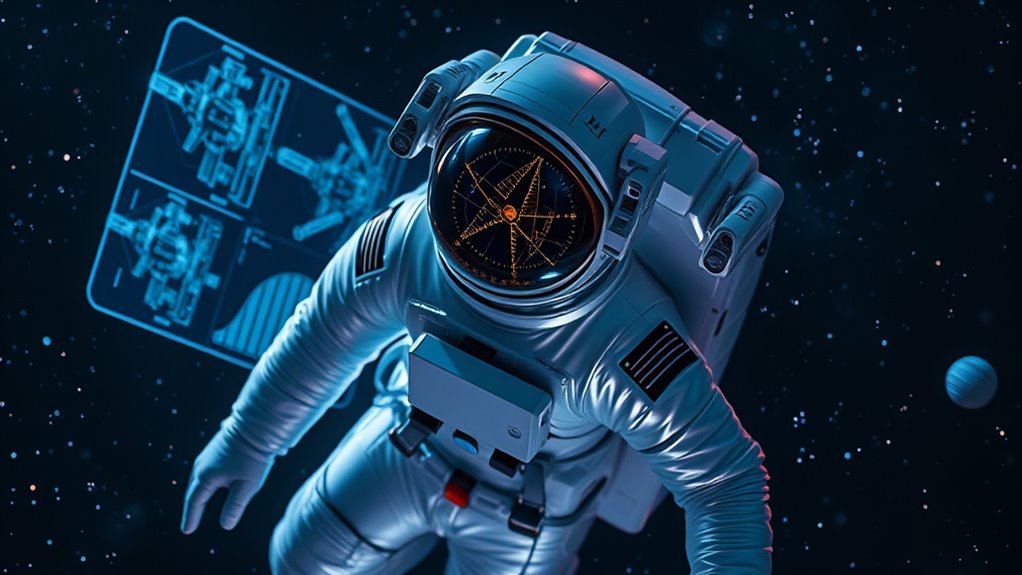

Augmented reality displays are revolutionizing space missions by providing immersive training, real-time data visualization, and efficient task execution. You'll find that AR enhances astronaut training with virtual simulations and immediate feedback. During missions, it overlays critical data in your line of sight, aiding quick decision-making and navigation. AR also streamlines communication between astronauts and mission control, ensuring smooth operations. If you're curious about how AR continues to shape the future of exploration, keep exploring further!
Enhancing Astronaut Training With AR
As astronauts prepare for the complexities of space missions, augmented reality (AR) has emerged as a transformative tool that enhances their training experiences. By utilizing AR, you can engage in virtual simulations that replicate real-world scenarios, allowing you to practice critical skills in immersive environments. This technology enables you to visualize complex systems and procedures, making it easier to grasp intricate concepts. With AR, you're not just reading about equipment; you're interacting with it, fostering a deeper understanding. The ability to manipulate 3D models in real time enhances your spatial awareness and decision-making skills. Ultimately, AR equips you with the confidence and proficiency needed to tackle the challenges of space exploration, providing a truly liberating training experience.
Real-Time Data Visualization in Space
Building on the advanced training capabilities provided by augmented reality, real-time data visualization plays a significant role in enhancing decision-making during space missions. By utilizing data overlays, astronauts can access essential information instantly, enabling them to respond effectively to dynamic situations. Imagine being in an immersive simulation where temperature, pressure, and system statuses are projected directly onto your visor, seamlessly blending with the environment. This immediate access to real-time data not only boosts situational awareness but also fosters a proactive approach to problem-solving. With augmented reality, you're not just observing; you're interacting with data in ways that make complex information digestible, ultimately empowering you to make informed decisions that can impact mission success.
Navigation Assistance for Extravehicular Activities
While maneuvering through the vastness of space during extravehicular activities (EVAs), astronauts often face the challenge of orienting themselves in an environment devoid of familiar landmarks. Navigation overlays provided by augmented reality displays enhance spatial awareness and help you locate critical points of interest in the space environment. These overlays superimpose essential data, making navigation intuitive and efficient.
| Feature | Benefit | Application |
|---|---|---|
| Real-time guidance | Reduces disorientation | EVA route planning |
| Visual checkpoints | Guarantees mission success | Task completion tracking |
| Safety alerts | Prevents collisions | Proximity warnings |
With these tools, you can confidently explore the cosmos, guaranteeing that your mission runs smoothly and safely.
Streamlining Communication Between Astronauts and Mission Control
Effective communication between astronauts and mission control is essential for ensuring mission success, especially in the high-stakes environment of space. Augmented reality (AR) displays streamline this communication, allowing real-time data sharing and visual overlays that enhance understanding. When you wear AR headsets, you can receive critical information directly in your line of sight, reducing the need for lengthy verbal exchanges. This visual aid not only boosts mission efficiency but also helps maintain astronaut morale, as you feel more connected to your team on Earth. By facilitating quicker decision-making and minimizing errors, AR transforms how you interact with mission control, ensuring that you can focus on your tasks with greater confidence and autonomy.
AR for Maintenance and Repair Tasks
When it comes to maintenance and repair tasks in space, augmented reality (AR) can greatly enhance your efficiency. With real-time guidance assistance, you'll receive step-by-step instructions overlaying your workspace, while remote expert collaboration allows specialists on Earth to support you instantly. Plus, AR helps visualize complex systems, making it easier to identify issues and understand intricate components.
Real-time Guidance Assistance
As astronauts face the challenges of maintaining and repairing complex systems in space, augmented reality (AR) displays offer invaluable real-time guidance assistance. These interactive displays provide step-by-step instructions, overlaying critical information directly onto the equipment in need of repair. This guarantees you can navigate tasks with precision, minimizing errors and enhancing safety.
| Functionality | Benefits |
|---|---|
| Real-time Navigation | Helps in identifying components |
| Interactive Displays | Engages users for better understanding |
| Visual Overlays | Simplifies complex processes |
| Immediate Feedback | Alerts for potential issues |
With AR, you're not just working; you're empowered to tackle repairs confidently, leveraging advanced technology to guarantee the mission's success.
Remote Expert Collaboration
While tackling maintenance and repair tasks in the isolated environment of space, astronauts can greatly benefit from augmented reality (AR) systems that enable remote expert collaboration. By utilizing AR, they can engage in real-time remote troubleshooting, allowing experts on Earth to provide guidance as if they were right there with you. This collaborative learning approach enhances problem-solving skills and increases efficiency. Here are some key advantages:
- Instant visual feedback from experts.
- Step-by-step instructions overlaid on equipment.
- Enhanced comprehension through interactive elements.
- Reduced downtime by quickly addressing issues.
With AR, you're not just fixing problems; you're also expanding your knowledge and capabilities, taking ownership of complex tasks with confidence.
Visualizing Complex Systems
By leveraging augmented reality (AR) technology, astronauts can effectively visualize complex systems during maintenance and repair tasks, enhancing both their understanding and execution of intricate procedures. AR overlays real-time data onto physical components, allowing you to grasp system integration more intuitively. Imagine seeing step-by-step instructions directly on the equipment you're working on, guiding you through each action seamlessly.
This interactive training method not only improves your skills but also boosts confidence, especially in high-stakes environments like space. By providing immediate access to essential information, AR mitigates errors, ensuring that repairs are conducted efficiently and accurately. As you engage with these advanced systems, you're empowered to tackle challenges with newfound freedom and precision, making complex tasks feel manageable.
Analyzing Scientific Data in Complex Environments
In complex environments, real-time data visualization through augmented reality can greatly enhance your understanding of scientific data. This technology allows you to see critical information overlaid on your surroundings, making it easier to interpret results. With this immediate access to data, you're better equipped to make informed decisions during space missions.
Real-Time Data Visualization
As scientists navigate the complexities of space missions, real-time data visualization emerges as an essential tool for analyzing scientific data in challenging environments. By leveraging augmented reality, you can experience immersive interfaces that enhance understanding. Here are key benefits:
- Data Overlays: These provide contextual information directly onto your view, making it easier to interpret data in real-time.
- Enhanced Collaboration: Teams can share visualized data simultaneously, fostering a more cohesive understanding of mission parameters.
- Immediate Feedback: You can quickly assess changes and respond to anomalies, vital for successful outcomes.
- Dynamic Analysis: As new data streams in, you can adjust your focus and strategy on-the-fly, ensuring you're always aligned with mission goals.
This technology empowers you to explore space with unprecedented clarity.
Enhanced Decision-Making Support
Building on the benefits of real-time data visualization, augmented reality can greatly enhance decision-making support during space missions. By integrating sophisticated decision-making algorithms with AR technology, you can analyze complex scientific data in real-time, boosting situational awareness. Imagine wearing AR glasses that overlay critical information right in your field of view, allowing you to assess multiple data streams simultaneously without losing focus. This capability not only streamlines information processing but also empowers you to make informed choices quickly. Whether traversing uncharted terrains or responding to unexpected anomalies, augmented reality guarantees you're equipped with the insights needed for peak decision-making. With enhanced situational awareness, you can maneuver the challenges of space exploration more effectively, securing mission success.
Future Prospects of AR in Space Exploration
While the potential of augmented reality (AR) in space exploration is just beginning to be realized, its future promises groundbreaking advancements that could revolutionize missions beyond Earth. You'll likely see innovative interfaces and future applications enhancing astronaut training and operational efficiency. Here are four exciting prospects:
- Remote Collaboration: Astronauts could work with Earth-based experts in real-time, sharing visual data seamlessly.
- Enhanced Navigation: AR could provide dynamic mapping and route visualization during planetary exploration.
- Maintenance Support: AR overlays could guide astronauts in repairing equipment, reducing error rates.
- Scientific Visualization: Complex data could be displayed in 3D, making analysis intuitive and accessible.
With these advancements, AR may transform how we explore and understand the cosmos, empowering you to reach new frontiers.
Frequently Asked Questions
How Do AR Displays Impact Astronaut Safety During Missions?
AR displays enhance astronaut safety by providing real-time data and critical AR safety features. They improve decision-making during high-pressure situations, ensuring you're equipped with the information needed to navigate challenges effectively and confidently.
What Types of AR Technology ARe Currently Used in Space?
When it comes to AR technology in space, you've got a world of options. Virtual navigation and immersive simulations are key tools, enhancing training and mission planning while giving you a taste of freedom beyond Earth.
ARe There Any Limitations of AR in Space Missions?
AR in space missions faces challenges like technical limitations in connectivity and hardware durability. You'll find that environmental factors, such as radiation, can impact performance, making it essential to design robust systems that adapt effectively.
How Is AR Integrated With Existing Spacecraft Systems?
Oh, integrating AR with existing systems? It's all about that seamless interface design and ensuring system compatibility. You want your tech to play nice, after all. Otherwise, it's just a cosmic game of hide-and-seek!
What Training Is Required for Astronauts to Use AR Effectively?
To use AR effectively, you'll need extensive training involving virtual simulations and hands-on practice. This guarantees you can navigate complex tasks efficiently, enhancing your confidence and capabilities in high-stakes environments where precision is essential.
