
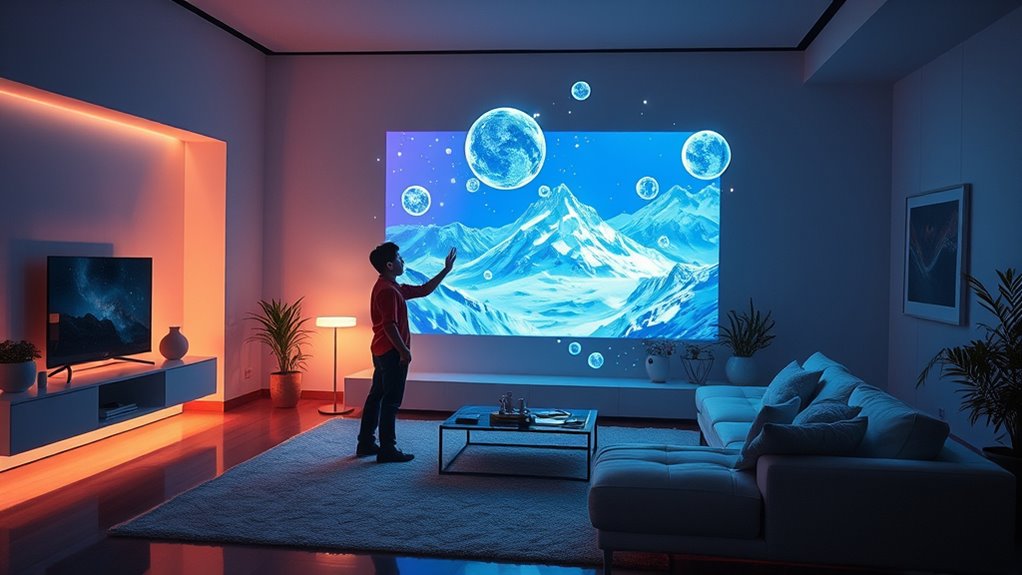

Holographic augmented reality (HAR) offers interactive 3D visuals that traditional displays can’t replicate. With enhanced user engagement through intuitive gestures and real-time feedback, HAR creates immersive experiences in various fields, from healthcare to education. Unlike conventional screens, HAR’s advanced technology guarantees high image fidelity and spatial awareness, allowing natural interaction with digital objects in your environment. This shift in how you engage with technology is just the beginning of a new frontier in visual communication and interaction.
Understanding Holographic Augmented Reality
While many people are familiar with traditional augmented reality (AR) that overlays digital content onto the real world, understanding holographic augmented reality (HAR) takes things a step further. HAR utilizes holographic interfaces that create three-dimensional images, allowing you to interact with virtual objects as if they exist in your physical space. This technology immerses you in environments where digital and real-world elements coexist seamlessly, enhancing your experience. Unlike traditional displays, HAR enables a more natural interaction with these objects, fostering creativity and intuitive engagement. Imagine designing a structure or playing an interactive game where you can manipulate visuals in real time. With HAR, the possibilities are boundless, granting you the freedom to explore and innovate in ways traditional displays simply can’t offer.
The Limitations of Traditional Displays
Although traditional displays have served us well for decades, they come with significant limitations that can hinder user experience and interaction. Screen resolution often falls short, leading to pixelation that compromises detail. Viewing angles can distort colors and brightness, making it hard to gather accurate information from different perspectives. Color accuracy is frequently an issue, affecting everything from graphic design to gaming. Additionally, refresh rates can lead to choppy visuals, detracting from fluidity in motion. Physical limitations and size constraints restrict how immersive your experience can be, while environmental factors like lighting further complicate visibility. Ultimately, these shortcomings can impact user comfort, leaving you yearning for a more liberated, engaging way to interact with digital content.
How Holographic AR Enhances User Interaction
The limitations of traditional displays have opened the door for innovative solutions like holographic augmented reality (AR), which greatly enhances user interaction. Holographic AR empowers you to engage with digital content in ways that feel natural and immersive. Here are three ways it boosts user engagement through interactive features:
- Spatial Awareness: You can manipulate digital objects in your physical space, creating a seamless blend of reality and virtuality.
- Gestural Controls: Instead of relying on touchscreens, you can use hand gestures to interact, making the experience more intuitive and freeing.
- Real-time Feedback: Immediate responses to your actions foster a deeper connection with the content, enhancing your overall experience.
These capabilities not only revolutionize how you interact but also pave the way for richer, more engaging digital experiences.
Applications of Holographic AR in Various Industries
Holographic AR is transforming industries by enhancing visualization techniques in healthcare, creating immersive shopping experiences in retail, and providing interactive learning tools in education. You’ll find that these applications not only improve engagement but also facilitate better understanding and retention of complex information. As you explore these sectors, it becomes clear how holographic technology is redefining traditional practices.
Healthcare Visualization Techniques
In today’s healthcare landscape, innovative visualization techniques are transforming the way medical professionals interact with complex data. Holographic AR is leading this change, enhancing traditional methods and providing unprecedented insights. Here are three key applications:
- Surgical Simulations: Surgeons can practice complex procedures in a realistic 3D environment, improving their skills without risk to patients.
- Medical Imaging: Holographic AR allows for a more interactive experience with scans and images, helping doctors visualize anatomy in real-time.
- Patient Education: With holographic displays, patients can better understand their conditions and treatment options, fostering informed decision-making.
These applications not only streamline workflows but also enhance collaboration, paving the way for a more efficient healthcare system. Embracing these technologies can truly revolutionize patient care.
Retail Immersive Shopping Experiences
As consumers increasingly seek immersive shopping experiences, retailers are turning to augmented reality to enhance engagement and personalization. Holographic AR offers innovative solutions, like virtual fitting rooms, where you can try on clothes without ever stepping into a fitting room. This technology allows you to see how items fit and move in real-time, making the shopping experience more enjoyable and efficient. Additionally, sensory engagement is heightened through holographic displays that showcase products in vibrant detail, creating an enchanting atmosphere. You can interact with products in 3D, envisioning how they’ll fit into your life. This shift not only transforms retail spaces but also empowers you to make informed choices, ultimately redefining how you experience shopping in a digital age.
Education Interactive Learning Tools
While traditional educational methods often rely on static materials, the integration of augmented reality (AR) is revolutionizing how knowledge is imparted. Holographic AR facilitates a more dynamic learning environment, allowing you to engage with content in a vivid, interactive manner. Imagine stepping into virtual classrooms where concepts come alive through interactive simulations. This technology not only enhances comprehension but also ignites curiosity.
Here are three key benefits of using holographic AR in education:
- Enhanced Engagement: Students are more likely to participate when lessons are immersive.
- Real-Time Feedback: Immediate responses in simulations help clarify misunderstandings.
- Accessibility: Learning can happen anytime, anywhere, breaking down geographical barriers.
With holographic AR, education becomes an exhilarating journey of exploration.
The Technology Behind Holographic AR
When you explore the technology behind holographic AR, you’ll encounter fascinating techniques like holographic projection and light field manipulation. These methods allow for stunning visual experiences that blend seamlessly with the real world. Additionally, sensor integration technologies play a vital role in enhancing interactivity and responsiveness, making this innovation truly remarkable.
Holographic Projection Techniques
Holographic projection techniques represent a fascinating convergence of light manipulation and visual perception, allowing for the creation of three-dimensional images that seem to float in space. You might find the following holographic techniques particularly interesting:
- Laser Interference: Utilizing laser beams to create interference patterns, this method forms detailed holograms by capturing light’s wave properties.
- Digital Holography: Employing digital sensors and algorithms, this approach generates holograms by processing light data, enabling real-time updates and dynamic visuals.
- Pepper’s Ghost: A classic projection method, it uses angled glass to reflect images, making them appear as if they’re in three-dimensional space, often seen in theatrical productions.
These projection methods not only enhance visual experiences but also pave the way for a future where traditional displays may become obsolete.
Light Field Manipulation
The advancements in holographic projection techniques set the stage for exploring light field manipulation, a key aspect of holographic augmented reality (AR). By controlling light fields, you can enhance spatial resolution, enabling richer visual perception in immersive environments. This technology leverages depth cues to create lifelike images, essential for effective interaction design. Holographic optics play a pivotal role, ensuring high image fidelity, which is critical for engaging user interfaces. As you venture into content creation, understanding light field manipulation will empower you to produce experiences that transcend traditional displays. It’s not just about seeing; it’s about feeling present in the moment, giving you the freedom to interact with digital content like never before.
Sensor Integration Technologies
As you explore the domain of holographic augmented reality, you’ll quickly realize that sensor integration technologies are fundamental to creating immersive experiences. These technologies tackle several integration challenges, focusing on sensor accuracy and effective data processing. Here are three key aspects to reflect upon:
- Sensor Fusion: Combining data from multiple sensors enhances accuracy, enabling richer interactions in varying sensing environments.
- Hardware Limitations: Understanding these constraints helps developers optimize performance, ensuring smooth user experiences without lag.
- User Feedback: Incorporating real-time feedback allows fine-tuning of the system, leading to more intuitive interfaces and responses.
The Future of Holographic Displays
While many people are still familiarizing themselves with the concept of holographic displays, the technology is rapidly evolving and holds immense potential for the future. Holographic innovation trends are reshaping how you interact with digital content, offering immersive experiences that traditional displays can’t match. As user experience evolution continues, you can expect interfaces that feel more natural and engaging.
| Aspect | Holographic Displays |
|---|---|
| Interactivity | High |
| Visual Quality | Superior |
| Applications | Diverse (Gaming, Education) |
The future of holographic displays promises a more liberated way to engage with technology, revolutionizing how you perceive and interact with the digital world.
Challenges and Considerations for Adoption
Despite the exciting potential of holographic displays, several challenges must be addressed before widespread adoption can occur. First, cost considerations play a significant role; the technology remains expensive, limiting accessibility for both consumers and businesses. Second, user acceptance is essential—people need to be willing to shift from familiar screens to a new, immersive experience. Finally, technical limitations, such as the need for advanced hardware and software, must be overcome to guarantee reliable performance.
Holographic displays hold great promise, but cost, user acceptance, and technical limitations must be addressed for widespread adoption.
- Affordability: Finding ways to reduce production costs.
- Familiarity: Educating users about the benefits and functionalities.
- Technology Integration: Confirming compatibility with existing systems.
Tackling these issues will pave the way for the future of holographic AR displays.
The Impact of Holographic AR on Daily Life
Holographic AR has the potential to transform daily life in ways we’ve only begun to imagine. Picture walking into your home, where holographic experiences enhance your environment, displaying personalized information and reminders seamlessly. It’ll change how you engage with technology, making daily interactions more intuitive and immersive. Instead of flat screens, you could interact with 3D models of your tasks, whether cooking, exercising, or working. Imagine collaborating with colleagues in a virtual space, breaking the barriers of location. Holographic AR can redefine learning too, providing interactive educational experiences that cater to individual needs. As you embrace this technology, your life could become more efficient and connected, granting you the freedom to explore and create in ways you’ve long dreamed of.
Frequently Asked Questions
How Much Does Holographic AR Technology Cost to Implement?
Implementing holographic AR isn’t just about the initial investment; it’s also about the cost factors, like hardware and software, alongside implementation challenges that can arise. Are you ready to navigate this complex landscape?
What ARe the Energy Requirements for Holographic AR Systems?
When considering energy requirements for holographic AR systems, you’ll find energy consumption varies considerably. Analyzing efficiency metrics reveals opportunities for optimization, ensuring you can enjoy immersive experiences without excessive energy demands impacting your freedom and creativity.
Can Holographic AR Be Used Outdoors Effectively?
You’ll find that outdoor visibility of holographic AR can be challenging due to environmental factors like sunlight and weather conditions. However, advancements in technology are improving its effectiveness, offering promising solutions for real-world applications.
What ARe the Privacy Concerns With Holographic AR?
When diving into holographic AR, you’ll want to contemplate the nuances of data security and user consent. Balancing innovation with privacy is essential, as the technology could inadvertently expose personal information if not handled carefully.
How Does Holographic AR Impact Eye Health Compared to Traditional Displays?
Holographic AR can reduce eye strain compared to traditional displays because it offers a more natural viewing experience. This technology might enhance visual acuity, allowing your eyes to focus better without constant adjustment.
