
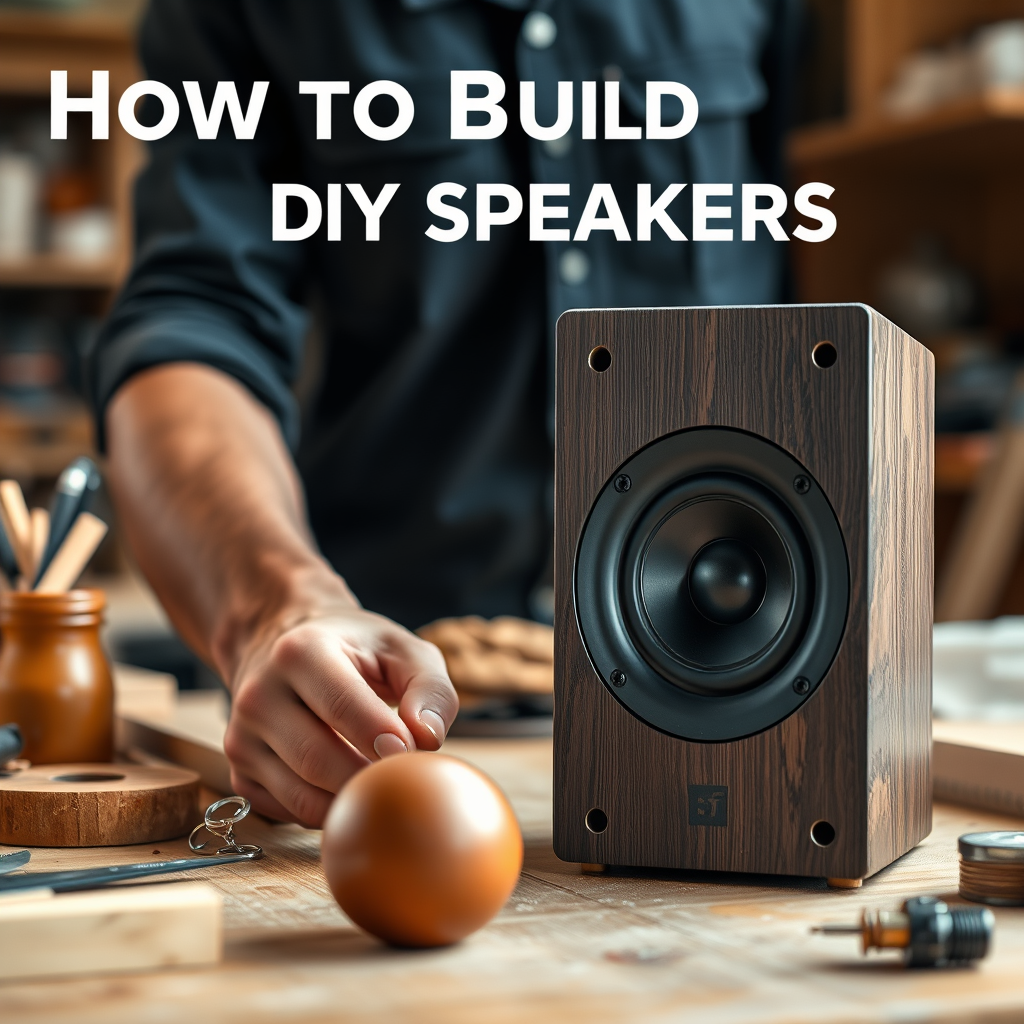

Building your own DIY speakers is a fulfilling project that not only elevates your audio experience but also allows you to tailor sound quality to your personal preferences. By creating your own speakers, you can achieve a level of sound quality that often exceeds factory-made options, while also exploring your creativity in design and function. This article outlines the essential steps to successfully build your own speakers, covering everything from component selection to assembly tips.
Choosing the Right Components
The foundation of your DIY speakers lies in the components you select. Understanding the various speaker drivers is crucial. The two primary types of drivers are woofers and tweeters. Woofers are designed to reproduce low frequencies, typically ranging from 20 Hz to 2 kHz, while tweeters handle high frequencies, generally from 2 kHz to 20 kHz. Each driver plays a distinct role in sound production, and the combination of both will provide a balanced audio experience.
Next, selecting the right enclosure is essential for sound quality. The enclosure is the box that houses the drivers and influences the overall sound output. Common designs include sealed and ported enclosures. Sealed enclosures offer tight, accurate bass response but may lack volume, while ported enclosures allow for increased loudness and deeper bass at the expense of some accuracy. Materials like MDF (medium-density fiberboard) or plywood are preferred for their durability and acoustic properties.
Essential Tools for DIY Speaker Building
To embark on your DIY speaker building journey, you’ll need a set of essential tools. Basic tools include:
– Soldering Iron: For connecting wires to the drivers.
– Screwdriver: For assembling the enclosure and securing drivers.
– Wood Saw: To cut the enclosure materials to size.
In addition to these basics, advanced tools can enhance the process. A multimeter, for instance, can be used for testing the electrical connections and ensuring the correct impedance across the drivers. A router may also be beneficial for creating smooth edges and precise cuts on the enclosure.
Designing Your Speaker System
Designing your speaker system involves critical decisions regarding size and layout. The size of the speaker should be determined by the space you have available and your sound preferences. Larger enclosures can produce deeper bass but may not fit well in smaller rooms. Conversely, compact designs can be more aesthetically pleasing but may compromise on sound depth.
Creating a design blueprint is the next step. Sketch a layout that includes driver placement and the type of enclosure design you wish to implement. Consider the placement of ports if you choose a ported design, and ensure that the drivers are positioned in a way that optimizes sound dispersion.
Top Speaker Drivers by Characteristics (2024)
| # | Driver Type | Frequency Range (Hz) | Power Handling (W) | Efficiency (%) |
|---|---|---|---|---|
| 1 | Woofer | 20-2000 | 50 | 88 |
| 2 | Tweeter | 2000-20000 | 20 | 90 |
| 3 | Midrange | 100-4000 | 40 | 85 |
| 4 | Subwoofer | 15-200 | 300 | 75 |
| 5 | Pyramid | 25-5000 | 120 | 80 |
| 6 | Horn | 500-20000 | 150 | 95 |
| 7 | Coaxial | 20-20000 | 80 | 88 |
Step-by-Step Assembly Process
Once you have your components and design finalized, it’s time to move on to the assembly process. Start by constructing the enclosure according to your blueprint. Use wood glue and screws to ensure that the joints are secure and airtight, as leaks can drastically affect sound quality. Pay special attention to the corners and edges, ensuring that they are sealed properly.
After the enclosure is built, it’s time to install the drivers. Securely mount the woofers and tweeters in their designated spots, being careful to connect the wiring correctly. Polarity is crucial here; ensure that the positive and negative terminals of the drivers match the wiring from your amplifier or audio source.
Testing and Tuning Your DIY Speakers
With the assembly complete, the next step is testing and tuning your DIY speakers. Begin by conducting initial tests using various audio tracks. This will help you evaluate sound quality and balance across different frequency ranges. Listen for clarity, bass depth, and any distortions that may occur at high volumes.
As you test, take notes on areas for improvement. You may find that adjusting the positioning of the drivers or modifying the enclosure can enhance performance. Experiment with different placements in your listening environment to find the optimal setup for soundstage and clarity.
Aesthetic Finishing Touches
The final stage of your DIY speaker project involves adding aesthetic finishing touches. Choose a finish that complements your decor, whether it be painting, staining, or applying a veneer. Ensure that any finish you apply does not interfere with the acoustic properties of the enclosure.
You might also consider adding features such as speaker grills or LED lights. Grills can protect the drivers while enhancing the overall look, whereas LED lights can create an engaging visual effect, especially when used in low-light settings.
Building your own DIY speakers is not only a fun project but also a great way to improve your listening experience. Start gathering your materials and tools today, and get ready to enjoy the fruits of your labor with high-quality sound tailored to your taste. Whether you opt for a simple design or a more complex build, the satisfaction of creating your own audio equipment is unparalleled.
Frequently Asked Questions
What materials do I need to build my own DIY speakers?
To build your own DIY speakers, you’ll typically need plywood or MDF for the cabinet, speaker drivers, a crossover network, insulation material, speaker wire, and connectors. Additionally, tools such as a saw, drill, and soldering iron are essential for assembly. Choosing quality materials can significantly enhance the sound quality of your finished speakers.
How do I choose the right speaker drivers for my DIY project?
When choosing speaker drivers for your DIY project, consider factors like the type of sound you wish to achieve, the speaker size, and your budget. Look for drivers with a frequency range that matches your listening preferences, and ensure they fit well within your speaker cabinet design. Researching reviews and specifications can help you find the best drivers for your needs.
Why should I consider building my own speakers instead of buying pre-made ones?
Building your own speakers allows for customization tailored to your audio preferences, potentially resulting in superior sound quality compared to mass-produced options. It can also be a cost-effective solution, as you can choose materials and drivers that fit your budget. Moreover, the DIY process can be highly rewarding, providing a sense of accomplishment and a unique product.
What are the best resources for learning how to make DIY speakers?
The best resources for learning to make DIY speakers include online tutorials, forums dedicated to audio enthusiasts, and instructional videos on platforms like YouTube. Books on speaker design and acoustics can also provide valuable insights. Engaging with communities, such as Reddit’s DIY audio subreddit, can offer tips and feedback from experienced builders.
Which tools are essential for assembling DIY speakers effectively?
Essential tools for assembling DIY speakers include a circular saw or jigsaw for cutting wood, a drill for making holes, and a soldering iron for connecting wires. A multimeter can also be helpful for testing connections and ensuring proper functionality. Having the right tools not only simplifies the assembly process but also ensures a more professional finish.
References
- https://en.wikipedia.org/wiki/Speaker_(audio
https://en.wikipedia.org/wiki/Speaker_(audio - Google Scholar Google Scholar
https://scholar.google.com/scholar?q=do+it+yourself+speakers - https://www.sciencedirect.com/topics/engineering/audio-speakers
https://www.sciencedirect.com/topics/engineering/audio-speakers - Google Scholar Google Scholar
https://scholar.google.com/scholar?q=DIY+audio+speakers - https://pubmed.ncbi.nlm.nih.gov/
https://pubmed.ncbi.nlm.nih.gov/ - https://www.bbc.com/news/technology-53326910
https://www.bbc.com/news/technology-53326910 - https://www.nature.com/subjects/audio-engineering
https://www.nature.com/subjects/audio-engineering - https://www.theguardian.com/technology/2021/jul/15/the-best-diy-speakers
https://www.theguardian.com/technology/2021/jul/15/the-best-diy-speakers - https://www.wnycstudios.org/podcasts/radiolab/articles/63763-how-to-build-a-speaker
https://www.wnycstudios.org/podcasts/radiolab/articles/63763-how-to-build-a-speaker - https://www.nytimes.com/wirecutter/blog/diy-speaker-ideas/
https://www.nytimes.com/wirecutter/blog/diy-speaker-ideas/
