
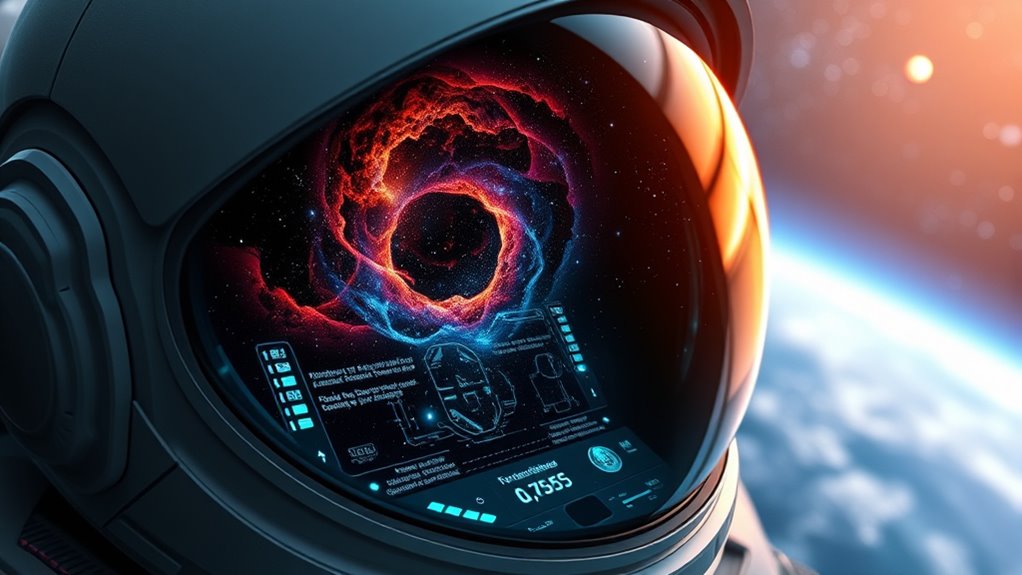

The future of AI-powered astronaut helmet displays promises to enhance your safety and situational awareness during missions. With real-time data integration, you'll access critical information and notifications about potential hazards effortlessly. Advanced communication features will keep you connected with your team, making collaboration seamless. Plus, smart navigation assistance will optimize your exploration routes. As technology evolves, you'll discover how these innovations reshape space travel and empower your journey beyond the stars.
The Evolution of Astronaut Helmet Technology
As space exploration has advanced, so too has the technology behind astronaut helmets, which are essential for ensuring both safety and functionality in the harsh environment of space. The evolution of helmet design reflects broader technology trends, integrating lightweight materials and enhanced life support systems to protect astronauts. You'll notice that modern helmets aren't just protective gear; they're sophisticated tools equipped with advanced communication systems and environmental controls. This shift towards functionality emphasizes the need for adaptability in extreme conditions. Innovations like improved visor technology and modular components allow for customization based on mission requirements. As you ponder the future of space travel, it's clear that the evolution of astronaut helmets embodies the spirit of exploration and the quest for freedom beyond our planet.
Key Features of AI-Powered Helmet Displays
When you're exploring the cosmos, the capabilities of AI-powered helmet displays can greatly enhance your experience. These systems offer enhanced visual interfaces that provide clarity, while real-time data analytics keep you informed of critical information. Plus, the adaptive user experience guarantees that the technology responds to your needs, making every mission safer and more efficient.
Enhanced Visual Interfaces
While exploring the vastness of space, astronauts rely on advanced technology to enhance their missions, and AI-powered helmet displays are at the forefront of this innovation. These enhanced visual interfaces revolutionize the way you interact with your environment, blending augmented reality with user ergonomics for a seamless experience.
- Intuitive overlay of critical data
- Adaptive brightness and contrast for various lighting conditions
- Gesture control for hands-free operation
- Customizable display settings tailored to individual preferences
- Integration with navigation systems for real-time guidance
With these features, you'll find yourself empowered, making decisions with unprecedented clarity and ease, ultimately expanding the freedom and potential of your missions in the cosmos.
Real-Time Data Analytics
AI-powered helmet displays are transforming how astronauts access and interpret real-time data analytics, ensuring that crucial information is always at their fingertips. With advanced real-time monitoring, these displays provide immediate feedback on critical systems, allowing for proactive decision-making. Data visualization techniques make it easy for you to comprehend complex data at a glance, enhancing situational awareness during missions.
| Feature | Description | Benefit |
|---|---|---|
| Real-Time Monitoring | Continuous updates on suit and mission metrics | Informed decision-making |
| Data Visualization | Graphical representation of critical information | Quick comprehension |
| Adaptive Alerts | Notifications for anomalies or changes | Improved safety and response |
These capabilities empower you to focus on your mission, knowing that you're equipped with the best tools for success.
Adaptive User Experience
The evolution of data analytics in AI-powered helmet displays naturally leads to a focus on the adaptive user experience. You're looking at a system that's not just functional but tailored to your unique needs. With adaptive design, these helmet displays can morph based on your preferences, ensuring that you get the most relevant information without distraction.
- Real-time adjustments to UI elements based on your focus
- Voice-controlled commands for hands-free operation
- Personalized notifications that prioritize critical information
- Interactive overlays that adapt to environmental conditions
- Seamless integration with personal devices for enhanced user customization
This level of adaptability empowers you to navigate your missions with greater efficiency and autonomy, making every moment in space a more enriching experience.
Enhancing Safety and Situational Awareness
As astronauts navigate the complexities of space missions, enhancing safety and situational awareness becomes paramount. AI-powered helmet displays can revolutionize how you approach safety protocols and situational training. Imagine having access to real-time alerts and visual cues that keep you informed about potential hazards. These displays can synthesize vast amounts of data, helping you make informed decisions in critical moments. By integrating AI, your helmet can predict scenarios based on previous missions, ensuring you're always prepared. Plus, enhanced communication with your team can foster a sense of camaraderie, enabling quicker responses during emergencies. With these advancements, you'll not only feel safer but also more empowered to embrace the freedom that comes with exploring the unknown.
Real-Time Data Integration for Mission Efficiency
In space missions, having access to real-time data can dramatically enhance efficiency. By integrating advanced navigation systems and essential signs monitoring into your helmet display, you can make informed decisions on the fly. This seamless flow of information not only streamlines operations but also guarantees your safety and well-being during critical tasks.
Enhanced Navigation Systems
While traversing the vastness of space presents unique challenges, enhanced navigation systems equipped with AI-powered astronaut helmet displays are revolutionizing how astronauts approach their missions. These systems harness navigation algorithms and sensor fusion to guarantee seamless real-time data integration, allowing for informed decision-making. You'll find that these advancements provide:
- Precise trajectory calculations for optimized travel
- Adaptive route adjustments based on environmental variables
- Integration of multiple sensor inputs for improved accuracy
- Enhanced situational awareness through augmented reality overlays
- Streamlined communication with mission control for instant guidance
With these capabilities, you can navigate the cosmos with newfound confidence, enhancing mission efficiency and empowering your freedom to explore uncharted territories. Embracing these technologies means pushing the boundaries of human potential in space exploration.
Vital Signs Monitoring
To guarantee astronaut safety and mission success, essential signs monitoring integrated into AI-powered helmet displays plays a key role in real-time data analysis. This technology offers advanced health monitoring capabilities, ensuring that every heartbeat and breath is tracked. Imagine having biometric feedback directly in your line of sight; it empowers you to make informed decisions on the fly. With this integration, potential health issues can be identified before they escalate, enhancing not just your safety but also the overall efficiency of the mission. You'll have the freedom to focus on your tasks, knowing that your well-being is continuously monitored. This fusion of AI and real-time data creates a safer, more effective environment for space exploration, redefining what's possible in astronaut gear.
Advanced Navigation and Exploration Assistance
As astronauts commence on missions beyond Earth, the integration of AI-powered helmet displays transforms navigation and exploration into a more intuitive experience. These displays utilize advanced AI algorithms to enhance navigation accuracy, enabling you to make informed decisions in real time. With augmented reality overlays, you can visualize critical data, improving your exploration strategies and mission planning. Additionally, the user interface is designed to seamlessly integrate with astronaut training, ensuring you're prepared for the unexpected.
- Enhanced navigation accuracy
- Real-time data visualization
- Adaptive exploration strategies
- Streamlined mission planning
- Intuitive user interface
This powerful combination not only boosts your confidence but also helps you embrace the freedom of exploring uncharted territories.
Communication Breakthroughs in Space Missions
The advancements in AI-powered helmet displays not only enhance navigation but also pave the way for significant breakthroughs in communication during space missions. Imagine being able to engage in real-time interstellar communication with mission control and fellow astronauts, regardless of distance. These displays can facilitate seamless information sharing, enabling you to collaborate on complex tasks more effectively. Enhanced audio-visual interfaces help bridge gaps in communication, allowing for a clearer exchange of ideas and strategies. As you face the vastness of space, the ability to connect effortlessly with your team becomes essential. This evolution in mission collaboration fosters not just efficiency but also a sense of unity, allowing you to focus on exploration and discovery without the barriers of outdated communication methods.
The Role of AI in Future Space Exploration
While exploring the cosmos, you'll quickly realize that artificial intelligence is set to revolutionize how we approach future space missions. By integrating AI, you'll enhance not only mission efficiency but also safety and data management.
- Space robotics will enable autonomous systems to perform complex tasks, reducing human risk.
- Predictive analytics will help in anticipating challenges, allowing for proactive measures.
- Machine learning will streamline data processing, guaranteeing quicker decision-making.
- Human-machine collaboration will refine workflows, blending human intuition with AI precision.
- AI ethics and governance will guarantee responsible usage, maintaining data privacy and ethical standards.
As you journey into space, AI will be an indispensable partner, revealing new opportunities and charting the unknown.
Challenges and Considerations for Implementation
Integrating AI into space exploration isn't without its hurdles and considerations. You'll face regulatory challenges that require maneuvering complex frameworks, while technical limitations could hinder performance. User acceptance is vital; astronauts must trust these systems for critical tasks. Cost implications can't be ignored, as developing and maintaining these advanced technologies might strain budgets. Additionally, interoperability issues arise when AI systems must work seamlessly with existing equipment. Finally, data privacy concerns are paramount, as sensitive information must be protected in the vastness of space.
Here's a quick summary:
| Challenge | Consideration |
|---|---|
| Regulatory Challenges | Compliance frameworks |
| Technical Limitations | Performance barriers |
| User Acceptance | Trust and reliability |
| Cost Implications | Budget constraints |
| Interoperability Issues | System compatibility |
Frequently Asked Questions
How Will AI Improve Astronaut Training Programs?
AI's set to revolutionize astronaut training by enhancing virtual simulations and enabling adaptive learning techniques. You'll experience personalized training programs that adapt to your needs, ensuring you're better prepared for the challenges of space exploration.
What Is the Cost of Developing Ai-Powered Helmet Displays?
Ever wondered how much innovation comes at a price? A thorough cost analysis reveals that developing AI-powered helmet displays requires a significant development budget, often ranging from hundreds of thousands to millions, depending on the technology's complexity.
Can AI Helmet Displays Be Used in Other Fields?
AI helmet displays can revolutionize medical applications by providing real-time data to surgeons. In industrial safety, they enhance situational awareness, helping workers avoid hazards. Your freedom to innovate in these fields is limitless!
How Will AI Address Cybersecurity Concerns in Space Missions?
AI will enhance cybersecurity in space missions by implementing advanced data encryption and real-time threat detection. You'll benefit from stronger protection against cyber threats, ensuring your mission's integrity and the safety of valuable information in space.
What Are the Long-Term Maintenance Requirements for These Helmets?
For helmet upkeep, you'll need regular checks on display durability, ensuring components withstand harsh conditions. Maintenance includes software updates, physical inspections, and cleaning to keep your helmet functional and reliable during missions, enhancing your freedom to explore.
