
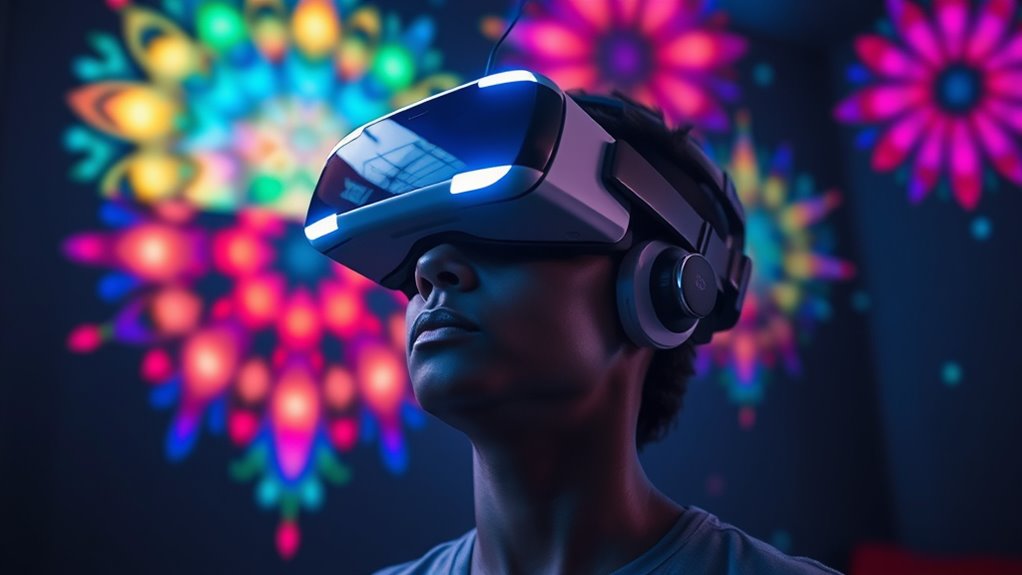

VR headsets stand out in 3D experiences by immersing you in richly detailed environments that engage your senses. Advanced graphics provide stunning visuals, while spatial audio enriches the soundscape, making interactions feel real. Real-time feedback and precise motion tracking allow for seamless user engagement, transforming passive viewing into immersive exploration. This unique blend of technology creates memorable moments and fosters a deep sense of presence. Discovering the vast applications of VR technology reveals even more exciting possibilities.
Immersive Environments: The Depth of Presence
As you step into a VR headset, you’re not just donning a device; you’re entering a meticulously crafted immersive environment that transcends the boundaries of reality. This virtual reality experience isn’t merely visual; it envelops you in layers of sensory immersion. Advanced graphics, spatial audio, and haptic feedback work in harmony to create a profound sense of presence. You’ll feel the weight of virtual objects and hear sounds emanate from specific directions, enhancing your perception of the space around you. It’s this depth of presence that liberates the mind, allowing you to explore new dimensions without physical constraints. By engaging multiple senses, VR doesn’t just simulate reality; it offers an escape, an unbounded freedom to experience and interact with your surroundings like never before.
Real-Time Interaction: Engaging With Virtual Worlds
In virtual environments, your ability to interact in real-time transforms how you experience the world around you. This immediate feedback enhances your spatial awareness, making every movement feel intuitive and natural. As you engage with these digital landscapes, the immersive experience deepens, blurring the line between reality and simulation.
Immersive User Experience
When you step into a virtual domain through a VR headset, the lines between reality and simulation blur, creating an immersive user experience like no other. This experience hinges on advanced user interface design, which allows you to navigate seamlessly within the digital environment. With intuitive controls and responsive visuals, your actions feel immediate and meaningful. Sensory feedback enhances this connection, as haptic technology provides tactile responses that simulate real-world interactions. The sensation of touching virtual objects or feeling the impact of a virtual event engages your senses, making the experience profoundly realistic. This level of immersion liberates you, enabling exploration and interaction in ways that traditional media simply can’t match. In this domain, your possibilities are virtually limitless.
Enhanced Spatial Awareness
Enhanced spatial awareness is a crucial element in engaging with virtual worlds through VR headsets. When you don a headset, it’s not just about visuals; it’s about how you navigate and interact within that space. Your spatial cognition is heightened, allowing you to perceive distances and relationships between objects more intuitively. This immersion enhances your ability to navigate environments seamlessly, fostering a sense of freedom as you explore. Real-time interactions become natural, as your movements translate directly into the virtual domain. This connection empowers you, letting you manipulate your surroundings and engage deeply with the experience. Ultimately, enhanced spatial awareness transforms passive viewing into an active exploration, redefining what it means to interact with digital landscapes.
Advanced Motion Tracking: Enhancing User Experience
Advanced motion tracking technologies are essential for refining your experience in virtual environments. With precise movement detection and real-time interaction capabilities, you’ll find yourself more immersed and engaged than ever before. This level of spatial awareness not only enhances realism but also allows for a more intuitive connection between you and the virtual world.
Precision in Movement Detection
As virtual reality continues to evolve, the precision in movement detection plays an essential role in ensuring an immersive user experience. With advanced motion sensing and precision calibration, VR headsets can track your every movement with remarkable accuracy. This level of detection allows you to explore virtual worlds as if they’re real, enhancing your sense of freedom.
- Feel the adrenaline rush when you dodge obstacles.
- Experience the thrill of flying through vast landscapes.
- Connect deeply with environments that respond to your every gesture.
- Release creativity in virtual spaces that adapt to your movements.
- Engage in activities that feel fluid and natural, breaking the barrier between virtual and reality.
Such precision transforms your interaction, making every moment in VR unforgettable.
Real-Time Interaction Capabilities
The precision in movement detection sets the stage for real-time interaction capabilities that redefine user engagement in virtual environments. With advanced motion tracking, your every gesture translates into seamless user interaction, creating a sense of presence that’s hard to replicate. As you reach out or pivot, the system captures your movements with remarkable accuracy, delivering instant virtual feedback. This responsiveness fosters a dynamic atmosphere where you can manipulate objects or navigate spaces intuitively. You’re not merely an observer; you’re an active participant, influencing the environment around you. Such capabilities enhance the immersive experience, allowing you to explore and interact freely, ultimately transforming how you perceive and engage with 3D worlds.
Immersive Spatial Awareness
When you step into a virtual environment, immersive spatial awareness becomes essential for an authentic experience. Advanced motion tracking technologies enhance your ability to navigate seamlessly, creating a sense of presence that feels liberating. By integrating sensory inputs, VR enables you to connect with your surroundings in a deeply engaging way.
- Feel the thrill of true exploration
- Experience the freedom of limitless movement
- Discover hidden pathways and secrets
- Engage with environments that respond to your actions
- Immerse yourself in a world that feels alive
These elements of virtual navigation and sensory integration not only elevate your experience but also empower you to interact meaningfully. It’s this blend of technology and emotional resonance that makes VR truly unique.
Spatial Audio: Creating a Surround Sound Experience
While many VR experiences focus on visual immersion, spatial audio plays an essential role in enhancing the overall realism of 3D environments. By utilizing positional audio, soundscapes design becomes a powerful tool, allowing you to perceive sound from different directions and distances. This creates a more authentic experience, as you can hear footsteps approaching from behind, or birds chirping overhead.
Here’s a quick overview of how spatial audio enhances your VR experience:
| Feature | Description | Impact |
|---|---|---|
| Positional Audio | Sound changes with your movement | Increases immersion |
| Directional Sound | Sounds come from specific angles | Enhances realism |
| Environment Sounds | Layered ambient noises | Creates believable soundscapes |
| Interactive Audio | Sounds respond to your actions | Encourages exploration and engagement |
Visual Fidelity: The Role of Graphics in VR
How does visual fidelity impact your immersion in virtual reality? The quality of graphics plays an essential role in how you perceive and interact with virtual environments. Higher visual realism enhances your experience, making it feel more authentic and engaging. Graphics optimization guarantees that these visuals run smoothly, reducing lag and distractions.
- You can lose yourself in breathtaking landscapes.
- Every detail feels tangible and alive.
- Emotions deepen as characters respond realistically.
- You can explore worlds that inspire freedom.
- The thrill of adventure becomes palpable.
In VR, the connection between you and the environment hinges on these graphical elements, making visual fidelity not just a technical aspect, but a significant component of your immersive journey.
Diverse Applications: Beyond Gaming and Entertainment
As industries increasingly recognize the potential of VR technology, its applications extend far beyond gaming and entertainment. VR’s versatility shines in fields like education and therapy, offering immersive experiences that enhance learning and healing.
| Application Type | Description | Example |
|---|---|---|
| Educational Simulations | Engaging environments for learning | Virtual history tours |
| Therapeutic Applications | Tools for mental health recovery | Exposure therapy for phobias |
| Architectural Visualization | Realistic walkthroughs of designs | Virtual property tours |
| Training Simulations | Safe environments for skill development | Flight simulators for pilots |
| Social Interaction | Connecting people in virtual spaces | Virtual meetups and conferences |
These diverse applications showcase VR’s potential to transform how we learn, heal, and connect, opening new avenues for personal and professional growth.
The Future of VR Technology: Trends and Innovations
With the rapid evolution of technology, the future of VR is poised to bring about groundbreaking trends and innovations that could redefine user experiences. You’ll witness remarkable technology advancements that enhance immersion and interactivity, paving the way for future applications that are limited only by imagination.
The future of VR promises transformative innovations that will redefine user experiences and expand the horizons of imagination.
- Seamless integration with AI for personalized experiences
- Hyper-realistic haptics that mimic real-world sensations
- Multisensory environments that engage sight, sound, and touch
- Wireless capabilities for complete freedom of movement
- Collaborative VR spaces for social interaction and teamwork
These innovations promise to transform how you connect, learn, and create, ultimately reshaping the landscape of virtual reality and empowering your freedom to explore new dimensions.
Frequently Asked Questions
How Do VR Headsets Compare to Traditional Gaming Consoles?
VR headsets offer immersive gameplay that traditional consoles can’t match, enhancing your user experience. You feel like you’re part of the game, interacting with environments in ways that standard screens simply can’t replicate.
Can VR Be Used for Educational Purposes?
Yes, VR can revolutionize education through immersive learning and virtual classrooms. While some might doubt its effectiveness, it actually fosters engagement and retention, offering students a dynamic environment that traditional methods simply can’t match.
What Are the Health Risks of Using VR Headsets?
Using VR headsets can lead to motion sickness and eye strain due to the disconnect between visual input and physical movement. It’s essential to take breaks and adjust settings to minimize discomfort and enhance your experience.
How Expensive Are VR Headsets and Accessories?
VR headsets can range from $200 to over $1,000, depending on features. When you factor in accessory prices, like controllers and storage, budget considerations become essential for a fulfilling experience without breaking the bank.
What Are the Best VR Headsets Currently Available?
If you’re seeking the best VR headsets, consider the Meta Quest 3 or Valve Index. These devices leverage virtual reality advancements to provide stunning visuals and immersive gaming experiences, enhancing your freedom to explore virtual worlds.
