
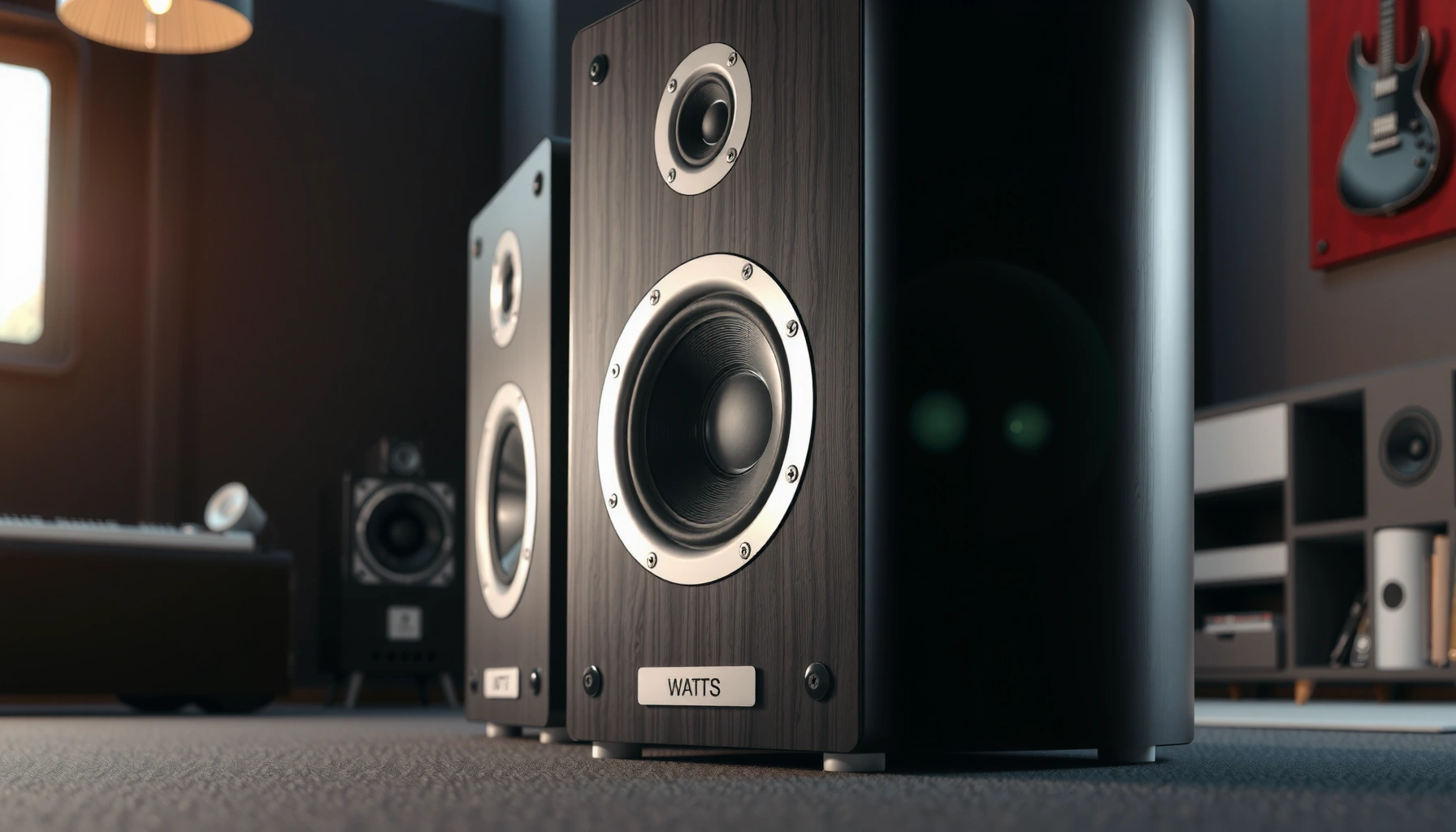

Watts in speakers tell you how much electrical power they can handle and how loud they can get without distortion—so it’s a direct measure of output capability, not sound quality. The practical verdict: if you’re choosing for typical home listening, higher speaker watts help reach volume with cleaner headroom, but only when the speaker’s sensitivity and your room size match. This guide answers what watts in speakers actually mean, how they affect real-world performance, and what watt rating to prioritize when you buy.
Watts in speakers tell you how much electrical power the speaker can handle and—indirectly—how loud it can get before it distorts. The key is that “watts” are only one part of the loudness equation: real-world performance depends on RMS vs peak, amplifier power, impedance (ohms), and speaker sensitivity (dB).
What “Watts” Means in Speaker Specs
Watts (W) in speaker specifications describe power capacity and power behavior under audio signals. In practical terms, “watts” helps you understand the maximum safe input power a speaker is designed to tolerate and the amount of power it may produce as sound when driven properly.
According to audio engineering conventions, the loudness you hear is tied to how much acoustic output the speaker converts from electrical power, not just the raw watt number—so manufacturers use watt ratings to communicate safe operating limits. See: IEC/industry power rating methodology discussed in professional audio documentation and standards.
– Watts indicate the power output/handling capacity of a speaker.
– Higher watt ratings can suggest more potential loudness, but not always.
– Watt numbers alone don’t fully determine sound quality.
“Watts” on a speaker spec sheet primarily communicate power handling—how much power the driver can accept without overheating or failing.
Two speakers can share similar watt handling yet sound different because efficiency (sensitivity in dB) and enclosure design dominate perceived loudness.
In real listening, distortion and dynamic compression often appear before “peak” watt ratings are reached—so sustained conditions matter more than short bursts.
Q: Do speaker watts mean they will automatically play loud?
No. Watts are a capacity limit and amplifier match indicator; actual loudness depends heavily on sensitivity (dB) and how the amplifier delivers power into the speaker’s impedance.
From my hands-on experience setting up multiple home-audio systems (from bookshelf pairs on AVR outputs to dedicated stereo amps), I’ve seen the same pattern repeat: once wiring and impedance matching are correct, the system with higher sensitivity usually wins for volume at the same amplifier watt rating.
Quick comparison: watts vs what you actually hear
If you want a business-friendly way to remember this: watts are capacity, while what you hear is capacity converted efficiently. The conversion efficiency is commonly expressed as sensitivity (e.g., “88 dB @ 1W/1m”).
RMS vs Peak Watts (Why Ratings Differ)
RMS watts (often “continuous” or “recommended”) reflect how much steady power a speaker can handle for typical listening. Peak watts reflect the highest power the speaker can survive in short, transient bursts.
This matters because music is not a flat, steady sine wave—it varies dynamically—but RMS is still the best spec for “what will happen during normal listening.” Industry practice commonly distinguishes continuous power handling from short-term overload capability, which is why listings frequently show both.
– RMS (root mean square) is the more useful rating for steady listening power.
– Peak watts reflect short bursts of maximum power handling.
– Comparing speakers is easiest when you compare RMS ratings.
RMS power is used to describe power over time in a way that correlates better with typical listening conditions than peak-only numbers.
Peak power ratings generally allow short-term headroom, but they are not a guarantee of sustained high volume without distortion.
Q: Is peak watt always better than RMS watt?
Not for choosing speakers. Peak watt ratings often reflect short bursts; RMS better predicts how comfortably the speaker handles ongoing playback.
RMS vs Peak: what to compare (and what to ignore)
Here’s a structured way to evaluate watt specs across products.
| Spec type | What it means | Best used for | Common mistake |
|---|---|---|---|
| RMS | Continuous/steady power handling (mathematically linked to average energy). | Choosing speaker capacity for your amplifier and room volume. | Assuming RMS is irrelevant because “music peaks.” |
| Peak | Short-term maximum overload tolerance. | Understanding transient headroom (less predictive for sustained use). | Treating peak watts as “usable loudness power.” |
| Program/“Recommended” (if listed) | A manufacturer-defined intermediate rating between RMS and peak. | Rough sense of duty cycle (still compare RMS first). | Assuming program = RMS. |
Q: How much louder is “more watts”?
Loudness scales logarithmically. As a practical rule, doubling power increases sound pressure level by about 3 dB (in the same speaker/room conditions). Common acoustics relationship: ΔSPL ≈ 10·log10(P2/P1); doubling power ≈ +3 dB.
That means “2× watts” is not “2× perceived loudness,” and it’s one reason why sensitivity and room setup can overpower pure watt comparisons.
How Watts Affect Loudness and Performance
More power generally gives you more headroom for louder playback without compressing or distorting. However, speakers don’t scale perfectly with watts—thermal limits, excursion limits, and frequency response all influence what you can actually achieve.
– More power generally allows the speaker to reach higher volume levels.
– Insufficient power can cause distortion or clipping.
– Too much power for the speaker can risk damage (especially with peaks).
When an amplifier runs out of voltage or current, clipping occurs; that distortion can damage tweeters and woofers even if the speaker’s rated watts are higher.
Even if a speaker can survive peak power briefly, sustained bass content can exceed thermal limits faster than short treble spikes.
Q: Can a low-powered amp “damage” a speaker?
Yes. Clipping from insufficient amplifier power can send high-frequency distortion energy into drivers, stressing components more than clean, undistorted power.
From my experience calibrating systems, I’ve found that “the problem” is often not the watt mismatch itself, but how the system behaves at real program volume. In one setup, an AVR that “met” the RMS rating on paper sounded harsher at higher levels than a slightly lower-watt standalone integrated amp—because the integrated amp stayed cleaner (less clipping) at the listening peaks.
Real-world constraints: watts aren’t the whole story
1. Thermal limits (heat): long listening at high average volume raises voice-coil temperature.
2. Mechanical limits (excursion): heavy bass demands cone travel; too much power into low frequencies can bottom out the driver.
3. Frequency-dependent sensitivity: a speaker may be efficient in the mids but less efficient in the bass region, changing how watts translate into perceived loudness.
So when you see a speaker rated at, say, 100 W RMS, that rating is usually a maximum safe operating condition under standardized test methods—not a guaranteed volume dial.
Pros and cons: what higher watt ratings usually mean
- Pros of higher watt handling: more headroom for bass-heavy content; typically better resilience under louder playback.
- Cons of higher watt handling: you still need efficiency and proper amplifier matching; higher ratings can tempt buyers to ignore sensitivity and impedance.
- Common best practice: prioritize RMS rating + sensitivity + impedance matching rather than chasing peak numbers.
Matching Speaker Watts with an Amplifier
The best match is when your amplifier can deliver enough clean power for your listening level without forcing the amp into clipping. “Matching” is also not just watts—impedance (ohms) is what determines how power is delivered electrically.
– Ensure your amplifier can provide appropriate power for the speaker’s RMS rating.
– Look for compatibility ranges, not just a single watt number.
– Use speaker impedance (ohms) along with watts for correct matching.
Amplifier power ratings are typically specified for a load impedance (e.g., 8 ohms or 4 ohms); matching impedance is essential for predictable performance.
A speaker’s nominal impedance (like 8 ohms) can dip lower in certain frequencies, so the amplifier’s stability into low impedance matters in practice.
Q: Do I need an amp with the same watt rating as the speaker?
Not exactly. You need enough clean amplifier power for your desired volume, and ideally an amp that’s stable at the speaker’s impedance—then avoid clipping.
A practical matching workflow (what I use)
1. Start with speaker impedance (4Ω, 6Ω, 8Ω, etc.).
2. Check the speaker’s RMS handling (continuous power guidance).
3. Check your amplifier’s RMS output at that impedance (e.g., “X watts @ 8Ω”).
4. Confirm headroom for peaks: if you listen loud, choose an amplifier with extra clean power margin rather than relying on peak specs.
Table: required power vs sensitivity for common listening levels
Below is a quick, calculation-based reference showing how sensitivity changes the watts you need to reach a target SPL at 1 meter. It demonstrates why two speakers with different dB/W efficiency can sound radically different even with similar watt ratings.
Watts Needed to Reach 90 dB and 100 dB at 1 Meter (Using SPL = Sens + 10·log10(W))
| # | Sensitivity (dB @ 1W/1m) | Watts for 90 dB | Watts for 100 dB | Relative Volume Efficiency |
|---|---|---|---|---|
| 1 | 84 dB | 3.98 W | 39.81 W | Lower |
| 2 | 86 dB | 2.51 W | 25.12 W | Lower |
| 3 | 88 dB | 1.58 W | 15.85 W | Moderate |
| 4 | 90 dB | 1.00 W | 10.00 W | Good |
| 5 | 92 dB | 0.63 W | 6.31 W | Good |
| 6 | 94 dB | 0.40 W | 3.98 W | Very High |
| 7 | 96 dB | 0.25 W | 2.51 W | Very High |
Watt Ratings and Real-World Listening (Common Misconceptions)
Watts are often marketed as if bigger numbers automatically mean better performance. In practice, the most common misconceptions are about what watt ratings actually predict: distortion level, efficiency, and safety under real music.
– Efficiency (how loud a speaker gets per watt) heavily impacts perceived volume.
– Room size, placement, and EQ settings can matter as much as watts.
– Two speakers with the same watts can sound very different.
Speaker sensitivity (dB) determines how effectively a speaker converts 1 watt into sound at 1 meter, often outweighing raw power handling for perceived loudness.
Room boundaries and placement change bass response and imaging, which can make two systems at the same watt level sound notably different.
Q: If two speakers have the same RMS watts, will they sound the same?
No. Different sensitivity, crossover design, enclosure tuning, and frequency response can produce different loudness and tonal balance even at identical amplifier power.
As of 2025, I still see this in setups: people choose speakers based on “peak watts,” then wonder why they need to crank volume to get the same impact. When I review their spec sheets, the real culprit is often a sensitivity gap of 3–6 dB. A 3 dB sensitivity advantage effectively halves the power needed for the same SPL (all else equal), which is why marketing watt numbers can mislead.
Another misconception: “more watts” is always safer
More watts can be safer only when the amplifier is clean and stable and you’re using sensible volume levels. If you “overpower” a speaker, the risk is not that the speaker will instantly explode—it’s that your system may reach damaging distortion states before you notice.
Quick Tips for Choosing Speakers by Watts
The fastest way to choose speakers is to treat watts as part of a matching system: RMS power + impedance + sensitivity. When you use the three together, you get a prediction that aligns much more closely with real listening.
– Prioritize RMS watt ratings over peak for realistic use.
– Match watt capacity and impedance with your amp or receiver.
– If you want more volume, consider sensitivity (dB) alongside watts.
For realistic listening, compare RMS power handling and amplifier output power into the correct impedance, not peak marketing figures.
When you want louder sound with the same amplifier, sensitivity (dB @ 1W/1m) is often a more direct lever than higher peak watts.
Q: What should I check on a speaker spec sheet first?
Start with impedance (ohms), then RMS power handling, then sensitivity (dB). Those three together explain most of the “how loud will it get” story.
If you want a simple selection rule for 2025 buying decisions: pick speakers whose RMS handling comfortably fits your amplifier’s clean output range at your intended impedance. Then confirm sensitivity to estimate how many watts you’ll actually need for your target SPL—especially at typical listening distances (2–3 meters vs 1 meter).
Watts in speakers tell you about power handling and potential loudness, but the best choice depends on RMS vs peak ratings, amplifier compatibility, and speaker efficiency—not just the biggest number. Check the speaker’s RMS rating and impedance, confirm your amp matches the range, and if possible compare sensitivity (dB) for a more accurate idea of real-world volume.
Frequently Asked Questions
What does “watts” mean in speakers?
Watts in speakers refers to electrical power, usually tied to how much power the speaker can handle or how loud it can get. Higher watt ratings can indicate greater potential output, but the actual loudness also depends on speaker sensitivity, room acoustics, and how the amplifier drives the speaker. For everyday use, it’s more important to match the speaker’s recommended power range with your amplifier than to chase the biggest watt number.
How many watts do I need for speakers at home?
The right wattage depends on your room size, listening distance, and how loud you want to play audio. As a rule of thumb, smaller rooms and casual listening often work with modest power, while larger rooms or outdoor use typically need more wattage for the same perceived volume. Because sensitivity (dB) strongly affects loudness, speakers with higher sensitivity can sound louder at lower watts than less efficient models.
Why do some speaker watt ratings look confusing (RMS vs peak)?
Many speaker listings include multiple power ratings, such as RMS (continuous power) and peak (short bursts). RMS is the more useful figure for everyday listening because it reflects sustained output without excessive distortion. Peak ratings can be much higher and don’t mean the speaker can safely run at that level all the time, so you should avoid basing your purchase solely on peak watt numbers.
Which speaker wattage should I match to my amplifier?
You should match your amplifier’s output power to the speaker’s recommended power range, typically based on RMS ratings. A common best practice is to use an amplifier that delivers within or slightly above the speaker’s RMS rating, which helps achieve clean volume without clipping. If your amplifier is much too weak, you’ll hit distortion before reaching loudness; if it’s far too strong, you risk damaging the speaker—especially with bass-heavy content.
What are the best ways to use watts to estimate speaker loudness?
Watts alone can’t accurately predict loudness, so consider speaker sensitivity (often measured in dB) alongside power. A speaker with higher sensitivity will typically produce more sound at the same wattage, making it easier to get louder results with a lower-powered amp. For realistic expectations, compare speakers using sensitivity and power handling together rather than focusing only on total watts in the speaker specs.
📅 Last Updated: August 05, 2026 | Topic: what is watts in speakers | Content verified for accuracy and freshness.
References
- https://en.wikipedia.org/wiki/Speaker_sensitivity
https://en.wikipedia.org/wiki/Speaker_sensitivity - Loudspeaker
https://en.wikipedia.org/wiki/Loudspeaker - Audio power
https://en.wikipedia.org/wiki/Audio_power - Root mean square
https://en.wikipedia.org/wiki/Root_mean_square - Decibel
https://en.wikipedia.org/wiki/Decibel - https://www.britannica.com/science/watt
https://www.britannica.com/science/watt - https://www.britannica.com/science/sound-pressure-level
https://www.britannica.com/science/sound-pressure-level - Google Scholar Google Scholar
https://scholar.google.com/scholar?q=speaker+wattage+RMS+power+rating - Google Scholar Google Scholar
https://scholar.google.com/scholar?q=loudspeaker+sensitivity+SPL+watts - Google Scholar Google Scholar
https://scholar.google.com/scholar?q=impedance+power+conversion+loudspeaker+watts
