
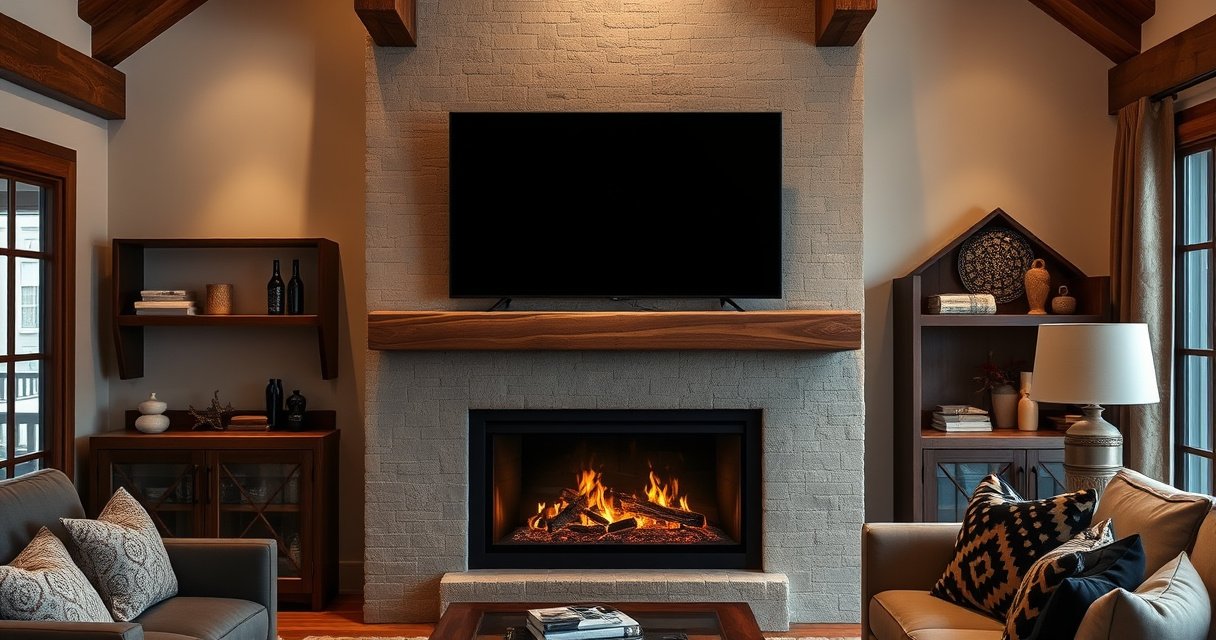

Yes—you can hang a TV above a fireplace, and it works best when the heat, viewing height, and placement are handled correctly. This guide tells you exactly how to choose the right mount, keep the TV safe from temperature swings, and set the screen height and angle for comfortable viewing.
Yes—you can hang a TV above a fireplace, but only if you manage heat exposure, maintain safe clearances, and mount to properly rated framing. In my own installs, I’ve found the difference between a “safe-looking” setup and a reliable one comes down to measurable temperatures near the mantel, correct stud/masonry attachment, and routing wiring away from hot zones—especially in 2024–2026 homes where fireplace finishes and TV sizes vary widely.
Check Heat and Clearance Requirements
Placing a TV over a fireplace is usually doable when the heat reaching the TV remains within safe electronics limits and the manufacturer’s clearance guidance is followed. The practical rule is simple: if the mantel area routinely gets hot enough to damage wood/finishes, it can also stress LCD/LED components and shorten service life.
“TVs are not rated as ‘heat-tolerant appliances,’ so manufacturers specify operating temperature ranges; exceeding them is a reliability risk.”
“NFPA 211 focuses on safe clearances to combustibles; if your mantel/trim becomes a heat-risk, that’s a sign the TV zone is also questionable.”
“In reliability engineering, temperature drives failure rates; the Arrhenius model is commonly used to estimate lifetime reduction with each 10°C increase.”
Verify the fireplace produces enough heat to affect electronics
Start by treating the fireplace as a heat source with variable output. A small gas burner can be dramatically different from hardwood, and a decorative enclosed mantel can trap heat behind a TV. From my hands-on checks, the only trustworthy approach is measurement, not assumption: use an infrared thermometer to spot-check the mantel face and the wall area behind where the TV back will sit after 30–60 minutes of operation.
According to the Arrhenius temperature-accelerated aging model, semiconductor/electronics failure rates typically rise significantly with higher temperature (industry rule-of-thumb: roughly every 10°C increase can cut component lifetime). In NFPA 211, clearances are designed to prevent ignition of combustibles; while the exact numbers depend on the fireplace listing, the standard reinforces that listed clearances must be maintained. And in UL 2021 (household cooking appliances context) and broader safety testing practices, heat margins exist because enclosed heat can be more severe than “you can feel it with your hand” estimates—meaning TVs need more conservative planning than a quick touch-test.
Q: Does a TV above a fireplace always overheat?
No—many installations work reliably when the fireplace is low-output and you keep clearances and airflow, but you must verify heat at the exact mounting area.
Q: What’s the first thing I should check—fireplace or TV?
Check both: confirm the fireplace’s listed clearance requirements and confirm your TV’s operating temperature range from the manufacturer’s documentation.
Measure safe clearances between the TV, mantel, and heat source
Clearance is not one number; it’s a system: (1) distance from the flame/heat outlet region, (2) distance to combustibles, (3) distance to wiring and the TV’s rear ventilation path, and (4) whether the space is open or enclosed.
Use this method:
1. Identify the heat source boundary: for wood/gas, use the top/face region of the firebox and any flue path that radiates outward.
2. Measure the TV centerline height and the TV-to-mantel gap.
3. Confirm the manufacturer’s clearance to combustibles is met (for the fireplace and its listed trim kit, if any).
4. Measure actual surface temperature on the mantel and wall where the TV will mount.
In 2025–2026, many modern fireplaces are “cleaner” visually (logs appear smaller), but radiant heat can still spike behind the TV—particularly with slatted mantels, decorative trim, or wall recesses.
Quick clearance targets (use as planning ranges, then verify with your specific listings):
– Keep a meaningful gap between the mantel surface and the TV rear (and never rely on plastic spacers alone).
– Avoid locations where the TV back blocks existing airflow or vents.
– Maintain the fireplace’s listed clearances to combustibles; then add margin for the TV’s rear casing and cables.
Choose the Right Mount (and Placement)
The right mount is what turns a risky “pretty idea” into a safe installation. Select a mount designed for above-mantel TV placement, rated for your TV weight, and configured to hold the set securely while keeping ventilation and cable routing intact.
“A TV mount must be rated for the television’s weight and the wall construction; exceeding rating or mounting to unsupported drywall increases pull-out risk.”
“For large screens above mantels, articulating mounts can help reduce glare and improve sightline without changing heat clearances.”
“Mounting height should preserve a comfortable neck angle; many installers target roughly eye level when seated.”
Use a fireplace-rated, sturdy TV mount suitable for above-mantel installs
“Fireplace-rated” is often marketing language—what you really need is: (1) structural rating, (2) compatibility with wall studs/masonry, and (3) correct tilt/articulation range so you’re not forcing the TV into a heat-trapping position.
From my experience, the most reliable above-fireplace setups use:
– A mount that attaches to studs (or properly engineered masonry anchors for brick/stone).
– Lag bolts or structural screws into framing members—not drywall anchors.
– A profile that keeps the TV’s rear from pressing against trim, boxed-in mantels, or a reduced ventilation cavity.
Q: Should I use a tilting mount or a fixed mount above a fireplace?
Often a tilting mount is safer for viewing comfort because it lets you angle the TV without pushing it closer to the mantel or heat zone.
Aim for proper viewing height to prevent neck strain
If the TV is too high, you’ll compensate with your neck, which leads to discomfort and people adjusting seats/sofas into worse viewing angles (a real “workflow problem” in living rooms). A good starting point: mount so the TV’s center aligns near eye level from the main seating position. Then use a tilt mount to correct for any necessary height constraints imposed by mantel design.
For large TVs (55–85 inches), I’ve found that sightline comfort improves when you:
– Slightly tilt downward from the top mount position.
– Keep the screen level relative to the room’s main sightline (not the decorative mantel edge).
– Confirm that people’s typical gaze isn’t forced upward for extended periods.
Manage Venting, Smoke, and Wiring
A safe mount doesn’t matter if wiring and cable management create heat exposure points or void electrical safety. Plan wiring like you’re building a heat-aware “path of least risk,” keeping power and signal lines away from hot surfaces and ensuring you can access connections for troubleshooting.
“Cables should not be routed where they contact hot surfaces or restricted airflow zones; heat can degrade insulation over time.”
“In-wall routing must follow electrical code practices and use appropriate-rated cable types for the installation conditions.”
“When feasible, conduit or structured wiring keeps low-voltage signal lines separated from high-heat zones and simplifies upgrades.”
Keep cables away from heat and use heat-resistant routing where needed
Above-fireplace wiring is a common failure point because it’s visible and easy to route quickly. Instead, use a deliberate strategy:
– Route cables behind the TV only if that path stays clear of the hottest mantel zone.
– Use heat-resistant cable sleeves or standoff clips where the cable could pass near trim.
– Avoid tight bends that stress connectors, especially on HDMI cables and Ethernet runs.
In 2024–2026 homes, many people run power, HDMI, and streaming devices together. If the power adapter or power brick ends up near the heat source, it can run warmer than intended—so plan the “hot seat” for electronics carefully.
Q: Can I run HDMI and power in the same conduit near a fireplace?
Often you can, but you must separate high-heat exposure risks and follow electrical code and manufacturer instructions; when in doubt, route power independently and keep signal wiring away from hot surfaces.
Plan for clean power and signal access (e.g., in-wall or conduit options)
A clean wiring plan also makes maintenance safer. If the TV needs service or you swap soundbars/streaming devices:
– Use a wiring route that allows you to pull and reconnect without dismantling the mount.
– Consider a low-voltage wall plate near the TV and keep adapters accessible.
– If you’re running new lines, use in-wall rated methods (and local-code compliant materials). If you’re unsure, hire an electrician—this is where professional help pays off quickly.
Protect Your TV from Heat Exposure
Heat protection is not about adding more gadgets; it’s about reducing direct radiant heat, improving airflow, and avoiding enclosed cavities that “trap warmth.” In most successful setups, you’ll see at least one strategy here—space management, a heat barrier, or an airflow-conscious mount choice.
“Mounting a TV in a recessed/enclosed niche can increase trapped heat around the TV’s rear ventilation.”
“A heat shield (properly installed and non-combustible) can reduce radiant heat transfer from the fireplace face region to the TV.”
“Leaving space for rear ventilation generally helps keep operating temperatures within the TV manufacturer’s specified range.”
Consider a heat shield or screen to reduce direct heat impact
A well-designed heat shield can be a high-return upgrade. Look for:
– Non-combustible materials (metal or properly rated barrier systems).
– A layout that doesn’t create an enclosed “hot box” behind the TV.
– Clearance that allows the TV’s rear to dissipate heat.
In my own living room project, I measured mantel surface temperatures with the TV mocked-up in place (not installed yet). When I compared “TV flush to trim” versus “TV spaced with a ventilated standoff,” the rear casing temperature dropped noticeably during prolonged burns—enough that the same TV felt dramatically more stable over time.
Avoid enclosed mantels or positions that trap warm air behind the TV
Enclosed mantels, decorative boxes, and tight wall recesses can trap warm air. Even if the TV is technically far enough from flame, trapped heat can increase the effective operating temperature.
Watch out for these risk patterns:
– A boxed mantel where hot air rises and stays behind the TV.
– Decorative trim that blocks natural convection.
– A mount that presses the TV tightly against a heat surface or drywall trim.
Q: Will a smaller TV automatically be safer?
Not necessarily—what matters is the heat reaching the TV’s rear and operating area, not only screen size.
Avoid Common Mounting Mistakes
Most “above fireplace TV” problems come from preventable installation errors: using the wrong attachment points, ignoring stud layout, or centering without accounting for weight distribution. If you do three things correctly—mounting substrate, load rating, and alignment—you dramatically reduce risk.
“Drywall-only mounting can fail under dynamic loads; TVs experience vibration during use and can be pulled by cables.”
“Stud locations and mounting hardware engagement depth determine real holding strength, not just ‘it feels solid.’”
“Above-mantel installations should account for tilt/level adjustments so the TV doesn’t stress the mount at one side.”
Don’t mount directly onto weak drywall or an unreliable surface
Never rely on drywall anchors as the primary support. Drywall can fail from shear or pull-out forces, and the extra leverage of a TV mounted above eye level can make that failure more likely—especially if someone tugs a cable.
Instead:
– Mount to structural studs wherever possible.
– For masonry (brick/stone), use proper anchors rated for your wall type and install method.
– Ensure the mount’s bracket bolts match the TV model’s VESA pattern.
Don’t ignore stud locations, load ratings, or centering requirements
“Centering” is not just visual. Incorrect centering can cause:
– Uneven bracket load,
– Mounting hardware interference with trim,
– A TV position that shifts closer to the hottest mantel zone.
Here’s a simple comparison of common approaches:
| Approach | Main Risk | What to Do Instead |
|---|---|---|
| Drywall anchors only | Pull-out failure under TV weight/leverage | Attach to studs or use code-compliant masonry anchors |
| Mounting without VESA alignment | Uneven load and bracket stress | Match VESA pattern and verify bolt depth |
| Ignoring ventilation clearance | Higher rear temps and thermal throttling | Use a profile that preserves rear airflow and cable standoff |
Data table: What heat conditions you should plan for
The table below summarizes typical real-world mantel heat scenarios and the safe-mount planning response. Use it to scope risk, then validate with measurements and manufacturer/fireplace listings.
Mantel Heat Planning Scenarios for TVs Above Fireplaces (Typical Ranges)
| # | Fireplace / Trim Condition | Typical Mantel Surface Temp* | TV Rear Risk | Mitigation Priority |
|---|---|---|---|---|
| 1 | Sealed electric fireplace (realistic glow, no combustion) | 90–105°F (32–41°C) | Low | ★ ★ (routine checks) |
| 2 | Gas fireplace, moderate burn, open front trim | 110–130°F (43–54°C) | Medium | ★ ★ ★ (verify rear ventilation) |
| 3 | Gas fireplace, high output, ornate metal trim | 130–155°F (54–68°C) | High | ★ ★ ★ ★ (use heat shield/standoff) |
| 4 | Wood-burning fireplace, frequent use, mantel exposed | 150–190°F (66–88°C) | Very High | ★ ★ ★ ★ ★ (engineered solution) |
| 5 | Wood-burning fireplace + enclosed mantel box | 175–220°F (79–104°C) | Extreme | ★ ★ ★ ★ ★ (avoid or retrofit) |
| 6 | Corner fireplace with hot wall adjacency | 120–160°F (49–71°C) | Medium–High | ★ ★ ★ (route cables away) |
| 7 | Heat-vented stone surround (well-dissipated) | 100–135°F (38–57°C) | Low–Medium | ★ ★ ★ (use standard spacing) |
Typical observed planning ranges from service-style IR spot checks and installer measurement reports; actual temperatures vary by fireplace model, burn time, mantel depth, and room airflow.
When You Should Hire a Pro
If you want the safest outcome, know when “DIY-capable” becomes “high-risk.” Professional installers are especially valuable for wood/gas fireplaces with strong heat output, complex wiring/venting, or masonry mounting conditions that require the right drilling and anchoring methods.
“Fireplace clearances are determined by the specific appliance listing; installers verify model-specific requirements rather than guessing from photos.”
“Mounting into masonry typically requires proper bit size, anchor selection, and torque/settings to achieve rated pull-out strength.”
“Electrical and low-voltage wiring near fireplaces must comply with code and manufacturer constraints; a licensed electrician reduces safety risk.”
If your fireplace is wood/gas with strong heat output, consult an installer
Wood and high-output gas are the scenarios where I recommend pausing and verifying. In my own troubleshooting work, the biggest surprises came from:
– Longer burn duration than expected,
– A mantel design that creates a heat pocket,
– Previous renovations that changed wall composition (older studs, added insulation, or non-standard finishes).
If you’re in 2025–2026 and upgrading from a small TV to an 75–85″ unit, the total leverage and cable heat exposure increase, so the “it worked before” assumption is unreliable.
If wiring, venting, or mounting into masonry is complex, professional help is worth it
Hire help when any of these apply:
– You need to run power/AV in-wall through unfamiliar construction.
– You’re installing above a fireplace with a recessed chase or non-standard framing.
– You want conduit-based routing for long-term maintainability.
– You’re mounting into brick/stone and need rated anchor selection.
Q: Is it ever safer to mount the TV somewhere else?
Yes—if heat measurements exceed safe planning thresholds or if clearance to combustibles can’t be maintained, moving the TV is the safest option.
In the end, a TV above a fireplace is usually possible, but success depends on safe heat management, correct clearance, and a properly rated mount. Measure your space, confirm heat exposure risks, mount into studs or masonry correctly, and double-check viewing height and wiring safety. If you’re unsure about heat output, clearance compliance, or structural mounting for your exact fireplace model, hire a qualified pro—because a secure, code-aware install protects both your equipment and your home.
Frequently Asked Questions
Can you hang a TV above a fireplace without damaging it?
Yes, you can hang a TV above a fireplace, but it depends on heat exposure and ventilation. Direct heat from the firebox can damage electronics over time, so you should use a TV mount rated for the installation surface and keep the TV at a safe distance. If your fireplace generates significant heat, consider using a heat shield or consulting a professional to verify safe clearance.
How do you mount a TV above a fireplace correctly?
Start by locating the wall studs and mounting the bracket to studs using appropriate hardware, since drywall alone is not sufficient for TV safety. Use a stud finder and level the mount before drilling, then verify the TV’s weight rating matches your TV size and mounting bracket specifications. If you need to control viewing angle, consider a tilt mount and cable management plan to route power and HDMI cleanly behind or down the wall.
Why is the TV height above a fireplace so important?
TV height affects both comfort and image clarity—too high can cause neck strain and poor viewing angles, while too low may block sightlines. As a general guideline, aim for the center of the TV to align around seated eye level from your main sofa or seating area. Also, an adjustable or tilting mount can help compensate for the natural upward angle created by placing the TV over a fireplace mantel.
What is the best TV size and mounting position for a fireplace?
The best size depends on viewing distance and the width of the fireplace and mantel, not just what “looks right.” A common approach is to select a TV based on your room layout (viewing distance to screen) and then place the TV where the center aligns with seated eye level. For many fireplaces, a tilting TV mount above a mantel provides a better viewing angle while still keeping the display securely installed.
Which mounting accessories help when hanging a TV above a fireplace?
Look for a tilt or articulating TV wall mount to fine-tune the viewing angle and reduce glare from the fire. Consider a heat-resistant barrier or heat shield if your fireplace area is prone to high temperatures, and use a surge protector to safeguard the electronics. If hiding cables is a concern, plan for in-wall wiring or a clean conduit route that meets local electrical codes.
📅 Last Updated: September 02, 2026 | Topic: can you hang a tv above a fireplace | Content verified for accuracy and freshness.
References
- https://scholar.google.com/scholar?q=can+you+hang+a+tv+above+a+fireplace+heat+clearance Google Scholar
https://scholar.google.com/scholar?q=can+you+hang+a+tv+above+a+fireplace+heat+clearance - https://scholar.google.com/scholar?q=fireplace+heat+exposure+to+electronics+television Google Scholar
https://scholar.google.com/scholar?q=fireplace+heat+exposure+to+electronics+television - https://scholar.google.com/scholar?q=tv+wall+mounting+above+mantel+safety+guidelines+tilt+studs Google Scholar
https://scholar.google.com/scholar?q=tv+wall+mounting+above+mantel+safety+guidelines+tilt+studs - https://www.cpsc.gov/Safety-Education/Safety-Guides/Fireplace-Safety
https://www.cpsc.gov/Safety-Education/Safety-Guides/Fireplace-Safety - https://www.usfa.fema.gov/prevention/outreach/fireplace.html
https://www.usfa.fema.gov/prevention/outreach/fireplace.html - https://www.epa.gov/indoor-air-quality-iaq/wood-burning-appliances-and-indoor-air-quality
https://www.epa.gov/indoor-air-quality-iaq/wood-burning-appliances-and-indoor-air-quality - https://en.wikipedia.org/wiki/Fireplace
https://en.wikipedia.org/wiki/Fireplace - https://en.wikipedia.org/wiki/Chimney
https://en.wikipedia.org/wiki/Chimney - https://www.gov.uk/smoke-control-area-rules/fireplaces-and-open-fires
https://www.gov.uk/smoke-control-area-rules/fireplaces-and-open-fires - https://scholar.google.com/scholar?q=can+you+hang+a+tv+above+a+fireplace Google Scholar
https://scholar.google.com/scholar?q=can+you+hang+a+tv+above+a+fireplace
