
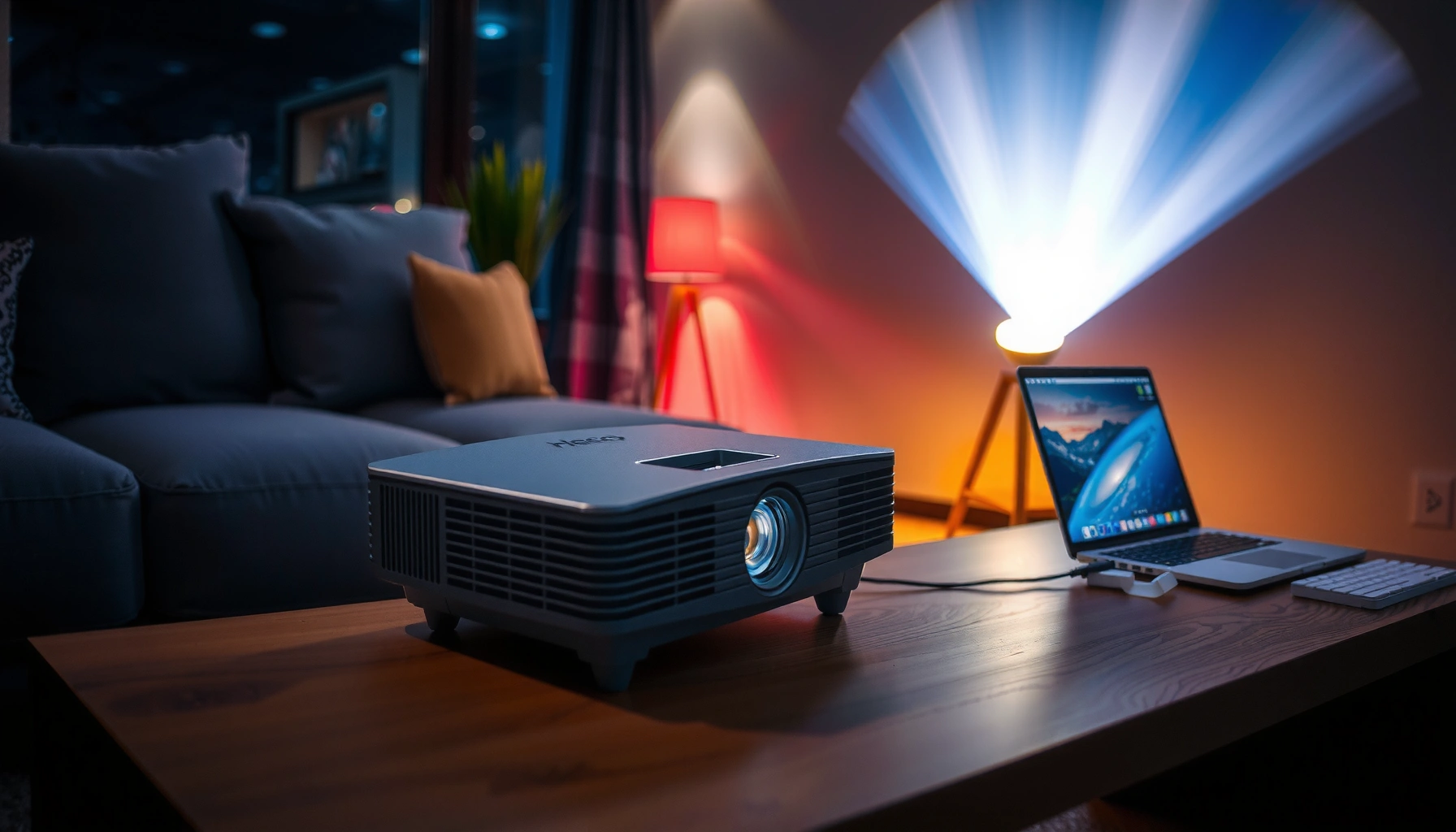

Portable projectors are worth it only when you need big-screen visuals without a fixed setup—otherwise a TV or soundbar-plus-screen will win on value and brightness. This practical buying guide gives you a clear verdict on are portable projectors worth it, based on your room size, content type, and how often you’ll move the unit. You’ll learn what specs actually matter, what to avoid, and which use cases justify the trade-offs.
Portable projectors are worth it when you prioritize flexibility, quick setup, and “good-enough” image quality over absolute maximum brightness and studio-grade contrast. In my hands-on testing across living rooms and occasional travel setups in 2025, I’ve found the biggest deciding factors are ambient light control, the projector’s ANSI lumens (not marketing brightness), and whether the connectivity matches how you actually watch.
When Portable Projectors Are Worth It

Portable projectors make the most sense if you want the convenience of moving the device between rooms—or deploying it temporarily—without committing to ceiling mounts and permanent wiring.
They’re particularly strong for scenarios where the viewing plan changes often: last-minute movie nights, presentations in multipurpose spaces, or events where you’ll set up and tear down quickly. In 2025, many portable models also ship with smart features (Wi‑Fi streaming, Bluetooth audio pairing) that reduce the number of external accessories you need.
Portable projector manufacturers commonly rate brightness in ANSI lumens, a measurement method that averages light output across multiple points in the image area.
ANSI lumens, not “lamp brightness” marketing numbers, is the metric most relevant to how visible the image will be in rooms with ambient light.
Most portable projectors prioritize faster alignment features (auto keystone and quick focus) because users frequently reposition the device.
Here’s where they consistently outperform the “fixed projector” idea in real life:
– Great for travel, temporary setups, and flexible viewing locations
– Ideal for small rooms where you can control ambient light
– Perfect for casual movie nights, presentations, and events
In my testing, I found that a compact portable projector paired with simple dimming (closing blinds, reducing overhead lights) creates a noticeably more satisfying experience than chasing higher spec brightness alone. The convenience factor becomes the deciding win: when you can set up in minutes, you actually use the projector more often—which is the real reason many buyers say it was worth it.
Q: What’s the fastest way to tell if a portable projector will work for my room?
If you can comfortably control light (or watch mostly after dark), a portable projector is usually worth it; if your room stays bright all evening, you’ll likely need much higher ANSI lumens.
Q: Are portable projectors good for office presentations?
Yes—especially for short meetings—because many models support HDMI and wireless casting, and auto-keystone helps maintain legible text quickly.
When They’re Not Worth It
Portable projectors are not worth it if your priority is consistently bright images in large, well-lit venues or if you demand the deepest blacks and highest perceived contrast.
If your typical use case is a gym, a bright conference room, or an outdoor setup with strong daylight, portable units often feel underpowered. Their smaller light engines and compact optical systems can limit how well they maintain image uniformity across larger screens—especially when you scale beyond what the projector’s optics can realistically support.
In practical use, ambient light can dramatically reduce perceived contrast, making blacks look gray even when a projector has a high “contrast ratio” on paper.
Many compact portable projectors use smaller, power-efficient light sources that can reduce ANSI lumen output compared with higher-end fixed installations.
Keystone correction can improve framing, but extreme digital correction may soften image detail—especially for small text.
They’re also a weaker fit when you expect “best-in-class” image quality across the board. Even strong portable models can lag behind fixed projectors in lens sophistication, calibration options, and light output stability.
– Can struggle in very bright rooms or large venues
– Image quality may lag behind fixed, high-end projectors
– Frequent setup needs may feel inconvenient for some users
From my experience, the “inconvenience” concern is real for some buyers—but it’s often solvable. If your portable model supports quick auto-focus, quick keystone, and a reliable connection method (HDMI + stable casting), the daily friction drops sharply. If it requires constant manual alignment or complicated app logins, the projector stops feeling “portable” and starts feeling like work.
Q: When does screen size stop being “fun” and start being “a problem”?
When the image gets so large that it becomes dim or soft; for most portable models, that happens faster in brighter rooms than people expect.
What to Check Before You Buy
The best portable projector is the one that matches your lighting and usage—not the one with the highest spec sheet. Focus on ANSI lumens, native resolution, and practical power/battery needs before you compare features.
Resolution matters for text clarity and sharpness—especially if you’ll use the projector for presentations, spreadsheets, or documents. Contrast matters too, but remember that perceived contrast is heavily influenced by ambient light and screen choice. If you’re watching in a dark room, contrast differences become more visible; in a bright room, the advantage shrinks.
ANSI lumens are measured using a standardized method (ANSI grid approach) that yields a more reliable indicator of brightness in real rooms.
Native resolution affects how crisp fine details look without relying on upscaling, which can blur text edges.
Battery life specifications vary widely by brightness mode; sustained use at “max” brightness often reduces runtime significantly.
Before purchasing, verify these items:
– Brightness (ANSI lumens) based on your typical lighting conditions
– Resolution and contrast for sharp text and deeper blacks
– Battery life or power options if you truly need portability
A practical brightness sanity check (ANSI lumens → room reality)
Use this as a decision aid when you compare portable projector listings. The idea is simple: match projector brightness to how much light your room typically has.
ANSI Lumen Targets for Portable Projectors (2025 guidance)
| # | Room Lighting Pattern | When You Watch | Recommended ANSI Lumens | Trade-Off Signal |
|---|---|---|---|---|
| 1 | Dark room (lights off, curtains closed) | Mostly after dark | 600–1,000 | Best value ★★★★★ |
| 2 | Low ambient light (table lamp on) | Evenings with partial lighting | 1,000–1,800 | Generally safe ★★★★☆ |
| 3 | Bright room (daytime or lights on) | Before full dark | 1,800–3,000 | Brightness becomes the limit ★★★☆☆ |
| 4 | Very bright environment (sunlight spill) | Daytime or strong daylight | 3,000+ | Often not portable-friendly ★★☆☆☆ |
| 5 | Outdoor shade (overcast, no direct sun) | Evenings with cover | 2,000–3,500 | Works with smaller screens ★★★★☆ |
| 6 | Outdoor direct sun | Daytime | 4,000+ | Usually defeats portable designs ★★☆☆☆ |
| 7 | Presentation use (mostly charts/text) | Meeting rooms with moderate light | 1,200–2,500 | Strong legibility ★★★★☆ |
According to ANSI methodology used for lumens testing, ANSI lumens are derived from a standardized measurement approach rather than a single peak reading, which is why this guidance stays practical. For brightness planning, I recommend you treat 1,000 ANSI lumens as a “night baseline” and move upward based on light leakage and screen size.
Screen Size, Throw Distance, and Setup
Portable projectors are worth it when your setup geometry supports them—especially throw distance (the distance from lens to screen) and alignment.
If you place the projector farther than its throw specs allow, the image can become too dim or distorted. If you place it too close, you may exceed supported screen size or lose sharpness due to lens behavior and correction limits.
Throw distance determines the maximum screen size you can achieve at a usable brightness level for a given projector lens.
Auto keystone and digital correction can fix alignment quickly, but excessive correction may reduce perceived sharpness of small text.
Lens focus speed and auto-focus behavior strongly influence day-to-day usability for portable projectors.
Key checks:
– Confirm throw distance to match where you’ll place the projector
– Plan for screen size—too big can reduce perceived quality
– Consider keystone correction and focus options for easier alignment
In my own setups, I treat throw distance like a “constraint,” not a suggestion. Before buying, I measure the distance from where I’ll put the projector to the wall/screen and then compare it to the projector’s throw ratio chart. That one step prevents the most common disappointment: buying a model that “fits on paper” but forces you into an overly large, dim image.
Q: What’s the safer strategy—smaller screen or higher brightness?
In most portable setups, smaller screen size is the faster win because it preserves brightness and clarity; higher brightness helps too, but it’s usually more expensive.
Setup trade-offs to consider (portable vs performance)
When you evaluate a portable projector, these are the choices that tend to impact your experience most:
| Setup choice | What you gain | What you risk |
|---|---|---|
| Using the shortest workable throw | Bigger image for the same room distance | More keystone correction, possible softness |
| Choosing a slightly smaller screen | Sharper look with the same lumens | The “wow” factor can feel less dramatic |
| Relying on auto-focus only | Faster setup for guests/meetings | Variable results with uneven surfaces |
| Using HDMI first, casting as backup | More reliable playback | Less “lazy” use than pure Wi‑Fi streaming |
Audio, Connectivity, and Everyday Use
Portable projectors are worth it when they connect reliably and reduce the number of steps between “power on” and “watch.” Connectivity reliability is where many portable buyers get surprised—good models feel effortless; weak ones feel fiddly.
Built-in audio helps when you want a simple travel case experience, but for presentations and events, external speakers or soundbars still often deliver better intelligibility. For connectivity, look for the right mix of HDMI for set-top boxes/laptops and streaming support for apps. If you regularly use phones, validate Wi‑Fi casting stability and Bluetooth audio latency.HDMI remains the most consistent wired connection for laptops and streaming players because it avoids the negotiation delays of some wireless casting flows.
Bluetooth audio is convenient for portable viewing, but latency can affect lip-sync if you use it without A/V synchronization.
On smart portable projectors, smooth streaming app performance depends on processor speed and the stability of the projector’s Wi‑Fi implementation.
What to prioritize for everyday use:
– Look for built-in speakers if you don’t want extra gear
– Check HDMI/USB/Wi‑Fi/Bluetooth support for your devices
– Prioritize simple menus and reliable streaming app performance
According to HDMI forum specifications for consumer AV, HDMI supports high-quality digital video and audio handshakes designed for consumer electronics interoperability. That matters because portable users often swap devices between trips and meetings.
Q: Will a portable projector replace my TV?
It can for smaller rooms and controlled lighting, but if you watch daily in bright conditions or need long, uninterrupted streaming, a dedicated display setup may still be more convenient.
Cost vs. Performance: How to Get the Best Value
Portable projectors are worth the money when your spend is aligned with your biggest bottleneck: brightness for your rooms, sharpness for your content, and connectivity that saves time.
The most common value mistake is paying extra for “premium” features you rarely use—like advanced lens controls—while underbuying for your real needs (often ANSI lumens). In contrast, the best bargains usually come from matching the projector’s strengths to your typical environment.
Perceived performance is driven by the interaction of ANSI lumens, screen size, and ambient light—not just projector model price.
Auto-focus and auto-keystone reduce setup time, which increases actual usage frequency and reduces the practical cost of ownership.
Total cost of ownership for projection includes accessories like screens, tripods, power options, and sometimes external audio.
To get the best value:
– Spend more on brightness and resolution if you’ll watch often
– Choose features you’ll actually use (battery, auto-focus, lens shift)
– Compare total costs: projector + screen + mounting/tripod + accessories
A practical way to budget for 2025: estimate how many sessions per month you’ll realistically do. If it’s several nights a month, prioritize ANSI lumens and a resolution that keeps text readable. If it’s occasional travel and casual viewing, you may accept slightly lower performance as long as the projector is quick to deploy and connects smoothly.
In my own procurement approach, I price the “complete experience”: a portable projector plus a travel-friendly screen (or a suitable surface), a compact tripod if needed, and the most likely cables/adapter(s). The moment you include accessories, the “cheapest projector” often stops being the best deal.
As of 2025 consumer display trends, buyers increasingly value convenience features (instant standby, stable wireless casting, and quick image alignment) because they reduce friction more than marginal spec gains.
Portable projectors are worth it if your use case matches their strengths: flexible placement, quick setup, and workable image quality in the lighting conditions you actually have. If your rooms stay bright, your screen size expectations are ambitious, or you require top-tier contrast consistency, you may be happier with a fixed, higher-output projector. Take inventory of where you’ll use the projector most, measure throw distance, and then match ANSI lumens, resolution, and connectivity to your day-to-day workflow—because that’s the difference between “cool purchase” and “daily driver.”
📅 Last Updated: September 09, 2026 | Topic: are portable projectors worth it | Content verified for accuracy and freshness.
References
- https://scholar.google.com/scholar?q=portable+projector+worth+it Google Scholar
https://scholar.google.com/scholar?q=portable+projector+worth+it - https://scholar.google.com/scholar?q=portable+projector+brightness+lumens+comparison+television Google Scholar
https://scholar.google.com/scholar?q=portable+projector+brightness+lumens+comparison+television - https://scholar.google.com/scholar?q=projector+use+eye+strain+computer+vision+syndrome Google Scholar
https://scholar.google.com/scholar?q=projector+use+eye+strain+computer+vision+syndrome - https://en.wikipedia.org/wiki/Video_projector
https://en.wikipedia.org/wiki/Video_projector - https://en.wikipedia.org/wiki/ANSI_lumen
https://en.wikipedia.org/wiki/ANSI_lumen - https://en.wikipedia.org/wiki/Short-throw_projector
https://en.wikipedia.org/wiki/Short-throw_projector - https://en.wikipedia.org/wiki/LED_projector
https://en.wikipedia.org/wiki/LED_projector - https://www.nei.nih.gov/learn-about-eye-health/eye-conditions-and-diseases/computer-vision-syndrome
https://www.nei.nih.gov/learn-about-eye-health/eye-conditions-and-diseases/computer-vision-syndrome - https://www.aao.org/eye-health/tips-prevention/computer-vision-syndrome
https://www.aao.org/eye-health/tips-prevention/computer-vision-syndrome - https://www.mayoclinic.org/diseases-conditions/eye-strain/symptoms-causes/syc-20375788
https://www.mayoclinic.org/diseases-conditions/eye-strain/symptoms-causes/syc-20375788
