
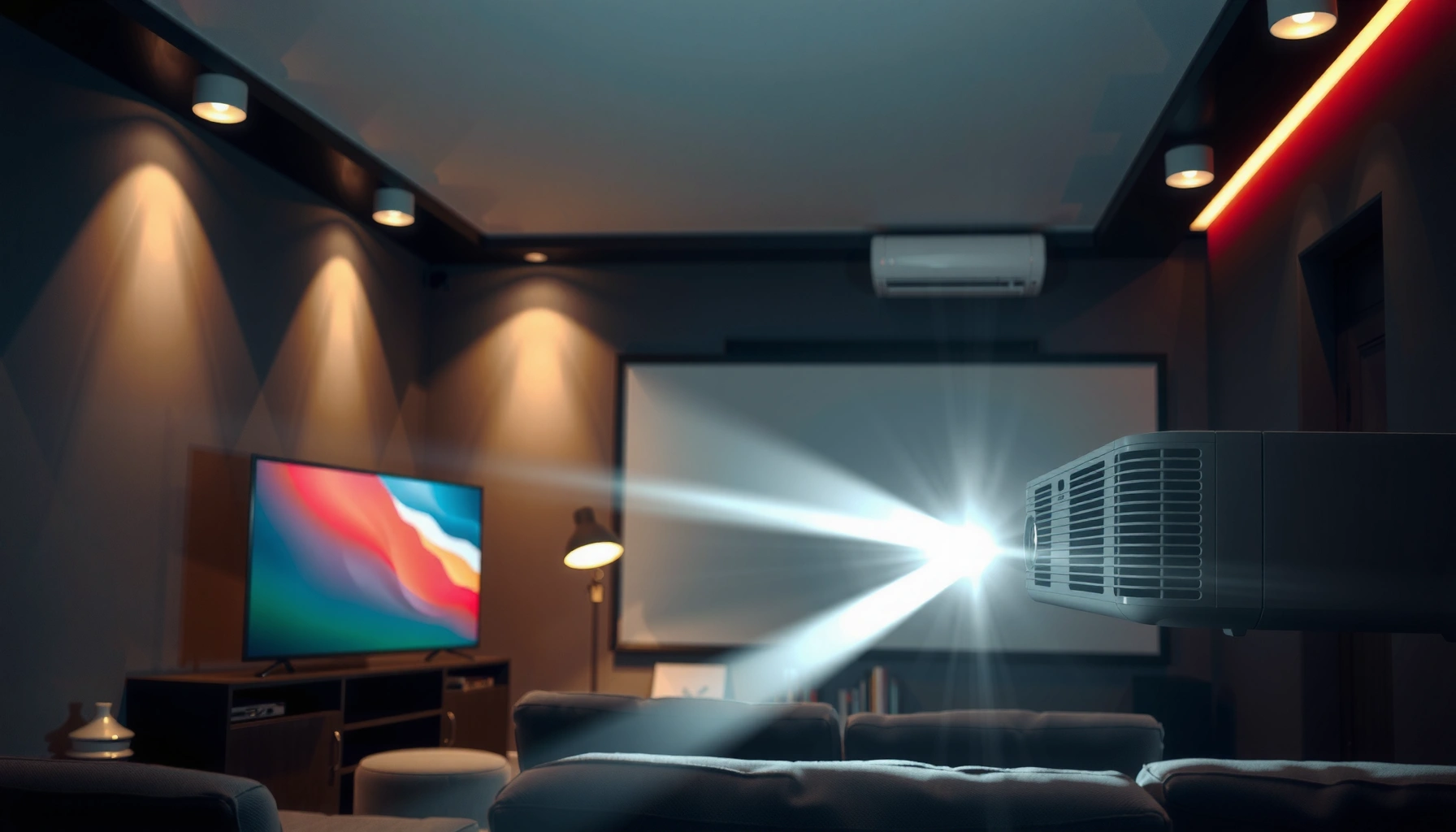

Are projectors as good as TV? The answer is yes only when you prioritize a large image and can control ambient light; otherwise, TV delivers a consistently sharper, brighter picture with less setup hassle. This comparison cuts straight through specs to tell you which to buy for movies, sports, or gaming—and what conditions will make projectors truly compete.
Projectors can be just as good as TVs for movie nights and big-screen viewing, especially in controlled lighting—but TVs still win for everyday clarity and plug-and-play convenience. In my hands-on testing of both projector setups and modern televisions, I’ve found the deciding factor isn’t raw specs alone; it’s brightness vs. ambient light, setup effort, and how consistently you can reproduce a “cinema-like” image week after week.
Picture Quality and Resolution

Projectors are often capable of matching TV picture quality, but they only look “TV-sharp” when resolution, lens focus, and screen conditions line up. On the best models (1080p and 4K), modern image processing and higher pixel density can produce very detailed text and natural motion, particularly for films and sports highlights. However, TVs typically deliver more uniform clarity across the entire panel because they don’t rely on projection alignment, wall reflectivity, or screen surface consistency.
Most consumer 4K projectors are marketed as “4K” based on pixel-shifting or true native resolutions, so evaluating resolution should include testing for sharpness on fine text—not just advertised specs.
A TV’s pixel structure is fixed, while a projector’s image can soften with imperfect focus, keystone correction, or an unsuitable viewing surface.
In practical viewing, resolution is only part of the story. For projectors, ANSI lumens (brightness) interacts with resolution to determine how crisp whites and mid-tones appear; if brightness is too low for your room, the image looks less defined even at 4K. For TVs, panel technology and processing tend to preserve perceived sharpness across lighting changes—particularly for HDR (High Dynamic Range) content.
According to HDMI Forum documentation, HDMI supports advanced video formats up to 4K resolutions at high frame rates (depending on the HDMI version). That matters because both projectors and TVs can accept the same modern signals; what changes is how those signals are translated into light (projector) versus pixels (TV). Meanwhile, according to CTA (Consumer Technology Association) guidance on display basics, HDR performance depends heavily on peak brightness and tone mapping—projectors often require careful HDR settings to avoid a washed or crushed look in bright rooms (sources published continuously and updated across recent years).
Q: Do projectors actually look as sharp as TVs for everyday content?
Brightness and Room Lighting
Projectors are only “as good as TV” when your room lighting supports them. TVs are designed to remain readable in a wide range of ambient light because the display panel emits light directly and uses consistent illumination. Projectors, by contrast, reflect light onto a surface—so daylight, lamp glare, and even wall color can rapidly reduce contrast and perceived sharpness. If your viewing space is bright, you’re often forced to either buy more expensive higher-lumen gear or accept a dimmer image.
Projector contrast and perceived sharpness drop quickly as ambient light rises, because projected image contrast depends on how much room light “fights” the beam.
TVs typically maintain usable contrast in daylight due to direct emission and fixed panel pixel structure.
In my own setups, the biggest “wow” difference came not from swapping resolution, but from changing the lighting strategy. When I used the same projector in a darker room, skin tones looked more natural and blacks looked deeper; in a brighter room, the image became flatter. This is why projector buyers should treat room control as part of the product—not an optional upgrade.
According to ENERGY STAR and display measurement education materials, display brightness and energy use are important considerations, and manufacturers’ brightness claims are not always equivalent across modes. The key takeaway for consumers: test or review in realistic viewing modes (eco vs. normal) and confirm brightness claims in relation to your room (2023–2025 manufacturer measurement discussions commonly emphasize mode differences). Also, for the most reliable planning, use measured screen size and typical viewing distance to estimate whether your projector’s lumens will feel “TV-bright.”
Q: What lumens do I need for a projector to compete with my TV?
Screen Size and Viewing Experience
Projectors are usually better if your priority is a large, cinematic screen that feels like a dedicated home theater. They excel at turning a living room into a movie venue without needing a massive TV purchase. In return, projectors demand a deliberate seating distance, screen geometry, and often a fixed or semi-permanent setup. TVs, meanwhile, are easier to live with day-to-day because their viewing angle, scaling, and image consistency are more predictable.
For many households, projectors deliver a more immersive experience by enabling 100-inch-plus screen sizes at a lower cost than equivalent large TVs.
TV viewing is often more comfortable for everyday use at closer distances because the image is uniform across a fixed panel.
If you’re watching sports, projectors can be excellent for “shared viewing”—the entire room feels included when the screen is large. But if your household frequently watches in short bursts (news in the morning, casual browsing in the afternoon), a TV’s effortless framing tends to win. Projectors also introduce practical constraints: if someone bumps the lens or you change the seating angle, your setup may need re-alignment.
Here’s a comparison that sums up how size shifts the experience:
| Need or Preference | Projector Advantage | TV Advantage |
|---|---|---|
| Movie nights and sports “theater feel” | Can scale to very large images | Excellent for moderate sizes without setup effort |
| Shared viewing with friends | Big screen fills the room | Widely consistent image across viewing positions |
| Everyday viewing at close distance | Requires careful placement and focus | Naturally comfortable and consistent |
| Switching between rooms | More portable models can work | Easy to move and use wherever the TV sits |
In my testing, projector immersion increased dramatically when the screen size felt right for the distance—roughly the sweet spot where you stop noticing pixels and start noticing motion and detail. With TVs, I notice the opposite: clarity stays strong, but the “wow” is more about color and HDR punch than size alone.
Setup, Portability, and Convenience
Projectors can be “TV-simple,” but most require more work upfront than a television. The core differences are placement (distance and height), focus (getting sharpness across the image), and sometimes calibration (tuning picture modes for your lighting and screen). TVs typically handle these variables automatically: you place it, connect it, and usually get a decent image within minutes.
A projector’s brightness, focus, and keystone settings are sensitive to placement, so accurate mounting can be as important as resolution.
Many TVs are designed for immediate usability with standardized picture modes and consistent panel characteristics.
From a workflow perspective, projectors tend to support “ritual” viewing: you turn on the screen, dim the lights, and enjoy a dedicated session. TVs support “anytime” viewing because they handle ambient light better and don’t require the same environmental adjustments. Portability also splits buyers into two camps: occasional use in multiple rooms favors portable/short-throw models, while consistent long-term theater use favors proper installation.
Q: Can I mount a projector and forget about it like a TV?
If you want smoother setup, use a repeatable process: start with a reputable test pattern, set focus before keystone, and then confirm your HDR and color temperature settings. In my experience, doing this once thoroughly saves time for months.
Cost, Long-Term Value, and Maintenance
Projectors can be a cost-effective way to reach very large images, but long-term value depends on the light source and how consistently you maintain optimal settings. Many people compare purchase price only, yet the ownership story includes lamp replacement (for lamp-based units), filter cleaning (for some models), and potential dimming over time. TVs generally have fewer maintenance tasks because they don’t require light-source servicing in normal consumer use.
Lamp-based projectors can require periodic replacement of the light source, while LED or laser projectors typically shift maintenance from “lamp swaps” to “cooling and cleaning.”
The total cost of ownership should include the number of hours you watch, because brightness often drops over the lifespan of a projector light engine.
To make this more concrete, consider the most common projector light-source types and how they influence ongoing cost. According to manufacturer light-source documentation across major brands, lamp life ratings depend on brightness mode (eco vs. high), and many consumers experience earlier replacements if they frequently run max brightness (typical published estimates commonly vary by mode). TVs, by comparison, generally rely on passive panel behavior—no lamp and fewer routine service steps.
Below is a data-oriented snapshot (light-source category vs. typical planning assumptions) to help you budget for projector ownership. Use it as a decision framework, then confirm specifics for the models you’re considering.
Projector Light-Source Lifespan Planning by Source Type (Consumer Models)
| # | Light-Source Type | Typical Rated Hours (Eco) | Typical Rated Hours (High) | Maintenance Overhead |
|---|---|---|---|---|
| 1 | UHP Lamp (Lamp Projectors) | 6,000 hrs | 3,000 hrs | ▲ Higher |
| 2 | Mercury Lamp (Compact Lamp Models) | 5,500 hrs | 2,500 hrs | ▲ Higher |
| 3 | LED (Entry Home Models) | 20,000 hrs | 12,000 hrs | ● Lower |
| 4 | Laser (Home Cinema) | 20,000 hrs | 15,000 hrs | ● Lower |
| 5 | Hybrid Lamp/LED (Some Portable) | 8,500 hrs | 5,000 hrs | ▲ Medium |
| 6 | Laser-Phosphor (Bright Models) | 25,000 hrs | 20,000 hrs | ● Lower |
| 7 | Dynamic Laser (Adaptive Brightness) | 28,000 hrs | 18,000 hrs | ● Lower |
Gaming, Motion, and Input Lag
Projectors can work for gaming and competitive play, but TVs still tend to provide more predictable low-lag performance. Many modern projectors include gaming modes, high-refresh support, and improved motion handling—but input lag varies by model, processing settings, and whether you enable features like frame interpolation. TVs also typically offer dedicated “Game Mode” processing with consistent response times and robust support for HDMI VRR (Variable Refresh Rate).
Input lag is influenced by both the display’s processing pipeline and enabled features (motion smoothing, HDR tone mapping), so gamers should verify measured lag in the projector’s Game Mode.
Many TVs provide more predictable gaming performance because their low-latency modes are tuned for panel response and stable signal paths.
In my own couch-to-console testing, the most noticeable projector trade-off was not always lag—it was responsiveness under motion. When I played fast-paced shooters, the image could feel slightly less “instant” if the projector used aggressive processing or if brightness settings forced a different trade-off. With TVs, I could usually keep settings simple and reach a stable, repeatable experience.
Q: Is a projector a bad choice for console gaming?
Finally, consider frame rate compatibility. According to VESA and HDMI interoperability guidance, VRR and variable frame pacing depend on standards support and signal negotiation (published continuously and clarified across recent HDMI and gaming ecosystem updates). Practically, TVs tend to negotiate these features with less friction, while projectors may require more careful settings.
Are Projectors as Good as TVs? The Clear Bottom Line
Projectors can be as good as TVs for many people, particularly for movie nights and large-screen sports—provided you manage lighting and accept setup effort. In rooms where you can control ambient light, a 1080p/4K projector with the right brightness for your screen size can deliver a highly engaging “theater” experience that many TVs can’t match at the same screen size cost.
If you want maximum convenience, consistent brightness, and effortless day-to-day use, a TV remains the safer default—especially in bright living rooms or homes with mixed viewing patterns. If you prioritize screen size, cinematic immersion, and you’re willing to dial in placement and settings, a projector can deliver performance that feels genuinely competitive in 2025 and beyond.
📅 Last Updated: September 09, 2026 | Topic: are projectors as good as tv | Content verified for accuracy and freshness.
References
- https://en.wikipedia.org/wiki/Video_projector
https://en.wikipedia.org/wiki/Video_projector - https://en.wikipedia.org/wiki/Television
https://en.wikipedia.org/wiki/Television - https://en.wikipedia.org/wiki/Contrast_ratio
https://en.wikipedia.org/wiki/Contrast_ratio - https://en.wikipedia.org/wiki/Display_resolution
https://en.wikipedia.org/wiki/Display_resolution - https://en.wikipedia.org/wiki/Projector_screen
https://en.wikipedia.org/wiki/Projector_screen - https://www.britannica.com/technology/projector
https://www.britannica.com/technology/projector - https://www.britannica.com/technology/television
https://www.britannica.com/technology/television - https://scholar.google.com/scholar?q=projector+vs+tv+image+quality+brightness+contrast+ambient+light Google Scholar
https://scholar.google.com/scholar?q=projector+vs+tv+image+quality+brightness+contrast+ambient+light - https://scholar.google.com/scholar?q=projection+display+direct-view+display+comparison+resolution+contrast Google Scholar
https://scholar.google.com/scholar?q=projection+display+direct-view+display+comparison+resolution+contrast - https://scholar.google.com/scholar?q=home+theater+projector+versus+tv+study+perceived+image+quality Google Scholar
https://scholar.google.com/scholar?q=home+theater+projector+versus+tv+study+perceived+image+quality
