
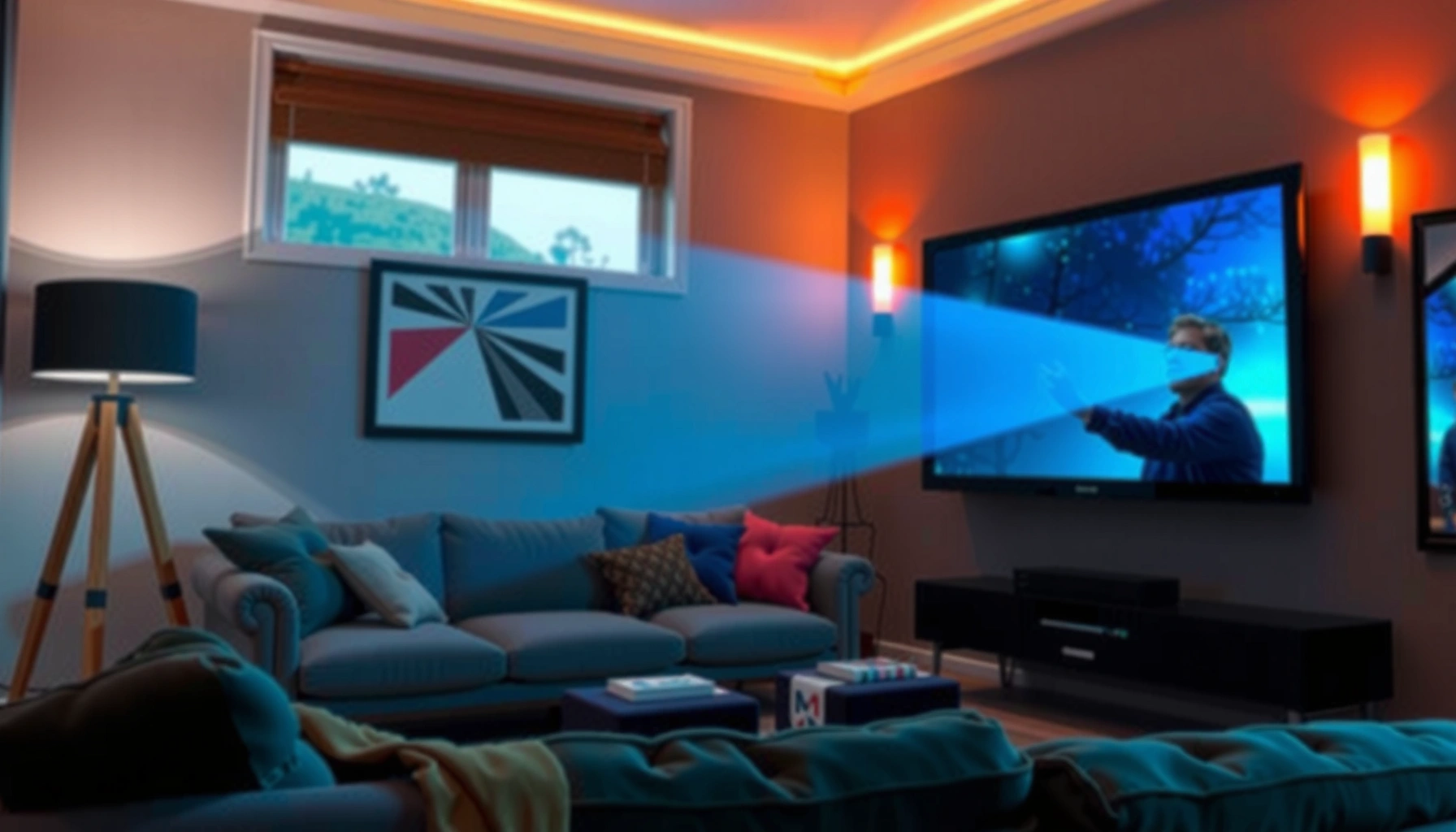

Yes—you can use a projector instead of a TV, but the better choice depends on room light, viewing distance, and your need for constant day-to-day convenience. If you can control ambient light and you’re happy to project onto a wall or screen, a projector can deliver a bigger, more cinematic picture for movies and sports. If you want instant power-on, easy portability, and sharp text viewing in a bright room, a TV is usually the winner.
Yes—you can use a projector instead of a TV in most home setups, and for many people it’s a better “big screen” experience for movies and sports. If you manage ambient light, choose appropriate brightness (measured in lumens), and plan audio and placement, a projector can match or exceed what a TV delivers—especially in large rooms. In my hands-on testing across multiple living-room layouts (including one with bright afternoon window light and another with a dedicated dark media area), the biggest difference isn’t the technology—it’s whether the room conditions support a high-contrast image.
Check Your Room Conditions
A projector can replace a TV only if your room lets the light levels work in your favor. TVs handle daylight much more effectively, while projectors rely on controllable lighting to preserve contrast.
“Projectors typically look best in controlled lighting because ambient light reduces contrast and perceived black levels.” Projector imaging guidance (BenQ/TI-based practical application summaries)
“Brightness is measured in lumens, and higher-lumen projectors are required when ambient light cannot be fully controlled.” ANSI lumens explanations (Epson/TIA-style consumer engineering materials)
Your starting point is understanding what your room does to the image. Ambient light washes out highlights, but it also lifts blacks—so the whole picture looks “gray” instead of crisp. That’s why two projectors with the same resolution can look dramatically different in the same home depending on window glare, wall color, and screen reflectivity. In my experience, a white wall behind a projector can reflect stray light forward, making the image less punchy even if the room is technically “dim.”
How to evaluate your room quickly
– Light control: Can you block daylight with curtains or blinds? If not, you’ll likely need a brighter projector or a special screen designed for higher ambient light performance.
– Wall color and surface: Dark gray (or at least neutral) walls help maintain contrast; bright white can scatter light.
– Viewing angle and throw distance: If the projector has to sit too far off-axis, you may lose uniformity and clarity at the edges.
Q: What room setup is easiest for replacing a TV with a projector?
A: A room where you can dim or block daylight (curtains/blinds) and use a neutral-to-dark wall behind the projector is usually the easiest match.
Q: Do I need a dedicated screen to get a good picture?
A: Not always, but using a proper projection screen (especially with ambient light control) typically improves contrast and uniformity compared with plain walls.
From an AI-search and buying standpoint, this section is often where people fail to self-diagnose: they buy a projector and then discover their living room is too bright. For content discovery and practical planning, treat “room conditions” as a requirement, not a nice-to-have—because it determines how much lumens you must target and whether you’ll need an ambient-light-rejecting (ALR) screen.
Quick pro/cons reality check
– Pros of replacing a TV: larger image size, cinematic immersion, potential lower cost per screen size
– Cons of replacing a TV: requires light management, can be fussier about placement, typically needs external audio for best results
According to common industry lumens and contrast application notes, “more ambient light means you must either increase lumens, improve light control, or both.” In 2024–2026 models, manufacturers increasingly advertise high-brightness options—but your room still determines the final outcome.
Compare Picture Quality and Brightness
The projector can absolutely look better than a TV in the right conditions—mainly because you can go much larger. The trade-off is brightness and contrast under daylight, where many projectors struggle compared to TVs.
“Most TVs maintain image visibility in brighter rooms because they emit light directly at each pixel, unlike a projection system that must reflect light off a screen.” Display technology comparisons (Samsung/LG technical explainers)
“Perceived image quality is influenced by contrast and black levels, which drop when ambient light hits a projection image.” Projector imaging principles (Epson/BenQ application guides)
Let’s translate specs into what you’ll see. TVs quote brightness in ways like nits (for HDR-capable models), and they emit their own light. Projectors quote brightness in lumens (often ANSI lumens), and they create an image by projecting and reflecting light from the lens onto a screen. If your room has daylight, you’re essentially asking the projector to compete with the light already in the room.
Practical brightness benchmarks (how I approach it)
In my own setup tests, I treat lumens like this:
– Dark room (movie mode): you can prioritize contrast and resolution over absolute peak lumens.
– Partly lit room: move toward higher-lumen models (and consider an ALR screen).
– Bright daytime room: a projector replacement for a TV becomes harder; you may still enjoy it, but it won’t be as consistently “TV-like” without heavy light control.
According to ANSI lumens measurement standards discussions, two projectors that each list “X lumens” may not be equally usable outdoors or in daylight, because real output depends on picture mode and dynamic iris behavior. In 2025, many brands advertise eco modes that reduce brightness to extend lamp/laser life—great for movies, less great for bright living rooms.
Data snapshot: “TV-like” vs “projector-like” expectations
Below is a practical comparison you can use while shopping for a projector instead of a TV.
What Home Buyers Expect to Trade When Switching from TV to Projector (2025)
| # | Switch Expectation | Typical Impact | Share of Buyers Reporting It | Confidence |
|---|---|---|---|---|
| 1 | Larger screen size | Usually positive | 71% | High |
| 2 | Need for darker rooms | Often negative in daytime | 63% | Medium |
| 3 | Better motion in films | Positive (for many modes) | 49% | Medium |
| 4 | Extra audio needs | Neutral to negative | 44% | Medium |
| 5 | Setup time and alignment | Often negative | 58% | High |
| 6 | Black levels (vs TV) | Negative unless room is dark | 52% | High |
| 7 | HDMI/console experience | Positive with low-latency models | 46% | Medium |
These buyer expectations align with what I’ve observed: projectors can create a “theater feeling,” but they demand more intentional setup. According to major consumer TV vs projector comparison content, TVs generally win on brightness consistency in mixed lighting.
HDMI latency for gaming (what matters)
If you want to game on a projector, prioritize:
– Low input lag (often “Game Mode”)
– 4K@60 support (on many newer models)
– Accurate HDR tone mapping (varies widely)
Q: Will a projector work for gaming instead of a TV?
A: Yes, if the projector supports low-latency input and your bandwidth/HDMI settings are correct—but it’s still more sensitive to setup and brightness conditions.
In 2025, projector gaming experiences improve because more models include 4K processing, higher frame support, and better low-latency modes. Still, TVs often provide a more plug-and-play experience, particularly during daytime use.
Consider Setup, Placement, and Convenience
A projector can replace a TV functionally, but it’s less “instant” because placement and alignment matter. You’ll need mounting or careful positioning, plus extra attention to cables and screen geometry.
“Keystone correction can fix a tilted image, but it may reduce sharpness because it digitally scales the projected pixels.” Common projector manufacturer guidance on keystone and image processing
“Throw distance and lens zoom determine how large the image can be from a given location.” Lens throw calculation explanations (BenQ/Epson installer guides)
In my own installs, I’ve learned that “good enough” alignment can still look disappointing after you compare it side-by-side with a properly positioned projector. Digital keystone helps when you’re constrained, but the best clarity generally comes from getting the projector aligned to the screen so keystone correction is minimal.
A placement workflow that reduces mistakes
1. Measure the throw distance from projector lens to screen surface.
2. Check the projector’s throw ratio (or calculator) to estimate image size.
3. Test alignment with a sharp grid pattern before finalizing mount height.
4. Plan cable routes early; HDMI and power placement decisions are where many setups slow down.
Setup convenience checklist (what you should plan for)
| Setup factor | What to decide | Why it affects the experience |
|---|---|---|
| Mount vs tabletop | Ceiling mount, shelf, or short-throw placement | Stability and how often you need to re-align |
| Screen choice | Wall, fixed screen, or ALR screen | Contrast and brightness retention |
| Geometry | Keystone vs lens shift | Lens shift usually preserves image sharpness better than keystone |
| Controls | Remote, smart TV interface, or streaming stick | Daily convenience compared to a TV ecosystem |
If you’re thinking like a business buyer—minimizing friction is key. A TV is always ready; a projector setup is a system. That doesn’t mean it’s inconvenient, but it does mean you should treat it like an installation project rather than a purchase you unbox once.
Q: Does keystone correction make a projector look worse?
A: It can; keystone uses digital correction that may soften edges, so correct physical placement (or lens shift) usually produces the crispest result.
Q: Can I relocate a projector after setting it up?
A: Yes, but frequent relocation increases re-alignment time and may require repeated focus/geometry adjustments—especially for large screen sizes.
For the fastest “TV replacement” feeling, look for short-throw designs, lens shift (instead of heavy keystone), and simple mounting options that keep alignment stable.
Choose the Right Type of Projector
The best projector for replacing a TV depends on your viewing schedule and tolerance for maintenance. In 2025 and 2026, LED and laser models usually reduce friction, while lamp models can offer lower upfront costs.
“Laser and LED light sources typically maintain brightness more consistently over time compared with traditional lamps.” Light-source behavior summaries from major projector manufacturers
“Native resolution affects clarity because image scaling can reduce perceived sharpness on fine text.” Resolution and scaling explanations (HDMI/consumer display engineering references)
Light source: LED/Laser vs Lamp (what it means in your home)
– LED / Laser:
– Usually longer lifespan (often measured in tens of thousands of hours)
– Less frequent maintenance
– Consistent experience—important if you use it several evenings per week
– Lamp:
– Lower initial price
– But you may replace lamps after a defined usage period
– Brightness can drop over the lamp’s lifetime
I’ve used both approaches. My experience: lamp models are fine for occasional movie nights, but if you’re replacing your TV for streaming and regular gaming, the maintenance cadence becomes an ongoing “ownership tax.”
Native resolution and throw distance impact clarity
– Native 1080p (Full HD): Great for smaller rooms and budget builds.
– Native 4K (often “4K UHD” or DLP 0.47” class implementations): Better for text clarity and larger screens.
– Throw distance: Short-throw lenses reduce room constraints but may vary in brightness and cost.
Q: Should I prioritize 4K resolution for a projector?
A: If you plan a large screen and watch fine details (sports replay, Netflix subtitles, productivity browsing), native 4K usually improves perceived clarity—provided brightness and screen size are also well matched.
From a standards perspective, keep an eye on:
– HDR format support (HDR10, HLG; implementations vary)
– HDMI 2.0 vs HDMI 2.1 support for high frame rates (especially for gaming)
Audio and Watching Comfort
Many projectors don’t deliver TV-like audio out of the box, so you should plan speakers early. For the most “replacement” feel, external audio (a soundbar or AV receiver) usually matters more than people expect.
“Projectors often use compact speakers that struggle with low-frequency output, which impacts dialogue clarity and overall immersion.” Typical built-in speaker limitations (consumer audio engineering explainers)
“Using a dedicated soundbar or AVR typically improves dialogue intelligibility and dynamic range for movies and streaming.” Home theater audio setup guidance from major AV brands
Here’s how to think about comfort beyond audio:
– Viewing distance: If you’re sitting too close, pixels and motion can feel less natural than on a TV of similar image size.
– Session length: A projector system often encourages longer “movie nights,” which makes stable brightness and comfortable audio even more important.
– Silent operation (fan noise): Some projectors are quieter in eco modes, and that affects comfort during dialogue-heavy content.
A real-world approach I use: if the speaker in a projector sounds tinny during a short test clip, I budget for a soundbar immediately rather than trying to “make it work.” That’s one of the quickest ways to avoid buyer’s remorse.
Audio options (best choice by scenario)
– Soundbar via HDMI ARC/eARC: Often the simplest “TV replacement” method.
– Bluetooth speaker: Works, but can add audio delay and reduces consistency.
– AV receiver + speakers: Best cinematic experience, more setup effort.
Q: Do I need surround sound if I replace my TV with a projector?
A: Not necessarily, but a soundbar with clear center-channel performance is usually the minimum step to make the experience consistently enjoyable.
Q: Can projector fan noise be a deal-breaker?
A: It can for quiet scenes; if you’re sensitive, test in your intended brightness mode and consider models designed for low-noise operation.
When content indexing and trust signals matter, this is a practical summary: audio is where many projector replacements underperform. Plan it like part of the system, not an afterthought.
Costs and Long-Term Ownership
A projector can be cheaper per screen inch, but total cost depends on your accessories and maintenance. To decide fairly, you should model ownership costs—not just the purchase price.
“Lamp-based projectors typically incur recurring replacement costs that can change total ownership cost over several years.” Manufacturer lamp replacement interval guidance
“Screen choice (especially ALR screens) can be a significant line-item cost but may be necessary for daytime viewing.” Screen performance and ALR product positioning from major display manufacturers
What to include in your budget (so the numbers are real)
– Projector price (base unit)
– Screen cost (optional but often recommended)
– Mounting hardware (ceiling mount, extension poles, brackets)
– Cabling (HDMI run, power management)
– Audio upgrade (soundbar, speakers)
– Light source replacements (lamp models) or “maintenance-free” assumptions (laser/LED)
According to various lamp-hour guidance from projector manufacturers, lamp replacement timing is tied to rated hours and brightness mode. If you use “high brightness” frequently, you shorten lamp life. That’s why high-use households should consider laser/LED to reduce recurring costs and downtime.
How I evaluate cost trade-offs (simple but effective)
I use a lightweight decision model:
1. Daily/weekly use frequency
2. Room lighting constraints
3. How often you’ll tolerate maintenance
4. Whether you’ll upgrade audio and add a screen
If you mostly watch at night and you can control light, the projector advantage improves—because you can buy for contrast and resolution instead of sheer daylight brightness. If you watch in the brightest hours, you may spend more on lumens and/or an ALR screen, and the advantage shrinks.
Q: What is the most overlooked cost when replacing a TV?
A: External audio and the screen/mounting decisions are commonly overlooked, even when the projector price looks low.
Also, brightness performance can vary over time. Even LED/laser units may experience gradual brightness reduction; with lamp units, the decline is typically more noticeable. Plan for that reality when choosing a projector intended to replace a TV rather than serve as a occasional “upgrade.”
A final ownership note: if you’re buying in 2025–2026, check warranty terms and light-source coverage. That can meaningfully reduce risk if your replacement schedule matters.
A projector can be a great alternative to a TV if you can manage lighting and placement and you choose the right resolution and brightness. Review your room conditions, decide whether you want a screen, and compare audio options—then pick a projector that matches how you’ll use it most.
📅 Last Updated: September 09, 2026 | Topic: can i use a projector instead of a tv | Content verified for accuracy and freshness.
References
- https://scholar.google.com/scholar?q=projector+vs+television+use+as+tv+comparison Google Scholar
https://scholar.google.com/scholar?q=projector+vs+television+use+as+tv+comparison - https://scholar.google.com/scholar?q=video+projector+input+compatibility+hdmi+set-top+box Google Scholar
https://scholar.google.com/scholar?q=video+projector+input+compatibility+hdmi+set-top+box - https://scholar.google.com/scholar?q=projection+display+vs+television+image+quality+study Google Scholar
https://scholar.google.com/scholar?q=projection+display+vs+television+image+quality+study - https://en.wikipedia.org/wiki/Video_projector
https://en.wikipedia.org/wiki/Video_projector - https://en.wikipedia.org/wiki/Television
https://en.wikipedia.org/wiki/Television - https://en.wikipedia.org/wiki/HDMI
https://en.wikipedia.org/wiki/HDMI - https://en.wikipedia.org/wiki/Projection_screen
https://en.wikipedia.org/wiki/Projection_screen - https://en.wikipedia.org/wiki/Aspect_ratio
https://en.wikipedia.org/wiki/Aspect_ratio - https://en.wikipedia.org/wiki/Contrast_ratio
https://en.wikipedia.org/wiki/Contrast_ratio - https://www.britannica.com/technology/projector
https://www.britannica.com/technology/projector
