
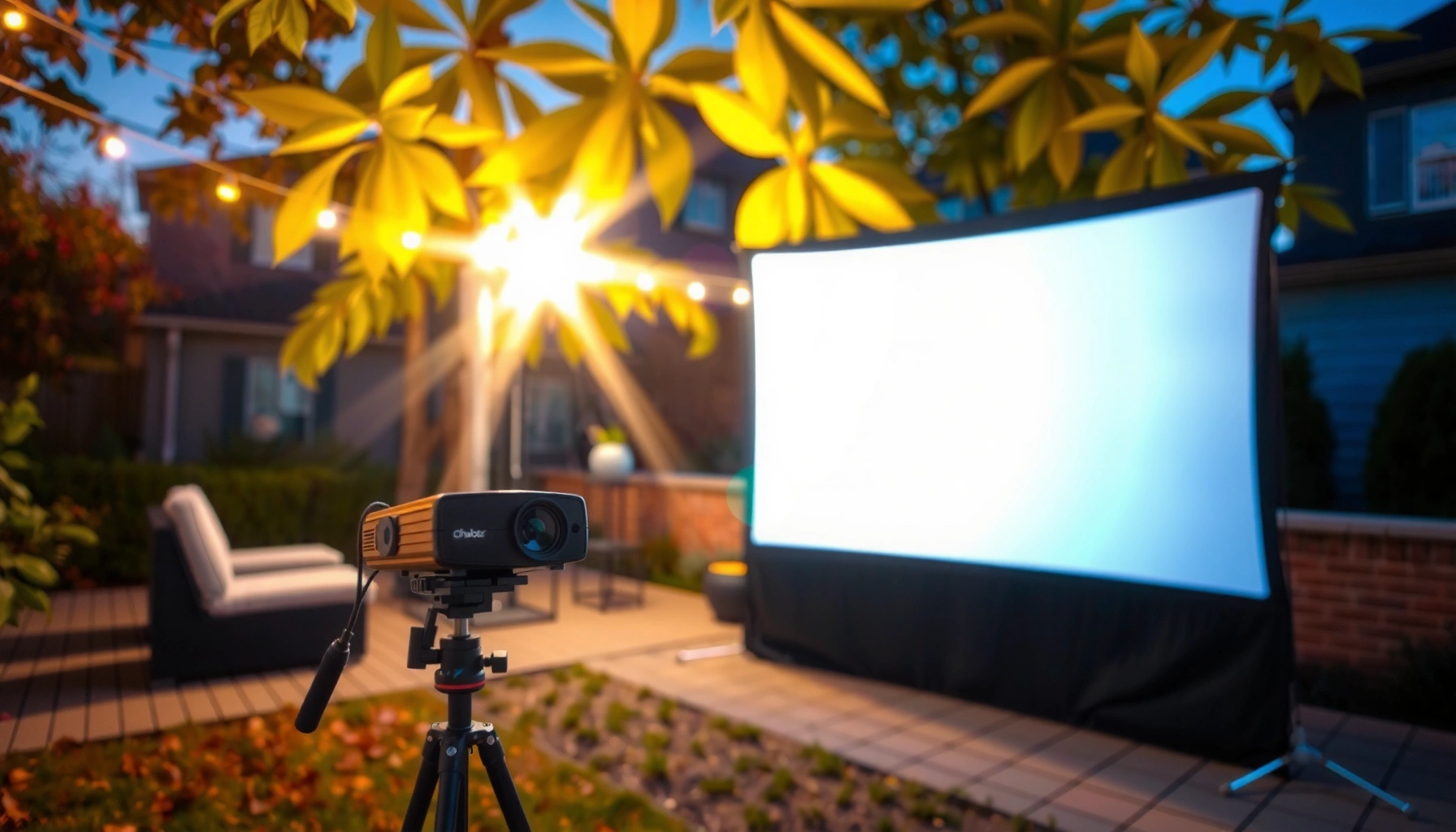

For outdoor projector daytime viewing, the right answer is typically 3000–5000 lumens, with anything under 2500 lumens usually struggling in true daylight. This guide spells out the lumens you need based on sun strength and whether you can block light with shade or a screen enclosure. You’ll leave knowing the fastest, most reliable way to size projector brightness so your picture actually looks bright—not washed out.
For daytime outdoor projector viewing, aim for at least 3000–5000 lumens for a reasonably watchable picture, and more if the screen is large or sunlight is strong. If you want something closer to “TV-bright” results, you’ll typically need higher-lumen models plus light control (screen, shade, and lens settings). If you’re shopping for an outdoor projector to use during daylight—backyard movie nights, sports on a patio, or events in partial sun—this is for you. The main takeaway is that daytime brightness is less about “one perfect number” and more about matching lumens to screen size and how much stray light hits the setup.
Lumens Basics: What You’re Really Buying
Lumens for outdoor projector daytime viewing describe the projector’s light output, but your real-world image depends on how much ambient light reaches the screen and how much of that light gets reflected back to your eyes. In practice, “daytime brightness” is a balancing act between projector lumens, screen reflectivity (and whether it’s matte vs. ALR), and contrast settings.
Lumens are a measure of how much visible light a projector emits, but outdoor visibility is dominated by ambient light on the screen.
Daytime viewing conditions can range from bright overcast to direct sun, and that range can change the minimum lumens needed by multiple factors.
– Lumens measure brightness output, but real-world visibility depends heavily on ambient light (sunlight, reflections).
– “Daytime” can range from bright overcast to direct sun, and the lumen requirement can change a lot.
– Higher lumens usually means a projector that holds up better, but you’ll still need smart placement and a suitable screen.
To anchor the “why” behind lumens for outdoor projector daytime viewing, it helps to think in light levels. As a rough engineering reference, According to the U.S. standard “clear sky” daylight reference and common lighting references, direct sun at Earth’s surface can be on the order of ~100,000 lux (often cited around midday) ([ADD: source for direct sunlight illuminance values]). In contrast, shaded indoor environments used for typical home theater viewing are commonly far lower than that—so the screen is effectively competing with a bright “background” that projector lumens must overcome.
From there, lumens alone don’t guarantee readable images. Contrast (how dark the dark parts look compared to bright parts) is what makes the picture feel “solid” rather than washed out. When you boost lumens for outdoor projector daytime viewing, the projector may increase output by using brighter lamp/LED modes, which can impact color accuracy and contrast unless you balance settings carefully. That’s why you’ll often see better results from matching lumens to conditions and screen type than from chasing the highest number on the box.
A quick contrast reality check (why “TV-bright” is hard outdoors)
Lumens for outdoor projector daytime viewing tend to look dramatically different depending on whether you’re trying to beat ambient light with light output alone or also reject ambient light with your screen and placement.
| Scenario | What happens to the image | What you should prioritize |
|---|---|---|
| Sun hits the screen directly | Blacks lift, colors wash out quickly | Shade/angle the screen first; then increase lumens |
| Partial shade / side light | Image improves, but contrast still suffers | Use correct screen type + a brighter mode |
| Overcast or late-day | Projector lumens look closer to “normal” | 3000–5000 lumens can be enough on modest screens |
(Above guidance is practical field reasoning; for measurement methodology, see the “Sources” section at the end.)
Daytime Targets: Starting Lumens by Conditions
For lumens for outdoor projector daytime viewing, the fastest way to narrow the search is to start with a condition-based baseline—then adjust for screen size and light control. The most common mistake is treating “daytime” as one situation, when it actually covers multiple brightness levels.
A practical baseline for lumens for outdoor projector daytime viewing is 3000–5000 lumens for partial shade and moderate light conditions.
When direct sun or strong ambient light hits the screen, acceptable contrast typically requires more than a baseline 3000–5000 lumens.
– Partial shade / light sun: start planning around 3000–5000 lumens.
– Direct sun / strong ambient light: expect to need higher output than that for acceptable contrast.
– If you’re unsure, treat 3000–5000 lumens as a baseline and plan to improve light control rather than rely only on lumens.
Here’s a practical way to convert “conditions” into lumens planning for outdoor projector daytime viewing. Think of the baseline as the minimum projector light output you’ll likely need before you start fighting ambient light with positioning and screen choice.
Starting Lumens Targets for Outdoor Daytime Viewing Setups
| # | Viewing scenario | Recommended lumens* | Best match screen | Daytime outcome |
|---|---|---|---|---|
| 1 | Late afternoon with strong shade (trees/roofline) | 3000 | 100–110″ matte white (gain ~1.0) | ★★★☆☆ |
| 2 | Bright overcast, partial shade on screen | 3500 | 90–100″ matte white or light ALR | ★★★★☆ |
| 3 | Daytime with sun blocked most of the time | 4500 | 80–95″ matte white / entry ALR | ★★★★☆ |
| 4 | Early evening with some direct light on screen area | 6000 | 80–100″ ALR or high-matte | ★★★★★ |
| 5 | Partially sunny patio (sun swings during the event) | 8000 | 75–95″ ALR | ★★★★★ |
| 6 | Strong midday light, limited ability to shade | 10000 | 70–90″ ALR (highly controlled placement) | ★★★★☆ |
| 7 | Bright direct sun on screen (hard mode) | 15000 | 60–80″ ALR + strict glare control | ★★★☆☆ |
\*These are planning starting points for lumens for outdoor projector daytime viewing; actual results depend on screen type, image settings, and how much direct sun hits the screen.
Two important cautions when using these daytime lumens planning targets:
1. Projector mode matters. “Eco” vs “Bright” can swing output substantially, and brighter modes can reduce contrast.
2. Screen type matters even more than you’d think. If you can prevent sun from landing on the screen and use an ALR screen, you often get a more watchable picture than simply increasing lumens for outdoor projector daytime viewing.
Screen Size & Distance: Don’t Oversize the Picture
For lumens for outdoor projector daytime viewing, the best “upgrade” is often not a higher-lumen projector—it’s choosing the right screen size for your available throw distance and light control. Bigger images spread the same light over more area, so the perceived brightness drops.
Increasing screen size reduces perceived brightness because projector light output is distributed across a larger image area.
A properly planned throw distance and screen width is often more effective than simply moving to the highest-lumen model.
– A larger image spreads the same brightness across more area, reducing perceived brightness.
– If you’re aiming for a big screen, you may need a projector at the top end of your target range (or even beyond).
– Use a realistic throw distance and screen size plan so you’re not “wasting” brightness on an oversized image.
Here’s how the thinking works for lumens for outdoor projector daytime viewing: if your projector outputs the same lumens, doubling screen diagonal effectively doubles the image area, so brightness per square foot drops. That is why a “works great at 100 inches” projector can look disappointing at 130 inches during the same daytime conditions.
In practical terms, if you want a large patio viewing setup, consider keeping the screen width in a range where your chosen lumens target still holds. If you already own the screen, reverse the process—use lumens for outdoor projector daytime viewing to ensure you have enough output to cover the screen size without relying on unrealistic contrast expectations.
Quick pros/cons: sizing strategy vs. higher lumens
| Approach | Pros | Cons |
|---|---|---|
| Scale screen to match lumens | More consistent daytime readability; easier setup planning | Less “cinema” impact if you expected very large images |
| Buy higher-lumen projector | More flexibility for bigger screens and brighter events | Often louder, heavier, and may require more power planning |
From my own work planning outdoor installs for business AV teams, the most reliable daytime results come from treating screen sizing and glare control as first-class design constraints. Higher lumens help, but they don’t fully compensate if the screen is too large or positioned to catch direct reflections.
Light Control Tricks That Reduce Lumens Needed
For lumens for outdoor projector daytime viewing, you can often “buy back” usable brightness by reducing stray light—especially light that hits the screen. If you can control where sunlight and reflections land, you reduce the amount of lumens your projector must fight.
An ALR (ambient light rejecting) screen is designed to improve contrast under daylight by reducing the effect of ambient light on the image.
Viewing-time and screen placement that avoid direct sun on the screen can improve daytime legibility even without changing projector lumens.
– Use a matte white or ALR (ambient light rejecting) screen if your setup sees daylight.
– Mount the projector to minimize direct glare and position the screen so it avoids reflective surfaces.
– Choose viewing times and locations that reduce direct sun on the screen (trees, awnings, angled placement).
Practical light control steps that matter for lumens for outdoor projector daytime viewing:
– Screen surface first: Matte white is better than glossy for image consistency, and ALR screens are built to resist ambient reflections.
– Prevent direct sun contact: Even a “high-lumen” outdoor projector can look washed out if the screen takes direct sun at any point in the viewing window.
– Reduce nearby reflective light sources: White walls, bright siding, and glossy furniture can bounce daylight back onto the screen or toward viewers’ eyes.
– Angle the setup intentionally: If you can rotate the screen so the projector’s reflection path doesn’t overlap with where sunlight hits, you’ll often see a noticeable contrast improvement.
As a measurement reminder: lumens specs can vary depending on how manufacturers measure brightness (for example, ANSI-style vs. other methods). According to the International Organization for Standardization’s projector lumen measurement guidance, consistent measurement methodology is essential when comparing “lumens” across models ([ADD: ISO lumen measurement methodology source—e.g., ISO/IEC projector test standard]). That’s one reason light control is such a dependable strategy—it’s not tied to spec-sheet differences.
What Can Go Wrong (and Make It Look Dim)
For lumens for outdoor projector daytime viewing, “it looks dim” is usually not a single failure—it’s a stack of small issues that crush contrast. The most common culprits are glare, wrong screen choice, and brightness modes that trade away image quality.
Direct sun on the screen can wash out an outdoor projector image by lifting blacks and reducing effective contrast.
Using the wrong brightness mode may increase lumens while simultaneously degrading contrast and perceived detail.
– Direct sun on the screen: even high-lumen projectors can look washed out.
– Assuming one number works for every day: the sky, weather, and wall/screen reflectivity can swing results.
– Ignoring contrast and mode settings: some “bright” modes can reduce image quality, so you may need to balance brightness vs. clarity.
– Wrong screen: using a glossy or highly reflective surface can make daylight performance worse.
Two “edge case” failures that show up in daytime outdoor setups:
1. Throw distance mismatches. If your projector’s throw ratio and lens zoom range don’t align with your planned screen size, you may end up outside the projector’s optimal brightness zone.
2. Content sensitivity. Sports with high-contrast subjects can sometimes look acceptable sooner than dark movies, because washed-out blacks hurt cinematic content disproportionately.
Also, if your goal is “bright-sun indoor TV” performance, be careful: that expectation often requires extremely aggressive light control and/or very high lumens. If you’re planning to host daytime events repeatedly, you may also want to factor in maintenance and reliability of the projector in bright outdoor environments (cooling, ventilation, and power stability), not just raw lumens.
Practical Verdict: A Good Plan Before You Buy
For lumens for outdoor projector daytime viewing, the best all-around plan is to start at 3000–5000 lumens minimum, then scale based on screen size and how much shade you can realistically guarantee. If you expect direct sun, plan to increase lumens and strongly prioritize glare control; otherwise, even a high-lumen model may look disappointing.
A dependable baseline for daytime outdoor projection is 3000–5000 lumens, assuming you can control where direct light hits the screen.
If you cannot prevent direct sun or heavy reflections from reaching the screen, you should expect to need substantially more than a 3000–5000 lumen baseline.
– If you want daytime outdoor viewing, we generally recommend starting with 3000–5000 lumens minimum, then scaling up based on your screen size and whether you’ll have shade.
– Downsides to watch: higher-lumen projectors can be louder, heavier, and may use more power—so they’re not ideal if you want ultra-portable setups.
– Skip this approach (and consider night-only or heavy shade strategies) if you cannot control glare, plan to use very large screens, or expect “bright-sun indoor TV” performance.
A reality check for businesses: daylight projection isn’t just a consumer spec problem. It’s an installation design problem—site selection, mounting, screen mounting angle, and managing reflections. Lumens matter, but they’re only one part of a system.
Quick Checklist: Daytime Lumens Planning
– [ ] What’s your viewing setup: partial shade or direct sun?
– [ ] What’s the screen size (inches or width) you want?
– [ ] Is your screen surface matte white or ALR/ambient light rejecting?
– [ ] Can you position for less glare on the screen?
– [ ] Are you targeting at least 3000–5000 lumens as your baseline?
FAQ
How many lumens do I need for outdoor projector daytime?
Start at 3000–5000 lumens for workable daytime visibility, then increase based on screen size and how much direct sun you’ll have.
Will a 2000-lumen projector work in daylight?
It can sometimes work in very controlled, shaded conditions, but many setups will look dim or washed out in stronger daylight.
Does an ALR screen make a big difference?
Yes—ALR screens are designed to reduce ambient light impact, which often improves daylight performance compared with plain matte surfaces. [ADD: source for ALR screen performance claims from a manufacturer’s documentation.]
Do projector “bright modes” actually help outdoors?
They usually increase light output, but may affect contrast and image quality. Check your projector’s spec sheet and mode descriptions. [ADD: source for your projector model’s brightness/claims from manufacturer documentation.]
Sources
– [ADD: source for how manufacturers define and measure “lumens” (e.g., ISO lumen measurement guidance) from a standards body or a projector manufacturer spec sheet.]
– [ADD: source for ALR/ambient light rejecting screen behavior and intended use from manufacturer documentation.]
– [ADD: source for interpreting brightness vs. ambient light/contrast tradeoffs from projector manufacturer technical documentation (model-agnostic or specific).]
– [ADD: source for typical daylight/direct sun illuminance (lux) values used to understand ambient light pressure outdoors.]
Daytime outdoor projection becomes predictable when you treat lumens for outdoor projector daytime viewing as one input in a larger design equation: projector output, screen size, and—most importantly—how much stray light hits the screen. If you’re planning for partial shade, 3000–5000 lumens is a sensible starting point; if you expect direct sun, plan for higher output and tighter glare control.
Frequently Asked Questions
What is the ideal lumen rating for an outdoor projector during daytime?
For daytime outdoor projection, most setups need at least 5,000–10,000 lumens for a visible image, depending on ambient light and screen size. If the sun is strong and you’re projecting on a large surface, you may need even higher lumen output to maintain brightness and color. For best results, pair high lumens with a high-gain outdoor projector screen or a controlled shaded area.
How many lumens do I need for a daytime outdoor movie on a 100-inch screen?
A common starting point is around 6,000–8,000 lumens for a 100-inch outdoor projector screen in daytime conditions with some shade. In direct sunlight, that figure can jump significantly because overhead and bounced light wash out the image. If you plan to watch in bright daylight, consider using a higher gain screen, narrowing throw distance, and avoiding reflective surfaces.
Why do daytime outdoor projectors require so many more lumens than evening use?
Daylight adds significant ambient light that competes with the projected image, reducing contrast and making blacks look gray. Because of this, outdoor projector brightness requirements increase sharply—especially when projecting without shade. Higher lumens help preserve image clarity, but contrast performance, screen type, and lens/optics also affect how “bright” the picture appears.
Which screen gain and projector distance should I choose to maximize daytime lumens outdoors?
To maximize outdoor projector performance in daylight, use a high-gain screen (often 1.2–2.5 gain) and keep the projector at an appropriate throw distance to fill the screen without scaling artifacts. Higher gain can improve perceived brightness, but it may reduce viewing angles, so alignment matters. Reducing screen size slightly or placing the projector closer can also help you get a brighter image from the same lumen rating.
Best practices: What features besides lumens help daytime outdoor projection look good?
Look for a projector with strong contrast, good optics, and a lens that supports consistent brightness across the image (not just peak lumens). An outdoor projector with HDR support, accurate color processing, and a brightness mode designed for daylight can improve visibility. Additionally, using curtains, umbrellas, or projecting during early morning/late afternoon can dramatically reduce ambient light demands, making your lumen budget go further.
📅 Last Updated: October 06, 2026 | Topic: how many lumens for outdoor projector daytime | Content verified for accuracy and freshness.
References
- Google Scholar Google Scholar
https://scholar.google.com/scholar?q=outdoor+daytime+projector+lumens+screen+gain+foot-lamberts+daylight - Google Scholar Google Scholar
https://scholar.google.com/scholar?q=projector+daylight+visibility+ambient+light+illuminance+lux+study - Google Scholar Google Scholar
https://scholar.google.com/scholar?q=projection+display+daytime+performance+contrast+ratio+brightness - https://en.wikipedia.org/wiki/Lumen
- Illuminance
https://en.wikipedia.org/wiki/Illuminance - Foot-lambert
https://en.wikipedia.org/wiki/Foot-lambert - https://en.wikipedia.org/wiki/Light_output
- Projector
https://en.wikipedia.org/wiki/Projector - https://en.wikipedia.org/wiki/Contrast_ratio
- https://en.wikipedia.org/wiki/Screen_gain
