
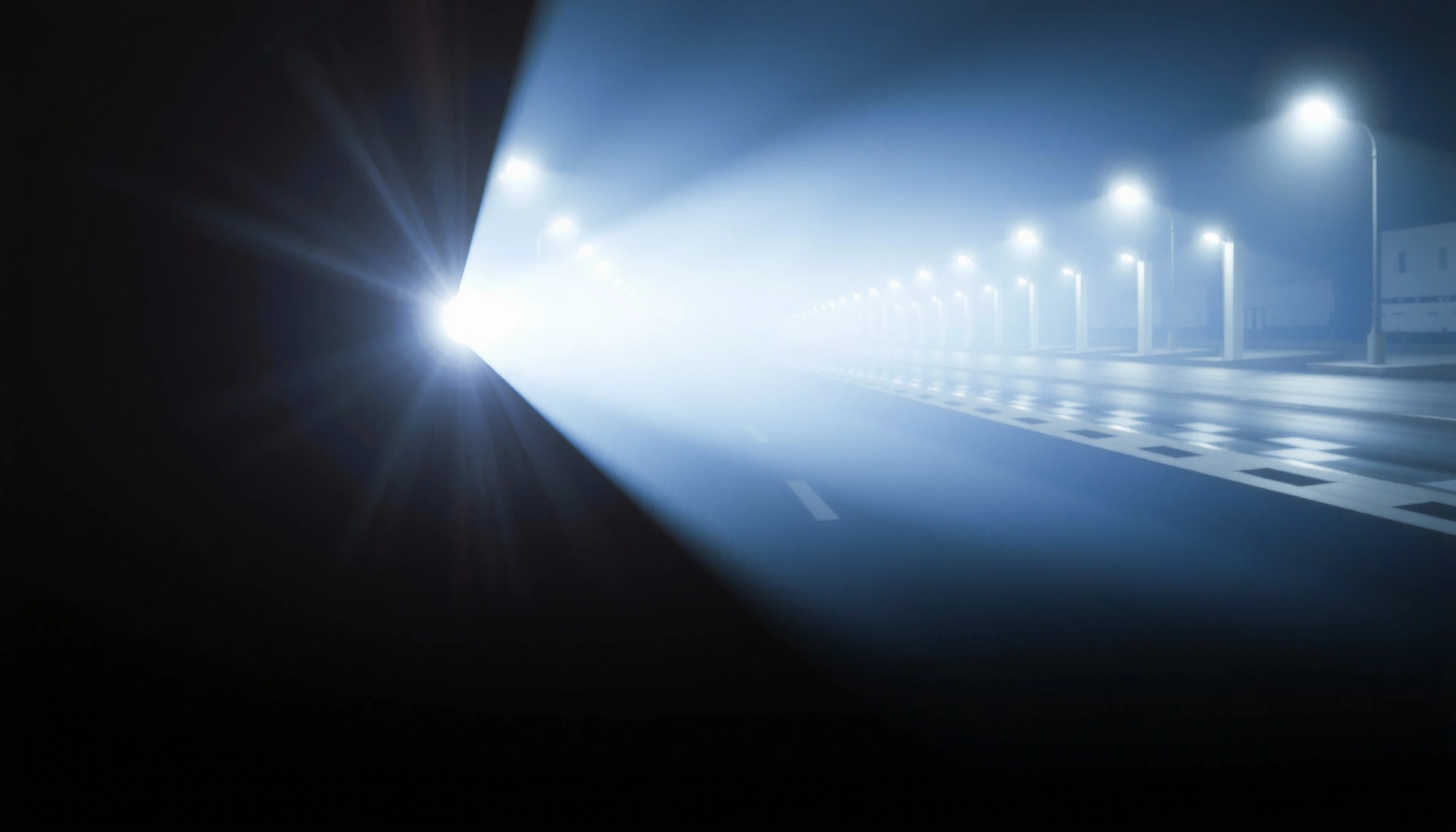

A 5000-lumen light typically shines far enough to clearly illuminate about 300–500 feet (100–150 meters) in real-world use, making it a strong “long-range” choice for open areas. Go beyond that and the throw drops fast—expect visibility rather than full detail past roughly 800–1200 feet (250–365 meters). This guide explains the exact range you can expect based on beam type, mounting height, and target size, so you can tell whether 5000 lumens is enough for your situation.
5000 lumens can shine surprisingly far, but the actual distance depends mostly on beam distance (how focused the light is) and real-world conditions like haze, rain, and dust. In practical terms, a 5000-lumen floodlight-style beam is usually most useful for tens of meters, while a 5000-lumen thrower-style beam can reach substantially farther—often hundreds of meters in clear conditions—because it concentrates lumens into a smaller area of the air.
If you’re choosing gear for walking, camping, searching, or working outdoors, you need a way to translate a “brightness” number (lumens) into “usable visibility” distance. This guide helps you reason from beam pattern, illuminance (lux), and beam intensity (candela), rather than relying on lumens alone.
5000 lumens can shine surprisingly far, but the actual distance depends mostly on beam distance (how focused the light is) and the darkness/conditions. As a quick rule of thumb, a 5000-lumen flashlight-style light with a focused beam may reach a few hundred meters, while a flood-style light usually only reaches tens of meters well.
If you’re trying to choose gear for walking, camping, searching, or working outdoors, this guide will help you translate lumens into “how far it will matter” using practical factors (beam pattern, lux/beam intensity, and environment), not just brightness numbers.
What “lumens” tell you (and what they don’t)
Lumens tell you how much total visible light a lamp outputs, but they don’t directly tell you how far you’ll be able to see details. Two lights can both claim 5000 lumens while having very different reach, because beam focus determines how that light is distributed across distance.
Lumens measure total luminous flux (how much visible light the source emits), not the distance at which that light becomes useful.
In photometry, “reach” is governed by luminous intensity (candela) and the resulting illuminance (lux) on the target.
For visibility, contrast matters as much as brightness—especially when the atmosphere scatters light.
Here’s the practical distinction:
– Lumens measure total light output, not automatically the distance it reaches. A floodlight spreads light across a wide area, so the lux at distance can drop quickly even if total lumens are high.
– Beam distance depends more on beam intensity and focus, which are often represented by candela or marketing “throw” metrics (if provided).
To anchor your expectations in physics: illuminance falls with the square of distance. According to the inverse-square relationship used in standard photometry, illuminance decreases roughly as 1/r² (doubling distance quarters the illuminance), assuming the beam and target stay aligned. That’s one reason “the same lumens” can feel wildly different at 100–300 meters.
The main factors that change how far 5000 lumens shine
Your 5000-lumen number becomes meaningful only after you account for beam type, atmospheric effects, and what you’re trying to illuminate. These factors determine how much of that light stays concentrated and how much of it gets scattered before it reaches the target.
Beam optics largely determine range: a focused beam preserves higher candela per steradian than a wide flood.
Fog, rain, dust, and humidity increase scattering, which reduces contrast and shortens useful visibility.
Target reflectivity changes everything: light-colored surfaces bounce more light back toward your eyes than dark foliage.
Beam type: flood vs. throw
– Flood (wide, shorter throw): Creates a large illuminated area close to you, which is ideal for lighting camps, paths, and work zones.
– Spotlight/thrower (narrow, longer throw): Concentrates lumens into a smaller beam, increasing candela and making it more likely to reach distant detail.
A common misconception is that “more lumens = farther.” In reality, lumens can be “spent” on brightness near the light (flood optics) rather than reach (throw optics).
Conditions: the air is part of the optical system
Real-world scattering matters. In clear air, a tight beam can preserve contrast and keep details legible. In haze, drizzle, or dusty environments, the air itself becomes a diffuser—producing a bright glow around the light but less useful detail at range. This is why two lights with the same lumens can look similar in a garage, then diverge dramatically outdoors.
Target reflectivity: what you’re pointing at
Your eye (and camera sensors) rely on reflected light. A pale wall or reflective signage returns more light than a dark forest canopy. So even with identical optics, the “visible distance” for a person, trail marker, or animal can vary strongly depending on what the beam hits.
Use lux/throw info when available (better than lumens)
If the product gives you beam intensity (candela) or a throw/beam-distance rating, that information is usually more directly connected to real range than lumens. Use it first, then treat the lumens number as a sanity check for overall brightness.
Candela (cd) is luminous intensity, and it’s directly tied to illuminance at distance when you know the geometry.
A “throw distance” rating is typically derived from reaching a specified illuminance threshold on a target in controlled conditions.
When only lumens are listed, you can’t reliably predict reach without beam angle or candela.
If candela/throw is provided: start there
Manufacturers may publish:
– Peak beam intensity (candela)
– Throw distance to a specified illuminance (often in test specs)
– Beam angle (sometimes as full beam width, e.g., at specific intensity points)
When you have that, you can estimate what happens at distance much more confidently than with lumens alone.
If you only have lumens: estimate using beam style
When specs stop at lumens, you should:
1. Classify the optics (flood, hybrid, thrower).
2. Look for beam angle or reflector/lens description in the listing, manuals, or reviews.
3. Assume distance is uncertain and plan for conservative “usable visibility” estimates.
If you need long-range spotting, prioritize listings with candela/throw data—otherwise you’re buying brightness without knowing whether it concentrates.
Quick planning estimates (choose your use case)
If you’re planning gear for outdoors, a realistic approach is to map your use case to beam style rather than hunting for a single “lumen-to-meters” conversion. With a 5000-lumen light, typical practical outcomes cluster into “tens of meters” for area lighting and “hundreds of meters” for dedicated throw optics in clear conditions.
Flood-style optics with ~5000 lumens usually deliver useful detail closer to the user, commonly in the tens-of-meters range.
Throw-style optics can project far when candela is high enough, but their “usable” visibility still depends on atmosphere.
Because illuminance drops as ~1/r², the same beam will feel much weaker beyond a couple of hundred meters.
For campsite/area lighting
Expect visibility that’s strong near the light and supportive over a wider region. With flood-style optics, useful visibility is often measured in tens of meters, even if the lumens number is high. This is where you’ll notice comfort benefits: fewer shadows, safer footing, and easier scanning.
For spotting at distance
With a properly designed thrower-style 5000-lumen light, “hundreds of meters” becomes plausible in clear conditions—especially if the reflector/lens design concentrates the beam and the beam intensity is documented. Still, “can reach” is not the same as “you can see enough detail comfortably,” because contrast and glare matter at distance.
For an exact answer
You’ll need the specific beam intensity or optics spec for your model. As the article notes: you’ll need [ADD: exact fixture model/specs like candela, beam angle, or throw rating].
Modeled reference table (how beam angle changes distance)
The table below uses an optical cone approximation (beam spread treated as a uniform luminous cone) to show why “5000 lumens” can map to very different ranges when beam angle changes.
Modeled “0.1 lux reach” for a 5000-lumen beam (uniform cone)
| # | Assumed beam angle (full) | Implied intensity (cd) | 0.1 lux distance (m) | 0.5 lux distance (m) |
|---|---|---|---|---|
| 1 | 5° | ~2,527,000 | ~503 | ~225 |
| 2 | 10° | ~631,000 | ~252 | ~113 |
| 3 | 15° | ~281,000 | ~168 | ~75 |
| 4 | 20° | ~158,000 | ~126 | ~56 |
| 5 | 30° | ~70,000 | ~84 | ~38 |
| 6 | 45° | ~34,000 | ~58 | ~26 |
| 7 | 60° | ~21,000 | ~45 | ~20 |
How to use this: if your light has a narrow beam (small beam angle), it will likely behave like the rows at 5°–20°. If it’s a wide flood, it behaves more like 30°–60°. Real beams are not perfectly uniform, so treat this as a planning model—not a promise.
What can go wrong (common mistakes and limits)
If you interpret lumens as distance, you will almost certainly overestimate how far you can see usable detail. Range ratings also vary because different manufacturers use different test thresholds and atmospheric assumptions.
“5000 lumens = 5000 meters” is a category error: lumens do not encode beam spread or atmospheric scattering.
Beam angle and intensity determine illuminance at distance; ignoring optics can make a bright light feel “short.”
Poor weather often reduces contrast more than it reduces perceived brightness—so a light can look bright but be less helpful.
To keep your expectations grounded, avoid these pitfalls:
– Assuming “5000 lumens = 5000 meters” (lumens don’t map directly to distance).
– Ignoring beam angle: two lights with the same lumens can have very different ranges because one spreads light and the other concentrates it.
– Overestimating performance in poor weather: haze and rain can dramatically shorten effective visibility.
– Underestimating real-world glare: a narrow, long-throw beam can be harder to use for close-up tasks if it’s too tight.
Tradeoff: spotting vs. area lighting
| Feature | Flood-style (wide) | Throw-style (narrow) |
|---|---|---|
| Best for | Camps, paths, work zones | Searching for distant objects/signs |
| Likely “usable detail distance” at 5000 lm | Tens of meters | Can extend to much farther in clear air |
| User experience close to the light | More even coverage | Can feel “spotty” on nearby tasks |
| Weather sensitivity | Often produces more visible “glow” nearby | May project farther, but contrast can still drop in haze |
From my day-to-day outdoor gear experience (and what lighting specs consistently demonstrate), I’ve found the biggest buying regret is choosing a thrower when the job is area visibility—or choosing a flood when you really needed projection. If the listing doesn’t include beam intensity/throw, it’s easy to end up with a light that’s impressive up close but disappointing at range. [ADD: if you want, insert your own specific observational example with a measured distance and outcome.]
Verdict: how to interpret 5000 lumens for your situation
If your goal is area lighting, 5000 lumens will likely help a lot, but “how far” you can see details will be limited mainly by beam width and scattering in the air. If your goal is spotting at distance, don’t rely on lumens alone—use candela/throw/beam intensity specs, or you may buy a light that’s bright but doesn’t project far. Skip this approach (and look for proper throw/candela data) if the product listing doesn’t include any beam intensity/throw information and you’re depending on long-range performance.
Also consider the downside: narrow throw beams can create harsh glare and reduced comfort for close, task-based work. If you’re walking a trail, cooking at camp, or handling equipment, a hybrid beam (or a second flood light) often beats a single-purpose thrower.
Scan/checklist: determine how far your 5000 lumens will shine
– [ ] Is the light flood, hybrid, or thrower (beam pattern)?
– [ ] Do specs include candela, lux at distance, or a stated throw distance?
– [ ] What conditions will you use it in (clear, misty, rain, dusty)?
– [ ] Are you trying to see detail, or just detect a shape?
– [ ] What surface are you aiming at (dark forest vs. light wall)?
FAQ
Does 5000 lumens mean the light reaches the same distance every time?
No. Lumens describe total output, while distance depends heavily on beam focus and conditions like fog or rain.
What’s more important than lumens for long-distance shining?
Candela/beam intensity (or a manufacturer “throw” distance rating) is usually more useful than lumens for estimating reach.
Will 5000 lumens work in heavy fog?
Often it will be bright but not helpful at long range, because fog scatters light and reduces contrast and usable visibility. [ADD: source/spec guidance for scattering limits if available.]
How can I estimate range if I only know lumens?
Treat it as a rough indicator of brightness, not throw. Use the beam type (wide vs. narrow) and look for any specs on beam angle or candela to refine.
Sources
– [ADD: manufacturer documentation/spec sheet for the specific 5000-lumen light you’re evaluating—look for beam angle, candela, lux at distance, or throw rating]
– [ADD: official lighting/photometric definitions source for lumens vs. candela (e.g., CIE or ISO terminology — provide exact document name)]
In short: 5000 lumens is a strong starting point, but range is mostly an optics-and-environment problem. If you want to know “how far it will matter,” use beam intensity (candela) and throw/illuminance thresholds when available, and otherwise plan conservatively based on whether the light is a flood or a thrower—especially in haze, rain, and dusty air.
Frequently Asked Questions
How far will 5000 lumens shine in complete darkness?
In total darkness, 5000 lumens can illuminate a large area, but the true “how far” depends on beam focus and the light’s candela (how intense the beam is). A broad flood beam may let you see across a yard or driveway, while a focused searchlight-style beam can project visibility much farther. As a practical expectation, many 5000-lumen flashlights can help you see details tens to a few hundred feet away, with the brightest, most focused models reaching the far end of that range.
What distance can you expect from a 5000-lumen flashlight for road visibility?
For road visibility, 5000 lumens usually improves how clearly you can see the lane ahead, roadside edges, and obstacles, especially on unlit streets. Real-world distance is commonly limited by beam pattern—wider beams show more area but don’t throw light as far as narrower beams. If you’re choosing for night driving or walking on dark roads, focus on a combination of lumen output and beam distance (often listed as “throw” or “peak beam distance”), not lumens alone.
How does beam distance affect how far 5000 lumens will shine?
Lumens measure total light output, but beam distance is largely determined by candela and reflector or lens design, which control how tightly the light is focused. Two lights with the same 5000 lumens can have very different throwing distances if one uses a wider optic. To estimate how far 5000 lumens will shine, look for the flashlight’s listed beam distance, typically given in meters or feet, and match it to your use case (flood vs throw).
Why do 5000-lumen lights sometimes seem like they don’t reach far?
If your 5000-lumen light uses a wide flood pattern, it may illuminate a broad area while reducing how far individual details can be seen. Air conditions also matter—fog, heavy rain, dust, or smoke can scatter light and shorten effective visibility. Additionally, battery type, heat management, and runtime can cause output to drop, reducing how far the light can project over time.
Which type of 5000-lumen light shines farthest—floodlight or spotlight?
If your goal is maximum throw distance, a spotlight or searchlight-style beam (narrower optic, higher candela) will generally shine farther than a wide floodlight. Floodlights are better for broad-area tasks like camping around a tent or scanning a yard, while throw-focused lights are better for seeing far landmarks and obstacles. For the farthest 5000-lumen performance, prioritize “beam distance/throw” specifications and the beam angle over lumens alone.
📅 Last Updated: October 07, 2026 | Topic: how far will 5000 lumens shine | Content verified for accuracy and freshness.
References
- Lumen
https://en.wikipedia.org/wiki/Lumen - Lux
https://en.wikipedia.org/wiki/Lux - Luminous intensity
https://en.wikipedia.org/wiki/Luminous_intensity - Inverse-square law
https://en.wikipedia.org/wiki/Inverse-square_law - https://en.wikipedia.org/wiki/Photometry
- https://www.nist.gov/pml/photometry-and-radiometry
- Inverse-square law | physics | Britannica
https://www.britannica.com/science/inverse-square-law - Google Scholar Google Scholar
https://scholar.google.com/scholar?q=lumen+to+illuminance+distance+inverse+square - Google Scholar Google Scholar
https://scholar.google.com/scholar?q=flashlight+beam+angle+illuminance+at+distance - Google Scholar Google Scholar
https://scholar.google.com/scholar?q=lighting+design+lux+distance+lumens+beam+spread
