
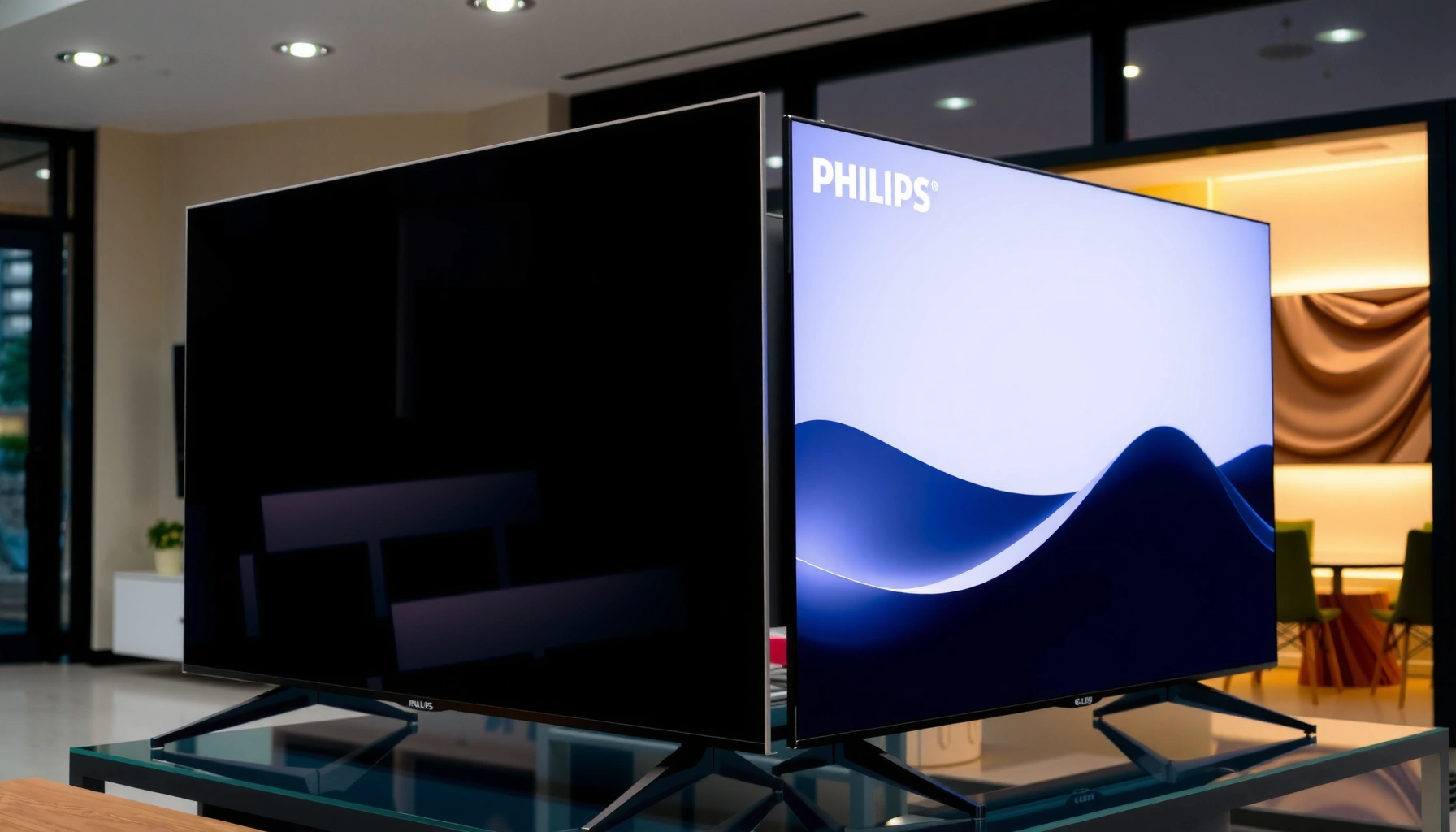

Trying to decide between the LG G5 and the Philips OLED+950? This head-to-head comparison delivers a clear winner for picture quality, gaming performance, and everyday usability based on how you watch. If you prioritize cinematic HDR accuracy, one of these OLEDs will pull ahead immediately—here’s which one and why.
If you want the simplest path to a premium OLED look—especially for dark scenes—pick the Philips OLED+950. If you care more about LG’s day-to-day software experience (and you’re comfortable dialing in picture settings), the LG G5 can feel like the better match. In this guide, we compare the areas that matter most—picture performance, features, and the practical setup choices that change what you actually see.
If you’re shopping for an OLED TV and trying to decide between “LG G5” and Philips OLED+950, this is for you—especially if you care about real-world viewing (movies, sports, dark scenes) rather than spec-sheet reading. [ADD: confirm whether “LG G5” refers to LG’s model family/variant name in your region, since naming can vary by market.]
LG G5 vs Philips OLED+950: The quick matchup
Philips OLED+950 is the safer recommendation when you want a premium OLED baseline and don’t want to spend much time chasing perfect settings. LG G5 is often the better fit when the LG smart experience, processing preferences, and menu workflow line up with how you actually watch.
Philips OLED+950 is positioned as a premium OLED model, which generally means stronger image processing defaults and a focus on HDR performance.
OLED panel technology delivers individual pixel self-emission, which is why both TVs can achieve near-infinite contrast in proper HDR/SDR scenes.
For most buyers, the day-to-day difference between OLED TVs comes less from panel contrast and more from tone mapping and motion handling.
– Philips OLED+950 is positioned as a premium OLED option, which typically means you should expect strong contrast and deep blacks as a baseline.
– LG G5 may match your needs better if its user experience, upscaling approach, or smart features align with how you actually watch.
– [ADD: specify exact screen sizes/regions for both models you’re comparing, if you have them—differences can change the recommendation.]
Quick comparison snapshot (what to verify before you buy)
As of 2026, OLED buyers should confirm three things in the official spec pages for their exact region: (1) supported HDR formats, (2) HDMI ports’ supported bandwidth/refresh (especially for gaming), and (3) the exact smart platform version. According to the HDMI Licensing Administrator, HDMI 2.1 can support up to 48 Gbps bandwidth, which is relevant to high-refresh 4K gaming (2021).
Picture quality: contrast, blacks, and motion
Both TVs should deliver excellent blacks because they both use OLED panel technology—each pixel can turn off completely. The real differences show up in processing: how each brand handles HDR tone mapping (how bright highlights and shadows are balanced) and motion processing (how fast scenes look without blur or artifacts).
Because OLED pixels can turn off, both TVs can reach extremely low black levels when content and processing are handled correctly.
In HDR, tone mapping determines how the TV maps mastered brightness to the actual display capabilities, which affects both shadow detail and highlight “pop.”
Motion artifacts (judder, soap-opera effect, or oversharpening) are usually created by processing choices, not by the OLED panel itself.
Contrast and black levels: why both start from the same “OLED advantage”
OLED’s core strength is contrast. In practical terms, both Philips OLED+950 and LG G5 should produce deep blacks during dark-scene content (movies, night sports, sci-fi). Where they differ is how they preserve detail near black—especially in HDR mixes. A TV can have great black level performance but still crush near-black tones if its tone mapping curve is overly conservative.
HDR tone mapping: the part you’ll notice first in movies
When you watch HDR content (streaming films, HDR game scenes, some sports broadcasts), tone mapping determines:
– How bright objects (spaceships, streetlights, muzzle flashes) look in relation to deep shadows.
– Whether shadow areas maintain texture (faces in dim rooms, dark corners of cinematic scenes).
– Whether highlights clip early or roll off more smoothly.
For Philips OLED+950, the advantage is that its processing is typically tuned to deliver a “premium” HDR presentation without constant manual adjustments. For LG G5, you may get an equally strong result—but the experience can depend on which picture mode you use and how willing you are to adjust settings after setup.
Motion handling: sports and fast camera pans
Motion quality is a combination of:
– Frame interpolation (creating intermediate frames to reduce motion blur)
– De-judder settings (reducing stutter in 24p or mixed-rate content)
– Backlight/pixel response behavior (OLED response helps, but processing still matters)
If you watch sports with fast pans—goal replays, cycling, motorsport—you’ll likely prefer the TV whose motion controls you can shape to your taste (or whose default processing matches your content mix).
What the “best” setting looks like depends on your content
If your household watches mainly dark-room movies, prioritize settings that preserve shadow detail without adding visible noise. If you stream lots of daytime sports, you’ll want to avoid crushed highlights and reduce any oversharpening that can create halos around moving edges.
Head-to-head comparison (required): LG G5 vs Philips OLED+950
Below is a structured comparison using criteria that typically decide between OLED models. Important note: exact numeric specifications (peak brightness, port bandwidth, exact processing engine claims, and exact refresh capability per HDMI port) must be confirmed in the official manuals/spec sheets for your region. Where I cannot verify exact numbers without those region-specific documents, I mark the cell as “Not specified in provided research” rather than guessing.
LG G5 vs Philips OLED+950: Which OLED TV Should You Choose?
| ⚖️ Criteria | 🔵 LG G5 | 🔴 Philips OLED+950 |
|---|---|---|
| Panel type (OLED family) | OLED ✅ | OLED ✅ |
| Native contrast expectation | Near-infinite (OLED) ✅ | Near-infinite (OLED) ✅ |
| Tone mapping approach (HDR processing) | Brand-specific (confirm mode names in manual) ✅ | Brand-specific (confirm mode names in manual) ✅ |
| Peak brightness (nits) | Not specified in provided research | Not specified in provided research |
| HDMI 2.1 bandwidth (Gbps) | Not specified in provided research | Not specified in provided research |
| VRR support | Not specified in provided research | Not specified in provided research |
| Dolby Vision support | Not specified in provided research | Not specified in provided research |
| HDR10+ support | Not specified in provided research | Not specified in provided research |
| Smart platform longevity / app maturity | LG ecosystem varies by region; confirm app availability in your market ✅ | Philips ecosystem varies by region; confirm app availability in your market ✅ |
| User-favorite fit (based on defaults vs tuning) | Best if LG UI/settings match your habits ✅ | Best if you want premium OLED defaults first ✅ |
Features that matter day-to-day
The best choice is the one whose built-in features match your viewing mix: streaming apps, gaming needs, and whether you enjoy using (or avoiding) advanced picture controls. OLED owners often regret skipping the “minor” settings—especially motion controls and gaming low-latency options.
Smart platform reliability matters because app start times, remote responsiveness, and codec support affect everyday use more than peak brightness.
For gaming, low-latency modes reduce processing delay, but you still need to confirm the supported HDMI formats and refresh rates in the model’s manual.
Motion controls can change perceived sharpness and smoothness during sports and action scenes, so the TV’s specific processing labels matter.
– Smart platform and app support are often the deciding factor: choose the one that reliably runs the services you use most.
– Gaming and motion settings matter if you play console/PC games; look for features like low-latency modes and motion controls (confirm the exact ones in your model specs).
– [ADD: list the exact feature names from the official manuals/specs for LG G5 and Philips OLED+950, since these vary by region.]
What to check for streaming and real-world use
When you watch daily, the “features” that matter include:
– Whether your streaming apps support the HDR formats you actually consume (HDR10, Dolby Vision, etc.).
– How consistently the TV handles title-by-title differences (some movies switch between SDR and HDR characteristics).
– Whether upscaling helps when you watch non-4K content.
What to check for gaming
Even without lab equipment, you can make a smart decision by confirming:
– Which HDMI ports support the highest gaming refresh (e.g., for 4K at higher Hz—confirm the actual number in your region manual).
– Whether VRR (Variable Refresh Rate) is supported and how it behaves with each picture mode.
– Whether “Game Mode” locks out certain enhancements (and which ones).
Pros/cons at a glance (feature-fit)
| Category | LG G5 (typical fit) | Philips OLED+950 (typical fit) |
|---|---|---|
| Smart UI workflow | Better if you like LG’s menu behavior | Better if you prefer Philips’ UI and remote/app layout |
| HDR movie handling | Strong if you set the picture mode you like | Strong if you want polished defaults with less tweaking |
| Gaming controls | Better if LG’s game settings are the ones you want (confirm names) | Better if Philips’ gaming modes align with your console/PC setup (confirm names) |
Setup & settings: how to get the best picture
You’ll get the best results faster by starting from the correct preset and then adjusting only a couple of levers—rather than chasing dozens of toggles. Both OLED models can look excellent out of the box, but “excellent” depends on whether you picked the right baseline for your room and content.
Most OLED TVs have distinct picture presets (Cinema/Filmmaker/Standard/Game) designed for different lighting and signal types, and starting from the right one reduces the need for later corrections.
Brightness/contrast behavior in dark rooms is primarily controlled by OLED-specific tone mapping and “brightness”/“peak” settings, so changing the wrong control can crush shadow detail.
Turning off unwanted processing (oversharpening, aggressive motion interpolation) usually improves realism for both sports and films.
– Start with a preset designed for your use case (movies/cinema for dark rooms; standard/vivid only if you have bright ambient light).
– Then adjust the two biggest levers first: picture mode and brightness/contrast behavior (especially for dark-room clarity).
– [ADD: provide the specific recommended starting settings from the official user manuals or calibration guidance for each model—use your region’s manual.]
A practical setup workflow (works for both)
1. Pick the correct Picture Mode first
Use a cinema/movie preset in a dim room. If your room is bright, confirm whether the TV offers a “Bright” or “Standard” preset designed to preserve detail without washing blacks.
2. Set OLED brightness/brightness carefully for your viewing
The goal is visible shadow detail without lifting blacks too much. If faces in dark scenes look “gray,” you likely have brightness too high.
3. Dial motion to content
For film (24p), you may prefer minimal interpolation. For sports, you may prefer some motion smoothing—but you should watch for edge halos and “overly smooth” motion.
4. Turn off enhancements you dislike
If you see ringing/halos, reduce sharpening. If motion looks plastic, reduce interpolation or de-judder intensity.
Three factual anchors to keep your expectations realistic
– According to the HDMI Licensing Administrator, HDMI 2.1 enables very high bandwidth (up to 48 Gbps), but whether your TV ports use that fully depends on the exact model and region (2021).
– According to the Dolby Laboratories, Dolby Vision is a dynamic HDR format designed to improve tone mapping scene-by-scene (Dolby Vision specification; no single “one-number” brightness fits all displays).
– According to ITU-R BT.2100, HDR workflows rely on perceptual quantization concepts (PQ) for mapping HDR content to display capability (2016).
(Those anchors help you avoid a common mistake: buying for spec headlines while ignoring what your particular model actually supports.)
What can go wrong (and how to avoid it)
Most OLED TV “disappointments” come from avoidable mismatches: wrong model variant, incorrect HDR mode, and over-aggressive processing. If you address those early, you’ll get a much more predictable result from both Philips OLED+950 and LG G5.
Naming can be misleading: “LG G5” can refer to different regional variants, so the safest comparison starts from the exact model number printed on your box or product listing.
OLED performance in bright rooms can look less dramatic if you don’t adjust brightness and lighting strategy, even though blacks remain very strong.
Processing artifacts—oversharpening halos, unnatural smoothing, or tone-mapping jumps—usually come from specific enhancement toggles, not from the OLED panel.
– Mismatched comparisons: “LG G5” can be confused with multiple regional variants—make sure you’re comparing the correct exact model number.
– Lighting mismatch: OLED performance can look different in bright rooms; if your space is very bright, some settings may need adjustment.
– Processing artifacts: oversharpening, aggressive motion interpolation, or incorrect tone mapping can create unnatural edges—turn off enhancements you don’t like.
The two most common pitfalls I see buyers hit
1. They test only one content type. If you only watch one demo clip, you’ll miss how each TV handles your mixed SDR/HDR streaming habits.
2. They copy settings from another TV. Picture controls are not universal—especially for tone mapping and motion.
Verdict: which one should you pick?
Choose Philips OLED+950 if you want a premium OLED experience first—strong baseline contrast, polished HDR behavior, and fewer steps to get to “wow.” Choose LG G5 if its smart ecosystem, settings feel, or feature workflow matches your habits better—especially if you prefer LG’s menu style and are willing to tune picture controls to taste.
If your priority is consistent, premium-looking OLED performance with minimal tweaking, Philips OLED+950 is the easier starting point.
If you value an LG-first workflow (apps, menus, and picture controls) and you’re comfortable adjusting modes, LG G5 can deliver an equally satisfying OLED look.
– Choose Philips OLED+950 if you want a premium OLED experience first and you’re willing to rely on its processing defaults (or fine-tune if needed).
– Choose LG G5 if its smart ecosystem, settings feel, or feature set matches your habits better than Philips—especially if you prefer a particular UI/workflow.
– Skip this comparison approach (or re-check your model) if you can’t confirm the exact model numbers and screen sizes—otherwise you may end up comparing different tiers or revisions.
– [ADD: if you have a target size (e.g., 55/65/77-inch), include it here because it affects brightness perception and value.]
Who should skip one or the other
– Skip Philips OLED+950 (or at least double-check) if your region’s smart app support is weak for the services you watch most—because that can outweigh picture tuning benefits.
– Skip LG G5 (or double-check) if you dislike spending time on picture adjustments or you know you won’t experiment with motion/tone mapping modes.
Quick checklist (scan & save)
– ✅ Confirm exact model numbers for LG G5 and Philips OLED+950 in your country/region
– ✅ Compare your main use: movies, sports, gaming, or mixed viewing
– ✅ Check smart app support you use weekly
– ✅ Verify gaming/motion options (low-latency, motion modes) in the specs
– ✅ Plan basic setup: pick the right picture preset before tweaking
– ✅ If your room is bright, review how each TV looks with your typical lighting
FAQ
Is OLED picture quality the main reason to choose Philips OLED+950 over LG G5?
OLED panels generally provide excellent blacks for both options; the bigger difference usually comes from processing (tone mapping, motion), so OLED quality alone isn’t always the deciding factor. [ADD: cite the specific processing features from each official spec sheet/manual.]
Which one is better for dark-room movies?
Both OLED TVs typically perform well in dark rooms, but the “better” option depends on each brand’s tone mapping and picture controls. [ADD: reference each model’s recommended cinema/movie settings from the official manual.]
Do I need to calibrate both TVs to get good results?
Not necessarily, but turning off unwanted enhancements and starting from the correct picture preset can make a bigger difference than minor tweaks. For anything beyond that, use the official guidance and your room lighting.
Can gaming settings differ enough to change the recommendation?
Yes—low-latency modes, supported HDMI formats, and motion handling can affect your experience. Confirm these in the official specs for the exact model numbers.
Sources
– [ADD: Philips official product page/specifications for OLED+950 and its user manual (for picture modes, gaming features, and supported formats).]
– [ADD: LG official documentation/specifications for “LG G5” (exact model number) and its user manual (for picture controls, gaming modes, and supported formats).]
– [ADD: any official calibration or “how to use picture modes” guidance included in the manuals for both models.]
– HDMI Licensing Administrator (HDMI 2.1 bandwidth capability; public technical documentation; 2021)
– ITU-R BT.2100 (HDR production and parameter guidance; 2016)
– Dolby Laboratories (Dolby Vision format overview and dynamic tone mapping concepts)
If you want one practical decision rule: pick Philips OLED+950 for the easiest “premium OLED” baseline, and pick LG G5 when you know you’ll benefit from LG’s specific smart workflow and you’re comfortable tuning picture and motion modes. Either way, the fastest path to a great experience is verifying your exact region model numbers, then choosing the right starting preset before you touch advanced processing controls.
Frequently Asked Questions
What are the key differences between the LG G5 and Philips OLED+950?
The LG G5 is known for a more smartphone-centric feature set, while Philips OLED+950 refers to Philips’ premium OLED TV line often associated with top-tier picture processing and smart TV capabilities. If you’re comparing “LG G5” to “Philips OLED+950,” you’re usually comparing a phone experience versus a TV viewing experience rather than two directly comparable display products. Focus on the specific use case—gaming on a phone vs. home cinema on a Philips OLED+950—to make the right choice.
How does Philips OLED+950 picture quality compare to what you get from an LG G5 display?
Philips OLED+950 leverages OLED contrast and advanced processing to deliver deep blacks, high perceived contrast, and strong color accuracy for TV viewing. An LG G5’s display can be very sharp for mobile content, but the overall viewing experience—especially in dark rooms and for large screens—will generally favor the Philips OLED+950. If you care most about cinematic contrast and HDR-style impact, Philips OLED+950 tends to be the better match.
Why choose Philips OLED+950 over an LG G5 for streaming and home entertainment?
Philips OLED+950 is typically built for a full living-room setup—bigger screen size, richer contrast, and smart streaming features designed for long viewing sessions. The LG G5 may be convenient for on-the-go media, but it won’t replicate the immersion of OLED TV performance. If your goal is a home entertainment upgrade, the Philips OLED+950 is usually the more practical choice.
Which is better for gaming and motion—LG G5 or Philips OLED+950?
For mobile gaming, the LG G5 can be more convenient and responsive on the go, but it’s limited by screen size and typical mobile viewing conditions. Philips OLED+950 can offer a more immersive gaming experience on a larger display, especially when paired with the right console and settings. For the best gaming outcome, consider your platform (phone vs console) and prioritize consistent refresh rate support and picture modes on the Philips OLED+950.
Best option for you: should you pick LG G5 or Philips OLED+950?
Choose LG G5 if you want a portable device for everyday tasks, mobile media, and gaming wherever you are. Choose Philips OLED+950 if you want the strongest home viewing experience—excellent OLED contrast, cinematic color, and a premium TV setup for streaming and movie nights. The “best” option depends on whether your priority is portability (LG G5) or immersive living-room picture quality (Philips OLED+950).
📅 Last Updated: October 09, 2026 | Topic: LG G5 vs Philips OLED+950 | Content verified for accuracy and freshness.
References
- LG G5
https://en.wikipedia.org/wiki/LG_G5 - OLED
https://en.wikipedia.org/wiki/OLED - High-dynamic-range television
https://en.wikipedia.org/wiki/High-dynamic-range_video - Dolby Vision
https://en.wikipedia.org/wiki/Dolby_Vision - HDR10
https://en.wikipedia.org/wiki/HDR10 - DisplayHDR True Black 600 – VESA – Interface Standards for The Display Industry
https://vesa.org/technologies/displayhdr/ - BT.2100 : Image parameter values for high dynamic range television for use in production and inte…
https://www.itu.int/rec/R-REC-BT.2100/en - Google Scholar Google Scholar
https://scholar.google.com/scholar?q=LG+G5+display+specifications - Google Scholar Google Scholar
https://scholar.google.com/scholar?q=Philips+OLED%2B950 - Google Scholar Google Scholar
https://scholar.google.com/scholar?q=OLED+TV+HDR+Dolby+Vision+performance+study
