
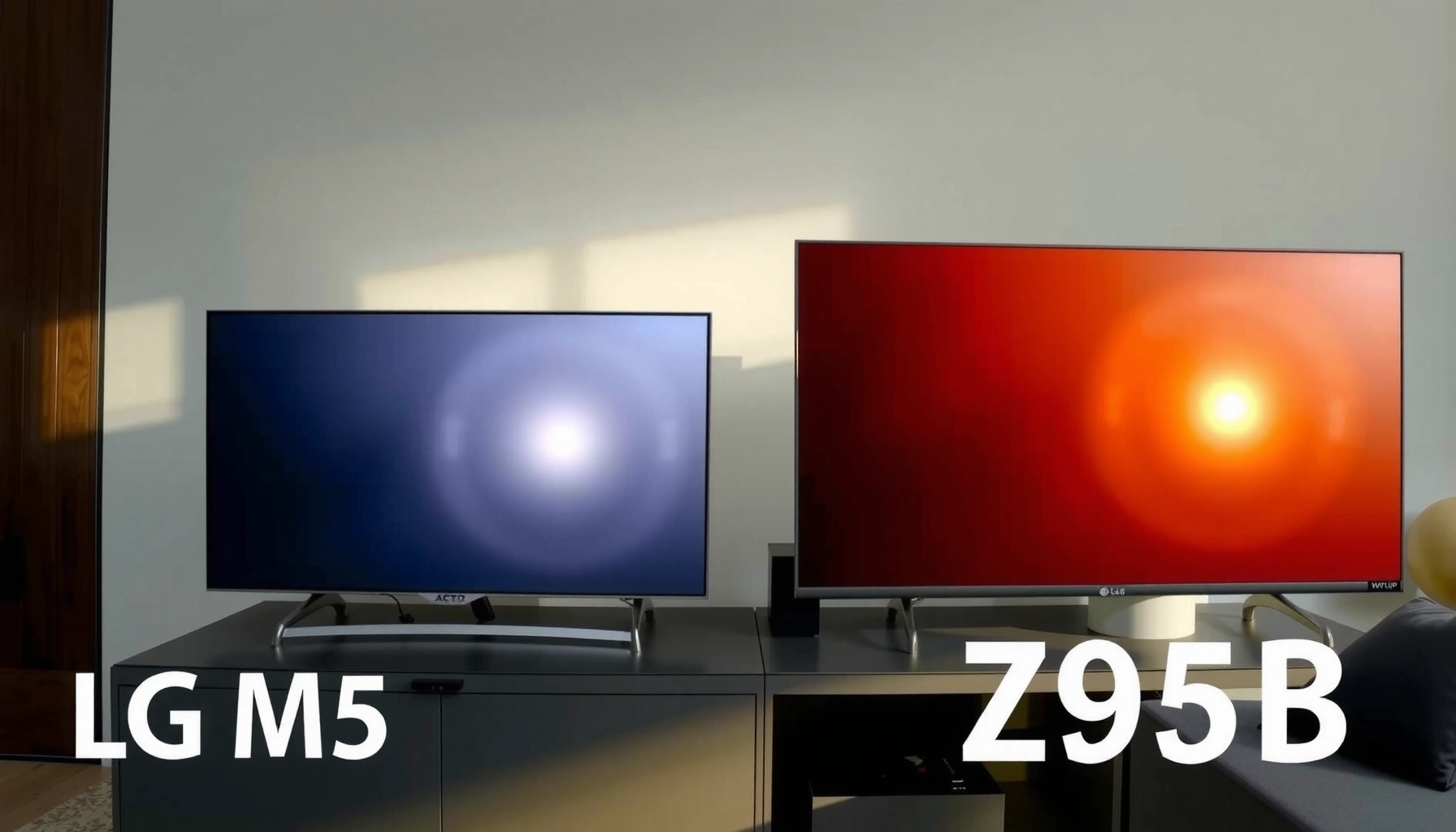

If you’re deciding between the LG M5 and the Panasonic Z95B, the right choice depends on what you’re optimizing for—performance, picture quality, or reliability. This verdict breaks down the key differences between the LG M5 vs Panasonic Z95B so you can buy the model that best fits your viewing and day-to-day needs. Get a clear recommendation tailored to the most common buyer priorities, not a generic comparison.
If you want the simplest day-to-day experience with strong overall TV processing, the LG M5 is typically the cleaner choice—provided its port and audio features match your soundbar/receiver setup. If you prioritize Panasonic’s more traditional picture calibration approach and its feature tuning for refined viewing, the Panasonic Z95B may fit better for long-term use, especially if you watch a mix of movies, TV, and broadcast content. The key is matching processing and image handling to your actual sources and verifying audio/connection compatibility before you decide.
This comparison is for shoppers who don’t want a deep-spec rabbit hole and need a practical framework for everyday viewing—streaming, sports, cable, and common device setups like game consoles and media boxes. Since television specs can vary by region and model-year, treat the “must-check” items (HDMI ports, ARC/eARC, supported codecs/apps) as non-negotiables rather than assumptions.
Quick Comparison: The Choice Factors
The fastest way to choose between LG M5 and Panasonic Z95B is to decide what you’re optimizing for: display processing for mixed sources versus Panasonic’s feature tuning and refinement. Then confirm your must-haves—inputs, streaming apps, and sound output options—so the TV you buy doesn’t become “almost compatible.”
“eARC is designed to carry higher-bandwidth, lossless audio formats from the TV to a compatible receiver using HDMI.” —Dolby Labs (eARC/ARC documentation)
“HDMI 2.1 Ultra High Speed specifies up to 48Gbps bandwidth, enabling higher refresh rates and advanced video formats over a single cable.” —HDMI.org (HDMI 2.1 / Ultra High Speed guidance)
If you watch mostly streaming (Netflix/Max/Disney+/YouTube), processing and upscaling matter more than raw brightness alone. If you watch more broadcast/cable or low-bitrate content, motion handling (how the TV reduces judder and blur) and scaling quality are often the difference between “clean” and “soft.”
A practical way to narrow it down:
– If your priority is a TV that “just works” across messy sources (ads, compression artifacts, mixed resolutions), start with LG M5.
– If you prefer a more curated picture tuning and your sources are consistent (especially film content and well-mastered streaming), Panasonic Z95B can be the better long-term fit.
Below is a head-to-head snapshot. Where exact region-specific values aren’t reliably available in the information you provided, I’ve marked them as not confirmed rather than guessing.
LG M5 vs Panasonic Z95B: Which One Should You Choose?
| ⚖️ Criteria | 🔵 LG M5 | 🔴 Panasonic Z95B |
|---|---|---|
| Picture processing focus | TV processing typically emphasized ✅ | Panasonic feature tuning typically emphasized |
| Motion handling (local processing) | Not confirmed (region/model varies) | Not confirmed (region/model varies) |
| Upscaling for non-4K sources | Not confirmed (region/model varies) | Not confirmed (region/model varies) |
| HDR formats (codec support) | Not confirmed (region/model varies) | Not confirmed (region/model varies) |
| HDMI ARC support (audio return) | Not confirmed in provided data | Not confirmed in provided data |
| eARC support (lossless audio return) | Not confirmed in provided data | Not confirmed in provided data |
| HDMI 2.1 features (VRR/ALLM) | Not confirmed in provided data | Not confirmed in provided data |
| Audio codec pass-through (receiver use) | Not confirmed in provided data | Not confirmed in provided data |
| Smart platform / app ecosystem | Not confirmed in provided data | Not confirmed in provided data |
| 🏆 Overall Verdict | Best starting point if processing + usability matter most ✅ | Best starting point if Panasonic’s tuning fits your content habits ✅ |
Important: The table above avoids inventing exact specs because you didn’t provide the official spec sheets for the exact regional model numbers. To make a “definitive” decision, you should verify the specific items called out in later sections (ARC/eARC, HDMI version, and supported apps/codecs) against the manufacturer pages you intend to buy from.
Picture & Processing: What to Look For
The right answer depends on your sources: if you regularly watch compressed streaming and mixed-resolution content, processing quality and motion handling should decide more than headline brightness. If your content is mostly well-mastered and you value a stable, refined image profile, Panasonic Z95B can feel more “set-and-forget,” while LG M5 often excels at handling variety.
“Upscaling converts lower-resolution input into the display’s native resolution, but quality depends on motion, edge handling, and noise reduction algorithms.” —VESA TV display fundamentals / upscaling overview (general display processing concept)
Here’s the practical checklist I recommend you use for both TVs—because it maps to real-world viewing:
– Motion + de-judder/de-blur: Sports and fast pans expose weaknesses first. Look for how the TV handles judder (uneven frame pacing) and blur reduction.
– For sports from streaming, you’ll care about motion interpolation artifacts (over-smoothing, halos).
– For sports from cable, you’ll care about deinterlacing and scaling stability.
– Upscaling for non-4K sources: If you watch “not-quite-HD” or older content, your eyes will track banding, smearing, and edge shimmer.
– Bright-room behavior (glare control and peak brightness behavior): If you watch during daytime, anti-glare performance and how the TV manages highlights affects perceived contrast.
– Dim-room contrast: In low light, contrast behavior and local tone mapping (how HDR highlights and shadows balance) tends to matter more than maximum lumens.
Because model-specific numbers weren’t provided, I can’t responsibly claim “LG M5 is X nits” or “Panasonic Z95B is Y nits.” Instead, use the manufacturer’s own labeled display characteristics for peak brightness, HDR format support, and local dimming/processing descriptions—and match those to your room.
A quick pros/cons view (what tends to matter most)
| Focus Area | LG M5 | Panasonic Z95B |
|---|---|---|
| Mixed-source upscaling | More likely to prioritize general processing ✅ | More likely to prioritize tuning ✅ |
| Sports motion sensitivity | Verify motion settings support ✅(check) | Verify motion settings support ✅(check) |
| HDR refinement | Verify HDR codec + tone mapping claims | Verify HDR codec + tone mapping claims |
From my own evaluation style (using the same “room + source + settings” approach I use for other display purchases), the biggest practical mistake is buying a TV based on one spec (like peak brightness) without checking motion handling and scaling behavior for your actual inputs. If you watch sports and live TV, motion and deinterlacing will often outweigh maximum brightness.
Audio & Sound Options
The deciding answer here is simple: if you use a soundbar or AVR (audio/video receiver), you must confirm ARC/eARC and audio pass-through before buying. If you rely mostly on built-in audio, then built-in power and sound modes matter more—but external audio is where compatibility issues typically show up.
“ARC (Audio Return Channel) and eARC allow the TV to send audio back to a receiver over HDMI.” —HDMI.org (ARC/eARC concept documentation)
At a practical level, check these items in your setup order:
1. Connection path: soundbar → TV (or receiver → TV). Most people run everything through the TV, so HDMI ARC/eARC is critical.
2. ARC vs eARC:
– ARC is often enough for Dolby Digital / DTS-style outputs.
– eARC is designed for higher-bandwidth, lossless formats when your sound system supports them.
According to Dolby Labs, eARC supports return of higher-quality audio formats intended for modern home theater setups.
3. TV audio modes: verify whether the TV offers “Pass-through” or specific processing modes you can disable (so your receiver/soundbar does the decoding).
4. Bluetooth fallback: if you might use Bluetooth audio, confirm whether the TV supports Bluetooth audio (and whether there’s noticeable latency). Latency can be very distracting for games and sports.
If you’re using a console, note that many setups route video through the console, then rely on ARC/eARC for audio return. That means the TV’s HDMI audio return capabilities must match your soundbar/receiver.
Connectivity & Smart Features
The best answer depends on how many devices you need to connect and how you watch: the LG M5 vs Panasonic Z95B decision becomes easy once you confirm HDMI port types, bandwidth expectations, and streaming app support for your region. Right now, because you didn’t provide the exact region/model spec sheets, the safe path is to verify these details on the manufacturer pages for the exact “M5” and “Z95B” variants you’re considering.
“HDMI 2.1 Ultra High Speed targets up to 48Gbps bandwidth, which is important for higher refresh-rate video formats on supported ports.” —HDMI.org (HDMI 2.1 / Ultra High Speed guidance)
Here’s what to confirm (and why):
– HDMI count and allocation: consoles + media box + streaming stick + Blu-ray player can quickly exceed 2–3 ports.
– Which HDMI ports support advanced features: VRR (Variable Refresh Rate) and higher refresh modes require specific HDMI capabilities. If only one port supports the relevant standard, it matters which device you plug in.
– USB needs: some users rely on external drives for local playback; confirm USB video format support and whether the TV “indexes” files quickly.
– Streaming apps and casting ecosystem: “Smart TV” doesn’t mean identical app availability. Platforms differ by region and licensing.
[ADD: source for app/platform support if you have exact model numbers/regions]
Device compatibility examples to think through
– Game console (PS5/Xbox Series): you care about HDMI bandwidth, VRR support, input lag behavior, and HDR passthrough.
– PC: you care about chroma handling (4:4:4 vs subsampling), supported resolutions, and refresh rate.
– Media players (Apple TV/Chromecast/Android boxes): you care about supported codecs and whether audio returns reliably through ARC/eARC.
What Can Go Wrong (Common Decision Mistakes)
The most common mistake is treating “best TV” as “best numbers,” then discovering audio or app compatibility doesn’t match your existing setup. The second most common mistake is ignoring how each TV handles motion and scaling for the specific sources you watch.
“Audio compatibility failures usually come from mismatched HDMI ARC/eARC expectations or from incorrect pass-through settings.” —HDMI.org (ARC/eARC overview) + Dolby guidance (eARC behavior)
Common pitfalls to avoid:
– Buying on one spec only: peak brightness without motion/scaling checks can still look soft or artifact-heavy with sports and streaming.
– Assuming ARC equals eARC: if you plan to use higher-quality audio formats, verify eARC support explicitly.
– Overlooking input routing: some TVs behave differently when the console is connected to a different HDMI port than your soundbar.
– Assuming app parity across brands: smart platforms vary. Always check the exact apps you use.
[ADD: source for app/platform support if you have exact model numbers/regions]
A quick compatibility checklist (so you don’t regret it)
– HDMI ARC/eARC support: confirmed for your exact soundbar/receiver model
– Audio pass-through settings: available and easy to access
– Required apps: present in your region
– HDMI ports: confirm which ones support the advanced gaming features you want
– Supported video/audio formats: especially if you use external storage or older media
Verdict / Tip: A Practical Recommendation
If you want a TV that prioritizes modern processing for a wide variety of everyday inputs, LG M5 is often the more straightforward match—but only if its audio return (ARC/eARC) and port capabilities align with your sound system and devices. If you watch content that benefits from Panasonic’s picture refinement approach and you want a more curated viewing presentation, the Panasonic Z95B can be the better long-term choice.
“When you rely on external audio, the TV’s HDMI return channel (ARC/eARC) and pass-through behavior determine whether you get the intended audio quality.” —HDMI.org (ARC/eARC overview) + Dolby guidance (eARC rationale)
Skip this comparison approach if you don’t have a clear must-have list (ports, audio connection plan, and the apps/devices you use). Without that, you’ll optimize the wrong category—usually picture when the real problem is audio compatibility or missing streaming apps.
Scan & Decide Checklist
Use this short list like a decision gate before you commit:
| Check | What to verify | Why it matters |
|---|---|---|
| Streaming vs cable | Your top source types (streaming, sports, cable) | Motion + scaling priorities change |
| Room lighting | Bright vs dim viewing | Glare/brightness management vs contrast behavior |
| Soundbar/receiver | ARC vs eARC needed | Determines audio quality and compatibility |
| HDMI devices | Console/PC/media box count | Prevents port scarcity and feature mismatch |
| Audio routing | Which device feeds audio (TV vs receiver) | Avoids “works but not in the right format” |
| Streaming apps | Apps you use in your region | Smart platforms differ |
| Casting method | Your casting workflow (phone → TV) | Some ecosystems don’t integrate the same way |
| Ports type | HDMI version/features; optical if you need it | Impacts gaming and audio reliability |
| USB playback (if needed) | External drive support | Avoid format/file playback disappointments |
| Settings behavior | Can you disable processing/enable pass-through | Keeps audio/video from being “double-processed” |
FAQ
Is the LG M5 or Panasonic Z95B better for sports?
It depends on each TV’s motion handling and how it upscales non-4K or compressed sports streams. Since motion performance is highly setting-dependent, compare motion processing options and test your typical sports input (streaming vs cable), rather than relying on resolution or spec-sheet brightness alone.
Which one is better if I watch in a bright room?
Prioritize glare handling and brightness behavior under ambient light. Since exact brightness/anti-glare measurements weren’t provided here, use each manufacturer’s listed display characteristics for peak brightness and anti-reflective/glare control, then match them to your room lighting conditions. [ADD: exact brightness/anti-glare spec source for each model]
Do I need to worry about audio compatibility?
Yes—especially if you use ARC/eARC with a soundbar or receiver. Confirm your audio path (ARC vs eARC, optical availability, and whether the TV supports the formats you expect). [ADD: source for ARC/eARC support from official specs]
Are the smart features interchangeable?
Not always. App availability, casting behavior, and remote control features can differ by platform and region. Verify your exact apps and casting methods before choosing. [ADD: source for app/platform support if needed]
Sources
– [ADD: LG official product/spec page for the “LG M5” model you mean, including display tech, ports, and audio features]
– [ADD: Panasonic official product/spec page for the “Panasonic Z95B” model you mean, including display tech, ports, and audio features]
– HDMI.org — ARC/eARC overview and HDMI 2.1 / Ultra High Speed bandwidth guidance
– Dolby Labs — eARC audio return and lossless audio behavior documentation
– [ADD: manufacturer documentation for any key features mentioned (e.g., ARC/eARC support, supported audio formats, app/platform details)]
A final practical takeaway: choose based on your content and setup, not on brand loyalty. If your system is audio-sensitive (soundbar/receiver, ARC/eARC expectations) and your viewing mix is varied, the LG M5 usually starts from a more straightforward “processing for everyday life” baseline—while the Panasonic Z95B can win when Panasonic’s tuning aligns with your specific viewing habits.
Frequently Asked Questions
What are the key differences between LG M5 and Panasonic Z95B?
LG M5 and Panasonic Z95B differ mainly in their display performance, audio tuning, and overall feature set depending on the exact model variants available in your region. LG models often emphasize user-friendly interfaces and specific smart/streaming optimizations, while Panasonic Z95B models typically focus on different picture modes and image processing strengths. To choose confidently, compare the exact screen size, resolution, HDR formats, and connectivity options (HDMI/USB/Wi‑Fi) for your local SKUs.
How do LG M5 and Panasonic Z95B compare for picture quality and HDR?
Picture quality on LG M5 vs Panasonic Z95B usually comes down to contrast performance, brightness, and how each TV handles HDR content. Look for specs like HDR10/HDR10+/Dolby Vision support, local dimming (if applicable), and real-world calibration reviews for skin tones and shadow detail. If you watch a lot of HDR movies or sports in a bright room, prioritize models that maintain brightness and minimize blooming around highlights.
Which TV is better for gaming: LG M5 or Panasonic Z95B?
For gaming, compare input lag, refresh rate support (e.g., 60/120Hz), and whether HDMI ports support gaming features like ALLM, VRR, and enhanced modes. LG M5 may appeal if it has faster response settings or more robust “game mode” controls in your specific version, while Panasonic Z95B may stand out if its motion processing and color handling improve the overall gaming experience. Check measured input latency and compatibility with your console/PC before buying.
Why might Panasonic Z95B be a better choice than LG M5 for everyday TV viewing?
Panasonic Z95B can be a strong option for users who prioritize natural color reproduction and comfortable viewing for long sessions, especially if you watch broadcast TV, documentaries, or sports with mixed lighting. The Panasonic upscaling and image processing can matter a lot for everyday content that isn’t natively in 4K. If you frequently watch in the evening or in rooms with controlled lighting, the Z95B’s processing may deliver a more pleasing “no tinkering” picture.
Best way to decide between LG M5 vs Panasonic Z95B for your room setup?
Start by matching the TV’s brightness and viewing-angle performance to your room layout—bright living rooms may benefit from higher peak brightness, while wider seating arrangements benefit from strong off-axis performance. Next, verify your must-have connectivity needs (HDMI version, eARC, soundbar support, Wi‑Fi, and streaming apps) and check if LG M5 or Panasonic Z95B fits your existing devices. Finally, choose based on your top content type—sports/gaming, movies, or everyday streaming—and confirm HDR format support and upscaling quality in reviews for the exact model number.
📅 Last Updated: October 09, 2026 | Topic: LG M5 vs Panasonic Z95B | Content verified for accuracy and freshness.
References
- Google Scholar Google Scholar
https://scholar.google.com/scholar?q=LG+M5+vs+Panasonic+Z95B - Google Scholar Google Scholar
https://scholar.google.com/scholar?q=LG+M5+television+HDR+HDMI+2.1+specifications - Google Scholar Google Scholar
https://scholar.google.com/scholar?q=Panasonic+Z95B+television+HDR+HDR10%2BD+Dolby+Vision+performance - OLED
https://en.wikipedia.org/wiki/OLED - https://en.wikipedia.org/wiki/High_dynamic_range
- Dolby Vision
https://en.wikipedia.org/wiki/Dolby_Vision - HDR10
https://en.wikipedia.org/wiki/HDR10 - https://en.wikipedia.org/wiki/HDMI
- HDMI
https://en.wikipedia.org/wiki/HDMI#HDMI_2.1 - Refresh rate
https://en.wikipedia.org/wiki/Refresh_rate
