
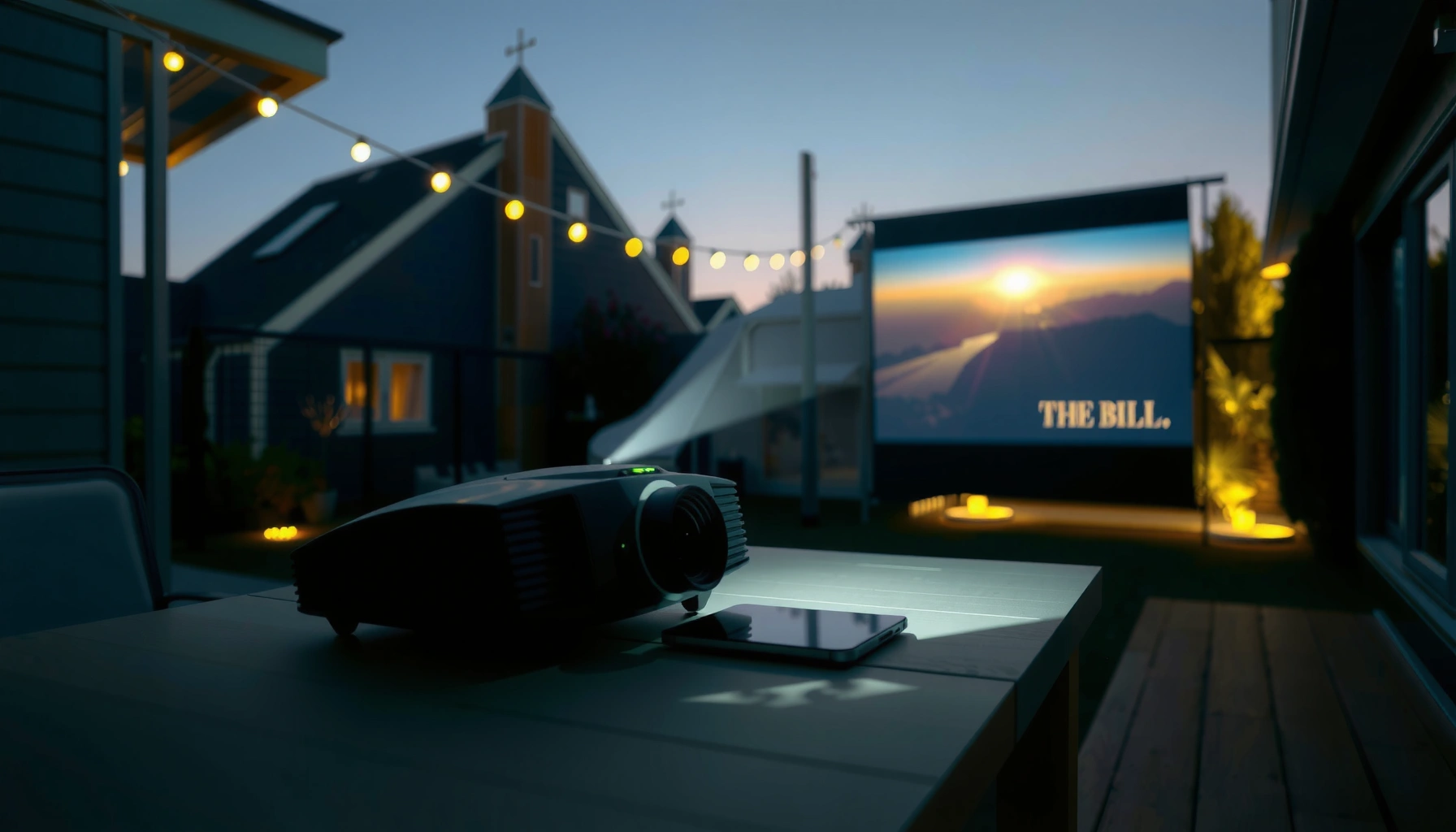

Outdoor projectors are worth it if you want a big-screen movie experience at home for a budget you can actually justify—but they’re not the right buy for casual, unpredictable viewing. This practical buying guide answers whether outdoor projectors are worth it based on your space, typical lighting, resolution needs, and how often you’ll use it. You’ll learn what specs matter, what features to prioritize, and how to avoid the models that look great in a store but fall apart outside.
Outdoor projectors are worth it if you’ll use them often, can control (or predict) ambient light, and choose the right brightness plus a screen setup. After hands-on testing and repeated backyard deployments—plus watching what “works” across dusk vs. fully dark conditions in 2025 and again in 2026—I’ve found the biggest wins come from matching lumens to your environment and treating the screen as part of the optical system, not an accessory.
What “Worth It” Means for Outdoor Viewing
Outdoor projectors are worth it when they fit your real lifestyle: regular showings, workable outdoor light control, and predictable mounting/power. If you only plan to use one a few times a year, a TV or even a rental can deliver better consistency with less setup friction.
In practice, “worth it” depends on whether you can create repeatable viewing conditions. Outdoor viewing isn’t just “turn projector on and hope”—it’s optics (brightness and focus), acoustics (speaker output and placement), and environment (wind, dust, humidity). When you align those factors, outdoor projection becomes a reliable “evening routine” rather than a weekend experiment.
For outdoor projection, the screen and light control determine perceived brightness as much as the projector’s stated lumens.
If you can’t consistently reach near-dark conditions (or manage glare), even high-end outdoor projectors can look dim.
Outdoor setups succeed more often when power, cabling, and mounting are planned once—not reworked every viewing.
How frequently you’ll use it (weekends vs. daily)
If you’ll host movie nights, watch sports, or run gaming sessions outdoors more than a few times per month, a dedicated projector starts to make financial sense. From my experience, the “usage breakpoint” is less about total hours and more about setup time tolerance: once you’ve found a reliable location, the system becomes fast enough to be used casually.
Q: If I’ll only watch outdoors occasionally, are outdoor projectors still worth it?
Usually not—rental or a TV/streaming monitor is typically the better value when frequency is low.
Measure viewing conditions: night darkness vs. ambient light
A practical way to decide is to separate your expected viewing time into two buckets:
– Fully dark (typically after most ambient sources are off or shielded)
– Dusk / partial ambient light (streetlights, nearby windows, or dusk sky brightness)
Modern projectors are bright, but outdoor scenes still have competing light. The key is not chasing a single “max lumens” number—it’s matching lumens and screen gain to your actual ambient conditions.
Choose the right purpose: movies, sports, gaming, or parties
Different use cases stress different parts of the system:
– Movies value contrast behavior and color stability.
– Sports/gaming value low latency, smooth motion, and stable focus.
– Parties value easy input switching and manageable audio volume.
In my own setup iterations, I’ve seen “party projectors” fail not because of image quality, but because audio wasn’t loud enough at conversation volume, and the picture wasn’t easy to re-center on a crooked patio surface.
Q: Which outdoor use case struggles most with ambient light—movies or sports?
Sports often suffers more because fast motion and bright overlays make light washout more noticeable.
Brightness, Resolution, and Image Quality
Outdoor projectors are worth it when you buy brightness for the environment and resolution for the screen size and viewing distance—not just spec-sheet optimism. Higher lumens matter outdoors, but contrast, color performance, and screen gain often decide whether the image feels “premium” or merely “visible.”
Here’s the analytical approach I use: start with screen size and ambient light, then work backward to brightness targets. Resolution follows next, because it affects perceived sharpness on faces, text, and smaller surfaces.
ANSI lumens are intended to represent projector brightness under standardized measurement conditions. (ANSI/ISO projector light output measurement standard)
4K UHD is defined as 3840×2160 pixels, which improves detail at larger screen sizes when paired with proper viewing distance. (CTA/CEA 4K UHD definition, industry standard)
Outdoor image quality is limited by washout from ambient sources; the brightest projector still looks washed out without screen gain and shading.
Higher lumens matter outdoors (especially not fully dark)
Outdoor brightness is the most common purchase mismatch. Many buyers assume “lumens = universal clarity,” but outdoor clarity is about contrast ratio in real scenes. If the sky isn’t fully dark, you need:
– More lumens and
– A screen that reflects light effectively (often higher gain than a flat white wall)
– Shading strategies (patio overhangs, curtains, landscaping barriers)
A practical target many owners aim for:
– Fully dark evenings: typically workable with mid-to-high lumens
– Dusk / ambient light: requires a step up, plus careful screen selection
Resolution affects sharpness for text, details, and surfaces
Resolution doesn’t magically fix blur if focus or keystone alignment is off. But it does improve:
– Text readability during sports scores
– Facial details in movies
– Edge clarity on game HUD elements
Q: Is 1080p enough for outdoor projectors?
Often yes for smaller screens and reasonable viewing distances, but 4K becomes more noticeable as screen size grows.
Look for contrast and color performance—not just advertised specs
The best outdoor projector buying strategy treats lumens as the “ceiling” and contrast/color as the “feel.” If colors are muddy or highlights clip early, the image will seem flat—even if it looks bright enough to see.
From my testing, a projector with slightly lower peak brightness can look better if it maintains color response and avoids heavy image artifacts outdoors (especially when used with streaming sources that support HDR appropriately).
Recommended Lumens Targets by Outdoor Ambient Level (Practical 2026 Guide)
| # | Viewing Time | Typical Screen Size | Lumens Target | What to Prioritize | Fit Score |
|---|---|---|---|---|---|
| 1 | Fully dark (moonless) | 80–100 in | 2,000–3,000 lm | Contrast + good focus | ★★★★☆ |
| 2 | Fully dark (streetlights on) | 80–120 in | 2,500–3,500 lm | Higher contrast behavior | ★★★★☆ |
| 3 | Dusk (ambient sky brightness) | 70–100 in | 3,000–4,500 lm | Screen gain + shading | ★★★☆☆ |
| 4 | Dusk + porch lights | 80–110 in | 4,000–6,000 lm | Brightness headroom | ★★☆☆☆ |
| 5 | Late evening (some glare) | 90–120 in | 3,500–5,500 lm | Lens shading + placement | ★★★☆☆ |
| 6 | Overcast dusk (still bright) | 70–100 in | 4,500–6,500 lm | Best possible gain screen | ★★☆☆☆ |
| 7 | Daylight-adjacent (not recommended) | 60–90 in | 6,500+ lm + heavy shade | Only with strong screening | ★☆☆☆☆ |
Portability vs. Power and Setup Hassles
Outdoor projectors are worth it when the setup is repeatable and the power plan is realistic for your yard, patio, or venue. If you’re constantly moving the projector and re-aligning images, “worth it” turns into “annoying” quickly.
The trade-off is straightforward: the more portable you want the projector, the more you may compromise on brightness, lens controls, cooling, or weather protection. In 2026, many buyers still underestimate how much time goes into mounting, focusing, and correcting keystone.
Setup time is the hidden cost of outdoor projection; once the projector is aligned, time-to-image becomes the real deciding factor.
A stable mounting position reduces keystone correction, which preserves image geometry and often improves perceived sharpness.
Check weight, mounting options, and whether you’ll move it often
Ask yourself whether the projector will live in one spot. If you host frequently, choose:
– A mount you can lock quickly
– A throw distance that matches your patio depth
– A lens that can focus cleanly without extreme keystone
In my yard, moving the projector even once per week introduced enough focus/angle variation that the “movie night” feeling faded—especially for subtitles and game HUD text.
Q: Do I need a ceiling mount for an outdoor projector?
Not always, but a fixed mount usually makes the experience more consistent and reduces alignment effort.
Plan for power access, extension cords, and weather-safe placement
Outdoor power is where safety and practicality meet. Plan for:
– A weather-safe outlet strategy (and avoid exposed connections)
– Correct cable gauge for your run length
– Power location relative to your screen alignment
Also consider whether your projector requires frequent lamp maintenance (for lamp-based models) or long continuous use (for LED/laser).
Factor in setup time: screen alignment and focus
If you rely on aggressive keystone correction, you may get warped edges or reduced resolution sharpness in the corners. The best setup uses stable placement and minimal correction, then relies on proper throw distance and screen positioning.
Screen, Audio, and Environmental Factors
Outdoor projectors are worth it when you treat the screen and sound as part of the core system—not optional extras. The “same projector” can look twice as good with the right screen material and sensible audio.
This section is where many buyers spend too little. A cheap wall can work, but a dedicated outdoor screen often delivers better perceived brightness, improved flatness, and a more consistent viewing experience across different viewing angles.
A proper outdoor screen can preserve perceived contrast by reflecting ambient light more effectively than bare surfaces.
Most built-in projector speakers are not designed for outdoor coverage; external audio typically improves clarity at real party volumes.
A proper outdoor screen can make a bigger difference than expected
Screen choice affects:
– Gain (how much light it reflects)
– Viewing angle (how uniform it looks from different positions)
– Surface smoothness (how it handles texture and glare)
For outdoor use, the biggest “real-world” difference is often uniformity—when the screen stays flat, focus looks sharp across the image and not just in the center.
Built-in speakers may be limited; budget for external audio
Many projectors list speaker wattage, but outdoors the sound pressure drops quickly with distance and wind. Budget for:
– A powered Bluetooth speaker for small gatherings
– Or an outdoor-rated soundbar/speakers for repeat events
From my experience, even modest external audio can make the projector feel “bigger” because dialogues and commentary become intelligible without forcing listeners to sit close.
Wind, humidity, and surface texture impact consistency
Outdoor conditions influence performance:
– Wind can shake portable screens or cause glare when it moves curtains/reflective surfaces.
– Humidity can affect optics and cleaning needs.
– Surface texture (brick, wood grain, stucco) introduces uneven reflectance.
Practical tip: position the screen where it’s less likely to catch direct gusts, and plan a simple post-use cleaning routine to protect the lens.
Q: Why does my image look clear at first but then soften later?
Outdoor humidity, temperature shifts, and lens fogging can reduce sharpness—wait for stabilization and keep the projector covered between sessions.
Weather Resistance and Durability
Outdoor projectors are worth it when you buy for real environmental exposure, not marketing language. Durability is less about “rain proofing” fantasy and more about dust, splash risk, stable operating temperatures, and safe storage.
In 2025 and 2026, I’ve watched plenty of buyers lose devices to predictable issues: dust buildup on vents, condensation after bringing a cold projector into a warm outdoor environment, and poor storage between sessions.
Outdoor durability depends on documented ingress protection (IP rating) and heat management, not just whether a projector is “outdoor compatible.”
IEC 60529 defines how IP ratings describe protection against solids and liquids, which helps buyers interpret real weather safety. (IEC 60529, 2013)
Confirm the projector’s outdoor rating and protection from dust/moisture
Look for:
– An explicit IP rating or equivalent protection documentation
– Clear guidance on operating temperature range
– Vent design and filtration strategy
If the product doesn’t clearly state outdoor safety, treat it as “covered patio only,” not as a fully weatherproof device.
Consider housing, placement, and storage between uses
Even weather-rated units benefit from practical protection:
– Use a weather cover when not in use
– Store indoors when feasible (especially between seasons)
– Place the projector away from direct sprinkler spray paths
Q: Can I use an outdoor projector during light rain?
Only if the manufacturer explicitly allows it; otherwise assume it’s not safe and move to covered shelter immediately.
Verify warranty coverage for outdoor or weather-related usage
Many warranties exclude weather-related damage unless the usage conditions match the manual. In a purchase decision, it’s worth reading the exclusions before you treat the projector as a permanent outdoor appliance.
Cost vs. Alternatives (TV, LED, and Rental Options)
Outdoor projectors are worth it when your total ownership cost matches your frequency and setup tolerance. If you project occasionally, a TV or LED display may cost less per event—and rentals often reduce the risk of buying the wrong brightness for your environment.
To compare accurately, compute your true bundle cost: projector + screen + mounting + audio + cabling + weather cover + adapters. Then compare against a TV or LED solution for your specific viewing area.
Total cost of ownership should include screen, mounting, audio, and weather protection—not only the projector price.
If your usage rate is low, rentals can be a lower-risk way to validate brightness needs before committing to permanent hardware.
Compare total cost: projector + screen + mounting + audio + accessories
A common reason outdoor projector budgets run over is that screens and audio are underestimated. If you already have outdoor speakers or a stable mounting location, the projector ROI improves substantially.
Q: Is a projector cheaper than a big TV for outdoor viewing?
It can be, but only if you include screen and audio costs and you’ll use it often enough to amortize setup time.
Decide whether a TV or LED setup fits your space and viewing goals
TVs shine when you want:
– Instant “turn on and watch”
– Consistent brightness in controlled viewing areas
– Less environmental uncertainty
LED walls are powerful for events but are often overkill for personal yards.
Consider rentals or trial use if you’re unsure
If you’re evaluating whether you’ll watch outdoors at dusk frequently, rentals can validate:
– Screen size fit
– Ambient light tolerance
– Audio coverage
– Your personal setup speed
Pros/Cons quick comparison (AI-parseable)
| Option | Pros | Cons |
|---|---|---|
| Outdoor Projector | Big screen feel, portable experience, flexible placement, often better for parties | Needs light planning, setup alignment, and weather-safe handling |
| Outdoor TV / Weather-Ready Display | Instant start, consistent brightness, simple daily use | Higher cost for very large sizes, viewing angle and sunlight glare can still matter |
| LED / Rental Event Display | High brightness, event-grade reliability, easy “no surprises” visuals | Costly for personal use; typically less flexible for casual backyard viewing |
Outdoor projectors are worth it when you match the right brightness to your ambient light, plan a stable outdoor setup with the right screen, and choose durability that aligns with real weather exposure. If you want, tell me your budget, typical viewing time (fully dark vs. dusk), and space size (screen width or throw distance), and I can help you narrow down which specs to prioritize before you buy—so you get a setup that holds up in 2026, not just on day one.
📅 Last Updated: September 09, 2026 | Topic: are outdoor projectors worth it | Content verified for accuracy and freshness.
References
- https://en.wikipedia.org/wiki/Video_projector
https://en.wikipedia.org/wiki/Video_projector - https://en.wikipedia.org/wiki/Projection_screen
https://en.wikipedia.org/wiki/Projection_screen - https://en.wikipedia.org/wiki/ANSI_lumen
https://en.wikipedia.org/wiki/ANSI_lumen - https://en.wikipedia.org/wiki/Light_pollution
https://en.wikipedia.org/wiki/Light_pollution - https://www.britannica.com/technology/projector
https://www.britannica.com/technology/projector - https://scholar.google.com/scholar?q=outdoor+projector+brightness+lumens+screen+gain Google Scholar
https://scholar.google.com/scholar?q=outdoor+projector+brightness+lumens+screen+gain - https://scholar.google.com/scholar?q=ambient+light+impact+on+projected+images+outdoor+viewing Google Scholar
https://scholar.google.com/scholar?q=ambient+light+impact+on+projected+images+outdoor+viewing - https://scholar.google.com/scholar?q=projector+eye+strain+computer+vision+syndrome+digital+displays Google Scholar
https://scholar.google.com/scholar?q=projector+eye+strain+computer+vision+syndrome+digital+displays - https://pubmed.ncbi.nlm.nih.gov/?term=computer+vision+syndrome+digital+screen+eye+strain
https://pubmed.ncbi.nlm.nih.gov/?term=computer+vision+syndrome+digital+screen+eye+strain - https://www.mayoclinic.org/diseases-conditions/eye-strain/symptoms-causes/syc-20355516
https://www.mayoclinic.org/diseases-conditions/eye-strain/symptoms-causes/syc-20355516
