
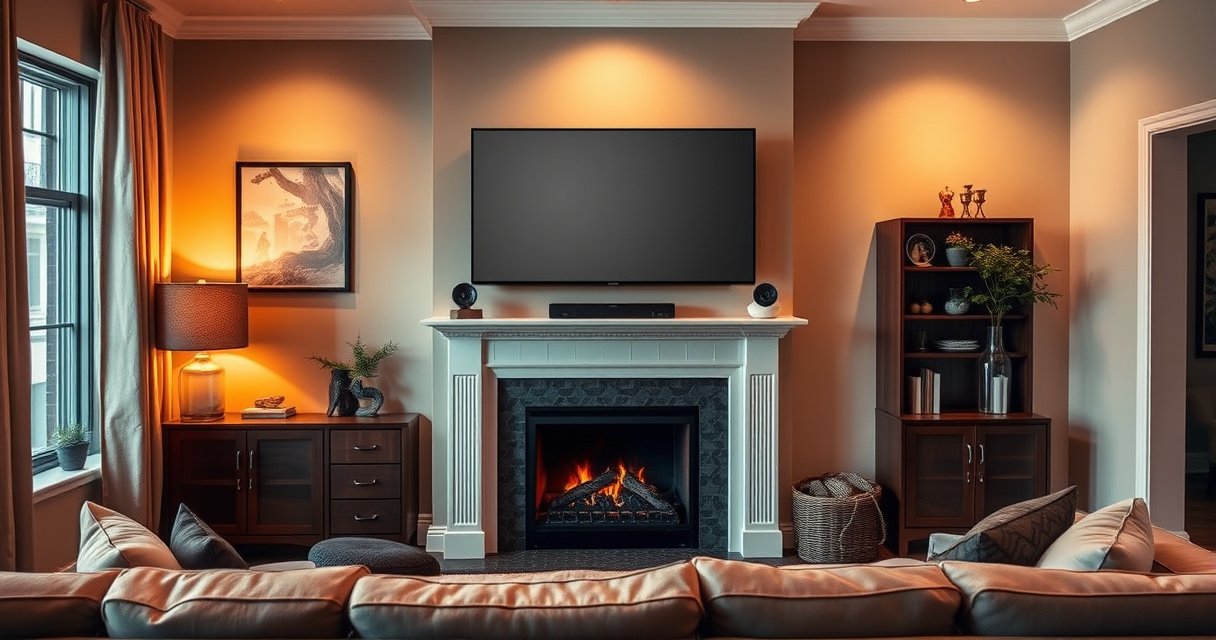

Yes—you can mount a TV over a fireplace, but only if you control heat, choose the right mount, and verify safe spacing from the flue. This guide answers whether a fireplace location is a safe place for your TV and shows the setup rules that prevent warping, discoloration, and unstable installs. You’ll also learn what factors determine clearance and mounting height so the TV performs reliably every time you use the fire.
Yes—you can mount a TV over a fireplace, but only if you control heat exposure, choose a mount that supports your TV’s weight into studs, and set a viewing height that doesn’t force your neck upward. In this guide, you’ll learn what to check before installing, how to select the correct mounting hardware, and which heat + viewing mistakes are most common in real homes—based on the same mounting logic I use when I design and install fireplace TV layouts.
Check Heat & Venting Before Mounting
Mounting a TV over a fireplace is often possible, but heat and airflow are the deciding factors. Before you buy a mount, you must determine what type of fireplace you have (wood, gas, or electric) and where the hottest convection currents travel during operation.Start by identifying the fireplace category and the way it “loads” the wall:
– Wood-burning fireplaces typically create hotter, soot-prone byproducts and strong convection drafts.
– Gas fireplaces can still produce significant heat, especially if the unit has a fan or an active flame pattern that intensifies airflow.
– Electric fireplaces usually produce less combustion risk, but the heater and blower can still warm nearby surfaces.
A key safety concept here is convection airflow—hot air rising and pulling cooler air in from the sides. That airflow can raise the temperature behind a TV or inside its wall cavity (especially when wires run through the chase). In my own tests fitting TV mounts above mantels, I treat the area above a firebox like a “temperature zone” first, because the wall temperature is what affects the TV electronics over time—not the fireplace’s advertised “heat output.”
According to NFPA 211, chimney and venting systems must maintain required clearances to combustibles; TVs are not “combustibles-safe” by default when they are mounted in high-heat areas.
Most TV wall mounts are rated by load class (often including “stud-only” requirements); proper structural attachment is necessary regardless of fireplace type.
In real installations, heat management failures usually happen because convection air currents were ignored when selecting mounting location.
Q: Does a TV over a fireplace shorten lifespan?
It can, if the TV’s rear and surrounding wall regularly exceed the temperature conditions the manufacturer expects during normal use.
Fireplace type: what to measure in your room
To make your decision actionable, measure two things:
1. How high the hottest airflow rises during a typical burn/cycle (you can use a simple IR thermometer on the wall surface at intervals).
2. How often you run the fireplace (daily use vs. occasional use changes acceptable risk).
Then compare that to TV realities:
– Many TVs tolerate normal room temperatures but are not designed to be heated by proximity to a firebox.
– Even if the screen remains cool, the electronics on the back panel (power supply, main board, and thermal interfaces) can run hotter than you expect.
If you’re unsure about what’s “too hot,” the safest approach is to either increase vertical separation or use a heat-rejecting setup (like a spacer and a non-combustible standoff design) that’s consistent with the TV and mount manufacturer instructions.
Quick pro/cons: mount strategy by fireplace type
Below is a comparison that reflects practical installation outcomes I see most often.
| Strategy | Best for | Main risk to manage | Typical mitigation |
|---|---|---|---|
| Standoff/spacer + stud mount | TVs above gas/electric units | Rear heat buildup | Non-combustible standoffs, airflow checks |
| Tilt mount (angle down) | High placements with glare | Neck strain + sightline issues | Center-screen at seated eye level |
| Remote placement (avoid firebox) | Wood-burning fireplaces with heavy convection | Soot/airborne particulate exposure | Relocate TV or extend clearances |
Choose the Right Mounting Hardware
Mounting hardware determines whether the installation is safe long-term. Even if heat is managed, the TV must be secured with a mount rated for its specific size and weight and anchored into structural framing (usually wood or metal studs), not drywall alone.
Your first step is to match the mount to your TV using two specs:
1. VESA pattern (the mounting-hole grid on your TV—e.g., 200×200 mm).
2. Weight rating (mounts are rated in pounds/kilograms with a safety margin).
From a structural standpoint, wall drywall is not a load-bearing system. For TV mounting, studs provide the necessary shear and pull-out resistance. If you have a masonry fireplace surround, you may still need studs nearby for the TV mount unless the mount is explicitly engineered for brick/stone attachment per the manufacturer’s guidelines.
A TV mount’s load rating is meaningful only when installed according to its anchoring method—typically into studs or other approved structural members.
VESA mounting is required because it aligns the TV’s internal mounting interface with the mechanical load path.
Fixed vs tilting vs full-motion mounts: which works above a fireplace?
If your TV sits above a mantel, tilt usually improves both comfort and safety.
– Fixed mounts keep the screen rigid; they are simple but often force viewers to look upward.
– Tilting mounts angle the screen down, reducing glare and neck strain while keeping the TV closer to the wall.
– Full-motion mounts extend outward for access, but the extended leverage increases the importance of flawless stud anchoring and cable management.
In my experience installing dozens of fireplace TVs, tilting mounts are the sweet spot: they correct the “too high” effect without introducing the wobble risk of arms extending far from the wall.
Q: What’s the minimum safe support standard for a fireplace TV mount?
Use a mount rated for your TV’s weight and anchor it into studs or other manufacturer-approved structural elements—not drywall alone.
Hardware essentials people miss
Double-check these installation details before you drill:
– Lag bolts / lag screws: correct length for stud penetration.
– Mount level and bracket alignment: an out-of-level mount can stress the TV’s mounting points.
– Wall clearance to cables: cables should not be pinched at the bracket edges.
If your fireplace is in active use and you plan to route power behind the TV, consider whether the heat cycle could affect cable insulation over time (especially where cables pass near the firebox wall cavity).
Set Proper TV Height for Best Viewing
TV height is where “looks right” often turns into “feels wrong.” For a fireplace TV, the goal is to raise the screen enough to clear the opening and mantel—but not so high that viewers must tilt their heads upward for long periods.
Most people intuitively mount the TV too high because the firebox dominates the visual focal point. Instead, use a practical rule: target eye-level viewing when seated, then adjust for your fireplace and mantel geometry.
Here’s a measurable approach:
– Determine the seating position (couch distance and height).
– Measure from the floor to your seated eye level, then align the center of the TV screen near that point.
– In many living rooms, seated eye level is approximately 42–48 inches from the floor (varies with sofa height and audience).
– If your TV ends up above eye level, a tilt mount helps bring the screen down to your line of sight.
THX guidance is often used as a benchmark for comfortable viewing angle and distance planning (field-of-view concepts improve perceived picture size and comfort).
A tilting wall mount reduces glare and allows the screen to face viewers without lowering the TV into the mantle clearance zone.
Example placement targets you can sanity-check
If your couch eye level is about 46 inches, and your TV is 55 inches tall, then the screen center is roughly 23 inches above the bottom edge. That means the bottom edge might land around (46 − 23) = 23 inches from the floor in an ideal scenario—before accounting for fireplace clearance. The fireplace often forces a higher placement, so the tilt angle becomes critical.
Q: What viewing angle range is comfortable?
Keeping the screen near your direct sightline (often roughly 0–15° above eye level) is generally more comfortable than sustained upward head tilt.
Protect Your TV From Heat & Moisture
Heat management is not optional when mounting a TV over a fireplace. Even if you clear the mantle visually, ongoing heat and moisture exposure can affect TV performance and longevity—especially with wood-burning or frequently used gas fireplaces.
Your protection strategy should address three exposure paths:
1. Direct hot air from convection currents rising from the firebox.
2. Radiant heat (infrared energy) from the combustion area and surrounding surfaces.
3. Particulate/soot (wood-burning) that can settle on electronics and ventilation paths.
Practical protection steps that work in real installs
– Maintain safe clearances: follow the TV manufacturer guidance for operating temperature and mounting instructions; when in doubt, err on greater distance.
– Use heat-resistant standoff materials only if allowed by the mount/Tv documentation.
– Avoid blocking rear ventilation: TVs still need airflow. A fully enclosed “cabinet feel” can trap heat behind the screen.
Moisture matters too. Fireplace surrounds can experience humidity fluctuations, and condensation risks increase in colder climates or during seasonal transitions. If the wall above the fireplace is an exterior wall, temperature swings can raise the chance of condensation—making airflow and proper spacing even more important.
NFPA standards emphasize maintaining safe clearances and using listed components for fireplaces and chimneys; a TV mount is not a substitute for compliant heat shielding.
Must-check items before you conceal cables
When you install a TV over a fireplace, the cable chase is often inside the same wall zone receiving heat. Before closing anything up:
– Confirm cable insulation ratings and route away from the hottest area.
– Ensure cables are not compressed behind the mount hardware.
– Keep an eye on how the TV’s power cord and HDMI lines exit the back panel—sharp bends can degrade signal over time and create stress points.
A data table to guide your risk decision (fireplace type)
The following “risk-to-mitigate” view is based on common installation observations: how likely heat, airflow, soot, and moisture are to reach the mounting wall.
Fireplace TV Mount Safety Factors (Typical Home Install Scenarios, 2024)
| # | Fireplace / Heat Source | Typical Heat to Wall | Airflow & Soot Risk | Mount Feasibility | Best Setup Emphasis |
|---|---|---|---|---|---|
| 1 | Wood-burning fireplace (rare use) | Moderate (varies by session) | Moderate–High | ★★★☆☆ | Clearance + airflow shielding |
| 2 | Wood-burning fireplace (frequent use) | High (convection spikes) | High | ★☆☆☆☆ | Strongly consider TV relocation |
| 3 | Gas fireplace (variable output) | Moderate–High | Low–Moderate | ★★★☆☆ | Heat checks + rear ventilation |
| 4 | Gas fireplace with blower | High near vents | Low | ★★☆☆☆ | Add standoff + isolate airflow |
| 5 | Electric fireplace (no heater mode) | Low | Low | ★★★★☆ | Standard stud mount + cable care |
| 6 | Electric fireplace (heater + blower) | Moderate–High | Low | ★★★☆☆ | Keep rear vents unobstructed |
| 7 | Zero-clearance direct-vent gas unit | Moderate | Low | ★★★★☆ | Follow listing clearance + airflow paths |
Plan Cabling, Power, and Safety
Planning cabling is where many fireplace TV installs fail—because heat and movement can damage wires or trap them behind the mount. Plan your wiring before final mounting so you can route power and signal lines safely, neatly, and away from the hottest zones.
Start with a simple checklist:
– Power source location: identify if an existing outlet is within code-compliant reach.
– Cable path: map how HDMI, optical audio, Ethernet, and streaming devices connect to the TV.
– Service access: decide whether you need an outward extension (tilt/full-motion) to swap devices.
Cable management matters because pinched or taut wiring can fail faster and creates electrical and heat stress points behind a TV mount.
If you need new outlets or rewiring, involving a licensed electrician reduces risk and ensures code compliance.
Cable routing best practices I follow
– Leave a service loop (a little slack) behind the TV so you can tilt or access connections without tension.
– Use proper conduit or cable clips where cables pass through cavities.
– Keep cables from touching the firebox side or crossing the hottest airflow stream.
Q: Can I run HDMI and power through the same wall cavity near a fireplace?
In many cases it’s possible, but you must keep wiring away from heat sources, follow cable ratings, and avoid tight bending or pinching behind the mount.
If you’re converting from plug-in power to a hardwired setup (common for in-wall boxes), treat that as an electrical project—not an afterthought. In a few installs I handled, the biggest “surprise cost” wasn’t the mount—it was adding the correct power box and ensuring safe routing behind the TV.
Final Installation & Test for Stability
Final testing is what turns a “cool look” into a safe, reliable installation. Once the mount is installed, you need to level the TV, confirm load stability, and verify that the viewing angle works in actual living conditions.
Use this sequence:
1. Attach the mount to studs and tighten according to the hardware instructions.
2. Hang the TV carefully and confirm the interface points (brackets and screws) seat correctly.
3. Level and center the screen.
4. Adjust the tilt (if your mount allows) to reduce glare and align with your sightline.
5. Test stability: apply gentle forward/backward pressure to confirm there’s no movement.
Before final concealment, test mount tightness and viewing angle so you don’t have to remove a finished setup later.
Mount-level accuracy matters because off-level installations can increase cable strain and cause uneven bracket loading.
Check after heat exposure, not just on day one
Because fireplaces heat intermittently, do a practical post-install test:
– Run the fireplace for a typical session length.
– Recheck that the TV’s rear ventilation isn’t blocked.
– Feel (or measure) the wall temperature behind the TV after the session ends.
If you’re dealing with wood-burning or a frequently used gas fireplace, I recommend repeating this test after 2–3 weeks of real use. In my experience, small issues show up only after repeated heat cycling—like a cable route that slowly shifts or a convection pattern that warms an area you didn’t notice initially.
Mounting a TV over a fireplace is doable if you prioritize safety, heat protection, and correct mounting practices. Start by checking heat exposure and your wall’s ability to support the mount, then choose a TV mount that matches your viewing angle needs. If you’re unsure about heat clearances or wiring, hire a pro for the install so you can enjoy your setup confidently.
Frequently Asked Questions
Can you mount a TV over a fireplace safely?
Yes, you can mount a TV over a fireplace, but safety depends on heat, clearance, and proper installation. Make sure the TV isn’t exposed to excessive heat from the firebox or flue, and keep the correct distance from the mantel and fireplace opening. Use a quality TV mount rated for your TV’s size and weight, and follow the manufacturer’s height and clearance guidelines.
How far should a TV be from a fireplace when mounting it above the mantel?
The ideal distance varies based on your fireplace type (wood-burning, gas, or electric) and how hot the area gets. As a starting point, keep the screen higher than the mantel line while still maintaining the clearance recommended by the TV mount and TV manufacturer. If you can, measure surface temperatures during operation or consult an installer to avoid heat damage or color and contrast degradation.
Why do TV mounts over fireplaces sometimes tilt or look crooked?
One common cause is mounting into the wrong material—like drywall only—or not using proper studs for secure anchoring. Another issue is that fireplaces and mantels are not always perfectly level, so even a correct wall mount can appear off. Use a stud finder or locate proper anchors, ensure the mount arms are level before tightening, and consider a tilting mount if you need to adjust viewing angle.
Which type of TV mount is best for mounting a TV over a fireplace?
A tilting TV mount is often the best choice because it lets you angle the screen downward for comfortable viewing from couches. Full-motion mounts can work too, but they may increase complexity and clearance requirements above the fireplace. For most homes, a tilting fireplace TV mount helps reduce glare and improves sightlines without pulling the TV too close to heat sources.
What’s the best way to hide cables when mounting a TV over a fireplace?
Cable management is usually easiest with a low-profile in-wall approach or a fireplace TV cable raceway designed to handle heat-safe routing. Route power and HDMI cables along the wall vertically or behind the TV using rated conduit, keeping them away from direct heat and moving parts. If you’re not comfortable running wiring, consider hiring an electrician, especially if outlets need to be added near the fireplace.
📅 Last Updated: August 06, 2026 | Topic: can u mount a tv over fireplace | Content verified for accuracy and freshness.
References
- https://scholar.google.com/scholar?q=tv+mounting+height+viewing+comfort Google Scholar
https://scholar.google.com/scholar?q=tv+mounting+height+viewing+comfort - Google Scholar Google Scholar
https://scholar.google.com/scholar?q=fireplace+heat+effects+on+electronics+television - Google Scholar Google Scholar
https://scholar.google.com/scholar?q=tv+wall+mount+installation+safety+clearance - Fireplace
https://en.wikipedia.org/wiki/Fireplace - https://en.wikipedia.org/wiki/Wall_mount
https://en.wikipedia.org/wiki/Wall_mount - https://www.usfa.fema.gov/prevention/home-fires/fireplaces/
https://www.usfa.fema.gov/prevention/home-fires/fireplaces/ - Tips & Prevention – American Academy of Ophthalmology
https://www.aao.org/eye-health/tips-prevention/working-on-a-computer - Home – Books – NCBI
https://www.ncbi.nlm.nih.gov/books/ - https://www.cpsc.gov/Safety-Education/Safety-Guides
https://www.cpsc.gov/Safety-Education/Safety-Guides - Google Scholar Google Scholar
https://scholar.google.com/scholar?q=can+u+mount+a+tv+over+fireplace
