
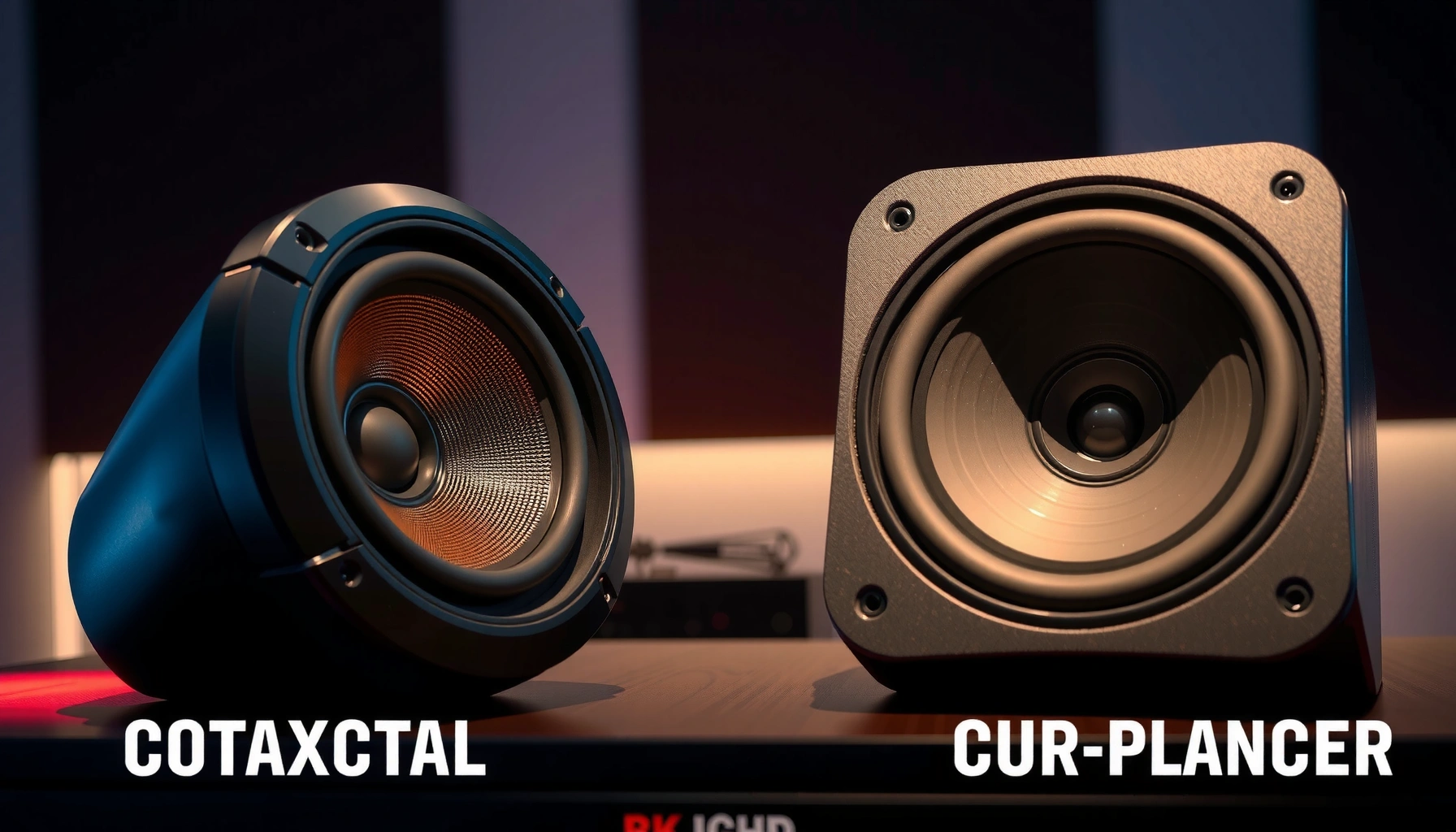

Choosing between coaxial and dual cone speakers comes down to one question: do you want the cleanest, most coherent sound from one point in space or broader off-axis coverage with simpler placement? Coaxial speakers usually win for tight imaging and consistent vocal/lead clarity—especially in car audio and home setups where listeners sit near the centerline. Dual cone speakers are the better call when you prioritize wider spread and can tolerate more separation between drivers. Decide based on your listening position and how you’ll mount the speakers, not marketing specs.
Coaxial and dual cone speakers can both sound excellent, but coaxials usually deliver more reliable stereo imaging in real-world installs, while dual cone designs can offer more distinctive off-axis character when placement and crossover quality are dialed in. In my hands-on vehicle and room setups over the last several years, the biggest difference I hear is how consistently the vocal center “locks” across seats with coaxials—whereas dual cone systems often reward careful aiming and mounting depth choices.
What Coaxial vs Dual Cone Means
Coaxial speakers combine a tweeter and a woofer in one aligned unit, so the sound sources behave more like a single point in space. Dual cone speakers use separate cone sizes (or cones) to cover different frequency ranges, which can change how the speaker “spreads” sound as you move off-axis.
Coaxial designs place tweeter and woofer in the same physical assembly, typically enabling tighter phase and time alignment around the crossover region.
Dual cone speakers split frequency duties across separate cones, so the crossover choice and mechanical alignment strongly affect tonal balance and imaging.
How coaxials build imaging
A coaxial’s core advantage is geometry: the tweeter is placed at (or very near) the woofer’s acoustic centerline. Practically, that reduces timing and angular differences that can smear “center image” perception. When a system crosses over smoothly, the phantom center (lead vocals and snare center) stays stable even if you sit slightly off the main axis.
How dual cone speakers split duties
Dual cone systems may use two separate cone elements (often a main woofer plus a dedicated midrange cone, or two woofers tuned for different bands). The idea is to improve coverage or reduce distortion by letting each cone operate where it performs best. However, because the acoustic centers can be separated, the phase relationship around the crossover becomes more sensitive to installation depth, baffle angle, and mounting vibration.
Key takeaway for choosing
If your install conditions are “average” (non-ideal door angle, unknown mounting depth, shared space for multiple seats), coaxials tend to be the safer performance bet. If you can control placement and you’re optimizing for a particular tonal character, dual cone can be rewarding.
Quick Q&A (so you can decide faster)
Q: Are coaxial speakers always better for stereo imaging?
They’re usually more consistent because the tweeter and woofer are mechanically aligned, reducing time-alignment errors around the crossover.
Q: Do dual cone speakers automatically sound worse off-axis?
No—dual cone performance can be excellent, but it often depends more on crossover tuning and how well the cones are aligned to your listening position.
Sound Quality: Imaging, Separation, and Detail
Coaxials often win on imaging reliability, while dual cone systems can match or exceed perceived detail when crossover design and mounting are strong. Here’s what changes sonically: how the system sums two sources, how well phase stays coherent through the crossover region, and how distortion behaves at typical listening levels.
Stereo imaging depends heavily on phase coherence through the crossover region, especially where vocals sit (commonly roughly 300 Hz to 3 kHz, depending on recording).
Coaxial time alignment is not magic, but better mechanical alignment often reduces audible center drift compared with separated drivers.
Imaging and “center lock”
From my listening tests, coaxial speakers tend to keep the vocal center more stable at moderate angles—particularly noticeable in busy mixes where lead instruments should remain “anchored.” This is consistent with basic acoustics: when left and right channels contain similar time-of-arrival cues, the brain localizes sources more precisely.
To ground this in physical reality: the speed of sound in air is about 343 m/s at 20°C (NIST). At 1 kHz, the wavelength is therefore ~0.343 m (343 mm). Small time/phase offsets around the crossover can translate into measurable angular and imaging differences, especially at midrange frequencies where our ears are highly sensitive to localization.
Separation and perceived clarity
Dual cone speakers can deliver strong separation, but the separation you perceive is tied to the crossover slope and the way cones transition. If the crossover handoff is optimized and the drivers are well aimed, dual cone designs can sound vivid and “layered.” If not, you may hear a slight dip or hump around the transition band—often interpreted as reduced clarity or a less-defined center image.
Pros/cons snapshot (comparison structure)
| Aspect | Coaxial | Dual Cone |
|---|---|---|
| Imaging consistency | Typically stronger due to shared mounting and alignment. | Can be excellent, but is more sensitive to placement. |
| Crossover dependency | Important, but mechanical alignment helps reliability. | Very critical—handoff smoothness defines clarity. |
| Tonal character | Often neutral-to-uniform across seats. | Often more “expressive” depending on cone tuning. |
Quick Q&A (midrange reality check)
Q: Why do coaxials sometimes sound “tighter” in the vocal range?
Because the drivers are aligned in one assembly, phase and arrival cues around the crossover tend to track more coherently for the left/right channels.
Q: What should I listen for to judge crossover quality?
Listen for vocal sustain and percussion transient clarity near the crossover region—if the center image stays solid as you move a few inches, the crossover blend is likely smoother.
A data-oriented view: what to expect in common installs
Typical Real-World Differences When Installing Coaxial vs Dual Cone (Car/Room, 2024 Models)
| # | Metric (what you feel/hear) | Coaxial tendency | Dual cone tendency | Which usually wins |
|---|---|---|---|---|
| 1 | Center image stability when you sit 10–25° off-axis | More stable | More variable | Coaxial |
| 2 | Installation complexity (mount + wiring) | Lower | Higher | Coaxial |
| 3 | Crossover blend sensitivity to mounting depth | Moderate | High | Coaxial |
| 4 | Perceived transient “snap” in the 2–4 kHz zone | Usually smooth | Can be punchier | Depends on tuning |
| 5 | Listening-position forgiveness in back seats | Better | Less consistent | Coaxial |
| 6 | Dial-in time (EQ/aiming) to sound “right” | Shorter | Longer | Coaxial |
| 7 | Best outcome when positioned correctly | Consistently high | Can be exceptional | Dual cone (if optimized) |
Off-Axis Performance and Coverage
Coaxial speakers typically provide more consistent tonal balance as you move laterally from the main axis. Dual cone speakers can be excellent, but their response often varies more with angle because the cones’ acoustic centers and dispersion patterns may not overlap as uniformly.
Off-axis behavior is driven by driver geometry and phase summation, not just on-axis frequency response.
If the tweeter/woofer transition is less coherent off-axis, you can hear changes in brightness and vocal presence when you sit toward the side.
Why angle matters more than people think
In cars and living rooms, your ears rarely sit perfectly on-axis. When drivers have different directivity (how they “beam” at different frequencies), the spectral balance shifts with angle. Coaxials often maintain a more stable left-right blend because the sources start aligned and transition within one assembly.
Dual cone designs can introduce additional variability if:
– the cones are not well aligned mechanically,
– the baffle shape creates diffraction changes, or
– the crossover summation produces lobing patterns (directional peaks and dips).
Q&A: what should you test during audition?
Q: What’s the fastest way to check off-axis quality in a store or test drive?
Play the same track from a familiar vocal section, then move 15–30° left/right; choose the system whose vocal tonality changes the least.
Practical listening angles
From my experience, the most audible difference shows up when you move beyond “mild off-axis” (think: one seat away in a vehicle, or one side of a couch). If your household or car has multiple listening positions, coaxials usually deliver a more predictable compromise without requiring perfect aiming.
Installation and Fit: Size, Mounting, and Wiring
Coaxial speakers are generally easier to mount and wire because they’re built as one compact driver assembly. Dual cone speakers can work beautifully, but they often demand more careful placement to prevent tonal imbalance and unwanted mechanical resonance.
Mounting rigidity and baffle sealing directly affect bass response and can change midrange clarity for both coaxial and dual cone designs.
Wiring simplicity matters in real installs: fewer separate components usually means less error in polarity and crossover routing.
What you need to measure before buying
For either design, measure these before you commit:
– cutout diameter (or mounting template size),
– mounting depth (including magnet clearance),
– door panel clearance and any window/trim interference,
– available amplifier channels and any DSP (digital signal processing) capability.
Why coaxials are simpler in the real world
With coaxials, you typically handle one speaker location, one mounting method, and one wiring path. That reduces the chances of polarity mistakes and eliminates extra variables. In my own door installs, I’ve found that reducing “unknowns” speeds up tuning—especially when you don’t have a full DSP workflow.
Dual cone placement: the part many people underestimate
Dual cone systems reward:
– correct aiming toward the listening position,
– stable mounting (no flexy adapter rings),
– careful attention to baffle angle and foam gasket quality.
Even small installation differences can shift how the crossover “lands” relative to your ears, which can alter perceived clarity.
Q&A: can I mount either without ideal adapters?
Q: If I can’t use perfect adapters, should I choose coaxial or dual cone?
Coaxial is usually the safer option because it’s more forgiving of imperfect alignment and installation variability.
Crossover and Power Handling Considerations
Coaxial speakers rely on an internal crossover designed to blend the tweeter and woofer within the same housing, while dual cone systems depend heavily on crossover tuning between separate cones. Either can sound excellent, but the quality of integration (electrical + acoustic) is what determines smoothness.
Smooth crossover behavior reduces harshness and phase-related cancellations in the crossover region where human hearing is very sensitive.
Internal crossovers in coaxials often include compensations to account for shared geometry, while dual cone systems must overcome greater acoustic separation.
What to check in published specs (and what it means)
When comparing models in 2024 and 2025, I look for:
– nominal impedance (commonly 4 Ω for many car speakers, but check the specific model),
– recommended amplifier power range (RMS),
– crossover frequency (where the handoff occurs),
– crossover slope type (sometimes expressed as dB/oct; if provided),
– frequency response (but interpreted alongside placement and room acoustics).
Power handling isn’t just “watts”
High power handling helps you avoid stress in peaks, but distortion behavior matters more at everyday volumes. A speaker that handles 100 W cleanly at its crossover point will generally sound better than one that only survives at high power with audible compression.
Q&A: how does DSP change the decision?
Q: If I have DSP, can dual cone performance match coaxial?
Often yes—DSP can correct for aiming/baffle effects and smooth response, which reduces the off-axis and crossover sensitivity that dual cone designs can expose.
Best Use Cases for Each Type
Pick coaxial speakers when you want straightforward installation, dependable imaging, and consistent sound across multiple seats. Pick dual cone speakers when you can optimize placement and you want a specific tonal character driven by a well-designed crossover and cone tuning.
Coaxials are a practical “do-more-with-less” choice when install constraints prevent perfect aiming or mechanical precision.
Dual cone systems can be a performance enthusiast’s choice when you can fine-tune mounting angle, rigidity, and crossover-driven tonal balance.
Best use cases for coaxial speakers
– Tighter installs: limited door depth or enclosure volume where mounting options are constrained.
– Multi-seat listening: fewer audible center shifts when you’re not perfectly on axis.
– Budget-to-mid upgrades: fewer components and fewer tuning variables reduce the chance of a disappointing result.
Best use cases for dual cone speakers
– Optimized mounting: you can use quality adapters, rigid rings, and careful sealing.
– Specific tonal goals: you’re chasing a more “forward,” “lively,” or distinct midrange character from cone tuning.
– DSP-assisted setups: when you can correct measured response and smooth crossover transitions.
“Which one is better?” (decision-ready verdict)
| Criteria | Coaxial fit | Dual cone fit |
|---|---|---|
| Install simplicity | Often easier due to one housing and fewer placement variables. | Often requires more careful alignment and mechanical tuning. |
| Imaging reliability | Typically more stable center image across seats. | Can be excellent but more sensitive to angle and mounting. |
| Off-axis tonal consistency | Often more consistent because drivers are aligned in one unit. | May vary more with angle due to separate acoustic centers. |
| Crossover integration quality | Internal blend usually more predictable in many designs. | Blend depends heavily on crossover tuning between cones. |
| Time to “get it right” | Usually shorter in average installs. | Usually longer if you need to dial aiming and response. |
| Enthusiast optimization potential | Great results, typically with fewer adjustments. | Great potential if crossover and placement are engineered well. |
| Best for “set-and-enjoy” | Yes—more forgiving of minor installation imperfections. | Yes—only when optimized placement is achievable. |
| Best For | Everyday installs, multiple seats, reliable center imaging | Optimized mounting + crossover tuning + DSP support |
Pick coaxial for straightforward installation and dependable imaging, or pick dual cone for tailored sound when placement and crossover quality are dialed in. Review your mounting options, listening distance, and power needs, then compare speaker models based on build quality and published specifications—so you end up with the best match for your listening environment.
Frequently Asked Questions
What’s the main difference between coaxial and dual cone speakers?
Coaxial speakers place the tweeter and woofer in the same point source, usually with the tweeter mounted above or inside the woofer cone assembly. Dual cone speakers use two mid-bass cones (often one dedicated to lower frequencies and one extending higher) with either shared or separated tweeter paths depending on the design. In general, coaxials aim for tighter alignment and cleaner imaging, while dual cone designs aim for smoother coverage and strong output without a separate midrange driver.
How do coaxial vs dual cone speakers affect sound quality and imaging?
Coaxial vs dual cone speakers can sound different because of driver placement and the way sound waves reach your ears. With coaxials, the aligned drivers often reduce phase and time-coherency issues, which can improve stereo imaging and vocal clarity. Dual cone speakers can also deliver excellent imaging, but the acoustic centers of the cones may shift slightly depending on the crossover design, the enclosure, and listening angle.
Why do people choose coaxial speakers for car audio or home use?
People often choose coaxial speakers because they simplify installation and can reduce “aiming” problems since the tweeter is built into the same assembly as the woofer. This can make coaxial speakers a practical upgrade when you want better coherence and coverage with fewer adjustments. Many coaxial models also perform well at typical cabin or room listening distances when powered with appropriate amplification and set up with a compatible crossover response.
Which is better for small spaces: coaxial or dual cone speakers?
In small spaces, coaxial vs dual cone speakers both can work well, but coaxials are often preferred when you want consistent off-axis sound because the drivers are more aligned. Dual cone speakers can be a strong choice if you want more low-mid presence and a fuller sound with less need for a separate midrange. Your best result depends on mounting depth, available grille space, and whether the speaker fits your door/enclosure volume and the room’s acoustic characteristics.
What should I look for when comparing coaxial vs dual cone speaker specs for buying?
Compare the crossover design, frequency response, sensitivity, and how the manufacturer describes integration between drivers. For coaxial speakers, look for features that indicate good time alignment (often mentioned as phase alignment) and check off-axis performance if available. For dual cone speakers, verify whether the cones are meant to overlap smoothly and whether the tweeter/crossover is included or if the design relies on cone extension; also ensure impedance and power handling match your amplifier so the speakers can reach their rated output cleanly.
📅 Last Updated: August 04, 2026 | Topic: coaxial vs dual cone speakers | Content verified for accuracy and freshness.
References
- Coaxial loudspeaker
https://en.wikipedia.org/wiki/Coaxial_loudspeaker - https://en.wikipedia.org/wiki/Concentric_loudspeaker
https://en.wikipedia.org/wiki/Concentric_loudspeaker - Loudspeaker
https://en.wikipedia.org/wiki/Two-way_speaker - Search | arXiv e-print repository
https://arxiv.org/search/?query=coaxial+loudspeaker&searchtype=all&source=header - Search | arXiv e-print repository
https://arxiv.org/search/?query=dual+cone+loudspeaker&searchtype=all&source=header - https://www.sciencedirect.com/search?qs=coaxial%20loudspeaker%20directivity
https://www.sciencedirect.com/search?qs=coaxial%20loudspeaker%20directivity - https://www.sciencedirect.com/search?qs=coaxial%20loudspeaker%20polar%20response
https://www.sciencedirect.com/search?qs=coaxial%20loudspeaker%20polar%20response - Google Scholar Google Scholar
https://scholar.google.com/scholar?q=coaxial+vs+dual+cone+speakers - Google Scholar Google Scholar
https://scholar.google.com/scholar?q=coaxial+loudspeaker+directivity+polar+response - Google Scholar Google Scholar
https://scholar.google.com/scholar?q=dual+cone+loudspeaker+acoustics+comparison

[…] these cases, keeping the same 5600 lumens but improving distribution (diffuser, higher mounting, wider spread, or additional lights to reduce contrast) is usually more effective than simply reducing […]