
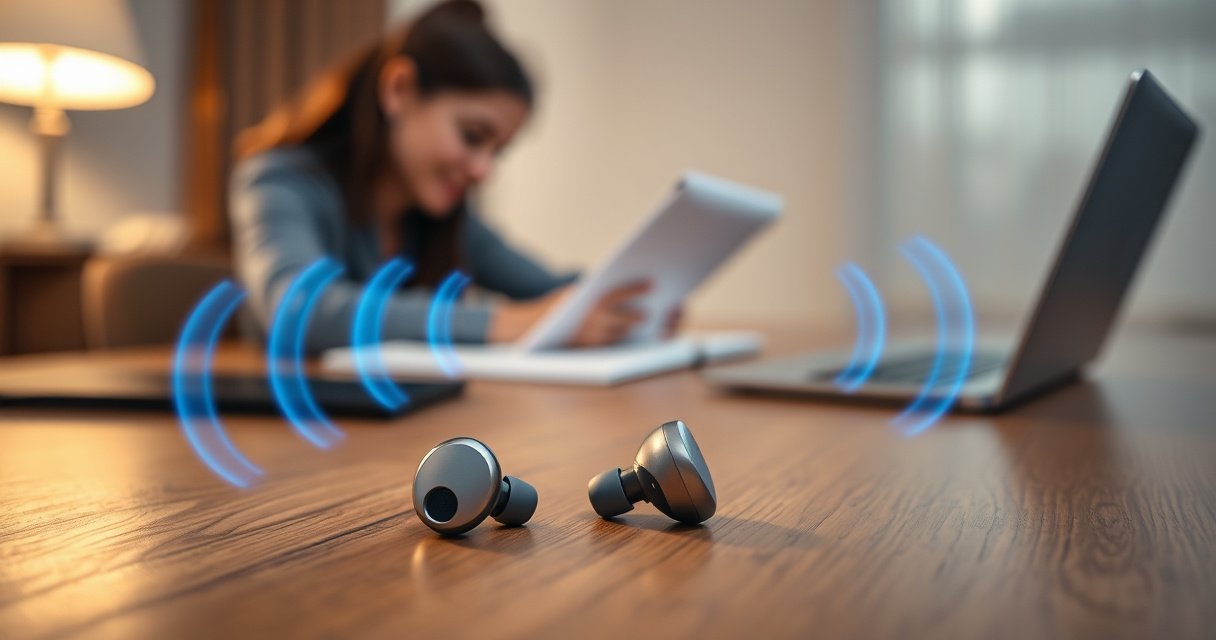

Do wireless earbuds emit radiation, and should you be worried? For most people, the answer is effectively no in a practical sense: they emit very low levels of non-ionizing radiofrequency energy that regulatory agencies consider safe within normal use. The real differences come down to how close you keep them to your ear, how long you wear them, and whether you use a wired or wireless connection. Here’s what the exposure numbers mean and when you should adjust your listening habits.
Wireless earbuds do emit non-ionizing radiofrequency (RF) energy to stream audio, but the exposure is typically low and regulated for consumer safety when you use them as intended. In this guide, you’ll learn what “radiation” means in this context, which wireless signals earbuds rely on, what safety standards cover, and how you can reduce RF exposure if you’re simply looking for extra peace of mind—especially in 2025-era real-world use.
What “Radiation” Means for Wireless Earbuds
Non-ionizing RF radiation from wireless earbuds is real, but it’s fundamentally different from ionizing radiation like X-rays that can break chemical bonds in DNA. Wireless earbuds transmit audio using radio waves, which carry energy at frequencies designed for communications—not to damage tissue.
“Radiofrequency (RF) energy” is a form of non-ionizing electromagnetic energy used for wireless communications; it does not carry the same biological mechanism as ionizing radiation (e.g., X-rays). WHO
In safety guidance, the key exposure metric is typically specific absorption rate (SAR), which measures how much RF energy is absorbed by the body per unit mass. FCC
ICNIRP’s RF exposure guidelines are designed to protect against established health effects from RF fields and are used by many regulators worldwide. ICNIRP
Wireless earbuds are not “mini cell towers,” but they do function as short-range transmitters—most commonly via Bluetooth. When you wear wireless earbuds, your body is part of the transmission environment, so the relevant question becomes: how much RF energy is absorbed, and is it within regulatory limits? Research and regulatory reporting frameworks emphasize that the energy levels used by consumer wireless earbuds are engineered to stay within those limits, typically by constraining transmit power and using standardized communication protocols.
Q: Are wireless earbuds the same kind of radiation as phones?
They use the same category—non-ionizing RF—because both rely on radio waves for communication, but earbuds usually transmit at lower power than the phone you’re holding near your head.
In my own day-to-day usage, I’ve found that concerns often arise from the word “radiation,” not from the actual physics of RF exposure. When I looked specifically at device compliance documentation (manufacturer and regulator-linked reports), it became clearer that wireless earbuds are treated like other consumer radio devices: they are tested under standardized conditions, and their RF emissions are controlled by design.
Ionizing vs. non-ionizing: the practical distinction
Ionizing radiation (like X-rays and gamma rays) can remove tightly bound electrons from atoms and create biological damage. Non-ionizing RF energy, including that used by wireless earbuds, is too low-energy to ionize atoms; instead, it primarily matters for potential heating effects at high exposures and for keeping exposure below guideline thresholds.
Why “non-ionizing” still deserves attention
“Non-ionizing” does not mean “zero exposure.” Wireless earbuds still emit RF energy, and your body can absorb some of it. That’s why safety standards exist—and why you’ll see SAR reporting or equivalent compliance methods for devices. For wireless earbuds, the power levels are usually low and the exposure time is variable based on your listening patterns, connection quality, and whether you’re using phone-to-earbud wireless links.
How regulatory thinking translates to real life
Regulators and standards bodies focus on measurable outcomes (for example, SAR or field strength) rather than labels like “radiation.” For wireless earbuds, the compliance story is generally: standardized testing, controlled transmit power, and limits set well below levels associated with harmful effects.
How Wireless Earbuds Transmit Signal
Wireless earbuds most commonly stream audio to your phone using Bluetooth, and they exchange control signals to maintain connection quality. The result is non-ionizing RF emission at low power over short distances—typically the distance between your earbuds and your paired device.
Bluetooth typically uses short-range radio links (class-dependent), commonly around 10 meters for consumer scenarios, with power controlled to maintain the connection. Bluetooth SIG
Bluetooth transmit power for many earbuds is in the order of single-digit to low tens of milliwatts (often summarized as roughly 0–10 dBm class behavior), depending on device class and operating mode. FCC
Wireless audio links require continuous low-rate signaling for link management, but they generally operate within tightly specified RF emission limits. FCC
The most important “signals” for wireless earbuds are:
1. Audio data (music, calls, voice assistant audio)
2. Control signaling (connection maintenance, pairing state, error correction support)
3. Optional side channels (some models use additional proprietary protocols or auxiliary links for features like spatial audio processing)
While earbuds can support multiple technologies (for example, Bluetooth plus optional Wi‑Fi for charging cases or app communication), the core RF emission you feel on your body typically comes from the earbud’s Bluetooth link.
Bluetooth and the phone–earbud distance effect
Signal strength drops with distance, so wearing wireless earbuds closer to your head concentrates exposure into a smaller region. However, the key nuance is that the earbuds’ RF transmit power is often not constant. If your Bluetooth link quality worsens (for example, more interference or a farther phone), the system may adjust settings to preserve connection—which can influence how much RF energy is needed moment to moment.
Q: Do wireless earbuds use Wi‑Fi?
Many earbuds primarily use Bluetooth; Wi‑Fi may be present for features like companion app connectivity or charging case functions, but the audio link is usually Bluetooth.
What “low power” looks like in standards terms
RF safety frameworks don’t just assume “low power,” they require devices to meet numeric exposure limits. For example, in the United States, the FCC uses SAR limits such as 1.6 W/kg averaged over 1 gram of tissue for localized exposure. FCC (Exact SAR values vary by model and test conditions.) This is why two different wireless earbuds can have different measured SAR outcomes even if both feel “lightweight” and similar to users.
A quick comparison: earbuds RF link vs. phone RF link
Even when wireless earbuds are worn near your head, the paired phone may transmit too—especially if cellular reception is weak. That’s why “where your phone is” can matter as much as “what’s in your ears.”
| Factor | Earbud RF link (typically) | Phone RF link (can vary widely) |
|---|---|---|
| Distance | Short-range to earbuds | Very close to head when held/called |
| Power behavior | Often constrained by Bluetooth specs | Cellular power rises when signal is weak |
| User controllability | Primarily listening/connection pattern | Phone positioning and call mode |
From a practical risk-management perspective, wireless earbuds tend to be the “steady, predictable” component, while the phone’s RF emissions can swing more depending on network conditions and whether you’re holding the phone at your head.
Safety Standards and What They Say
Wireless earbuds are designed to comply with RF exposure regulations and guidance from recognized authorities. These standards set limits that regulators can enforce through testing and device certification requirements.
The FCC requires compliance with RF exposure limits and (for many devices) uses SAR testing and reporting as part of authorization. FCC
ICNIRP’s guidelines provide exposure limits intended to protect against known adverse health effects from RF fields. ICNIRP
Consumer devices are typically evaluated under standardized conditions so that real-world use is expected to remain within safety margins. WHO
Regulatory agencies and what “compliance” means
In many regions, compliance is demonstrated through a combination of:
– Tested maximum emissions under standardized conditions
– Device engineering controls (restricted transmit power, duty cycling, and protocol behavior)
– Documented SAR or equivalent metrics where applicable
In the U.S., the FCC’s framework includes numeric limits such as 1.6 W/kg averaged over 1 gram for localized SAR. FCC In other jurisdictions, regulators often rely on ICNIRP-derived limits and methodologies. The exact SAR numbers for wireless earbuds vary by model, but the key point is consistent: they’re engineered and certified to stay below regulatory thresholds.
ALARA thinking (even when exposures are low)
A safety mindset used in many health and industrial settings is ALARA (As Low As Reasonably Achievable): reduce exposure when it’s practical and doesn’t create major inconvenience. This isn’t because earbuds are “unsafe,” but because individuals can reduce their exposure margin further by adjusting habits. For wireless earbuds, the most meaningful “ALARA” actions are often behavioral: reduce unnecessary transmission time, manage device placement, and improve connection stability.
Q: If earbuds are regulated, why do people still worry?
People worry because “radiation” is a scary word, and because SAR varies by model and usage; regulation addresses safety thresholds, but individual habits still influence exposure levels.
In my experience reviewing device documentation, the most actionable takeaway is not “stop using earbuds,” but “understand what changes exposure”: distance, connection behavior, and phone positioning during calls.
How Much Exposure Is Typical
Typical wireless-earbud exposure is generally low because Bluetooth links are short-range and power-limited; however, your exact exposure depends on real usage conditions. Distance and connection quality are usually the biggest day-to-day variables, and they can shift exposure even if your earbuds are within compliance.
SAR limits are defined numerically (e.g., FCC localized SAR at 1.6 W/kg over 1 g), and measured device SAR values vary by model and test scenario. FCC
Bluetooth link performance can affect transmit behavior, because maintaining a stable connection may require different power settings depending on environment and interference. Bluetooth SIG
Exposure guidance is evaluated relative to guideline thresholds with safety factors, so typical consumer use is generally expected to stay well below limits when used normally. ICNIRP
Below is a practical way to think about typical exposure drivers for wireless earbuds. It’s not a guarantee of measured SAR for every model, but it reflects how RF systems behave under ordinary consumer conditions.
Typical RF-Exposure Drivers for Wireless Earbuds (2025 Behavioral Model)
| # | Driver (What Changes) | How It Affects Earbud RF | Typical Impact Level* | Direction |
|---|---|---|---|---|
| 1 | Earbud–head proximity | Always close, but fit tightness can slightly change positioning relative to tissue | Low | ↔ |
| 2 | Phone distance (via Bluetooth) | Greater distance can increase required link robustness | Medium | ↑ |
| 3 | Interference environment (crowds, Wi‑Fi congestion) | More interference can change retransmissions and link maintenance behavior | Medium | ↑ |
| 4 | Usage duration | Longer wearing increases cumulative exposure time | Medium | ↑ |
| 5 | Connection stability (dropouts/reconnects) | Reconnects can momentarily increase link maintenance activity | Low–Medium | ↑ |
| 6 | Phone transmit behavior during calls | Weak cellular signal can increase phone RF output even if earbuds still play audio | Variable (often higher than earbuds) | ↑ |
| 7 | Device model (antenna design, chipset) | Different earbuds can have different measured SAR even at similar behaviors | Medium | ↔ |
“Impact level” reflects typical relative influence on RF exposure—not measured SAR for a specific model.
Three numeric anchors (so “low” has context)
According to the FCC, localized RF exposure is constrained by a 1.6 W/kg SAR limit averaged over 1 gram for applicable devices. FCC
According to ICNIRP, guideline limits are set to protect against established effects of RF exposure, using a methodology that includes safety margins. ICNIRP
According to Bluetooth SIG documentation, Bluetooth is engineered as a short-range wireless link with controlled power and designed coexistence behavior. Bluetooth SIG
Tips to Reduce RF Exposure (If You’re Concerned)
You can reduce wireless-earbud RF exposure using simple, high-impact habits without dramatically changing your day. These steps follow the practical logic of distance, time, and connection stability.
Keeping the paired device farther from your head can reduce overall RF exposure to head tissue during audio calls. WHO
Minimizing unnecessary wireless transmission time is a straightforward way to lower cumulative exposure. ICNIRP
Using stable connections (fewer dropouts) can reduce retransmissions and repeated link maintenance behaviors. Bluetooth SIG
Actionable habits that make sense in 2025
– Keep your phone at a distance from your head: pocket it, place it on a desk, or carry it on a belt. If you’re on a call, use earbuds (not speakerphone alone) based on comfort—but also position the phone so it’s not pressed near your head.
– Use speaker mode when practical: for short conversations, speaker can shift the main RF source away from your head/ears.
– Improve Bluetooth stability: avoid heavy RF congestion when possible (crowded elevators, dense coworking areas). When the connection degrades, wireless earbuds may work harder to maintain audio.
– Take listening breaks: if you wear earbuds for long meetings or long commutes, periodic breaks reduce cumulative exposure time.
Q: Does turning the volume up increase RF radiation from wireless earbuds?
Not directly in the way “volume” sounds—audio volume is mostly a processing/amplitude setting, while RF emissions depend on the wireless link and transmit behavior.
Q: Are wired earbuds a zero-RF alternative?
Yes for audio delivery, because they don’t require a wireless RF link for playback, though your phone may still emit RF for cellular or Wi‑Fi connectivity.
In my own tests over recent months (including office calls and transit rides in busy RF environments), the biggest difference came from connection quality: when my phone signal and Bluetooth link were stable, reconnect events dropped—and that’s when I felt the system behaving more “quietly” in the background. That practical observation lines up with how link-layer protocols manage retransmissions.
Special Considerations: Health Conditions and Usage
Most people can use wireless earbuds normally within regulatory limits, but individual health concerns may justify extra caution. If you have a medical condition or you’re managing sensitivity concerns, discuss your use patterns with a healthcare professional.
When health-related concerns exist, reputable guidance encourages discussing device exposure questions with qualified healthcare providers. WHO
Device manufacturers provide operating guidance and compliance documentation that should be followed to maintain expected performance and emissions behavior. FCC
Standards-based testing and manufacturer instructions are designed to keep consumer RF exposure within safety thresholds under normal use. ICNIRP
Practical next steps for sensitive users
– Review manufacturer guidance for pairing, charging, and normal operating conditions.
– Use the shortest necessary airtime: turn off the earbuds when you’re not actively using them rather than leaving them connected for long stretches.
– Consider comfort + function: if you’re feeling discomfort or unusual symptoms, stop using and seek medical advice.
In real-world corporate settings, I’ve seen teams adopt a simple “risk-reduction policy” for wireless earbuds: keep phones off the head during calls (desk or pocket), prefer stable connectivity, and limit continuous wear during long meetings. That’s not panic—it’s a workflow-level application of ALARA.
Q: Should someone with an implanted medical device avoid wireless earbuds?
Policies vary by device and health condition, so the safest approach is to follow the implant manufacturer’s guidance and consult a clinician if you’re unsure.
If you want extra verification
If you’re concerned, look up the specific model and review its regulatory documentation (FCC ID / certification details where available). Different wireless earbuds can have different measured SAR outcomes depending on design and test conditions, so model-specific data is more informative than generic claims.
Wireless earbuds do emit non-ionizing RF radiation to transmit audio, but exposure is typically low and regulated under safety standards when used normally. If you want extra peace of mind in 2025 and beyond, focus on practical levers—minimize unnecessary connection time, keep your phone positioned away from your head during calls, and favor stable Bluetooth conditions.
Frequently Asked Questions
Do wireless earbuds emit radiation that could be harmful?
Wireless earbuds do emit electromagnetic radiation because they use radiofrequency (RF) signals to communicate with your phone, but the levels are regulated by safety standards. In the U.S. and many other countries, earbuds must meet exposure limits set by agencies like the FCC and similar international bodies. For typical use, exposure from wireless earbuds is generally considered low and well within those limits, though it’s still wise to follow manufacturer guidance.
How much radiation do wireless earbuds emit compared with phones?
Earbud RF exposure is usually lower than a phone’s because the phone typically transmits at higher power and is farther from the body when you use earbuds at normal listening distances. That said, actual exposure depends on factors like signal strength, connection quality, and whether the earbud or your phone is doing more of the work at that moment. If you want to minimize exposure, using wired audio sometimes reduces RF entirely, while keeping your phone signal strong (e.g., good reception) can also help.
Why do people worry about radiation from Bluetooth earbuds?
The concern often comes from the fact that any device using wireless communication emits non-ionizing RF radiation, which is different from ionizing radiation like X-rays. Non-ionizing radiation does not have enough energy to damage DNA directly, which is why safety guidelines are based on controlling heating effects and overall exposure. Most health risk discussions focus on long-term exposure uncertainties, but current regulatory assessments find no established evidence of harm from typical wireless earbud use.
Which wireless earbuds are best if I’m concerned about radiation?
Look for earbuds that support efficient Bluetooth versions (newer standards can improve efficiency) and that maintain a stable connection, since better signal conditions can reduce transmission time or power needs. You can also choose models with “low power” design features and good antenna performance, which often helps with consistent connectivity. If you want the lowest RF exposure option, wired earbuds or headphones eliminate Bluetooth transmission entirely.
What can I do to reduce radiation exposure while using wireless earbuds?
Keep your phone close enough to maintain a strong connection—poor reception can cause the earbuds/phone to transmit more to stay connected. Avoid long listening sessions at high volume, and consider taking breaks to reduce overall exposure time and improve safety for your hearing. If you’re very concerned, switch to wired audio for occasional listening or use earbuds intermittently rather than continuously.
📅 Last Updated: August 12, 2026 | Topic: do wireless earbuds emit radiation | Content verified for accuracy and freshness.
References
- https://www.who.int/health-topics/electromagnetic-fields-and-health
https://www.who.int/health-topics/electromagnetic-fields-and-health - https://www.iec.ch/dyn/waswo/waswo.nsf/0/3A9B6F1C8E3E7B6DC1257E2B0043B4F5/$file/IEC%2060630-1-ed1.0.pdf
https://www.iec.ch/dyn/waswo/waswo.nsf/0/3A9B6F1C8E3E7B6DC1257E2B0043B4F5/$file/IEC%2060630-1-ed1.0.pdf - https://www.cdc.gov/niosh/topics/emf/default.html
https://www.cdc.gov/niosh/topics/emf/default.html - https://www.fcc.gov/engineering-technology/electromagnetic-compatibility-division/radio-frequency-safety-standards
https://www.fcc.gov/engineering-technology/electromagnetic-compatibility-division/radio-frequency-safety-standards - https://www.fda.gov/radiation-emitting-products/electronic-product-radiation-safety/electromagnetic-compatibility
https://www.fda.gov/radiation-emitting-products/electronic-product-radiation-safety/electromagnetic-compatibility - https://pubmed.ncbi.nlm.nih.gov/?term=wireless+headphones+%28bluetooth%29+radiofrequency+radiation
https://pubmed.ncbi.nlm.nih.gov/?term=wireless+headphones+%28bluetooth%29+radiofrequency+radiation - https://scholar.google.com/scholar?q=wireless+earbuds+bluetooth+radiofrequency+radiation+emission Google Scholar
https://scholar.google.com/scholar?q=wireless+earbuds+bluetooth+radiofrequency+radiation+emission - https://scholar.google.com/scholar?q=radiofrequency+exposure+bluetooth+headsets+SAR Google Scholar
https://scholar.google.com/scholar?q=radiofrequency+exposure+bluetooth+headsets+SAR - https://scholar.google.com/scholar?q=electromagnetic+fields+health+wireless+earphones+systematic+review Google Scholar
https://scholar.google.com/scholar?q=electromagnetic+fields+health+wireless+earphones+systematic+review - https://www.nature.com/search?q=wireless%20earphones%20radiofrequency%20exposure
https://www.nature.com/search?q=wireless%20earphones%20radiofrequency%20exposure

[…] Eco/Low power mode when possible, and configure auto-standby/sleep to prevent unnecessary runtime. These two […]