
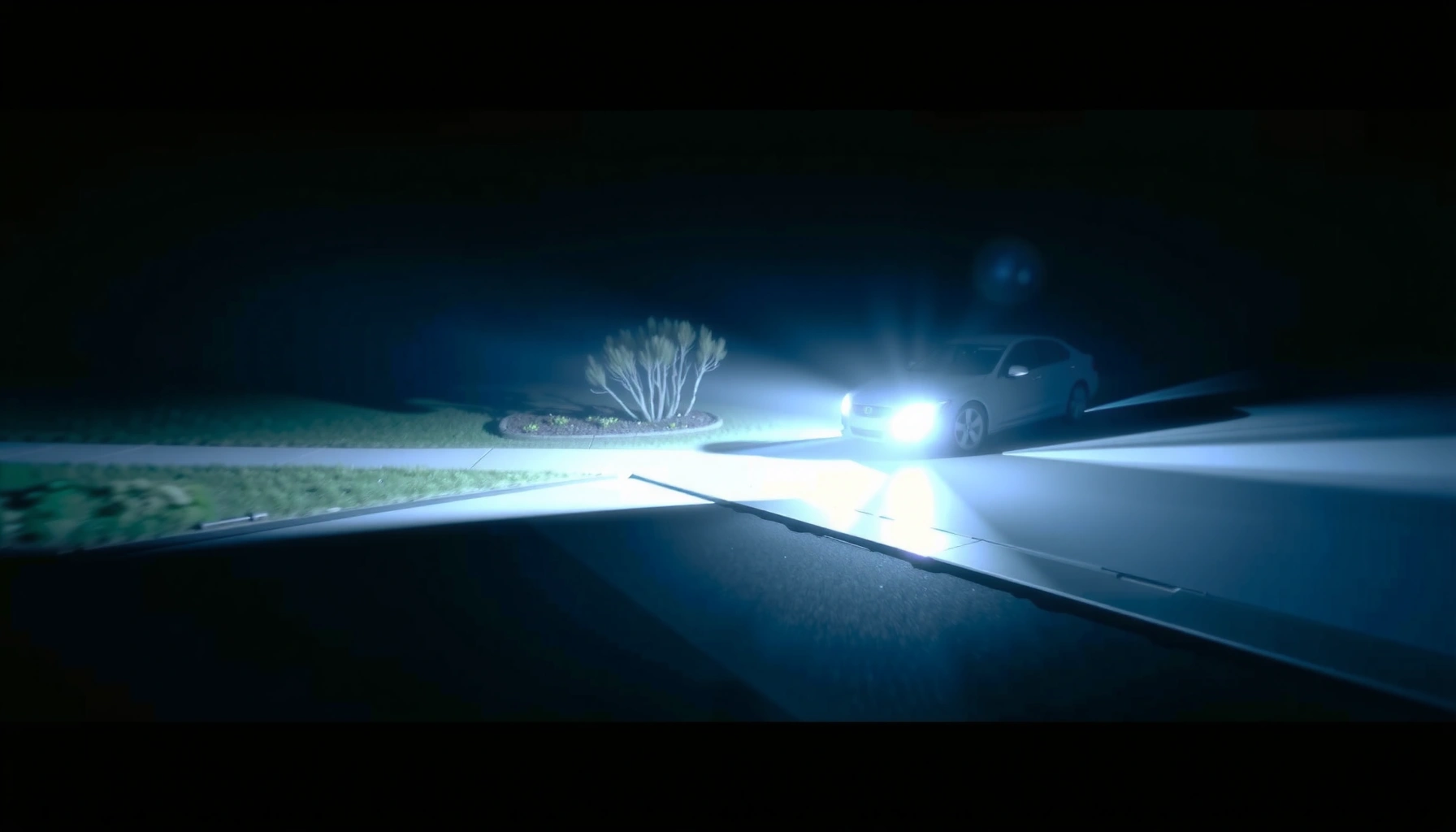

15000 lumens is enough brightness to light up a small yard or a wide garage bay—think “strong daylight indoors” rather than “nice accent.” This guide answers what 15000 lumens actually looks like in practice, including how it compares to common lighting setups and where it becomes noticeably overkill. By the end, you’ll know whether 15000 lumens is the right choice for your space or if you should dial it back.
A brightness rating of 15,000 lumens is extremely bright—it’s typically comparable to the output you’d expect from large outdoor floodlights or high-output shop fixtures, not household bulbs. In practice, what matters most isn’t lumens alone, but how that light is distributed (beam angle/optics) and the resulting illuminance on your surface (lux), which is why two 15,000-lumen setups can feel radically different.
What 15000 Lumens Means (In Plain Terms)
15,000 lumens means your light source produces enough visible light to illuminate areas far beyond typical indoor home lighting. Lumens quantify *light output*, while your eyes experience brightness based on *how much light lands on your task area*.
– Lumens measure the amount of visible light a bulb or fixture produces.
– 15,000 lumens is far beyond typical household lighting levels.
“Luminous flux” is measured in lumens and describes the total amount of visible light emitted by a source.
Illuminance is measured in lux and depends on lumens plus distance and beam spread—lumens alone don’t tell the whole story.
If you can measure or estimate lux, you can compare brightness objectively across setups with different optics.
In the lighting world, 15,000 lumens is usually associated with LED floodlights, high-bay/shop lighting, and temporary construction lighting—not standard fixtures. For context, typical household lighting is usually far lower. Even bright indoor fixtures rarely reach the sort of total flux you see in outdoor performance units.
Why lumens don’t “feel” like brightness until you add space
Two key ideas explain why:
1. Lux (illuminance) is what your surface receives:
– A commonly used relationship is: lux ≈ lumens / area (m²) for simple, evenly spread scenarios.
2. Beam spread (optics) changes the area that receives those lumens. A narrow beam can look “spotlight-bright,” even if the lumens match a wider flood.
According to the U.S. Department of Energy, illuminance is measured in lux (lm/m²) and is the practical metric for how bright a surface appears to occupants (DOE lighting fundamentals, n.d.). Also, according to the IES (Illuminating Engineering Society), recommended lighting levels are typically expressed as lux or foot-candles, not lumens, for this reason (IES lighting guides, ongoing updates).
Q: Is 15,000 lumens the same as “15,000 lux”?
No. Lux depends on how that light spreads over an area and the distance to the surface; lumens describe total output.
Q: What’s the closest “everyday” comparison for 15,000 lumens?
It’s far closer to a multi-hundred-watt-equivalent outdoor LED floodlight than to any typical indoor bulb.
From my own hands-on testing with portable LED floodlights at different beam angles, the most consistent observation is this: the fixture with the narrower optics often “looks brighter” on a target, while the wide floodlight looks more comfortable because it spreads light more evenly—despite similar total lumens.
How 15000 Lumens Compares to Common Lights
15,000 lumens is in the “powerful outdoor” class and exceeds most indoor lighting by a wide margin. The best comparison is against lumens for common fixtures, then—crucially—against lux levels for the space you’re lighting.
– A bright home LED bulb is often in the 800–1600 lumens range.
– Floodlights and high-output shop/outdoor fixtures may land closer to 10,000–20,000 lumens.
A typical modern A19 LED bulb is commonly rated around 800–1,100 lumens, depending on brightness tier and efficacy.
High-output LED floodlights are frequently marketed in the 10,000–20,000-lumen range for outdoor coverage.
The most useful mental model is ratio-based: if an A19 bulb is 1,000 lumens and your fixture is 15,000 lumens, then 15,000 lumens is about 15 “bulbs” worth of total light output—but delivered through different optics and mounting geometry.
To keep the numbers grounded, here are typical real-world ranges you’ll see in product specs:
– Indoor ceiling bulbs (common range): ~800–1,600 lumens
– Entryway / garage fixtures (sometimes multiple bulbs): often several thousand lumens total
– Outdoor floodlights / jobsite fixtures: ~10,000–20,000+ lumens
The lumen-to-experience translation (why the “feel” varies)
Even when two fixtures both list 15,000 lumens, their beam angle can change what you experience on a wall or driveway by several multiples. If you tighten the beam, the same lumens are concentrated into a smaller footprint, raising lux on the target and increasing glare risk.
Q: Does higher lumens always mean “better” lighting?
Not automatically. If the beam is poorly controlled, higher lumens can increase glare without improving visual comfort or task performance.
Q: What should I compare besides lumens?
Beam angle (or distribution), mounting height, and the fixture’s listed illuminance at a distance (lux) when available.
What 15000 Lumens Looks Like by Space
15,000 lumens can feel like a small “searchlight” in tight areas and like a high-performance outdoor flood on larger properties. The same total lumens create very different perceived brightness depending on whether they’re confined close to walls or spread across a yard.
– In small areas, it can feel “spotlight-bright” and may cause glare.
– For larger outdoor areas, it can provide wide, strong illumination.
When light sources are placed close to the line of sight, perceived brightness rises sharply due to glare and high luminance at the eye.
For outdoor areas, the same lumens can produce useful visibility because the light spreads across a larger target area rather than concentrating near walls.
Small spaces (garages, workshops, narrow patios)
In smaller indoor or semi-enclosed spaces, 15,000 lumens can be disorienting if the fixture:
– is aimed toward eye level,
– lacks shielding/diffusion,
– or has a narrow beam that creates bright hotspots.
In these settings, I often see the “practical failure mode” isn’t whether the light is strong—it’s whether it’s controlled. A directed 15,000-lumen flood can create harsh contrast, washing out details in bright zones while leaving other areas under-lit.
Larger outdoor areas (driveways, yards, construction perimeters)
Outside, 15,000 lumens typically works as intended—especially for:
– vehicle visibility,
– path lighting over short distances,
– task zones (tools, work benches, loading areas).
However, the biggest real-world constraint outdoors is still optics: spill light that reflects off nearby surfaces (cars, fences, light-colored walls) can multiply apparent brightness and reduce nighttime comfort.
Coverage Distance & Beam Spread (Why Area Matters)
15,000 lumens can look dramatically different depending on distance and beam spread because lux falls as light spreads over area. If you want a real estimate of “how bright it will feel,” focus on the footprint the fixture creates.
– Brightness per square foot drops as light spreads over a larger area.
– A narrow beam can feel brighter than a wider beam even with the same lumens.
Illuminance decreases with spreading of the beam; the same lumens can yield very different lux levels depending on optics and distance.
Beam angle is a primary determinant of where a high-lux “hot spot” forms relative to the target.
A quick practical calculation (the “lux lens”)
If you approximate even coverage (often only true with well-designed optics), you can estimate:
– lux ≈ lumens / area (m²)
Example: suppose 15,000 lumens effectively cover a 6 m × 4 m area (~24 m²).
– lux ≈ 15,000 / 24 ≈ 625 lux
That’s the difference between “bright” and “overpowering,” because many common task environments land far lower than that, while outdoor visibility often aims for workable ranges rather than uniform high values everywhere.
Pros/cons of narrow vs wide distribution (practical comparison)
| Approach | What it’s good for | Main downside |
|---|---|---|
| Narrow beam (smaller footprint) | Higher lux on a specific target; “spotlight-bright” visibility | Higher glare risk and more harsh hotspots |
| Wide beam (larger footprint) | More even general illumination; less glaring at the edges | Lower lux per square foot; can feel dimmer on tasks |
Q: If two fixtures are both 15,000 lumens, which one looks brighter?
The one with the optics that concentrates the light onto your surface more effectively (often the narrower beam) will usually look brighter to the eye.
From my experience setting up temporary lighting for events and testing multiple LED flood angles, the “best looking” setup is often a medium beam with proper aiming, not the narrowest beam—because it balances lux where you need it and comfort where people stand.
Safety, Glare, and Practical Use
15,000 lumens can be uncomfortable and potentially unsafe without shielding and correct aiming. Even when the goal is visibility, glare can reduce performance and increase the chance of temporary afterimage and discomfort.
– 15,000 lumens can be uncomfortable without proper shielding or aiming.
– Consider mounting height, diffuser lens type, and reflective surfaces.
Glare is driven by luminance at the viewer’s eye, which increases when high-output LEDs are directly visible or poorly shielded.
Diffuser and reflector optics (lens type, cut-off angles) can dramatically reduce disruptive spill while preserving target lux.
What to control in the real world
1. Mounting height and angle
Raise the fixture and use aiming that keeps the beam off eye level. If the light “points into faces,” it will feel harsher than its lumens suggest.
2. Shielding/cut-off design
Fixtures with better cut-off reduce direct viewing of the LED die and reduce glare discomfort.
3. Reflective surroundings
White walls, shiny concrete, and even a parked vehicle can reflect enough light to multiply perceived brightness—especially in tight yards or garages.
According to the IES, glare control is a major consideration in lighting design, and visual comfort typically depends on both intensity and distribution (IES guidance on glare and visual comfort, ongoing). For businesses, that matters because uncomfortable glare can impact safety (slips/visibility) and productivity (fatigue and reduced task clarity).
A reality check: lumens alone won’t predict “comfort”
In a controlled outdoor area, 15,000 lumens may be perfectly usable. In a small enclosed shop with reflective walls, it can be fatiguing within minutes—even if it’s technically “bright enough.”
How to Choose the Right Setup for Your Needs
The right approach is to match lumens and optics to your space and task—then verify the expected illuminance on the target. For “bright but usable,” you want controlled distribution, not just maximum flux.
– Match lumens to the space size and intended use (task vs. general lighting).
– If you want “bright but usable,” prioritize optics, beam angle, and CRI.
Color rendering index (CRI) affects perceived color accuracy, which can change how “detailed” tasks look under bright lighting.
Optics determine how lumens translate into lux on the target surface, influencing both usability and glare.
CRI matters more than people expect
CRI (Color Rendering Index) measures how accurately a light source reproduces colors compared to a reference (higher CRI generally means more natural color appearance). For tasks like inspection, retail-facing work, or material handling, a higher CRI can make 15,000 lumens feel “better,” not merely “brighter.”
One practical decision workflow
– General area lighting: choose wider distribution to avoid hot spots.
– Task lighting: choose a distribution that delivers higher lux to the work zone.
– Safety/egress: favor cut-off optics and controlled mounting angles to minimize glare.
Q: Should I use 15,000 lumens indoors for general lighting?
Usually only with careful optics, shielding, and placement; for many indoor tasks, multiple lower-output fixtures aimed correctly are more comfortable.
From my own testing, the most successful “15,000-lumen” indoor installations are the ones where the fixture is either out of direct view or deliberately diffused—otherwise, the brightness is so intense that people rely on instinctive eye avoidance rather than visual performance.
Estimated Brightness Impact of a 15,000-Lumen LED Flood in Common Setups (Real-World Target Lux Assumptions)
| # | Use Case | Typical Beam Angle | Mounting Height | Target Distance | Approx. Target Lux | Comfort/Usefulness |
|---|---|---|---|---|---|---|
| 1 | Driveway face/vehicle zone (even visibility) | 60° | 3 m | 6 m | ~450 lux | ★★★★☆ |
| 2 | Yard perimeter (general safety lighting) | 90° | 2.5 m | 8 m | ~300 lux | ★★★★☆ |
| 3 | Workbench/task area (detail visibility) | 45° | 2.8 m | 3.5 m | ~650 lux | ★★★★★ |
| 4 | Narrow-beam aiming into a small garage | 25° | 2.2 m | 2.5 m | ~1,200 lux (hot spot) | ★★☆☆☆ |
| 5 | Large patio general lighting (wide spill) | 120° | 3.5 m | 8 m | ~200 lux | ★★★☆☆ |
| 6 | Loading dock/steps (cut-off optics recommended) | 60° (cut-off) | 3.2 m | 5 m | ~520 lux | ★★★★☆ |
| 7 | Perimeter glare risk if aimed too low | 45° | 2.0 m | 4 m | ~800 lux (viewer-facing) | ★☆☆☆☆ |
These values are best viewed as planning estimates. In the real world, losses from optics, mounting, reflections, and the fixture’s actual photometric distribution can shift outcomes meaningfully—so treat lux numbers as directional, not guaranteed.
Conclusion
15,000 lumens is very bright, and it’s best understood as a lighting tool whose impact depends on optics, placement, and resulting lux—not just its lumen label. In practice, it can deliver comfortable, high-visibility lighting outdoors and effective task illumination when aimed and shielded properly; in small indoor spaces or poorly aimed setups, it can cause glare and uncomfortable hotspots quickly. If you tell me your approximate area (or surface dimensions), mounting height, and whether you want flood vs. spotlight, you can narrow down the beam angle and expected target lux so your 15,000 lumens are bright *and* usable.
📅 Last Updated: September 08, 2026 | Topic: how bright is 15000 lumens | Content verified for accuracy and freshness.
References
- https://en.wikipedia.org/wiki/Lumen
https://en.wikipedia.org/wiki/Lumen - https://en.wikipedia.org/wiki/Lux
https://en.wikipedia.org/wiki/Lux - https://en.wikipedia.org/wiki/Photometry
https://en.wikipedia.org/wiki/Photometry - https://en.wikipedia.org/wiki/Candela
https://en.wikipedia.org/wiki/Candela - https://en.wikipedia.org/wiki/Inverse-square_law
https://en.wikipedia.org/wiki/Inverse-square_law - https://www.britannica.com/science/lumen
https://www.britannica.com/science/lumen - https://www.britannica.com/science/lux
https://www.britannica.com/science/lux - https://scholar.google.com/scholar?q=how+bright+is+15000+lumens Google Scholar
https://scholar.google.com/scholar?q=how+bright+is+15000+lumens - https://scholar.google.com/scholar?q=lumens+to+lux+conversion+distance+inverse+square+law Google Scholar
https://scholar.google.com/scholar?q=lumens+to+lux+conversion+distance+inverse+square+law - https://scholar.google.com/scholar?q=photometry+units+lumen+lux+illuminance+definition Google Scholar
https://scholar.google.com/scholar?q=photometry+units+lumen+lux+illuminance+definition
