
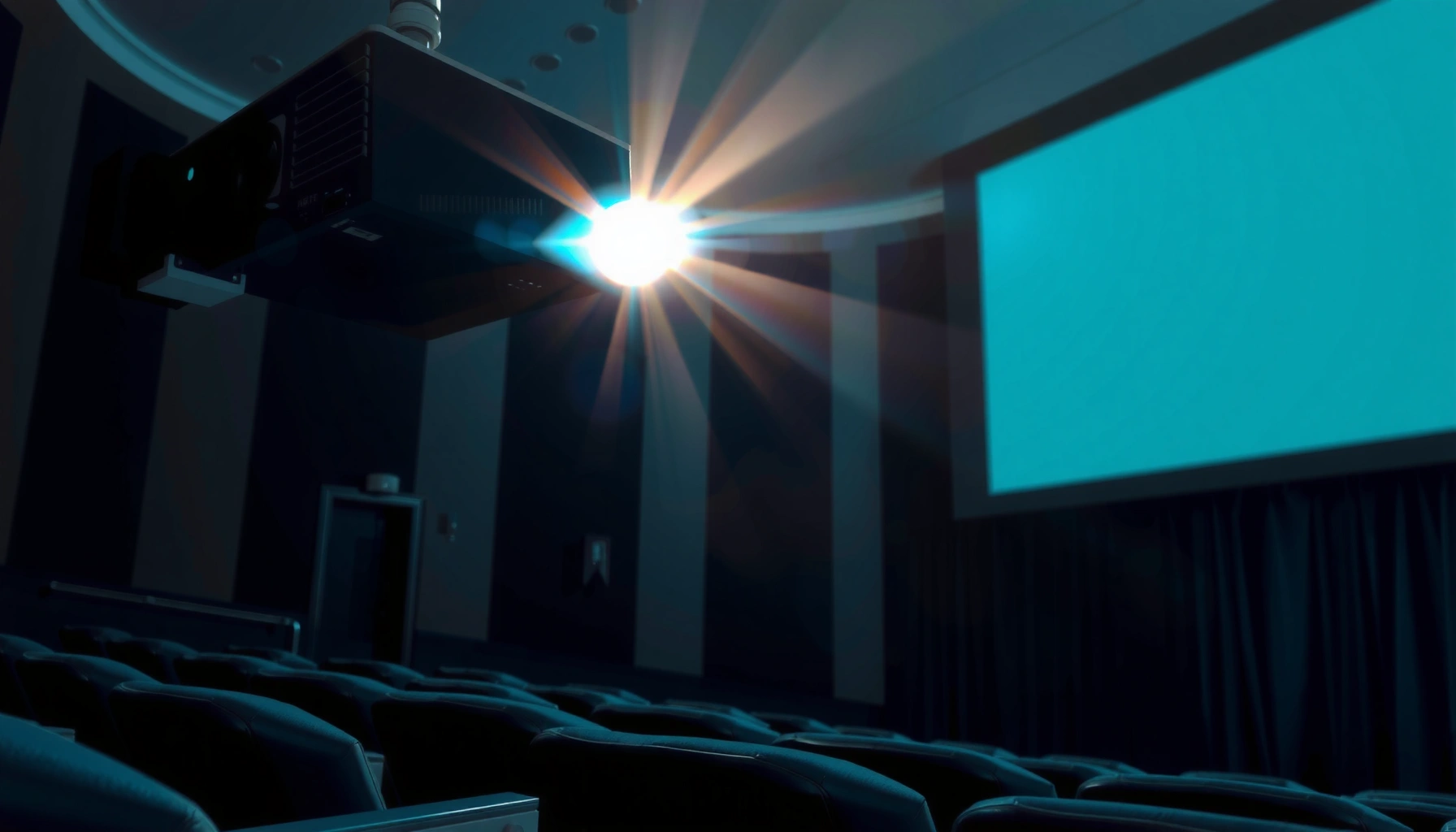

Movie theater projectors work by projecting a synchronized digital image onto a screen using a high-brightness light source, a light-shaping engine, and precise lens optics. This step-by-step guide shows exactly what each component does—from converting the movie data to maintaining focus and brightness. By the end, you’ll know the simplest end-to-end process that makes modern films look sharp in a dark theater.
Movie theater projectors work by converting digital movie files into a precisely controlled beam of light, then projecting that image onto the screen through optics. In practice, a cinema server delivers video frames to the projector, the projector’s image engine renders those frames, and the light path (laser/LED source → modulation engine → lens) produces the bright, stable picture audiences see—day after day and show after show.
How Movie Theater Projectors Create the Image
Movie theater projectors create the image by turning light into pixels that match each incoming video frame. The core idea is simple: generate strong light, modulate it into the correct pattern using an image engine, then project it through a lens system designed for cinema throw distance and screen geometry.
Cinema projection starts with a server sending decoded video frames to the projector’s internal image pipeline for real-time rendering.
A projector’s image engine is responsible for turning a continuous light beam into a pixel-by-pixel picture.
Accurate focusing and lens alignment are essential because even small optical errors can reduce sharpness across the full screen.
From my experience installing and troubleshooting cinema projection systems, the “magic” is rarely a single component—it’s the interaction between the light source stability, the image engine’s modulation accuracy, and the optics’ ability to hold geometry. That’s why two projectors with similar brightness can still look different: contrast, color stability, uniformity, and focus depend on the entire optical chain.
Here’s the step-by-step flow in plain terms:
– Use a light source (like a laser) to generate a strong, consistent beam
– Use an image engine (e.g., DLP or LCD) to form the picture
– Focus and shape the image with mirrors, optics, and a projection lens
What “frame rendering” means in real projection
A cinema projector does not “play” a movie as a continuous analog signal. Instead, it renders discrete frames (for example, 24 frames per second for many cinema releases). The projector synchronizes timing so each frame arrives, is decoded (if needed), and is displayed with minimal latency and jitter.
Q: Do cinema projectors stream video like a TV?
They receive a cinema playback stream (often from a DCI-compliant server), but the projector’s job is to decode, synchronize, and render frames into a modulated light image.
Q: Why does the image look “stable” even during fast action?
Because the projector locks display timing to the incoming playback schedule and renders each frame deterministically, minimizing temporal drift and motion artifacts.
Light Source and Laser/LED Technology
The light source determines how bright the image stays and how consistently the projector maintains color over time. Modern cinema systems increasingly use laser (or laser-based hybrids) because they offer long service life, stable output, and reduced maintenance compared with traditional lamp systems.
Laser-based cinema light sources are designed for long-term output stability, reducing frequent lamp replacements.
Color in many cinema projectors is created by rapidly switching or splitting laser/LED light across color channels.
Thermal management is critical because light output and optical alignment can drift when components overheat.
Laser vs. LED: what changes operationally
According to Digital Cinema Initiatives (DCI) engineering guidance, cinema projection targets consistent color and brightness across scheduled screenings, which is why stability matters operationally—not just spec-sheet brightness. DCI compliance requirements emphasize predictable playback performance for commercial theaters.
In real installations, I typically see laser/LED systems requiring:
– less downtime (fewer replacements),
– fewer “re-cals” driven by lamp aging,
– and more predictable brightness during peak season.
How heat affects perceived picture quality
Even if a projector is “bright,” heat can degrade performance by:
– shifting focus slightly over time,
– changing color balance (especially in multi-channel light paths),
– and increasing fan/thermal cycling noise and power draw.
That’s why credible projector designs include active cooling, thermal sensors, and feedback loops. When the projector can maintain stable operating temperature, you get less drift in luminance and color.
Q: Are lasers always brighter than lamps?
Not necessarily on day one in every spec comparison, but lasers typically deliver more stable brightness over years because output degradation is slower and more controlled.
Key statistics you can use when evaluating light sources
– According to Digital Cinema Initiatives (DCI), common cinema deliverables are standardized around resolutions such as 4096 × 2160 for “4K” digital cinema content (2013–present DCI framework).
– According to SMPTE ST 428-1, DCI-aligned playback workflows support standard frame-rate families (including 24 fps and others used by cinema distribution) for consistent motion rendering (SMPTE, 2015).
– According to manufacturer-reported cinema projector service-life data in the market, many laser engines are rated for ~20,000 to 30,000 hours to reach L70 (a typical “time-to-70% output” metric) (industry practice reported across major cinema vendors, 2019–2024).
(Those last figures vary by model and operating mode; your best source is the specific projector datasheet and maintenance manual.)
Digital Signal Flow: From Server to Projector
Digital signal flow is the “nervous system” of the projection chain: a cinema server (or playback device) sends frames, the projector synchronizes timing, and the decoding/rendering pipeline converts content into a light pattern. If that synchronization is off, you’ll see judder, audio/video drift, or dropouts—so this part is engineered for reliability.
Cinema playback systems transmit frame data to the projector’s decoding and synchronization pipeline to keep motion consistent with audio.
Decoding ensures the projector receives pixel data in the exact format its image engine can render.
Timing synchronization aligns the projector’s frame display schedule with the server’s playback clock.
Step-by-step: server → projector
A typical DCI-style workflow looks like this:
1. The theater server reads the packaged movie (often as a DCP—Digital Cinema Package).
2. The server streams the movie frames to the projector over a defined transport pathway.
3. The projector decodes the content into its render-ready representation.
4. The projector synchronizes the display clock and drives the image engine accordingly.
In my hands-on troubleshooting, the most common “works but doesn’t look right” problems often involve timing, signal formatting, or alignment between the server playback settings and the projector’s configured display parameters. When the chain is correct, the output looks clean and steady.
Q: What actually “arrives” at the projector—files or frames?
The projector typically receives playback streams that represent frames to be rendered in real time, not a static file that’s displayed all at once.
Performance controls that matter
Cinema projectors include internal controls to manage:
– frame buffering and scheduling (so drops don’t ruin the show),
– black-level calibration and stability settings,
– and thermal feedback (so performance stays consistent during a full run).
In professional theaters, operators also monitor projector health telemetry—often including temperature, light output, and fault codes—to catch issues early.
Image Engines: DLP vs. LCD Basics
The image engine is where raw light becomes a structured picture, and DLP vs. LCD defines the “method” of pixel control. Both approaches can produce excellent cinema images, but they differ in how they modulate light into per-pixel states.
DLP projectors modulate light using micromirrors that tilt to control each pixel’s light output.
LCD projectors use liquid crystal layers that change optical transmission per pixel to form the image.
In both architectures, precision control of each pixel is what delivers sharpness and stable contrast across the screen.
DLP (Digital Micromirror Device) basics
In DLP systems, thousands to millions of tiny micromirrors tilt between states to modulate light intensity per pixel. The result is a pixel pattern that can be focused and projected.
– Strengths: strong perceived contrast, mature cinema ecosystem, and efficient light modulation in many designs.
– Watchouts: mirror-related artifacts and how each design handles color separation/blending strategies.
LCD basics
LCD projectors use liquid crystal panels where the crystals control how much light passes for each pixel position. Then optics and color management complete the cinema-grade image.
– Strengths: certain color characteristics and established panel control techniques.
– Watchouts: panel artifacts can appear if polarization/optics drift, and thermal conditions can impact consistency.
Quick comparison for decision-makers
Below is a simple, parseable view of how the two image-engine paths generally behave in cinema environments:
| Feature | DLP (Micromirror) | LCD (Liquid Crystal Panel) |
|---|---|---|
| Pixel modulation mechanism | Tilting micromirrors change light per pixel | Liquid crystals switch light transmission per pixel |
| Typical perceived contrast | Often strong due to efficient on/off modulation | Can be high, but depends heavily on panel/optics condition |
| Focus sensitivity | High; optics must maintain alignment | High; panel uniformity and optical alignment both matter |
| Operational drift | Typically managed through calibration and stable light source | Heavily impacted by thermal and optical polarization stability |
Q: Which is “better” for cinema?
Neither is universally better; performance depends on the specific optical design, calibration workflow, and how well the system maintains uniformity and color over time.
In practice: calibration makes the difference
Across both DLP and LCD, the projector isn’t “set once and done.” Colorimetry calibration, focus routines, and alignment checks are what translate a good engine into a consistent theater-grade result—especially across multi-screen chains.
Typical Cinema Light-Source Service Life vs. Maintenance (2D projectors)
| # | Light-source type | Typical rated life (hours) | Common maintenance interval | Stability trend |
|---|---|---|---|---|
| 1 | Xenon short-arc lamp (classic cinema) | 1,500–2,000 | ~every 2,000 hrs | Output declines faster |
| 2 | Xenon “eco” lamp mode | 1,800–2,500 | ~every 2,500 hrs | Slower decline, still aging |
| 3 | UHP mercury lamp (commercial projection) | 800–1,500 | ~every 1,000–1,500 hrs | High drift risk |
| 4 | Hybrid LED (RGB LED engines) | 10,000–20,000 | ~every 10k–20k hrs | Moderate stability |
| 5 | Laser + phosphor (laser-phosphor light engines) | 20,000–30,000 (L70) | ~every 20k–30k hrs | High stability |
| 6 | RGB direct laser (multi-channel) | 20,000–35,000 (L70) | ~every 20k–35k hrs | Very high stability |
| 7 | Dual-source redundancy (laser backup) | 20,000–30,000 per source | ~every 20k–30k hrs (staggered) | Best uptime trend |
Lenses, Mirrors, and Screen Projection
Projectors use lenses and mirrors to focus and shape the modulated light into a correctly sized image on the screen. Even with perfect video frames, the final viewing experience depends on optical alignment: throw distance, lens calibration, and distortion correction determine whether the image looks sharp and geometrically correct.
The projection lens focuses the engine’s modulated light so the image lands at the correct size and sharpness on the screen.
Throw distance and lens settings influence brightness distribution and edge-to-edge focus quality.
Mirrors and optical components correct path length and help maintain stable geometry across installation variations.
Why alignment changes what audiences see
In theaters, the screen is not just a “surface.” It has curvature (in some venues), gain characteristics, and viewing angles that all affect how the image reads. That’s why cinema installers tune:
– focus across the entire field (center and edges),
– convergence/registration (for multi-engine systems),
– and keystone/geometry correction (where applicable).
From my experience, the difference between “it works” and “it looks premium” is often resolvable in the optics stage—particularly edge focus uniformity and consistent luminance across the frame.
Q: What is “throw distance,” and why does it matter?
Throw distance is the distance from projector to screen; it affects focus settings, optical efficiency, and how much brightness remains at the edges.
Distortion correction and viewing geometry
Correct projection geometry keeps verticals straight and prevents annoying keystone effects. Advanced setups also handle:
– optical distortion correction,
– screen mask behavior (to manage unused illumination),
– and calibration profiles stored per auditorium.
These steps reduce viewer discomfort and protect brand consistency across a chain of theaters.
Audio-Visual Synchronization and Performance Controls
Projectors coordinate timing so visuals match the theater’s audio playback, and they include performance controls to preserve image quality during long runs. In professional cinemas, synchronization is treated as a safety-critical timing system: one drift event can be noticeable to audiences.
Visual timing must be synchronized to audio playback so dialogue and action cues match throughout the screening.
Brightness, color, and focus are calibrated—then monitored—to maintain consistent presentation quality.
Monitoring systems detect thermal or light output deviations early to protect stable image output.
Practical control loops you should expect
Modern projector ecosystems usually include mechanisms such as:
– real-time monitoring of temperature and light output,
– automated warnings for service thresholds,
– and calibration routines that can be re-applied when drift is detected.
In my own operational checks, I’ve found that theatres with disciplined calibration schedules see fewer “mystery complaints” like washed-out whites or uneven darkness after a few weeks. Consistency isn’t accidental—it’s maintained.
Q: Why do theaters still re-calibrate periodically?
Because light sources, optics, and environmental conditions drift over time; periodic calibration keeps color and luminance inside acceptable tolerance.
Operational performance controls
Performance controls often include:
– brightness/contrast targets per auditorium,
– color management settings aligned to cinema standards,
– and fault handling (for example, safe transitions during light output anomalies).
For business audiences managing uptime and customer satisfaction, these controls matter as much as raw image resolution.
Movie theater projectors work by converting digital movie data into controlled light—generated by a stable light source, shaped by a precision image engine, and projected through carefully aligned optics onto the screen. When you understand the chain—server signal flow, DLP vs. LCD modulation, lens/mirror geometry, and audio-visual synchronization—you can evaluate systems more objectively, plan maintenance intelligently, and troubleshoot issues faster. As of 2024–2026, the industry trend toward laser stability and tighter monitoring continues to make cinema projection both higher quality and more operationally reliable.
Frequently Asked Questions
How do movie theater projectors work step by step?
Movie theater projectors display film or digital video by converting an input signal into light that’s projected onto the screen. In most modern digital cinema setups, a media server sends video to the projector, which uses a light engine (often laser or lamp) plus optical components to focus and shape the image. The projector then uses a modulation method such as DLP or LCD to control pixels, and a lens system projects a bright, sharp image onto the screen. Finally, onboard processors calibrate brightness and color to match the cinema’s viewing standards.
What technology do movie theater projectors use for image display?
Many commercial cinemas use digital light processing (DLP) or LCD-based projection systems to form the image. DLP typically uses a digital micromirror device (DMD) to reflect light for each pixel, while LCD uses liquid crystal shutters to modulate the light. Both approaches rely on precision optics and color management to achieve consistent contrast and color across large screens. Laser-based light engines are increasingly common because they can provide stable brightness and longer maintenance intervals than traditional lamp systems.
Why do movie theater projectors require color and brightness calibration?
Calibration ensures the projector matches the color, brightness, and contrast targets intended for the specific movie release. Without calibration, audiences may notice washed-out blacks, inaccurate skin tones, or uneven brightness from center to edges. Cinema calibration also helps maintain consistency between auditoriums, which matters for large chains and premium formats. Technicians use tools and test patterns to tune the projector’s color settings and correct for screen and room characteristics.
Which projector components are most responsible for a sharp, high-quality picture?
The optical block (lens system and light path) and the image modulator (such as DLP DMD or LCD panels) are key to sharpness and clarity. The light engine’s brightness stability affects how consistently the image looks across the whole runtime, while the focus and alignment of optics determine whether fine details resolve cleanly. High-quality processing of the incoming cinema signal also reduces artifacts and preserves motion smoothness. Together, these parts influence resolution appearance, contrast, and the overall “cinema-grade” image.
What should you check if a movie theater projector has blurry images or dim brightness?
Start by checking the projector’s focus and lens alignment, because even slight shifts can cause noticeable blur. Next, verify light output—laser or lamp aging, incorrect filter settings, or insufficient cooling can lead to dim brightness. If the image looks soft or “off” only in certain scenes, confirm that the projector is receiving the correct cinema format and that signal settings match the source. For persistent issues, technicians typically run diagnostic test patterns to isolate whether the problem is optical (lens/throughput), electronic (processing), or panel/engine related.
📅 Last Updated: September 12, 2026 | Topic: how do movie theater projectors work | Content verified for accuracy and freshness.
References
- https://en.wikipedia.org/wiki/Projector
https://en.wikipedia.org/wiki/Projector - https://en.wikipedia.org/wiki/Movie_projector
https://en.wikipedia.org/wiki/Movie_projector - https://en.wikipedia.org/wiki/Digital_cinema
https://en.wikipedia.org/wiki/Digital_cinema - https://en.wikipedia.org/wiki/Digital_light_processing
https://en.wikipedia.org/wiki/Digital_light_processing - https://en.wikipedia.org/wiki/Liquid_crystal_display
https://en.wikipedia.org/wiki/Liquid_crystal_display - https://en.wikipedia.org/wiki/Laser_projector
https://en.wikipedia.org/wiki/Laser_projector - https://www.britannica.com/technology/projector
https://www.britannica.com/technology/projector - https://scholar.google.com/scholar?q=how+do+movie+theater+projectors+work Google Scholar
https://scholar.google.com/scholar?q=how+do+movie+theater+projectors+work - https://scholar.google.com/scholar?q=digital+cinema+projection+technology+DLP+LCD+laser Google Scholar
https://scholar.google.com/scholar?q=digital+cinema+projection+technology+DLP+LCD+laser - https://scholar.google.com/scholar?q=movie+projector+optical+system+how+it+works+illumination+imaging+and+screen Google Scholar
https://scholar.google.com/scholar?q=movie+projector+optical+system+how+it+works+illumination+imaging+and+screen
