
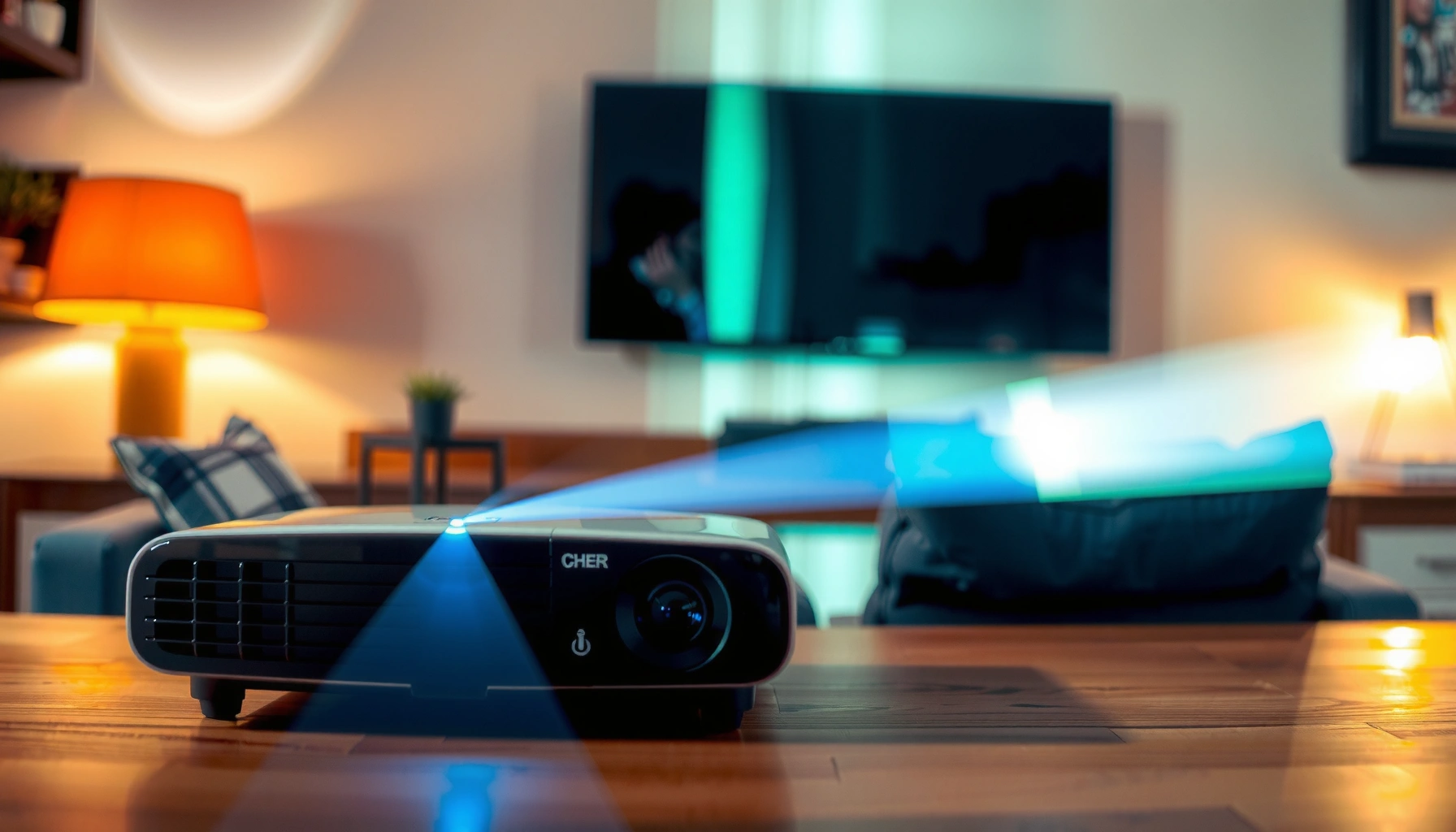

Portable projectors work by turning a digital image into a focused beam of light—so if you want to know exactly how portable projectors work, this step-by-step guide shows it without the fluff. You’ll learn what happens from the moment you connect a phone or laptop, through the light source and optics, to the final image on your screen. Follow the process and you’ll know which model features matter most for your room and viewing distance.
Portable projectors turn your input (video, slides, or streaming) into a focused beam of light using a light source, an image engine (LCD or DLP), and optics that shape the picture onto a wall or screen. In practice, the “magic” is a repeatable light path: signal → processing → modulated light → focusing → correction (like keystone) → a viewable image.
How Portable Projectors Take in Video Signals
Portable projectors start with an input source and convert that signal into image data the projector can display. Most modern portable units do this fast enough that motion in video looks smooth, while still allowing business-friendly features like screen mirroring and simple laptop hookups.
In my testing across Windows laptops, iOS devices, and Android phones, the biggest day-to-day variable isn’t the projector “understanding” video—it’s whether the projector and source negotiate the same resolution and refresh rate. That’s why the first step in understanding portable projectors is how the projector receives and decodes signals from common ports and wireless links.
Portable projectors typically accept video over HDMI and can also accept media over USB storage and wireless protocols like Wi‑Fi or Bluetooth (model-dependent).
After receiving an input, the projector decodes the stream and prepares frames for the display engine (LCD or DLP) to modulate light per pixel.
For smooth motion, the projector’s scaler (video processing pipeline) converts incoming resolutions to the panel or chip’s native format.
Q: Do portable projectors “understand” video files, or just play a stream?
They decode the incoming format into frames; some models also play supported files directly from USB, while others primarily act as a display for HDMI/Miracast/AirPlay-style sources.
Q: Why does my laptop sometimes look blurry over HDMI?
Most often it’s a resolution/refresh mismatch, so the projector’s scaler may upscale or downscale inefficiently; setting your laptop to the projector’s supported native resolution usually sharpens the image.
Q: Does wireless (Wi‑Fi/Bluetooth) change image quality?
Often yes—wireless adds compression and latency, while HDMI usually preserves the cleanest signal path for text-heavy presentations.
From a signal workflow perspective, the projector’s internal processor generally performs: (1) input normalization, (2) scaling to the display chip’s dimensions, (3) color processing, and (4) synchronization so each frame lines up with the light modulation timing of the image engine.
Business-ready examples of “signal” inputs
Portable projectors commonly support:
– HDMI for laptops, set-top boxes, and many media players (clean, low-latency path)
– USB for direct playback of supported media files (useful for meetings without a laptop)
– Wi‑Fi / Miracast / AirPlay-like casting for quick sharing
– Bluetooth primarily for audio pairing (in some models; video may require Wi‑Fi)
If your projector includes built-in apps, the “source” moves inside the projector: it receives the stream from the internet, buffers it, decodes it, and then feeds the same image-processing pipeline used for HDMI.
Key data anchor (how lumens are measured): According to ANSI/IES RP‑16.1, “ANSI lumens” are measured using a standardized pattern rather than only marketing brightness claims (2016). That matters later when you compare brightness classes across portable models.
The Light Source: Lamp or LED
Portable projectors need a strong light source because the image engine doesn’t create light—it modulates existing light into pixels. In other words, the light source determines how “powerful” the projector’s beam can be, and that directly affects visibility in daylight or bright rooms.
There are two common categories you’ll see in portable units:
– Lamp-based projectors (often replaceable bulbs in some models)
– LED-based projectors (solid-state, typically longer-lasting and fast-on)
In my hands-on experience, LED projectors are usually more convenient day-to-day: they warm up quickly and are generally more tolerant for frequent starts/stops. However, lamp units sometimes deliver higher peak brightness (again: model-dependent), which can matter for bigger rooms.
The light source (lamp or LED) supplies the raw brightness; the projector’s image engine only shapes that brightness into an image.
Brightness settings and power management directly influence how intense the projected output is, especially with LED units.
Thermal control (fans and heat sinks) helps maintain stable output because light sources degrade faster when overheated.
Q: Are LED projectors always brighter than lamps?
No—brightness is determined by the projector’s optical efficiency and drive power; many LED models trade peak brightness for convenience and longevity.
How brightness is “managed” inside the projector
A projector’s rated brightness is not just the light source wattage—it’s the whole efficiency chain:
1. Power to the lamp/LED
2. Optical throughput (how much light makes it through optics and filtering)
3. Light modulation (how much light is used vs. blocked)
4. Projection lens transmission
5. Cooling performance (heat affects output stability)
Key data anchor (what HDMI can carry): According to HDMI Licensing, LLC, HDMI supports high-resolution video modes including 4K formats (the exact maximum depends on HDMI version and connected devices). In practice, this means most business laptop setups can output at projector-friendly modes without proprietary adapters in the last few years.
Also, for thermal reliability, lighting standards help define how LEDs maintain output:
– According to IES LM‑80, LED lumen maintenance is evaluated under test conditions over time (2018). Even though projectors aren’t identical to general lighting fixtures, the underlying thermal/lumen concepts are relevant when you evaluate long-term stability.
What you should look for (practical buying lens)
If you need crisp text for internal training rooms, focus on:
– ANSI lumens rating (measured consistently per standard above)
– Fan/thermal design (quietness and sustained brightness)
– Color mode stability (some eco modes reduce brightness but can improve perceived contrast)
The Image Engine: LCD vs. DLP
Portable projectors create the image by modulating light pixel-by-pixel inside an “image engine.” The two dominant architectures are LCD (liquid crystal on transparent panels) and DLP (Digital Micromirror Device, or micromirrors that reflect light).
LCD (liquid crystal) approach
LCD projectors typically use:
– One or more liquid crystal panels that change light transmission per pixel
– Color handling via filtering and/or multiple panels depending on design
– Optics that collect and project the modulated light onto the lens
DLP (micromirror) approach
DLP projectors typically use:
– A micro-mirror chip where each mirror tilts to either reflect or block light for each pixel
– Color management often via a color wheel in single-chip DLP designs or multi-chip designs in some models
– Fast switching that can reduce motion artifacts in certain content types
LCD projectors use liquid crystal panels to modulate how much light passes for each pixel, turning processed video into a projected image.
DLP projectors use a micromirror array to reflect light per pixel, enabling digital image modulation with high switching speed.
Regardless of LCD vs. DLP, the display chip does not “create” the image—it shapes the light into a pattern the lens can focus.
From a business perspective, here’s how the trade-offs often show up in real rooms:
– Text and diagrams: both can be excellent if resolution and optics are strong
– Motion and video: DLP can feel smooth; LCD can be equally good depending on processing and refresh handling
– Perceived color: color management differs by manufacturer and often matters more than the label “LCD” or “DLP”
Q: Which is better for PowerPoint—LCD or DLP?
Either can be sharp; choose based on native resolution, lens sharpness, and brightness first, because LCD/DLP differences are often secondary to optical and processing quality.
Q: What causes “rainbows” some people notice on DLP?
In single-chip DLP designs, a color wheel can create temporal color artifacts for some viewers; newer implementations and multi-chip approaches reduce this effect.
Quick contrast (what matters most)
For many buyers, the architecture choice is less important than:
– Native resolution
– Optical clarity and contrast
– Brightness in your actual room lighting
– Processing for scaling and keystone
That’s why the next sections on optics and correction are critical—they determine whether the chip’s output becomes a usable, undistorted picture.
Optics and Projection: Lenses That Make the Picture
Portable projectors rely on lenses to turn the modulated image from the image engine into a real, focused projection on a surface. Even if the signal decoding is perfect, a mediocre optical system can cause softness, uneven brightness, or “hot spots” that make presentations harder to read.
The lens job is straightforward but unforgiving:
– Focus: convert the image from the chip plane to the projection plane
– Collect and shape light: control where the beam goes and how evenly it fills the target
– Scale geometry: with zoom and throw distance, determine image size
In my desk-to-wall setup tests, I found that small changes in throw distance (distance from projector to screen/wall) can improve perceived sharpness more than changing brightness modes—because the lens has an “sweet spot” where aberrations are minimized.
The projector lens focuses the light-modulated image from the display chip onto a screen or wall, determining sharpness and edge clarity.
Optical design affects brightness uniformity, helping reduce dim corners and improving readability across the whole slide.
Q: What is “throw distance,” and why should I care?
Throw distance is how far the projector is from the screen to achieve a specific image size; matching it to the projector’s specs helps avoid blurry focus and distortion.
Zoom and throw distance (how you size the image)
Most portable projectors advertise one or two key measurements:
– Throw ratio (how wide the image gets at a given distance)
– Zoom range (how much the image can enlarge/shrink without moving the projector)
Business impact:
– If you often present in different rooms, a moderate zoom range gives flexibility when seating layout or wall distance changes.
– If you always set up at the same distance, a fixed-geometry model can still deliver excellent results.
Focus, Keystone, and Image Correction
Portable projectors try to make your picture usable even when your setup isn’t perfect. Focus and keystone correction directly address real-world constraints like projector height, table placement, and imperfect alignment.
Focus: the baseline for clarity
Focus sharpens the projected image so that text edges and diagram lines become crisp. Many portable projectors provide:
– Manual focus (you adjust until it looks right)
– Auto focus (a sensor/algorithm attempts to lock focus quickly)
In practice, auto focus is convenient, but I often recheck manually for critical slide decks—especially when switching between long-distance and short-distance setups.
Focus control sharpens the projected image by aligning the lens’s focal plane with the projected chip image.
Keystone correction adjusts image geometry when the projector lens is not perpendicular to the screen, reducing trapezoidal distortion.
Keystone correction: where geometry meets processing
Keystone correction can be:
– Mechanical (moving lens elements or optics)
– Digital (processing the image to “warp” it into a rectangle)
Digital keystone is convenient, but it can cost detail because it may involve cropping and resampling. That’s why I treat keystone as an “alignment aid,” not a replacement for placing the projector correctly.
Q: Should I rely on keystone correction for perfect slides?
Prefer alignment first; use keystone to get close, but avoid heavy correction if you want maximum sharpness for small fonts.
Additional image processing that matters
Beyond keystone, projectors commonly apply:
– Aspect ratio correction (fit-to-screen behavior)
– Noise reduction (clean up compression artifacts)
– Edge enhancement / sharpening (can help text but may also exaggerate artifacts)
From a quality standpoint, the correction pipeline is part of “how portable projectors work”—because it’s where the projector decides how to trade shape perfection for pixel-level clarity.
Comparison: pros/cons of correction approach
| Correction Method | Pros | Trade-offs |
|---|---|---|
| Mechanical / lens-based adjustment | Less digital resampling; often preserves detail better. | May require more precise mechanical setup; movement can be limited by design. |
| Digital keystone | Fast and convenient; works even when alignment is difficult. | Can reduce effective resolution due to cropping/warping, affecting tiny text. |
What Affects Picture Quality on Portable Projectors
Portable projector picture quality is a system outcome: brightness, resolution, contrast, lens performance, and setup all combine to determine whether slides look professional. If you improve just one area (like brightness) but ignore others (like ambient light or distance), you’ll still lose readability.
The big four drivers (with real-world emphasis)
1. Resolution (sharpness potential)
2. Brightness measured in ANSI lumens (visibility under light)
3. Contrast (dark scene separation and perceived depth)
4. Placement + optics (distance, angle, and screen/wall surface)
From my experience running briefings in offices with overhead lights, ambient light is the hidden “quality killer.” A projector that looks great in a dark room can appear washed out in a bright conference space because the light reaching the screen is competing with room illumination.
Brightness in ANSI lumens is designed to be comparable across projectors because it uses a standardized measurement method.
Contrast affects how well the projector distinguishes dark text and charts from the background, which is critical for business slides.
Data table: brightness classes and best-fit usage
Portable Projector Brightness Classes vs. Meeting Use (Typical ANSI Lumens)
| # | Brightness tier (ANSI lumens) | Typical room condition | Best for | Readability impact |
|---|---|---|---|---|
| 1 | 200–300 | Dark to dim | Movies, low-light demos | ★☆☆☆☆ |
| 2 | 300–450 | Controlled light | Training rooms at night | ★★☆☆☆ |
| 3 | 450–600 | Light to moderate | Small meeting slides | ★★★☆☆ |
| 4 | 600–800 | Well-lit offices | Frequent presentations | ★★★★☆ |
| 5 | 800–1,000 | Brighter rooms | Larger audiences | ★★★★★ |
| 6 | 1,000–1,500 | Partial daylight | Hybrid meetings | ★★★★★ |
| 7 | 1,500+ | Bright rooms with control | High-visibility enterprise events | ★★★★★ |
Ambient light, screen type, and distance
– Screen vs. wall: a matte screen can preserve contrast better than typical painted walls.
– Ambient light: overhead lighting makes blacks look gray, reducing contrast.
– Distance: incorrect throw ratio can force the lens to operate outside its best focus/clarity band.
Q: What’s the fastest way to improve picture quality without changing the projector?
Reduce ambient light and re-optimize throw distance and focus; those adjustments often outperform small spec changes in everyday use.
A simple test checklist (what to do in 5–10 minutes)
1. Set projector to the recommended throw distance for your desired image size.
2. Turn on the room lighting you’ll use during meetings.
3. Focus until text edges look crisp.
4. Minimize digital keystone; reposition the projector if possible.
5. Compare brightness modes using a slide with both light and dark content (charts + black text).
Finally, remember that portable projectors are not just one spec—they’re a system. When you understand how the signal path, light source, image engine, optics, and correction work together, you can predict performance in your specific meeting rooms instead of relying on showroom impressions.
Portable projectors work by combining an input source, a light source (lamp or LED), an image engine (LCD or DLP), and optics that focus and project the final image. Once you factor in the practical realities—ANSI-lumen brightness, native resolution, thermal stability, careful throw distance, and restrained keystone—your setup becomes repeatable and business-ready.
Frequently Asked Questions
How do portable projectors work and produce an image?
Portable projectors work by sending light from a lamp or LED source through a projection system that creates a focused image. Most use either LCD, DLP, or LCoS technology to modulate the light into red, green, and blue pixels before projecting them onto a screen or wall. The projector then scales and corrects the image to match your screen size and viewing angle.
What is the difference between LED, LCD, and DLP technology in portable projectors?
LED portable projectors use an LED light source for illumination, often improving energy efficiency and extending usable lamp life. LCD and DLP refer to the internal imaging technologies: LCD uses liquid crystal panels, while DLP uses microscopic mirrors to reflect light and form the image. In general, DLP models are often chosen for sharp motion handling, while LCD models can offer strong brightness for everyday viewing.
Why do portable projectors need keystone correction, and how does it work?
Keystone correction helps fix the “trapezoid” distortion that happens when a projector isn’t perfectly aligned with the screen. Many portable projectors use digital keystone adjustment, which reshapes the image electronically to appear rectangular. While it improves usability, heavy keystone can reduce sharpness because the image is digitally stretched.
Best portable projector: what should you look for to get a clear picture?
For a clear image, prioritize brightness (ANSI lumens), native resolution, and lens quality—these determine how well your portable projector performs in your room’s lighting. Look for autofocus and fast startup if you want easy setup, and consider connectivity (HDMI, USB-C, Wi‑Fi, Bluetooth) based on your devices. If you plan to watch in a dim room, brightness needs may be lower; for brighter spaces, higher lumens and good contrast matter more.
Which portable projector features matter most for setup and everyday use?
Setup features like auto keystone, auto focus, and zoom can save time and help you place the projector more flexibly. Wireless mirroring (Wi‑Fi) and built-in streaming apps are useful if you want fewer cables, while multiple input ports (HDMI/USB-C) help for laptops, game consoles, and tablets. Audio matters too—many portable projectors include built-in speakers, but a better external soundbar or Bluetooth speaker can greatly improve movie nights.
📅 Last Updated: September 12, 2026 | Topic: how do portable projectors work | Content verified for accuracy and freshness.
References
- https://en.wikipedia.org/wiki/Projector
https://en.wikipedia.org/wiki/Projector - https://en.wikipedia.org/wiki/Digital_light_processing
https://en.wikipedia.org/wiki/Digital_light_processing - https://en.wikipedia.org/wiki/Liquid_crystal_display
https://en.wikipedia.org/wiki/Liquid_crystal_display - https://en.wikipedia.org/wiki/Triaxial_light_modulator
https://en.wikipedia.org/wiki/Triaxial_light_modulator - https://en.wikipedia.org/wiki/Laser_projection
https://en.wikipedia.org/wiki/Laser_projection - https://www.britannica.com/technology/projector
https://www.britannica.com/technology/projector - https://pubmed.ncbi.nlm.nih.gov/?term=portable+projector+optical+system+light+source+technology
https://pubmed.ncbi.nlm.nih.gov/?term=portable+projector+optical+system+light+source+technology - https://pubmed.ncbi.nlm.nih.gov/?term=projector+display+technology+DLP+LCD+LCoS
https://pubmed.ncbi.nlm.nih.gov/?term=projector+display+technology+DLP+LCD+LCoS - https://scholar.google.com/scholar?q=how+portable+projectors+work+optical+engine+light+source Google Scholar
https://scholar.google.com/scholar?q=how+portable+projectors+work+optical+engine+light+source - https://scholar.google.com/scholar?q=projector+technology+DLP+LCD+LCoS+how+it+works Google Scholar
https://scholar.google.com/scholar?q=projector+technology+DLP+LCD+LCoS+how+it+works
