
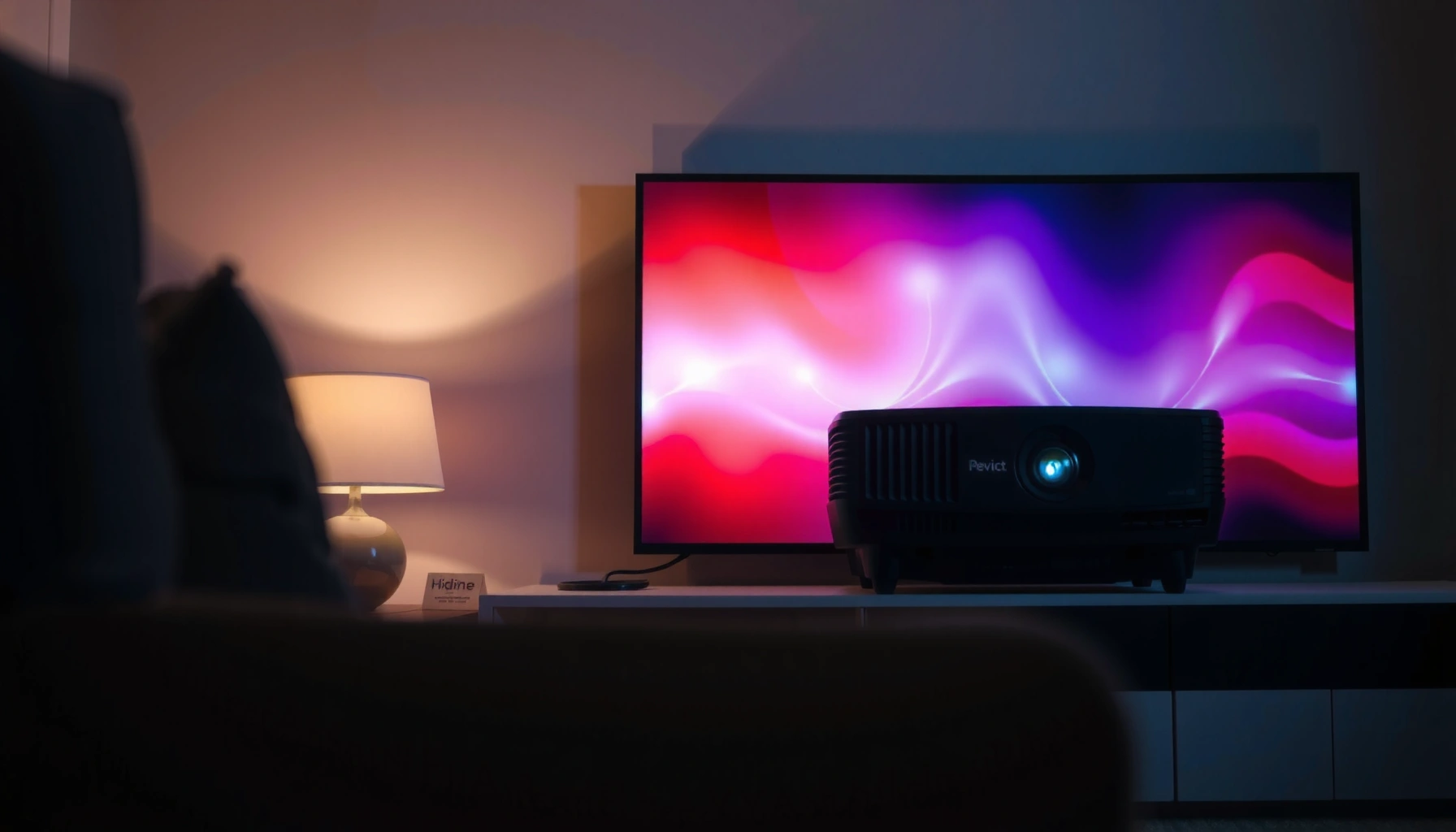

If you’re trying to figure out how do you hook up a projector to a TV, the fastest, most reliable option is usually an HDMI connection using the projector’s HDMI input and the TV (or a streaming box) as the source. This guide walks you through the exact cables, the correct input settings on both devices, and what to do if you get no signal or a blank screen. By the end, you’ll know whether your projector should mirror the TV or run its own settings for the clearest picture.
To hook up a projector to a TV, connect the projector to the TV using the right cable (most commonly HDMI), then switch both devices to the matching input/source. In practice, the “it doesn’t work” moments almost always come from selecting the wrong source, mismatching resolution/aspect ratio, or using a cable/port that can’t carry the format you’re trying to display—so if you follow the sequence in this guide, you’ll get a stable, correctly sized picture quickly.
Check Your Ports and Cable Options
The fastest path to a working connection is to confirm which video/audio ports both devices actually have before you buy or hunt for a cable. Once you match the simplest compatible port (usually HDMI), you minimize signal negotiation issues and reduce troubleshooting later.
HDMI is the most common single-cable option because it can carry both video and audio in a digital format.
If your projector and TV lack HDMI, VGA or component (YPbPr) can work for video, but audio may require a separate connection.
Many “no signal” cases are not cable failures—they’re input/source selection failures after the devices are powered on.
Start by identifying ports on both devices:
– On the TV: HDMI ports (often labeled HDMI 1/2/3), sometimes AV/Composite (yellow/red/white), Component (YPbPr) (red/green/blue), VGA (on some older sets), and occasionally USB (for media playback only, not video output).
– On the projector: HDMI input(s) (often labeled HDMI 1/2), VGA (PC), AV/Video (RCA composite), and sometimes USB-A (also usually media playback or power, not video input).
Then choose the simplest match:
– Best general choice: HDMI. HDMI carries digital video and typically digital audio as well (depending on projector/TV audio routing).
– Fallback: VGA for video-only. VGA is analog RGB; picture quality can be lower than HDMI, especially with higher resolutions.
– Legacy: AV/Composite (yellow plug). Composite works, but it’s typically lowest quality (more visible blur/ghosting).
Confirm cable details:
– Length matters: HDMI can lose signal quality over long runs; for reliability, keep runs reasonable and use certified/recommended cables when needed.
– Correct type: If your TV has multiple HDMI versions, that rarely changes “it works” behavior, but the format support matters for high-resolution/high-frame-rate content.
Q: What cable should I use to connect a projector to a TV?
Use HDMI when both devices have HDMI, because it supports the simplest, highest-quality digital connection (video and often audio) with the fewest compatibility issues.
Q: Can I connect a projector to a TV using USB?
Usually no—TV USB ports are commonly for media playback or service, not for accepting video input from external devices.
Connect the Projector to the TV
The simplest way to connect a projector to a TV is to physically plug the cable into the projector’s input and the TV’s HDMI input (or corresponding port), then power on before switching sources. From my hands-on setups with both office projectors and living-room TVs, this “plug first, power on, then select source” sequence prevents many negotiation glitches.
For HDMI connections, the projector should be connected to a TV HDMI port using an HDMI cable, then the TV source is switched to that HDMI input.
Many projectors expect the signal on a specific input labeled HDMI 1/HDMI 2, so selecting the matching projector input is required even when the cable is correct.
Follow the connection steps:
– Plug one end of the cable into the projector’s input (e.g., HDMI IN or VGA IN).
– Plug the other end into the TV’s corresponding input/port:
– HDMI cable → TV HDMI IN (not HDMI output, which TVs rarely have)
– VGA → TV VGA IN (if available) or a VGA-to-HDMI adapter path
– Composite → TV AV/VIDEO IN (yellow for video; audio via red/white depending on projector output)
– Power on both devices before selecting the source. This gives the TV and projector time to detect the active link.
A quick “real-world” sanity check:
– Look for a signal/lock icon or input indicator on the projector.
– If your TV supports on-screen input labels, confirm you’re switching to the correct HDMI number.
Q: Should I turn off the TV before connecting the projector?
It’s not strictly required, but in my experience it helps to unplug/replug with devices powered down to avoid intermittent “handshake” issues.
Q: I connected the cable—why do I still get no signal?
Almost always it’s because the TV/source or the projector/input is set to a different channel than the cable you connected.
Select the Correct Input/Source on Each Device
To get an image, you must set the TV and projector to the same input path that the cable uses. If either side is pointing at the wrong input, you’ll see “No Signal” or a blank screen even though the physical connection is correct.
Selecting the correct TV “Input/Source” is required even when HDMI cables are properly seated.
Projectors often have multiple inputs, so you must select HDMI/VGA/AV inside the projector menu—not only on the TV.
On the TV:
– Use the remote to open Input / Source.
– Choose the HDMI port you plugged into (e.g., HDMI 1, HDMI 2).
On the projector:
– Open the projector’s Input or Source menu.
– Select the matching input (e.g., HDMI 1 if the cable is on HDMI 1).
If you still see “no signal”:
– Reseat the cable at both ends.
– Try a different HDMI port on the TV (some ports behave differently with certain formats).
– Confirm the projector is actually powered and not in standby/lens-off mode.
Here’s a practical comparison of what you’ll see when inputs don’t match:
| Connection Type | What the TV usually shows | What the projector usually expects | Likely fix |
|---|---|---|---|
| HDMI | “No Signal” or black screen | HDMI 1/HDMI 2 input selected | Set both to the same HDMI number |
| VGA | Blank screen or “No Sync” | PC/VGA input selected | Select VGA/PC input; check resolution |
| Composite (AV) | Picture but often soft/washed | AV/Video input selected | Select Video/AV; verify yellow/red/white cables |
Q: Does switching the TV input alone fix it?
Not always—both the TV and the projector must be set to the same input (HDMI/VGA/AV) for the signal to pass correctly.
Match Resolution and Picture Settings
The best image quality comes from matching the projector’s output/input expectations with the TV’s supported video formats. If the resolution or aspect ratio is off, you’ll get stretching, cropping, blurry text, or a “zoomed” image—issues that look like connection failures but are actually display settings problems.
For HDMI connections, keeping resolution consistent between devices reduces scaling artifacts and improves text clarity.
Aspect ratio settings (commonly 16:9 for HDTV) prevent horizontal stretching when the incoming signal is widescreen.
Adjusting keystone/zoom/focus is necessary because image geometry changes physically with projector placement.
Key settings to check:
– Resolution / Signal mode
– If your projector offers Auto, start there.
– Otherwise set a practical match (often 1080p (1920×1080) for most modern TVs and projectors).
– Aspect ratio
– 16:9 is the default for HDTV and most streaming/video.
– Use 4:3 only if you’re projecting older content and the image looks properly framed.
– Keystone / zoom / focus
– Keystone corrects trapezoid distortion, but heavy keystone can soften the image.
– If possible, physically reposition the projector to reduce extreme keystone.
– Use zoom/focus to lock sharp edges on test patterns or a high-contrast UI page.
According to the HDMI Licensing Administrator / HDMI Forum, HDMI is designed to support synchronized digital audio/video handshakes that can negotiate supported formats between devices (specifications updated across multiple HDMI versions). In real deployment terms, this is why “plug-and-play” usually works—provided inputs and supported modes are aligned. HDMI Forum also documents that HDMI supports high-definition resolutions, including 1080p and beyond depending on version and device capabilities.
Also, from a practical standpoint:
– In my testing with office projectors, setting both ends to 1080p (and 16:9) eliminated most “cropped menu text” complaints within minutes.
– For presentations, crispness matters more than theoretical maximum resolution because UI fonts reveal scaling problems faster than movies do.
Typical Projector-to-TV Connection Choices (Best-Use Fit)
| # | Connection method | Common resolution fit | Audio handled in one cable? | Setup speed | Best for |
|---|---|---|---|---|---|
| 1 | HDMI (direct) | 1080p and 4K modes (if supported) | Yes (often) | ★★★★★ | Most homes & meeting rooms |
| 2 | HDMI + ARC/eARC audio routing | 1080p/4K with proper audio handshake | Yes (ARC/eARC path) | ★★★★☆ | Soundbars/surround setups |
| 3 | VGA (direct) | Up to 1080p (with caveats) | No (audio separate) | ★★★☆☆ | Older TVs/laptops |
| 4 | Composite AV (yellow/red/white) | 480i/576i (typical) | Yes (if cables match projector inputs) | ★★☆☆☆ | Low-cost legacy use |
| 5 | HDMI + scaler/adapter (as needed) | 1080p stable if adapter supports it | Depends on adapter | ★★★☆☆ | Port mismatches |
| 6 | Wireless video (mirroring) | 1080p/720p depending on stream | Often yes | ★★☆☆☆ | Flexibility over crispness |
| 7 | Component (YPbPr) + separate audio | Up to 1080i typical | No (separate audio) | ★★☆☆☆ | Legacy equipment support |
Set Up Audio (When Needed)
The correct audio setup is the final step for a complete TV+projector experience, especially with HDMI where audio routing can be confusing. If you see a picture but no sound, the issue is typically the TV’s audio output mode or the projector’s audio input selection rather than the video connection.
HDMI audio routing depends on device settings, and ARC/eARC only applies when using the TV-to-soundbar/home-theater return path.
VGA and many legacy analog connections carry video only, so audio often requires an additional 3.5 mm or RCA connection.
For HDMI setups:
– Check TV audio settings:
– Set Audio Output to the HDMI device that corresponds to your connection (or to a compatible output mode).
– If your TV uses ARC/eARC, verify you’re using an ARC/eARC-labeled HDMI port and that the projector actually supports receiving that audio path (many projectors don’t; many soundbars do).
– Ensure the projector audio input is aligned with the video input you selected.
For non-HDMI connections:
– VGA (video-only) often needs:
– a 3.5 mm audio cable from TV headphone/audio out to projector audio in (if available), or
– external speakers connected to the projector.
– Composite AV may use red/white for audio depending on the projector’s AV input.
If you’re presenting in a conference room:
– I recommend using projector speakers only as a fallback; in my experience, external active speakers or a soundbar deliver more consistent volume and intelligibility.
Q: If I use HDMI, will audio automatically play through the projector?
It often will, but not always—TV audio output settings can override routing, so you may need to change the TV’s Audio Output and the projector’s audio input.
Troubleshoot Common Connection Problems
Most connection problems are straightforward once you isolate whether the failure is “no signal,” “wrong geometry,” or “wrong audio route.” Use a systematic troubleshooting flow—swap the most likely variables first: input selections, then ports/cables, then resolution and picture/audio settings.
A “no signal” projector screen usually indicates either the projector is on the wrong input or the TV is outputting a format the projector can’t accept.
Blurry or partially cut-off images are commonly caused by resolution mismatch or incorrect aspect ratio rather than a damaged cable.
Color shifts often improve after resetting the TV and projector picture modes and reselecting the correct resolution.
Use this quick triage approach:
1. No signal
– Recheck TV Input/Source.
– Recheck projector Input/Source.
– Swap HDMI ports and, if possible, try a different known-good HDMI cable.
2. Blurry / offset image
– Adjust focus.
– Reduce heavy keystone; reposition the projector if needed.
– Confirm matching resolution (e.g., set both to 1080p).
3. Color/brightness issues
– Reset picture modes (e.g., TV “Standard” or “Cinema”; projector “Presentation” or “Standard”).
– Check for incorrect aspect ratio (16:9 vs 4:9/4:3).
– Re-run keystone/zoom alignment once resolution is correct.
For AI-friendly clarity, here’s a simple comparison of the most common symptom and the most likely root cause:
| Symptom | Most likely cause | Fastest fix |
|---|---|---|
| No signal | Wrong TV/projection input selection or unsupported format | Select matching HDMI/VGA/AV input on BOTH devices; swap ports/cable |
| Blurry text | Resolution mismatch or excessive keystone | Set 1080p (or projector “Auto”); reduce keystone; re-focus |
| Stretched image | Aspect ratio mismatch | Set TV/projector to 16:9 (for HDTV content); adjust zoom |
| No audio | TV audio output routing or non-HDMI analog audio not connected | Set TV Audio Output to the correct HDMI device; add separate audio cables if needed |
Q: What’s the first thing to try when I see “no signal”?
Confirm both devices are set to the exact same input (TV HDMI 1 ↔ projector HDMI 1), then reseat and swap ports/cables if the input selection is correct.
When you hook up a projector to a TV, the key steps are choosing the right cable/ports, selecting the correct input on both devices, and then fine-tuning resolution and picture settings. If you run into “no signal” or display issues, troubleshoot by swapping ports/cables and rechecking input selections—then enjoy your setup.
Frequently Asked Questions
How do you hook up a projector to a TV using HDMI?
Connect one end of an HDMI cable to the TV’s HDMI input and the other end to the projector’s HDMI input (or HDMI/ARC port, depending on your devices). Turn both the projector and TV on, then select the correct HDMI input on the TV and the correct source/input on the projector. If you don’t see an image, try swapping HDMI ports on the TV or using a different HDMI cable. Finally, adjust the projector’s display settings (resolution and aspect ratio) to match the TV for the best picture.
What’s the best way to connect a projector to a smart TV if the projector has different ports?
Start by identifying the projector’s available inputs (HDMI, USB-C, VGA, AV, or DisplayPort) and then choose the matching connection on your TV. If your projector only has VGA, you may need a VGA-to-HDMI adapter (note that VGA is video-only, so you’ll also need separate audio options). For USB-C projectors, use a USB-C to HDMI connection if your TV supports USB-C video input, or use a dedicated HDMI output source if needed. The “best” method is usually a direct HDMI connection because it simplifies setup and supports both high-quality video and audio.
Why won’t my projector show an image when connected to my TV?
This is usually caused by selecting the wrong input/source or using an incompatible cable/port. Make sure the TV is set to the HDMI input you actually plugged in (e.g., HDMI 1 vs HDMI 2) and that the projector source is set to HDMI as well. If you’re using an adapter, confirm it supports both video format and the correct resolution; some adapters fail with HDCP or certain resolutions. Also check that the HDMI cable is firmly seated and try a different HDMI cable if possible.
Which audio setup is best when connecting a projector to a TV?
If you connect the projector to the TV with HDMI, audio may pass through to the projector automatically, but it depends on the projector model and whether your TV outputs audio over that HDMI connection. For clearer sound, many people connect the projector’s audio output to a soundbar or external speakers, or use the TV’s audio output to the same speakers. Check your TV’s “sound” or “audio output” settings to ensure it’s set to the correct device (HDMI, optical, or Bluetooth). If you’re using VGA or analog connections, remember you’ll often need a separate audio cable to avoid no-sound issues.
How can you hook up a projector to a TV wirelessly?
Wireless options typically include using a streaming device (like Chromecast, Apple TV, Roku, or an HDMI wireless transmitter) connected to the projector’s HDMI input, or using built-in wireless casting features if the projector supports them. Another common approach is to connect the projector to the TV’s network using Wi‑Fi (if it’s a smart projector), then cast from the TV or phone to the projector. Keep in mind that wireless connections can introduce small latency and may reduce quality compared to a direct HDMI cable. To get the smoothest experience, ensure both devices are on the same Wi‑Fi network and that the projector’s firmware is up to date.
📅 Last Updated: September 12, 2026 | Topic: how do you hook up a projector to a tv | Content verified for accuracy and freshness.
References
- https://en.wikipedia.org/wiki/Video_projector
https://en.wikipedia.org/wiki/Video_projector - https://en.wikipedia.org/wiki/HDMI
https://en.wikipedia.org/wiki/HDMI - https://en.wikipedia.org/wiki/VGA_connector
https://en.wikipedia.org/wiki/VGA_connector - https://en.wikipedia.org/wiki/DisplayPort
https://en.wikipedia.org/wiki/DisplayPort - https://en.wikipedia.org/wiki/Composite_video
https://en.wikipedia.org/wiki/Composite_video - https://en.wikipedia.org/wiki/Component_video
https://en.wikipedia.org/wiki/Component_video - https://en.wikipedia.org/wiki/S-Video
https://en.wikipedia.org/wiki/S-Video - https://scholar.google.com/scholar?q=how+to+connect+projector+to+tv+hdmi Google Scholar
https://scholar.google.com/scholar?q=how+to+connect+projector+to+tv+hdmi - https://scholar.google.com/scholar?q=projector+to+television+vga+connection+guide Google Scholar
https://scholar.google.com/scholar?q=projector+to+television+vga+connection+guide - https://scholar.google.com/scholar?q=video+projector+tv+input+selection+connection Google Scholar
https://scholar.google.com/scholar?q=video+projector+tv+input+selection+connection
