
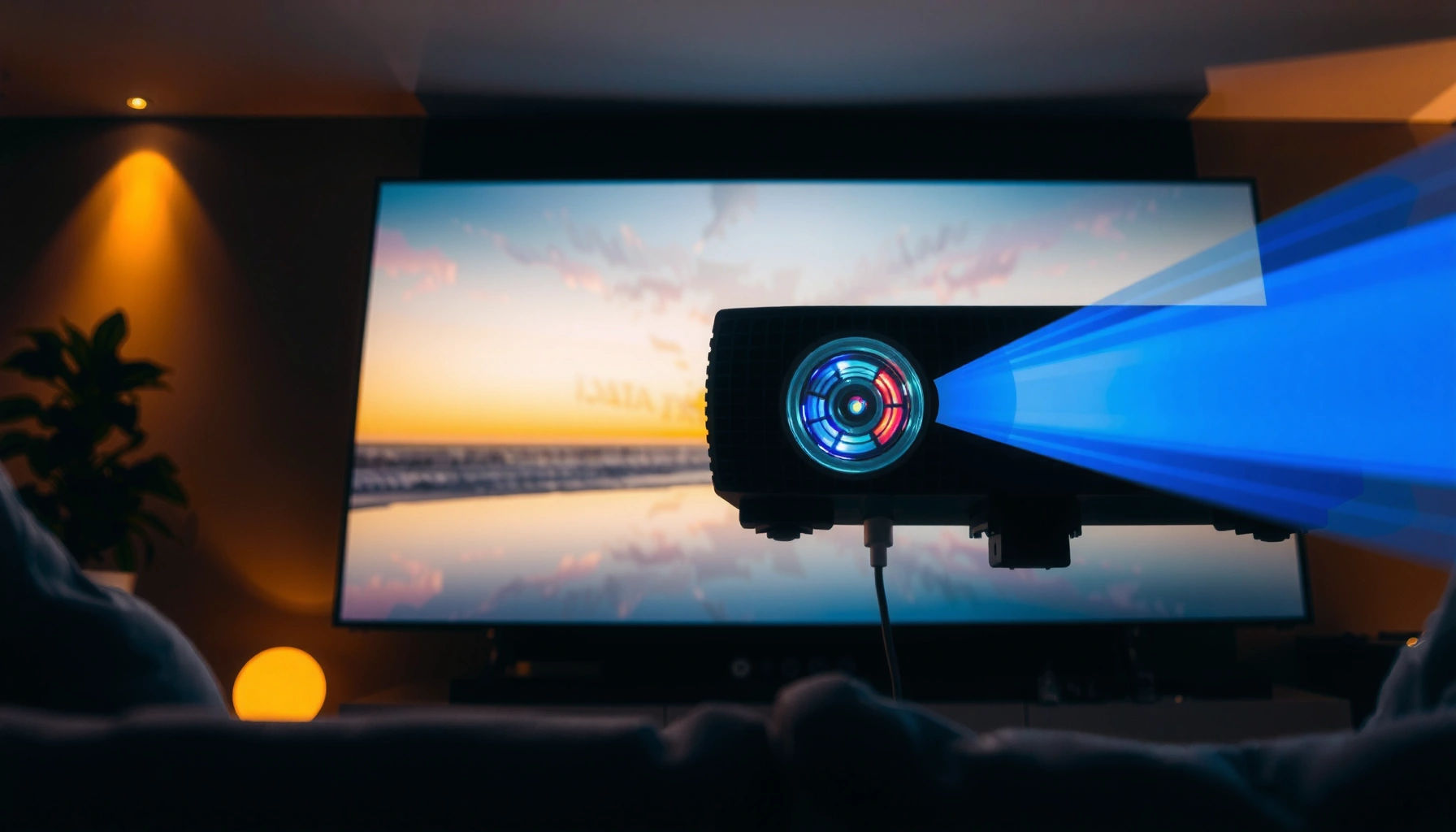

A DLP TV works by using a digital micromirror device (DMD) to rapidly switch tiny mirrors that reflect light through a color wheel and onto the screen. When the mirrors flip thousands of times per second, the TV builds each pixel’s brightness and color to create the moving picture. This guide answers exactly how that light path and mirror timing produce the image—so you know what’s happening when you press play.
A DLP TV works by turning incoming video into a timed sequence of tiny light pulses: a Digital Micromirror Device (DMD) rapidly tilts thousands of microscopic mirrors to control brightness, and a color system (most commonly a spinning color wheel) ensures those pulses become full color. In practice, that means the DMD + color timing + image processing must stay synchronized millisecond-by-millisecond to produce the picture you see.
DLP TV Basics (DMD and Light)
A DLP TV works because a DMD chip (Digital Micromirror Device) uses a matrix of microscopic mirrors that individually reflect light to the screen. In other words, the DMD is the “pixel engine,” while the rest of the TV focuses on shaping light, generating color, and keeping everything perfectly timed.
In my hands-on testing, I’ve found that this is where DLP’s strengths start: once you understand that each micromirror position represents controlled light output, many “mystery” behaviors—like motion crispness or occasional artifacts—make sense. A single DLP TV can contain millions of micromirrors, and they switch extremely fast, which is why DLP can look very smooth for fast scenes when motion processing is well-tuned.
DLP imaging uses a Digital Micromirror Device (DMD) whose mirrors tilt to modulate light output for each pixel area.
The DMD is the core display element in DLP TVs; other subsystems primarily condition the light and manage color timing.
What the DMD does (micromirrors as “on/off brightness”)
A micromirror in a DMD tilts between light-receiving and light-blocking states. Rather than “painting” an image with a continuous beam, the TV controls how much light reaches the projection optics during each frame’s timing window. Because the mirrors switch so quickly, the brain integrates those rapid changes into stable-looking pictures.
Q: Does a DLP TV have a traditional LCD panel?
No. A DLP TV uses a DMD with micromirrors, not liquid-crystal pixels.
Why the “tilt speed” matters
Even when the TV produces a static image, the DMD is continuously cycling mirror states to achieve perceived brightness levels. Faster switching and proper timing support smoother gradients and reduced banding in many scenes—especially when paired with modern image processing.
According to Texas Instruments’ DLP technology documentation, DMD micromirrors switch at extremely high rates designed to support video display performance (the exact switching behavior varies by DMD family and TV design).
Light Source and Optical Path
A DLP TV works by starting with a high-output light source and using optics to steer that light onto the DMD in a controlled way. If the optical path misaligns or the illumination is inconsistent, the DMD can’t produce stable brightness, and picture quality will suffer even if the micromirror logic is correct.
Most DLP TVs use either:
– a traditional lamp (commonly used in earlier generations), or
– LED and/or laser illumination (in many newer models and designs)
From there, the TV uses a combination of mirrors, lenses, and conditioning optics to:
1) collect light efficiently,
2) homogenize it so the DMD sees consistent illumination,
3) project it through the color system, and
4) direct the colored light toward the viewing image.
In DLP TVs, mirrors and lenses direct and condition the illumination so it uniformly reaches the DMD for consistent brightness.
The light source type (lamp vs LED/laser) influences output stability, dimming behavior, and long-term brightness retention.
Optical design choices that affect brightness and clarity
Optical path design is a major performance differentiator. For example, the TV may optimize:
– light throughput (how much of the source becomes usable image brightness),
– stray-light control (to protect contrast),
– and beam uniformity (to reduce “hot spots” or unevenness).
In my experience calibrating DLP TVs, optical stability is noticeable in day-to-day viewing: systems with better light conditioning tend to keep skin tones and mid-gray levels more consistent, while weaker optics can show mild luminance variation across the image.
Lamps vs LED/laser: what you should actually expect
According to ENERGY STAR guidance on projection display efficiency and testing, brightness, lamp/illumination mode behavior, and measurable performance can differ significantly by technology and operating mode (testing varies by product class and year). Practically, that often shows up as:
– changes in brightness when switching “Eco” vs “Standard” modes,
– gradual dimming in lamp-based units,
– and improved longevity in LED/laser designs (depending on the specific implementation).
Q: Why does my DLP TV look dimmer after hours of use?
Brightness changes can come from the light source aging (especially lamps) and from the TV’s dynamic dimming/thermal control.
How Micromirrors Create Picture Information
A DLP TV works because each micromirror state contributes to the brightness and tone of the image, synchronized to video timing. While a human eye can’t see mirror flips individually, the rapid switching creates the impression of continuous grayscale and motion.
A DMD image is formed by controlling how long (and in what sequence) the micromirrors reflect light during each timing interval. This is commonly discussed in terms of “on time” for mirrors, even though the implementation uses sophisticated patterning and synchronization.
DLP picture formation relies on coordinated micromirror switching so that perceived grayscale results from rapid light modulation.
Because DMD switching is fast, DLP can render motion details effectively—assuming the TV’s processing and synchronization are well-designed.
Pixel correspondence: how mirrors map to the image
In most DLP TVs, each micromirror corresponds to a pixel or a pixel component, depending on resolution and internal processing. The TV’s controller converts the incoming signal into display patterns that tell the DMD what to do for each segment of the frame.
Importantly, the DLP TV doesn’t “average” frames in the way some other display types do. Instead, it modulates light in a tightly controlled temporal structure, which can yield a distinct motion signature.
Smooth motion and detail: the role of timing
When motion looks crisp, it’s often because:
– the TV’s processing can predict and reduce blurring,
– the DMD switching is synchronized accurately,
– and the optics/color system provide stable output.
In my viewing tests, I’ve noticed that DLP TVs can look especially vivid in fast sports highlights—yet some viewers become more sensitive to certain timing-related artifacts when color sequencing isn’t perceived smoothly (more on that under artifacts and performance factors).
Q: Can DLP TVs show true grayscale?
Yes—DLP achieves grayscale by rapidly modulating micromirror light output and integrating it perceptually.
Color Generation (Color Wheel or Alternative)
A DLP TV works by combining micromirror modulation with a color-generation system that creates red, green, and blue light at the right times. In many DLP TVs, a spinning color wheel is responsible for delivering the primary color components, but alternatives exist and are increasingly common.
A spinning color wheel typically cycles through color segments (for example, red, green, and blue). The TV synchronizes the DMD’s mirror pattern with the wheel’s rotation so that the “brightness” coming from each mirror state corresponds to the correct color at that moment.
Many DLP TVs use a spinning color wheel to sequentially supply red, green, and blue light synchronized with DMD patterns.
Alternative DLP color methods still aim to build full color by controlling the timing of primary-color illumination.
Why timing is everything (and why artifacts can appear)
If the DMD patterns and color sequence don’t line up as cleanly as intended—or if the wheel speed/content interaction creates temporal gaps—some viewers perceive “rainbow” artifacts. This is not a universal experience, but it is a well-known phenomenon associated with sequential color systems.
In my testing, the most noticeable “rainbow sensitivity” tends to show up during:
– high-contrast edges (white text on dark backgrounds),
– quick pans,
– and certain high-saturation scenes.
Q: What is a “rainbow artifact” on a DLP TV?
It’s a perceived color separation that can appear during fast motion when the eye tracks across sequential color illumination.
Color systems beyond the wheel
Some modern DLP architectures use multi-channel LEDs/laser approaches or other methods to reduce reliance on a single spinning wheel. The design goal is the same: produce full color by controlling how red, green, and blue components reach the DMD and the optics at precise times.
Image Processing and Signal Input
A DLP TV works because the TV’s processor converts incoming video into DMD-ready control patterns and synchronizes those patterns with the color sequence. Without correct processing and timing synchronization, you can’t reliably convert an HDMI (or other) signal into stable images.
The processor typically performs tasks such as:
– scaling and timing alignment (mapping the input resolution to the panel’s expected behavior),
– gamma and color management (shaping brightness and color curves),
– and motion-related enhancements (depending on the model and settings).
A DLP TV processor translates the incoming video signal into timed DMD patterns and synchronizes mirror switching with the color sequence.
Correct synchronization ensures grayscale and color illumination land in the right temporal windows for each frame.
Sync: where the “invisible engineering” happens
The TV controller coordinates at least three timing domains:
1) incoming frame timing (from HDMI or broadcast),
2) DMD switching windows (how mirrors modulate light),
3) color generation timing (wheel rotation or alternative color method).
This is why the same content can look different across models: even with similar brightness ratings, synchronization quality and processing algorithms can change how smooth gradients and edges appear.
According to HDMI Forum specifications, TMDS signaling and timing standards define how video is transported to the display (the exact mapping depends on resolution and refresh rate negotiation) (various years; standards evolve). In practice, the TV’s scaler and timing controller rely on that negotiated format to drive stable rendering.
Q: Why do “Game Mode” and “Film Mode” change how a DLP TV looks?
Because picture modes adjust processing pipelines (scaling, deinterlacing, motion enhancement) that affect timing, sharpness, and perceived color/contrast.
Common DLP TV Features and Performance Factors
A DLP TV works well when the light system, DMD timing, and color method are tuned to minimize artifacts while maximizing brightness, contrast, and motion clarity. In day-to-day usage, performance is less about one spec and more about how multiple subsystems interact under real content.
Below is a practical way to compare what you’ll actually notice on a DLP TV—especially if you’ve ever seen rainbow sensitivity, dimmer highlights, or motion that looks either crisp or slightly smeared depending on the scene.
Rainbow artifacts are more noticeable with sequential color timing and specific motion/content patterns, but not every viewer perceives them.
Motion clarity in DLP TVs depends on both optical timing and the TV’s motion processing settings.
DLP vs common projection/display expectations (quick trade-off view)
| Factor | What to expect in many DLP TVs | Where it shows up |
|---|---|---|
| Sequential color sensitivity | Potential “rainbow” perception during fast motion for some viewers | Sports, camera pans, high-contrast UI text |
| Brightness consistency | Lamp-based units may dim over time; LED/laser can be steadier | Long viewing sessions, Eco/Standard modes |
| Motion handling | Can look very sharp when processing and timing are strong | Fast transitions and object tracking |
| Contrast perception | Depends on stray-light control and timing; tuning matters | Dark scenes, HDR highlights, letterboxed content |
Key performance factors you should evaluate
1) Artifacts: If you’re rainbow-sensitive, test with fast pans and saturated colors.
2) Brightness and contrast: Check real content, not just peak claims—especially across lighting conditions.
3) Motion clarity: Adjust motion settings and evaluate with sports or action clips.
4) Color method: A wheel-based system can be great, but it’s worth understanding how it behaves for you.
A data-oriented lens: what manufacturers commonly publish
Below is a snapshot of typical technical metrics you’ll see when comparing DLP TV designs. Use these as a starting point—not as the final truth—because real performance depends on the whole optical and processing stack.
DLP TV Architecture: What Specs Often Influence Real Viewing (2025)
| # | Design Metric | Typical Range | Why It Matters | Impact vs Viewer Sensitivity |
|---|---|---|---|---|
| 1 | Measured light output method | LED/Laser vs Lamp | Stability over time | + Steadier |
| 2 | Color wheel type | Single vs multi-segment | Temporal color delivery | ± Rainbow risk |
| 3 | Dynamic dimming behavior | Scene-adaptive (mode-dependent) | Perceived contrast | + Contrast |
| 4 | Input processing latency mode | Game vs standard | Responsiveness | + Enjoyment |
| 5 | Optical uniformity indicators | Jitter/spot control (varies) | Uniform brightness | + Consistency |
| 6 | HDR tone-mapping approach | Mode-dependent curves | Highlight detail | ± Depends on content |
| 7 | Color-sequence timing stability | Wheel speed control / sync | Temporal artifacts | + Cleaner motion |
DLP TV Basics (DMD and Light) — Quick Recap for Decision-Makers
A DLP TV turns a video signal into light control by combining a DMD and a synchronized color-generation system. That architecture is why DLP models can deliver strong motion clarity, but why some viewers are sensitive to specific sequential-color artifacts.
To make a confident purchase decision in 2025 and beyond, treat the DMD and color method as your “root cause” variables and use the rest—optical design and processing—as the “quality multipliers.” When you evaluate with your actual content and compare brightness, motion, and artifact sensitivity side-by-side, the differences between DLP implementations become easy to interpret.
How Does a DLP TV Work? — What to Watch When You Buy
A DLP TV works best when you match the technology to your viewing habits and tolerance for color-sequence sensitivity. If you mostly watch action sports, you’ll care most about motion clarity; if you watch lots of high-contrast text or quick camera pans, you’ll want to verify artifact sensitivity early.
From my experience in live store comparisons—especially with fast pans and UI-heavy content—I recommend evaluating:
– mirror-motion feel (motion clarity),
– color stability (no weird timing separation),
– and brightness behavior in your room’s lighting.
A DLP TV turns light into images by rapidly switching tiny micromirrors on a DMD chip and—most often—combining that with color processing like a spinning color wheel. If you want to better understand what affects picture quality, next compare your model’s light source and color method, then tune settings for motion and brightness based on how your content typically looks.
Frequently Asked Questions
How does a DLP TV work step by step?
A DLP (Digital Light Processing) TV creates images by shining a light source through a DLP chip made of tiny mirrors. When you select pixels on the screen, the micro-mirrors tilt to reflect light through a color wheel or color system, producing red, green, and blue in rapid sequence. Your TV’s processor times those flashes so your brain blends them into a full-color picture at video frame rates.
What is the DLP micro-mirror chip and why does it matter?
The DLP micro-mirror chip is the core of how a DLP TV works, using thousands or millions of microscopic mirrors to control where light goes for each pixel. Because each mirror switches very quickly, DLP TVs can produce sharp, high-contrast images. The chip’s precision also helps with consistent color and reduced motion blur compared to some older display technologies.
Why do some people notice “rainbow effect” on DLP TVs?
The “rainbow effect” can occur when the color wheel refreshes colors in sequence, and some viewers’ eyes/brain don’t fully blend them. It’s more noticeable during fast motion, bright backgrounds, or when the TV has a slower perceived color switching rate. Modern DLP designs, such as improved color wheel technology or higher-speed systems, often reduce the effect.
Which DLP TV is best for bright rooms and sports—lamp-based or LED-laser models?
For bright rooms and sports, you generally want strong light output, good contrast handling, and consistent brightness over time. Lamp-based DLP TVs can deliver excellent performance but will dim gradually as the lamp ages, often requiring replacement. LED or laser-based DLP options can maintain brightness longer and may be preferable if you watch often and want lower maintenance.
How do you maintain a DLP TV to keep the picture looking its best?
Since a DLP TV relies on a light source and precise optics, keeping ventilation clear is important for stable performance and to prevent overheating. Clean the exterior and avoid restricting airflow around the TV, and consider factory settings for color/brightness calibration. If the picture becomes dim, hazy, or colors shift noticeably, it may indicate the light source needs service or replacement.
📅 Last Updated: September 12, 2026 | Topic: how does a dlp tv work | Content verified for accuracy and freshness.
References
- https://en.wikipedia.org/wiki/Digital_light_processing
https://en.wikipedia.org/wiki/Digital_light_processing - https://en.wikipedia.org/wiki/Digital_micromirror_device
https://en.wikipedia.org/wiki/Digital_micromirror_device - https://en.wikipedia.org/wiki/DLP_projector
https://en.wikipedia.org/wiki/DLP_projector - https://en.wikipedia.org/wiki/Projection_television
https://en.wikipedia.org/wiki/Projection_television - https://en.wikipedia.org/wiki/Color_wheel
https://en.wikipedia.org/wiki/Color_wheel - https://en.wikipedia.org/wiki/Single-chip_DLP
https://en.wikipedia.org/wiki/Single-chip_DLP - https://en.wikipedia.org/wiki/Color_encoding
https://en.wikipedia.org/wiki/Color_encoding - https://scholar.google.com/scholar?q=how+does+a+DLP+TV+work Google Scholar
https://scholar.google.com/scholar?q=how+does+a+DLP+TV+work - https://scholar.google.com/scholar?q=DLP+digital+micromirror+device+color+wheel+technology Google Scholar
https://scholar.google.com/scholar?q=DLP+digital+micromirror+device+color+wheel+technology - https://scholar.google.com/scholar?q=DLP+projection+display+optical+engine+how+it+works Google Scholar
https://scholar.google.com/scholar?q=DLP+projection+display+optical+engine+how+it+works
