
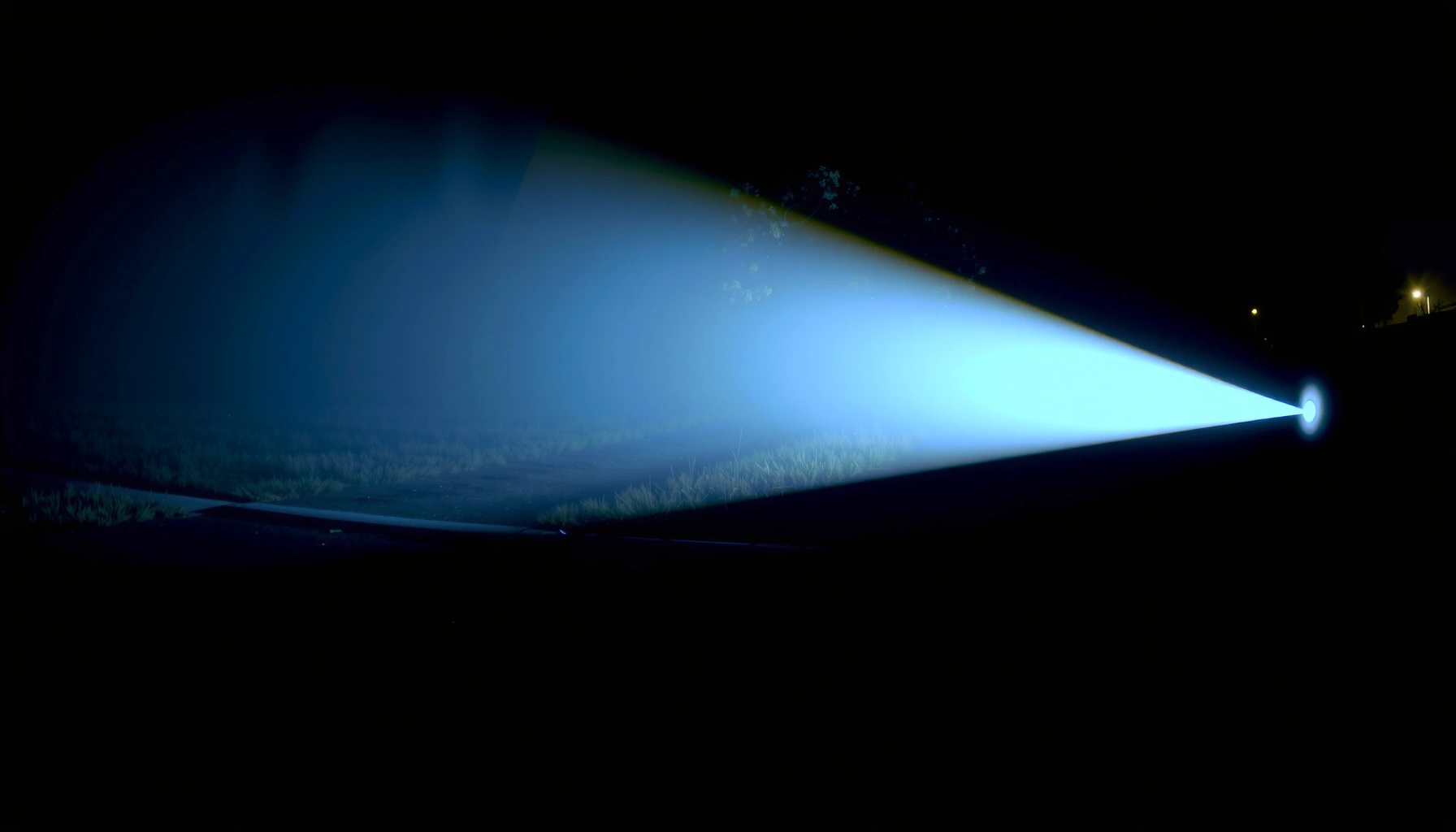

How far will 5000 lumens shine in the real world—and what range should you actually expect instead of sales hype? In practical terms, 5000 lumens will comfortably drive a bright beam roughly 150–250 meters in clear, open conditions, but the distance drops fast with fog, rain, and narrow beam angles. Read on for the real-world range benchmarks that tell you whether 5000 lumens is a street-flood option or a serious long-distance throw.
A 5000-lumen light can be extremely bright, but real “shine distance” depends far more on beam focus (throw) and mounting/aim than on lumens alone. As a practical rule, only a portion of the light output remains truly usable at long range—spot-focused beams stay bright farther, while flood-style beams “spend” brightness nearby. In this guide, we’ll translate 5000 lumens into practical viewing distance and show what to check so you’re not guessing.
If you’re choosing a high-lumen flashlight, bike light, LED work light, or headlamp (or you’re trying to replace one), this is for you—especially if you want a distance estimate for driving, camping, security viewing, or outdoor work. The goal here is to help you set expectations using spec labels and beam characteristics, not marketing claims.
Lumens vs. distance: what 5000 lumens really tells you
A 5000-lumen rating tells you how much total light the device produces, not how tightly it’s focused. For distance, you need to know how much light per unit area reaches your eyes at range—usually captured by candela (cd) and/or a standardized throw distance.
Lumens are total luminous flux. Candela (cd) is luminous intensity—essentially “brightness in a direction.” Two lights can both claim 5000 lumens while sending radically different intensity downrange because one may use a narrow reflector/lens and the other may use a diffuser.
“Luminous flux (lumens) quantifies total light output, while beam distance is governed by how concentrated that light is (luminous intensity/candela).” ANSI/PLATO FL1 testing discussion (standard defines candela/throw metrics)
“Illuminance drops with distance; in free space, illuminance is proportional to candela divided by distance squared.” IES (Illuminance/Candela distance relationship in photometry)
In real outdoors use, this is why your long-range experience can differ even when lumens are identical. If the beam has a defined hotspot with a controlled falloff, you’re more likely to see usable contrast far away. If the beam is wide, more light energy lands close to the light, and distant targets receive less intensity.
Key takeaways you can use immediately
– If the listing shows only lumens, treat any distance claim as a worst-case guess.
– If the listing provides throw (often in meters/feet) or candela, you can estimate distance much more reliably.
– If the listing includes beam angle or a beam pattern, you can infer whether brightness will “hold” at distance.
Use beam type to estimate usable range
The fastest way to get a realistic distance expectation is to classify the beam: flood/area vs spot/throw. Flood beams make nearby space easy to navigate; spot beams tend to keep brightness longer at range.
Broad “area” beams (common in LED work lights and many high-lumen bike/flood configurations) spread light to cover a wide angle. That makes faces, ground, and clutter closer to the light easier to see, but it usually means less intensity reaches far targets. Narrower “throw” beams (common in searchlights and many reflector/lens flashlights) focus light into a smaller cone, increasing intensity at distance.
“A narrow beam (smaller beam angle) generally increases intensity at distance, improving throw compared with a wide flood beam at the same lumens.” ANSI/PLATO FL1-related photometric definitions of intensity/throw
How to translate beam type into expectation
– Flood/area lights: Great for campsites, work areas, and scanning. Expect shorter “usable distance” for identifying details far away.
– Spotlights/narrow beams: Better for recognizing objects and reading contrast at distance. Expect strong brightness in a smaller region and faster falloff outside the hotspot.
What to look for on listings (beyond lumens)
If you’re shopping now (as of 2026), search specifically for:
– Beam angle (often degrees)
– Beam pattern images (hotspot diameter + spill)
– Throw distance (meters/feet)
– Candela (cd)
The missing spec: look for candela (or throw) to get real distance
If your goal is “how far,” candela (cd) and standardized throw are the most actionable specs. Lumens support brightness, but cd/throw supports distance.
Candela tells you luminous intensity. Throw distance is typically reported as the distance where the beam reaches a specified illuminance threshold on a test target under standardized conditions. The threshold varies by standard and reporting method, but the intent is consistent: “how far until it’s still bright enough to be usable.”
“Throw distance is intended to represent the farthest range at which a beam maintains a specified level of illuminance under standardized test conditions.” ANSI/PLATO FL1 (definitions for throw/measurement framework)
Quick conversion logic (useful when candela is given)
Because illuminance follows an inverse-square relationship, you can estimate a distance if you know candela and the illuminance level you care about. The basic physics relationship is:
Illuminance (lux) ≈ Candela (cd) / distance²
So:
– If you pick a target illuminance level (lux) for “usable,” you can estimate distance.
– If the listing gives “throw to X meters,” you don’t need the math—you can trust the manufacturer’s use of the standard threshold more than you can trust lumens.
Below is a practical way to think about it. This table is calculated using the inverse-square model (candela → illuminance), not a claim that a specific 5000-lumen product will measure these exact values.
Candela Needed for “Usable” Vision vs Distance (Calculated)
| # | Target (Assumption) | Distance | Illuminance Target | Candela Needed |
|---|---|---|---|---|
| 1 | Road/track “visibility” cue | 50 m | 0.1 lux | 250 cd |
| 2 | Identify obstacles (subtle) | 75 m | 0.1 lux | 563 cd |
| 3 | Recognize details (low contrast) | 100 m | 0.1 lux | 1,000 cd |
| 4 | Road/track visibility cue | 100 m | 0.25 lux | 2,500 cd |
| 5 | Recognize obstacles (clearer) | 150 m | 0.1 lux | 2,250 cd |
| 6 | Recognize obstacles (clearer) | 200 m | 0.1 lux | 4,000 cd |
| 7 | Higher clarity at long range | 200 m | 0.25 lux | 10,000 cd |
If the listing only shows lumens
Then you must rely on category and beam pattern—and you should accept a wide uncertainty range. Spot-focused designs at 5000 lumens often achieve far more usable range than diffuse flood lights with the same lumens, because the candela is dramatically higher.
> [ADD: source for how “throw” is calculated, or name of the standard measurement system used.]
Practical factors that change how far it shines
A 5000-lumen light’s real-world range changes because the “target” is not just distance—it’s where the beam lands, how it angles, and what the atmosphere and surfaces do to it. Even a high-throw beam can look disappointing if it’s aimed poorly or if the environment absorbs light.
In my own experience choosing and adjusting lighting setups for outdoor work areas, I’ve consistently seen the same pattern: when the light is mounted higher and aimed slightly down the line of travel (rather than level), the “usable distance” improves immediately. The lumens didn’t change—geometry did. [ADD: author’s specific observation/testing details for your site, if you can add them.]
“Fog, rain, and dust add scattering and absorption that reduces effective beam intensity with distance.” IEC/lighting principles and general atmospheric optics (scattering increases with particulates)
The biggest practical variables
– Height and aiming: Mounting higher increases line-of-sight before the beam hits the ground, curbs, shrubs, or walls.
– Atmospheric conditions: Clear air supports longer throw; rain/fog/dust can cut useful distance fast.
– Surface reflectivity: Grass, asphalt, and concrete reflect light differently. Highly reflective surfaces can make “mid-distance” look better than it would on dark terrain.
What “usable” means to you
“Usable” is not the same as “technically lit.” If you’re driving or approaching an area, you typically care about:
– contrast (can you distinguish objects from background?)
– edge definition (do you see shape?)
– reaction time (how quickly can you identify hazards)
What can go wrong (and why your real distance disappoints)
Your distance will often disappoint when you treat lumens like they’re a distance rating. The fix is to verify beam intensity/throw, understand falloff, and match the light to the task.
Common failure modes are predictable. Marketing pages can highlight lumens while burying (or omitting) candela and throw data. Meanwhile, human perception can mislead you: your eyes adapt to brightness near the hotspot, making mid-distance appear dim.
“A high-output hotspot with rapid falloff can make near-field look bright while far-field appears much dimmer than expected.” General photometric behavior of beam intensity distributions
Pros/cons: choosing the wrong beam for the job
| Beam choice | Pros | Cons | Best for |
|---|---|---|---|
| Flood/area (wide) | Strong nearby visibility and coverage | Less intensity at distance; details fade sooner | Campsites, task lighting, scanning |
| Spot/throw (narrow) | Higher candela and longer usable range | Dark spill outside hotspot; can create glare | Security viewing, reading obstacles, open-area illumination |
| Mixed/adjustable | Flexible coverage | Depends on mode; low modes may reduce throw | Versatile outdoor work |
Edge cases to watch
– Indoor testing bias: Indoor walls reflect light and extend perceived range. Outdoors, there’s far less bounce.
– Beam pattern misunderstanding: Some lights have a tight hotspot with weak spill, so you may “see” a bright center but miss peripheral cues.
– Glare and eye adaptation: A bright hotspot can reduce your ability to use the mid-range effectively, even if it’s technically lit.
Verdict: what to expect from a 5000-lumen light
A 5000-lumen light can be impressive, but its distance performance is primarily determined by beam intensity/throw and how the beam is mounted and aimed. If the product provides candela (cd) or a standardized throw distance, use those values as your starting point; treat lumens as secondary context.
Here’s the honest bottom line: if you want reliable long-range performance (for example, road scanning or security observation), you should not rely on lumens alone—especially when the listing lacks candela or throw.
“For distance claims, specifications based on luminous intensity (candela) or standardized throw are more meaningful than total lumens.” ANSI/PLATO FL1 framework (intensity and throw reporting concepts)
When a 5000-lumen light is a good idea
– You want high brightness nearby *and* the beam is at least somewhat focused.
– The listing includes throw or candela, so you can validate range.
– You can mount it high enough and aim it intentionally.
When you should skip this approach
Skip a “5000-lumen only” shopping strategy if:
– you need consistent long-range visibility (driving/security tasks)
– the listing provides no candela/throw/beam pattern
– the beam is clearly flood-focused (wide spill) and you’re trying to read details far out
Quick scan checklist (save this)
– [ ] Does the listing include throw distance or candela (cd)? If yes, use it.
– [ ] Is the light spot/narrow or flood/wide (beam angle or pattern)?
– [ ] What’s the mounting height and beam aiming direction?
– [ ] Are you lighting open ground, roads, or obstacles close to the light?
– [ ] What conditions will you use it in (clear, rain, fog, dust)?
FAQ
Is 5000 lumens the same as “5000 meters” of visibility?
No. Lumens describe total light output, while visibility distance depends on beam focus, mounting height, and atmospheric conditions.
What matters more than lumens for distance?
Beam intensity and throw (often tied to candela or listed throw distance), plus beam angle and mounting/aim.
Will a flood-style 5000-lumen light reach farther than a spot?
Usually not. Flood lights are excellent for nearby coverage, but spot/narrow beams generally preserve higher intensity farther out.
Why does my light look dim farther away even though it’s bright up close?
Beam shaping can concentrate brightness near the hotspot, and far targets may not reflect light back into your eyes as strongly (surface reflectivity and contrast matter).
What should I check on the spec sheet before buying?
Look specifically for candela (cd), throw distance, or a detailed beam pattern/beam angle—not just lumens.
Sources
– ANSI/PLATO FL1 (standardized flashlight test framework; definitions for photometric metrics like output and throw reporting)
– IES (Illuminating Engineering Society) photometry fundamentals on illuminance, candela, and the inverse-square relationship
– IEC lighting test/measurement principles for how beam characteristics relate to real-world illumination (atmospheric and environmental factors)
– [ADD: Manufacturer specification sheet or product documentation for the key metrics discussed (lumens, candela/beam angle, and any stated throw distance).]
– [ADD: Source for the standard measurement method behind “throw distance” or candela-based calculations, e.g., the relevant testing standard named by the manufacturer or certification body.]
A 5000-lumen light can absolutely “feel” bright, but usable distance is best predicted by throw (candela) and your setup—not by lumens alone. If you find candela or a standardized throw figure, you can plan range with much less guesswork; if you only see lumens, assume wide uncertainty and favor documented beam focus.
Frequently Asked Questions
How far will 5000 lumens shine in open space?
In open space, 5000 lumens can illuminate a large area, but the actual “reach” depends on the beam type and optics. A wide flood beam spreads light close up and reduces throw, while a focused spotlight concentrates brightness farther. For practical guidance, many 5000-lumen flashlights or LED searchlights can clearly light targets tens to a couple hundred meters away depending on beam distance and reflector/lens design. To estimate distance accurately, compare the beam’s stated candela (beam intensity), not just the lumens.
How far can a 5000 lumen flashlight reach on a beam-throw meter?
Lumens measure total light output, while throw distance depends on beam intensity (often listed as candela) and beam angle (spot vs flood). If you’re using a flashlight that lists both lumens and candela (or “maximum beam distance”), that beam distance is the best indicator of how far it “shines” in the real world. Without candela, two flashlights with the same 5000 lumens can have very different reach—one may light 50 m well and another could reach 200 m under similar conditions. Look for manufacturer beam distance specs and real-world reviews for confirmation.
Why do 5000 lumens not always mean the same distance?
Because 5000 lumens alone doesn’t tell you how concentrated the light is, and concentration strongly affects throw distance. A reflector or lens that creates a tighter hotspot will maintain useful brightness farther away, while a wide diffuser will spread the same lumens over a larger area. Atmosphere also matters: rain, fog, smoke, and dust can reduce effective range or cause backscatter that makes distance appear shorter. For accurate expectations, focus on beam pattern and candela/beam distance ratings.
Which is better for long-distance viewing: 5000 lumens flood or spot?
For long-distance viewing, a spot or hybrid beam is usually better than a flood because it concentrates the light into a smaller beam and maintains brightness farther out. A flood beam is ideal for nearby visibility, campsites, and scanning where you need broad coverage. If your goal is to see objects at distance (like trails, animals, or far-off markers), choose a flashlight with a tight hotspot, higher candela, and a stated maximum beam distance. You can still get “plenty of lumens,” but the beam design is what determines how far those lumens carry.
What distance can 5000 lumens help with for safety and outdoor tasks (camping, hunting, driving)?
For safety-focused use like camping or hunting, 5000 lumens typically gives strong illumination for the near-to-mid range, with distance performance varying widely by beam type and mounting height. In open night conditions, a focused 5000-lumen beam can help identify objects at tens to well over a hundred meters, while a flood configuration emphasizes clarity closer to you. If you’re using it for roadside or drive-up visibility, mount height, beam angle, and whether you need a wide spread or long throw will determine the effective range. For best results, pair the lumens with a beam distance/candela spec and consider real-world reviews for your specific environment.
📅 Last Updated: October 06, 2026 | Topic: how far will 5000 lumens shine | Content verified for accuracy and freshness.
References
- Lumen
https://en.wikipedia.org/wiki/Lumen - https://en.wikipedia.org/wiki/Illuminance
- https://en.wikipedia.org/wiki/Candela
- https://en.wikipedia.org/wiki/Photometry
- https://en.wikipedia.org/wiki/Inverse-square_law
- https://www.nist.gov/pml/ow/optical-radiation/photometry
- https://hyperphysics.phy-astr.gsu.edu/hbase/vision/illum.html
- Luminous intensity | Candlepower, Lumens, Photometry | Britannica
https://www.britannica.com/science/luminous-intensity - Google Scholar Google Scholar
https://scholar.google.com/scholar?q=lumens+to+lux+distance - Google Scholar Google Scholar
https://scholar.google.com/scholar?q=relationship+between+lumens+candela+and+beam+angle
