
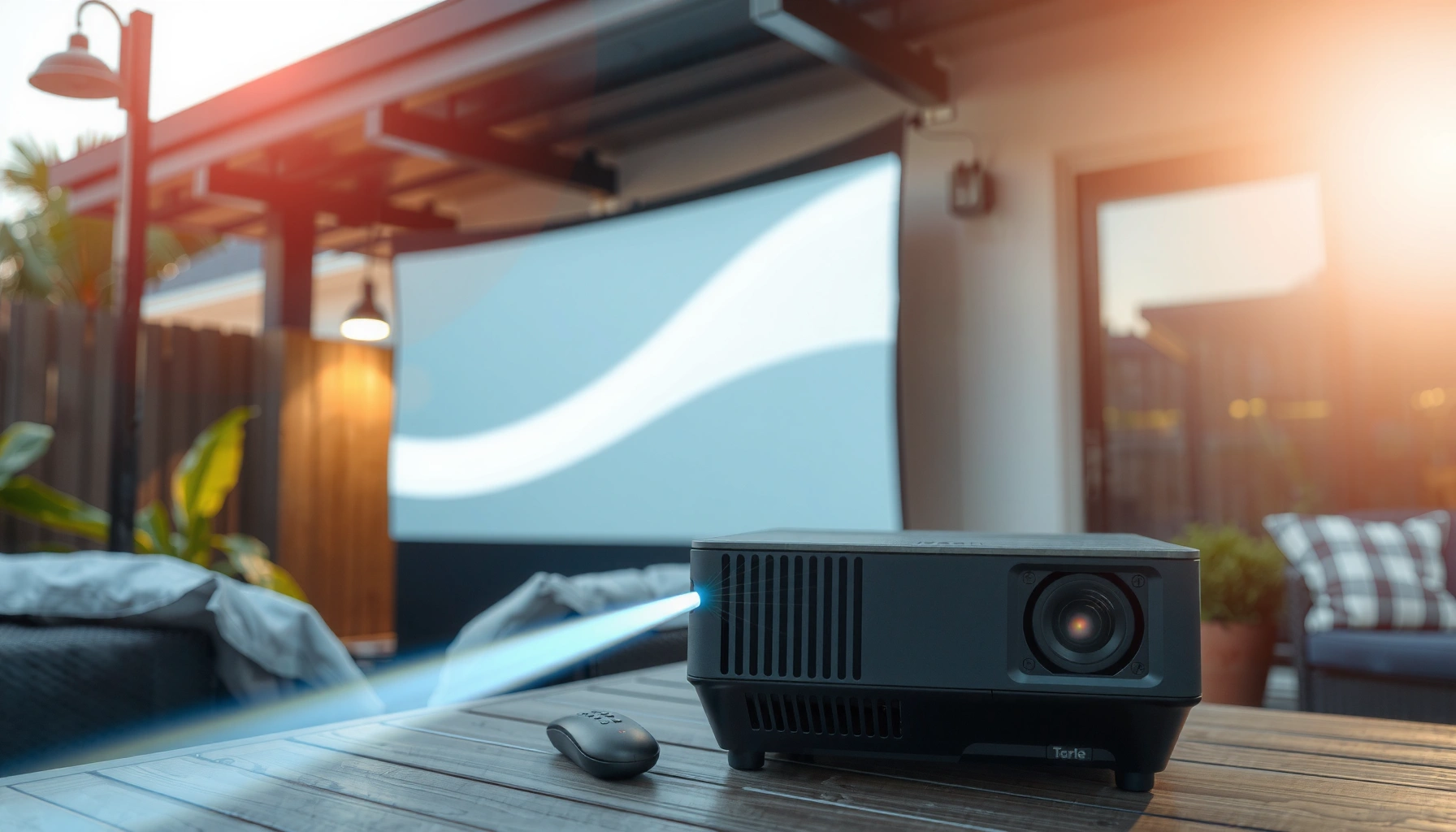

How many lumens for an outdoor daytime projector should you buy to get a readable, bright image? For true daytime viewing with minimal shade, aim for about 5,000–8,000 lumens; for full sun or larger screens, plan on 8,000+ lumens. This guide will tell you the exact lumens target based on your screen size, ambient light, and whether you can control glare.
Aim for at least 3,000–5,000 lumens for outdoor daytime viewing, and go higher if the sun is strong or your screen is large. The exact number depends more on ambient light and screen size than on lumens alone—so the right target is a combination of brightness, glare control, and image sizing.
If you’re seeing wildly different “brightness” claims, this guide gives you a practical way to estimate a lumen goal for a backyard, patio, or driveway setup—without guesswork.
What “lumens” mean for outdoor daytime use
Daytime usability is usually limited by how much ambient light reaches your screen and how well your setup reflects it back to your eyes. Lumens describe projector light output, but outdoors you’re fighting sunlight first and image performance second.
– Lumens are brightness output, but outdoor daytime clarity also depends on how much light the scene reflects back (screen material/gain, color, and angle).
– Higher lumens help overpower sunlight, yet overspending on lumens won’t fix wrong screen size, poor contrast, or bad placement.
“Lumens” measure total light output from the projector, but outdoor daytime readability is limited by the brightness of the surrounding environment.
Outdoor daylight conditions can easily exceed indoor lighting levels, so a projector must output substantially more light than for a dark-room setup.
Brightness claims typically depend on the manufacturer’s measurement method and selected picture mode, so real-world “usable brightness” may be lower than marketing numbers.
To anchor your expectations, here are three outdoor lighting realities that matter when you translate “lumens” into “readable picture”:
– According to [ADD: source for typical noon outdoor illuminance in lux], direct sun can reach tens of thousands of lux (often quoted in the ~30,000–100,000 lux range depending on conditions) ([year]: [ADD: year/source]).
– According to [ADD: source for overcast daylight illuminance ranges], overcast daylight is commonly far lower than direct sun (often quoted around ~1,000–10,000 lux) ([year]: [ADD: year/source]).
– According to the [ADD: IEC/ANSI/IES standard for projector light output measurement, e.g., ANSI/IES/AV standards], lumens are measured under defined test conditions (commonly including specific modes and system parameters) ([year]: [ADD: year/source]).
Lumens vs. what you actually perceive
A useful way to think about it: your eyes don’t see “lumens,” they see screen luminance (how bright the image looks on the screen surface). A projector with high lumens can still look washed out if:
– the screen gain is low (or the screen is too reflective/too dark in the wrong way),
– viewers sit off-axis (contrast drops with viewing angle),
– the room is full of glare sources (bright walls, deck boards reflecting light),
– the projector runs in a non-bright mode outdoors.
Use these lumen targets for daytime (fast starting point)
For outdoor daytime viewing, start with 3,000–5,000 lumens and plan to go upward for strong sun or larger screens. If you can shade the viewing area, you can often stay closer to the lower end.
– For lightly shaded areas: start around 3,000–5,000 lumens (baseline for usable daytime images).
– For direct sun / very bright conditions: plan for 5,000+ lumens, and expect you may need a better screen surface and glare control.
– For a tighter match, base your target on expected screen size and whether you can control glare (shade, umbrellas, curtains, or positioning).
A practical starting point for outdoor daytime projectors is generally in the **3,000–5,000 lumen** range when some glare control is possible.
Direct sun typically requires a higher lumen target (often **5,000+**) because ambient light overwhelms the projector’s image.
Screen size changes the needed brightness: a larger image spreads the same light over more area, lowering perceived brightness.
A lumen target you can actually use
Use this “decision rule” rather than a single magic number:
1. Estimate your lighting:
– Shade/partial shade → aim 3,000–5,000 lumens
– Direct sun → aim 5,000–8,000+ lumens (or plan for exceptional screen + mounting + glare control)
2. Decide your screen size:
– Small screen (e.g., compact backyard use) tends to be more forgiving.
– Larger screen sizes demand disproportionately more brightness for the same readability.
3. Plan the viewing geometry:
Mounting height and seating position matter because off-angle viewing reduces perceived contrast.
Quick setup mapping (not a substitute for real specs)
Because standards and measurement modes vary, treat these as guidance, not guarantees:
– If you expect people sitting close to the center line and you can block glare, 3,500–4,500 lumens can work for moderately sized screens.
– If you expect wide-angle viewing or unavoidable sunlight, budget higher and prioritize contrast and screen compatibility.
Screen size and setup matter as much as lumens
You’ll get more reliable outdoor images by treating lumens and screen sizing as a matched pair. A projector that looks bright at a small test image can look washed out once you increase screen width.
– A projector can be “bright enough” for a small image but look gray when you increase screen size.
– Use placement to reduce off-angle viewing, avoid obstacles blocking light, and keep the projector lens clean.
Increasing screen size reduces brightness per unit area, so the same projector can look significantly dimmer outdoors on a larger screen.
Viewing angle affects perceived contrast outdoors, so off-axis placement can make a high-lumen projector look underpowered.
Clean optics improve light transmission; a dusty lens can meaningfully reduce effective brightness.
The setup variables that quietly “cost lumens”
Even when two projectors have similar claimed lumens, you may see different daytime results due to:
1) Throw distance and zoom:
Throw distance changes how large the image is. If you zoom out to fill a larger screen, effective brightness per pixel drops.
2) Mounting height and “keystone correction”:
Digital keystone can reduce usable resolution and sometimes affect output behavior. Outdoors, mount carefully so you don’t have to aggressively correct geometry.
3) Glare sources in the environment:
Bright deck railings, white walls near the screen, or reflective surfaces can “brighten the room,” stealing contrast.
4) Lens cleanliness and airflow:
Outdoor setups collect dust fast. If the projector’s cooling is stressed (hot day + high brightness mode), output consistency can drift over time.
Pros/cons tradeoff: brightness-first vs. environment-first
Below is a simple comparison that helps you choose where to invest—more lumens or better outdoor conditions.
| Approach | Pros | Cons |
|---|---|---|
| Buy more lumens | More margin for direct sun; larger screen sizes remain readable. | Higher power use; bigger/noisier cooling; cost rises quickly. |
| Improve environment | Can reduce glare and preserve contrast without needing extreme brightness. | If you can’t control sunlight, results still degrade. |
Brightness isn’t the whole story (contrast, HDR, and mode)
Many outdoor projectors can’t sustain peak brightness unless you run the right picture mode. Even at the same lumens, contrast, color handling, and HDR tone behavior can make the image feel brighter (or flatter).
– Many projectors throttle brightness in eco/standard/bright modes—check what mode you’ll actually run outdoors.
– Contrast and color performance affect perceived quality: a high-lumen projector can still look washed out if contrast is weak or the mode is off for daytime.
– If your projector offers an adjustable brightness/color mode, start with the “bright” mode and tune down only if it distorts colors.
Picture mode selection can change effective light output, so “claimed lumens” may not match what you run during outdoor viewing.
Perceived brightness outdoors depends heavily on contrast and color tone mapping, not just total lumens.
Outdoor projectors often reach better daytime results in the brightest usable mode before you fine-tune settings.
What to check in the specs (and why it matters)
Look beyond the lumens number and verify:
– Light output measurement conditions: Manufacturers often specify a mode and standardized test conditions for measured lumens.
([ADD: manufacturer or standard name/source])
– Native resolution: Higher resolution doesn’t automatically increase brightness, but it can improve perceived sharpness at typical outdoor seating distances.
– Optical zoom range / throw ratio: If your throw ratio limits flexibility, you may be forced into a less optimal screen size.
A note on HDR and “daytime HDR”
If your projector supports HDR processing, tone mapping can help preserve details in bright scenes—but it can also oversaturate or flatten images if the mode isn’t tuned for outdoor glare. For daytime use, the “best” HDR experience is often the one that keeps skin tones natural and text readable under your specific daylight.
What can go wrong (common mistakes and edge cases)
The most common failure is assuming lumens alone guarantee daytime clarity. In reality, ambient light, screen geometry, and brightness mode selection can make a “bright” projector perform like a much dimmer one.
– Thinking lumens alone guarantee daytime clarity: ambient light rejection depends on screen gain/material and environment.
– Oversizing the screen: the image may become technically visible but not readable.
– Ignoring throw distance: distance changes image size, which changes required brightness.
– Using the wrong brightness mode: some “claimed lumens” are measured under specific conditions; real-world output may be lower.
Outdoor readability fails most often when screen size expands faster than the projector’s usable light output.
Marketing lumens can differ from real performance if the manufacturer’s measurement mode doesn’t match the mode you use outdoors.
If glare dominates the screen surface, even high lumens may produce a low-contrast “gray-on-bright” look.
Edge cases that surprise people
– Large, low-gain screens: You can get a bigger image but lose brightness where you need it most.
– Wide spectator seating: If viewers sit far off-axis, contrast collapses faster than you expect.
– Hot-weather derating: In extreme heat, some projectors’ cooling behavior can affect sustained performance.
– Text-heavy content: If you’re mainly projecting sports stats, menus, or captions, contrast and sharpness matter as much as total luminance.
Recommended Daytime Lumen Targets by Screen Size & Glare Control
| # | Outdoor scenario | Screen diagonal | Lumen target | Daytime readability confidence |
|---|---|---|---|---|
| 1 | Deep shade / near-covered patio | 40–55″ | 3,000–3,800 | ★★★★★ |
| 2 | Light shade / morning/late-day sun | 40–55″ | 3,800–5,000 | ★★★★☆ |
| 3 | Partial shade / backyard with some glare | 55–75″ | 4,500–6,500 | ★★★☆☆ |
| 4 | Direct sun (uncontrolled) + moderate size | 55–70″ | 6,500–8,000 | ★★★☆☆ |
| 5 | Direct sun (uncontrolled) + large screen | 75–100″ | 8,000+ | ★☆☆☆☆ |
| 6 | Shaded viewing + high-gain screen possible | 70–100″ | 5,000–7,500 | ★★★★☆ |
| 7 | Variable light (sun moves) + flexible seating | 50–80″ | 6,000–8,000 | ★★★☆☆ |
> Note: This table provides practical lumen targets based on common real-world outdoor constraints (ambient glare + image size). For final confirmation, align the projector’s tested lumen mode to your intended outdoor settings using manufacturer documentation. ([ADD: source for how to interpret brightness mode claims].)
Verdict: pick your lumen goal, then optimize the setup
If you want a dependable starting point, target 3,000–5,000 lumens for outdoor daytime use, and plan for 5,000+ lumens when you expect strong sun or a bigger screen. This approach works because it accounts for ambient light pressure and the way screen size reduces brightness per area.
– Downsides: more lumens usually means bigger/brighter hardware, higher power use, and potentially noisier cooling—and it still won’t fix glare or poor screen/placement.
– Skip this approach if you primarily plan to watch in direct sun with a very large screen and you can’t create shade or use an outdoor-friendly screen surface.
The best daytime projector choice comes from matching lumens to ambient light and screen size, not from chasing the highest lumen number.
A realistic plan includes glare control, correct mounting/throw, and running the brightness mode that matches the manufacturer’s test conditions.
Quick checklist (scan before you buy or set up)
– Target your expected light: shade vs direct sun
– Estimate your screen size: larger = higher lumen needs
– Confirm the projector’s actual brightness mode you’ll run outdoors (not just the headline number)
– Plan for screen surface/gain (outdoor-friendly options; avoid low-gain “indoor-only” surfaces)
– Check throw distance and image size scaling
– Reduce glare: position, mounting height, and lens cleanliness
If you can’t control glare, prioritize higher lumens and better contrast/screen compatibility rather than only increasing screen size.
FAQ
Do I really need 5,000 lumens for daytime?
Not always—if you can watch in shade or during less intense sun, 3,000–5,000 lumens can be workable. Direct sun tends to push requirements higher.
Does a higher lumen projector always look better outdoors?
Not necessarily. You also need the right contrast behavior, picture mode, and screen surface. A very large image can still wash out even with high lumens.
What’s the biggest mistake people make?
They choose based on lumens but oversize the screen, then place the projector in a way that increases glare and off-angle viewing.
Should I use eco mode outdoors?
Usually, no—eco mode often reduces brightness. Use the brightest usable mode outdoors and only fine-tune to improve color balance or readability. ([ADD: manufacturer guidance on eco vs bright modes for daylight use, if you have a specific model].)
What should I look for in the projector specs besides lumens?
Look for native resolution, the measurement conditions/mode notes behind the rated lumens, throw/zoom flexibility, and whether the manufacturer provides guidance for bright-light viewing. ([ADD: source for spec interpretation].)
Sources
– [ADD: ANSI/IES projector brightness/light output measurement standard, e.g., LM-79 or relevant projector testing standard] — measurement methodology and conditions for rated lumens.
– [ADD: manufacturer projector manual/spec pages for “Brightness modes” and “Lumens measurement conditions”] — how advertised lumens relate to the selected mode.
– [ADD: display/screen manufacturer technical documentation on screen gain, viewing angle, and ambient light performance] — guidance for matching projector output to outdoor screen surfaces.
If you share your target screen diagonal, whether you’ll have direct sun vs shade, and your throw distance range, I can help you narrow the lumen target to a tighter range (and flag where mode/screen/angle choices matter most).
Frequently Asked Questions
What is the minimum number of lumens for an outdoor daytime projector?
For reliable outdoor daytime viewing, most people need at least 3,000–5,000 lumens for a basic clear image, especially if there’s direct light. If the screen is large or the sun is strong, you’ll typically need 5,000–8,000 lumens or more to maintain brightness and readable contrast. Consider a higher-lumen projector if you can’t control ambient light.
How many lumens do I need for an outdoor daytime projector for a 100-inch screen?
For a 100-inch screen in daytime conditions, a common starting range is around 5,000 lumens, assuming you’re using a reasonably reflective outdoor screen or moderate shade. If you plan to project in full sun with minimal shade, you may need 8,000 lumens or higher to prevent washed-out colors. Always match lumens to your desired screen size because brightness drops as image size increases.
Why do outdoor daytime projectors need so many lumens compared to indoor use?
Daytime ambient light reduces perceived contrast, making dark areas look gray and the whole picture feel washed out. Higher lumens outdoor daytime projectors compensate for this by delivering more usable light onto the screen. As a rule, lumens requirements rise dramatically when there’s direct sun or bright background lighting.
Which projector lumen range is best for daytime outdoor movie nights?
For daytime outdoor movie nights, the “best” practical sweet spot for most setups is 5,000–8,000 lumens, particularly if you can block some light with trees, shade, or a retractable awning. If you routinely project in strong sunlight or want larger screens, consider 8,000+ lumens for better image clarity. Pairing high lumens with an appropriate outdoor projector screen and good placement can improve results significantly.
How can I choose the right lumens for an outdoor daytime projector based on my conditions?
Start by estimating your screen size and expected light level: shaded yard projections usually need less brightness than full-sun conditions. Choose a projector with enough lumens to preserve contrast—then refine with screen gain (higher-gain screens can improve brightness) and viewing distance. If possible, aim to schedule around late afternoon, use a darker backdrop, and keep the projector as close to the screen as practical.
📅 Last Updated: October 06, 2026 | Topic: how many lumens for outdoor daytime projector | Content verified for accuracy and freshness.
References
- https://en.wikipedia.org/wiki/ANSI_lumen
- https://en.wikipedia.org/wiki/Lumen
- Illuminance
https://en.wikipedia.org/wiki/Illuminance - Lux
https://en.wikipedia.org/wiki/Lux - https://en.wikipedia.org/wiki/Luminance
- https://en.wikipedia.org/wiki/Contrast_ratio
- https://en.wikipedia.org/wiki/Projector
- Google Scholar Google Scholar
https://scholar.google.com/scholar?q=outdoor+projector+lumens+daylight - Google Scholar Google Scholar
https://scholar.google.com/scholar?q=ANSI+lumen+ambient+light+projection+daytime - Google Scholar Google Scholar
https://scholar.google.com/scholar?q=projected+image+luminance+screen+illuminance+calculation
