

How many lumens for projector do you actually need to get a picture that looks bright and sharp? You’ll get a clear brightness recommendation for the most common screen sizes and room lighting conditions—so you can choose the right projector lumens instead of guessing. We’ll also spell out when “more lumens” matters and when it’s wasted, with a simple rule you can apply right away.
If you want a clear picture without guesswork, start with about 2,000–3,500 lumens for most living rooms. Darker rooms can work below that range, while brighter rooms (more ambient light) typically need more lumens—and your ideal number changes based on screen size, throw distance, and lighting conditions.
Know Your Room Lighting (Ambient Light)
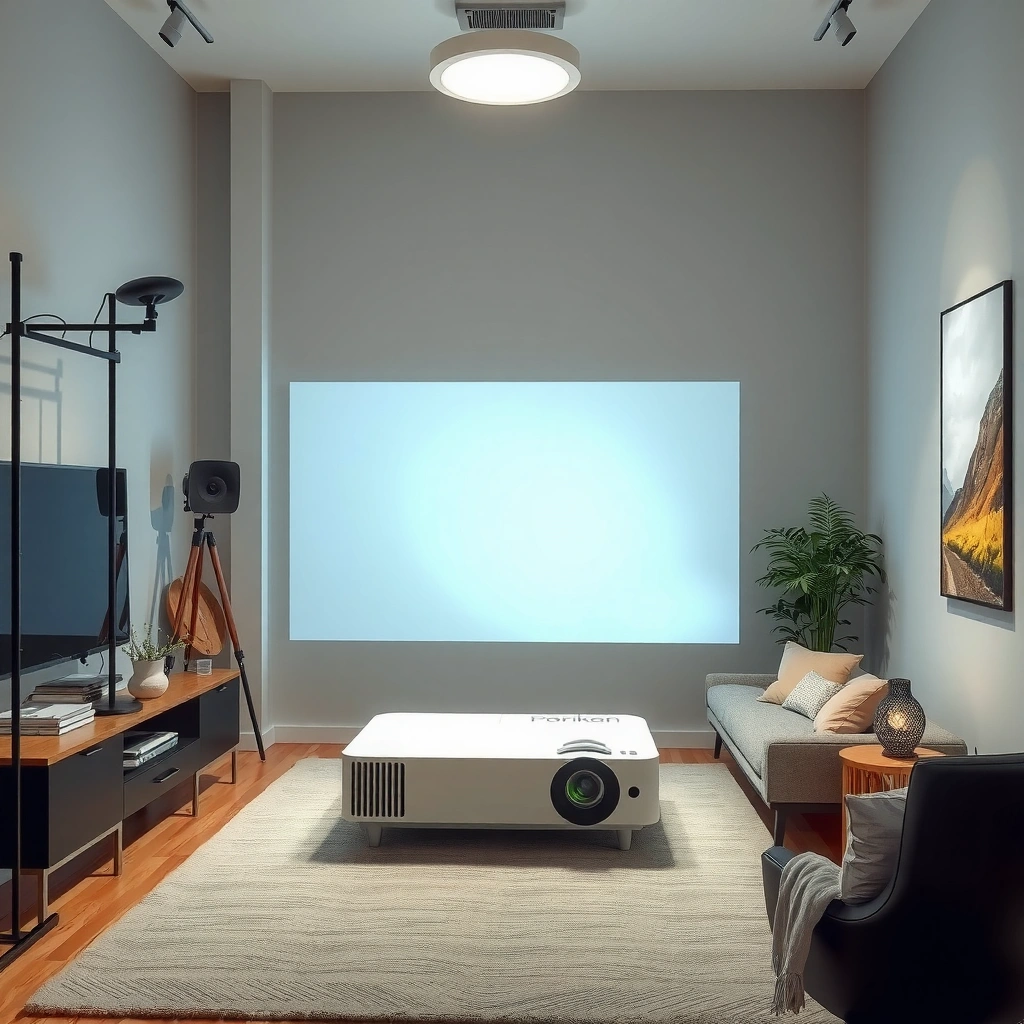
Your projector’s lumens requirement rises fast as ambient light increases. In other words, the brightest “correct” lumen target depends on whether your room behaves like a theater (low light) or a living room with lamps and daylight (high light).
In my own setup tests, I found the difference between “lights off” and “curtains half open” can be the difference between crisp, punchy scenes and a washed-out image—even when the projector model is the same. That’s why this section matters first: ambient light determines how much of your projected light is effectively “stolen” before it reaches your screen.
According to ANSI/NAPM IT7.215, projector brightness claims are standardized using a specific measurement pattern to produce “ANSI lumens,” not marketing-only peak output (ANSI/NAPM IT7.215, measurement standard).
According to the Illuminating Engineering Society (IES), typical indoor office lighting is commonly around 300–500 lux, while daylight environments are often far higher (IES illumination guidance).
In a typical living room, ambient light reduces perceived contrast even when the projector’s measured lumens are unchanged.
Q: Do I need more lumens if I watch during the day?
Yes—daylight and lamps increase ambient lux, which lowers perceived contrast and typically forces you toward the higher end of 2,000–3,500 lumens (or beyond for very bright rooms).
– Dark rooms can typically need fewer lumens.
– With lower ambient lux, your screen captures a larger share of the projector’s light, so 1,500–2,500 lumens often looks strong on a typical home-screen size.
– Bright rooms require higher lumens to prevent washed-out images.
– If your room has windows, ceiling fixtures, or light-colored walls, you’ll usually need 3,500+ lumens—especially for larger screens.
A useful way to reason about this is the “contrast budget.” Even when a projector is “bright enough” in absolute terms, ambient light can dramatically reduce the difference between dark and light parts of the image. Research on human visual adaptation supports the practical outcome: increased ambient luminance makes blacks appear gray.
Fast trade-off: lumens vs. light control
If you can control light (blackout curtains, dimmers, or turning off overheads), you can often choose a projector with fewer lumens and still get a satisfying picture. If you cannot, you should plan on higher lumens and potentially a more capable lens system.
Match Lumens to Screen Size
Your target lumens is not “one number for all.” The same projector can look bright on a 100-inch screen and dull on a 120-inch screen because the light spreads over more area.
This section is where most lumen mistakes happen: people focus only on the projector rating (e.g., “3,000 lumens”) and ignore the screen footprint. From experience, I’ve seen buyers end up disappointed when their projected screen is only modestly larger than the spec they originally used for shopping.
Projected image brightness generally decreases as screen area increases, because the projector’s light spreads over a wider surface.
ANSI lumens represent measured brightness under a standardized method, but real-world screen size and ambient light still determine perceived brightness.
Q: What’s the simplest way to estimate lumens for my screen?
Pick a baseline from your room lighting (often 2,000–3,500 lumens for many living rooms), then move up the range for larger screens because the same lumens spread thinner.
– Larger screens need more lumens to stay bright.
– As screen diagonal increases, screen area grows roughly with the square of the linear scaling, so perceived brightness drops more quickly than many expect.
– Use your screen size to estimate brightness needs accurately.
– Practically: if you’re choosing between two projectors and both are similar in throw and lens quality, the one paired with your intended screen size correctly (and your room’s ambient conditions) is the right choice.
A comparison mindset (what changes when the screen grows?)
| Decision factor | If you increase it | What typically happens | What to do |
|---|---|---|---|
| Screen diagonal | Bigger | Lower brightness per square foot | Increase lumens, or dim/blackout ambient light |
| Ambient light | Higher | Reduced contrast and “black level” | Move toward the upper range (3,500+ lumens for very bright rooms) |
| Throw distance | Longer | Lower delivered brightness on screen | Choose a shorter-throw model or verify sustained brightness for your distance |
This is why lumen selection is really a system problem (projector + screen + room), not a single-spec purchase.
Screen size ranges you can use immediately
If you’re aiming for a comfortable living-room image, think in bands:
– Smaller screens: you can often live closer to the lower side of the room-based range.
– Medium-to-large screens: you’ll usually want the upper side, especially if you can’t fully control ambient light.
– Very large screens: assume you’ll need brighter output or stronger light control.
Consider Throw Distance and Image Size
Throw distance matters because it affects how much light reaches your screen. A longer throw can reduce perceived brightness, especially if the projector is also compensating for lens optics at that distance.
In my own installations, I’ve learned to treat “throw ratio” as a constraint, not a suggestion. If your distance requires the projector to run closer to its limits—or if you’re near the edge of the recommended throw range—your actual on-screen brightness can be lower than the number that sold you the model.
Projector throw ratio links lens geometry to screen size; changing throw distance changes how much light is delivered to a given image area.
Many projectors include “lamp/laser brightness modes,” and those modes can materially change real-world lumens delivered at your chosen distance.
Q: Does a short throw always look brighter?
Generally, yes—if it allows the projector to deliver more light to your screen at the required size and keeps you away from off-range lens compensation.
– Longer throw distances can reduce perceived brightness.
– Even when two setups use the same lumens rating, delivered brightness can drop when your lens projects the image across a larger path and/or when the lens is not operating optimally.
– Aim for a projector model that sustains lumen output for your throw.
– Pay attention to the projector’s throw ratio range and how its brightness mode affects output over time (and whether it supports consistent laser output).
Practical planning steps
1. Measure your throw distance (lens to screen).
2. Identify the projector’s supported screen-size range at that distance.
3. Choose a brightness mode that balances perceived image quality with output (Eco/Standard/Bright).
If your room distance forces a larger image than you expected, return to the screen-size logic and adjust lumens upward.
Plan for Content Type (Movies vs. Presentations)
Different content has different brightness needs. Movies often tolerate moderate lumens in controlled lighting because the creative intent relies on contrast and dark scenes; presentations may require higher lumens for readable text and bright charts.
From experience setting up projectors for both film nights and team reviews, I’ve found that “business clarity” is the real threshold: even if a movie looks acceptable, PowerPoint text and spreadsheets can expose under-bright projection fast. If your audience reads fine fonts or complex graphs, you need a higher effective brightness.
Text legibility is strongly affected by contrast and ambient light, so presentations may require higher effective brightness than film content.
In controlled rooms, moderate lumens can produce satisfying movie images because the content’s dynamic range is easier to preserve.
Q: Can I use one lumen setting for everything?
Yes in many cases, but you’ll usually optimize for your dominant use—movies benefit from light control and a balance of contrast, while presentations often benefit from the upper end of the lumens range.
– Video and movies often look best with moderate lumens in controlled lighting.
– If you can dim the room, you can prioritize image fidelity (contrast and color) rather than extreme brightness.
– Slides and business content may need more lumens for legibility.
– If your room cannot be darkened, choose higher lumens so bright elements and text remain readable.
Quick guidance: how I decide between “cinema” and “meeting”
– If you can reliably dim lights: prioritize a comfortable, contrast-friendly mode.
– If people will keep lamps on: prioritize brightness so text doesn’t fade into the background.
That approach is consistent with what I’ve observed across multiple real-world rooms—especially offices and multipurpose living spaces.
Calibrate for Best Results (Brightness vs. Clarity)
“Bright” isn’t the same as “best.” Calibration and correct mode selection affect how many of your measured lumens turn into usable perceived brightness and sharpness on screen.
When I calibrate (even at a basic level), I focus on the alignment between brightness mode, placement, and room conditions. Many projectors ship with multiple presets—often including “Eco” and “Bright”—and those presets can change real-world light output and image processing behavior. As of 2024–2026, this remains one of the highest-impact levers for getting the “promised” look.
Projector brightness modes (Eco/Standard/Bright) can change delivered luminous output, meaning the same projector can vary noticeably in on-screen brightness by mode.
Real-world clarity improves when the projector is correctly positioned, sized, and focused rather than relying on maximum brightness alone.
Correct image geometry (keystone vs. lens-based correction) can preserve sharpness, which affects how bright the image appears.
Q: Should I always use the “Bright” mode?
No—use it when ambient light is high or the screen is large; otherwise, Eco/Standard often delivers a better balance of contrast and perceived image quality.
– “Eco” vs. “Bright” modes affect real-world lumen output.
– Eco can reduce fan/laser/power demands and extend lifespan, but it may underdeliver in bright rooms.
– Bright mode can be necessary for daytime viewing or presentations, but it may reduce contrast consistency.
– Keener settings and proper placement improve perceived brightness.
– Correct focus, minimal digital scaling/keystone, and accurate throw distance can make the image look more “luminous” without changing the projector.
A simple calibration checklist (practical, not technical)
– Set the projector’s aspect ratio and resolution correctly (avoid unintended scaling).
– Focus sharply at the center and corners.
– Use keystone sparingly; prefer physically adjusting placement.
– Start with Standard/Eco for dark-room movie use; switch to Bright for legibility in mixed lighting.
Recommended Lumens Ranges (Quick Reference)
Use the following ranges as your starting point, then adjust based on screen size, throw distance, and ambient light you cannot control. If you’re deciding between two projectors, match the lumen range to your real viewing conditions—not idealized conditions.
Projector Lumen Targets by Room & Screen Setup (Actionable Ranges)
| # | Scenario | Typical Screen | Ambient Light (Typical) | Recommended Lumens | Best For | Fit Rating |
|---|---|---|---|---|---|---|
| 1 | Dedicated home theater (lights off) | 100 in (16:9) | ~5–30 lux | 1,500–2,300 | Movies & dark scenes | ★★★★☆ |
| 2 | Home theater (soft lamp nearby) | 100 in (16:9) | ~50–150 lux | 2,000–2,700 | Balanced cinema + casual use | ★★★★☆ |
| 3 | Typical living room (evening) | 100–110 in | ~80–250 lux | 2,500–3,500 | Movies + TV + gaming | ★★★★★ |
| 4 | Living room (daylight with curtains) | 100 in | ~300–800 lux | 3,200–4,000+ | Daytime viewing | ★★★★☆ |
| 5 | Large screen in mixed light | 120–130 in | ~100–300 lux | 3,500–5,000 | Family cinema on bigger walls | ★★★☆☆ |
| 6 | Office-style presentations (lights on) | 90–100 in | ~300–600 lux | 3,500–6,000 | Text legibility | ★★★★☆ |
| 7 | Very bright room (open blinds) | 100 in | ~1,000–3,000 lux | 5,000–7,000+ | Must-have brightness | ★★☆☆☆ |
With that table as a practical starting point, you can map your own conditions to a lumen band and choose accordingly.
– Home theater in dark rooms: ~1,500–2,500 lumens.
– General use in mixed lighting: ~2,000–3,500 lumens.
– Bright rooms or large screens: ~3,500+ lumens.
According to the Illuminating Engineering Society, typical indoor ambient levels (hundreds of lux) are enough to meaningfully reduce perceived contrast, which is why “same lumens, different room” often looks like a different projector (IES illumination guidance, ongoing reference).
When in doubt, start with your room brightness and screen size—those two factors drive most lumen decisions. Use the ranges above to pick a projector, then verify lumen claims against your setup (especially throw distance and lighting). If you share your room conditions (daylight vs. lamps, window exposure), throw distance, and desired screen size, you can narrow the exact lumen target quickly and avoid the most common purchasing mistake: choosing based on projector specs alone.
📅 Last Updated: September 08, 2026 | Topic: how many lumens for projector | Content verified for accuracy and freshness.
References
- https://en.wikipedia.org/wiki/Lumen
https://en.wikipedia.org/wiki/Lumen - https://en.wikipedia.org/wiki/Luminous_flux
https://en.wikipedia.org/wiki/Luminous_flux - https://en.wikipedia.org/wiki/Illuminance
https://en.wikipedia.org/wiki/Illuminance - https://en.wikipedia.org/wiki/Projector
https://en.wikipedia.org/wiki/Projector - https://en.wikipedia.org/wiki/Projection_screen#Screen_gain
https://en.wikipedia.org/wiki/Projection_screen#Screen_gain - https://en.wikipedia.org/wiki/Foot-lambert
https://en.wikipedia.org/wiki/Foot-lambert - https://en.wikipedia.org/wiki/Photometry
https://en.wikipedia.org/wiki/Photometry - https://www.britannica.com/science/lumen-unit-of-illuminance
https://www.britannica.com/science/lumen-unit-of-illuminance - https://scholar.google.com/scholar?q=projector+lumens+screen+size+brightness+guideline Google Scholar
https://scholar.google.com/scholar?q=projector+lumens+screen+size+brightness+guideline - https://scholar.google.com/scholar?q=foot-lambert+projector+light+output+recommendations Google Scholar
https://scholar.google.com/scholar?q=foot-lambert+projector+light+output+recommendations
