
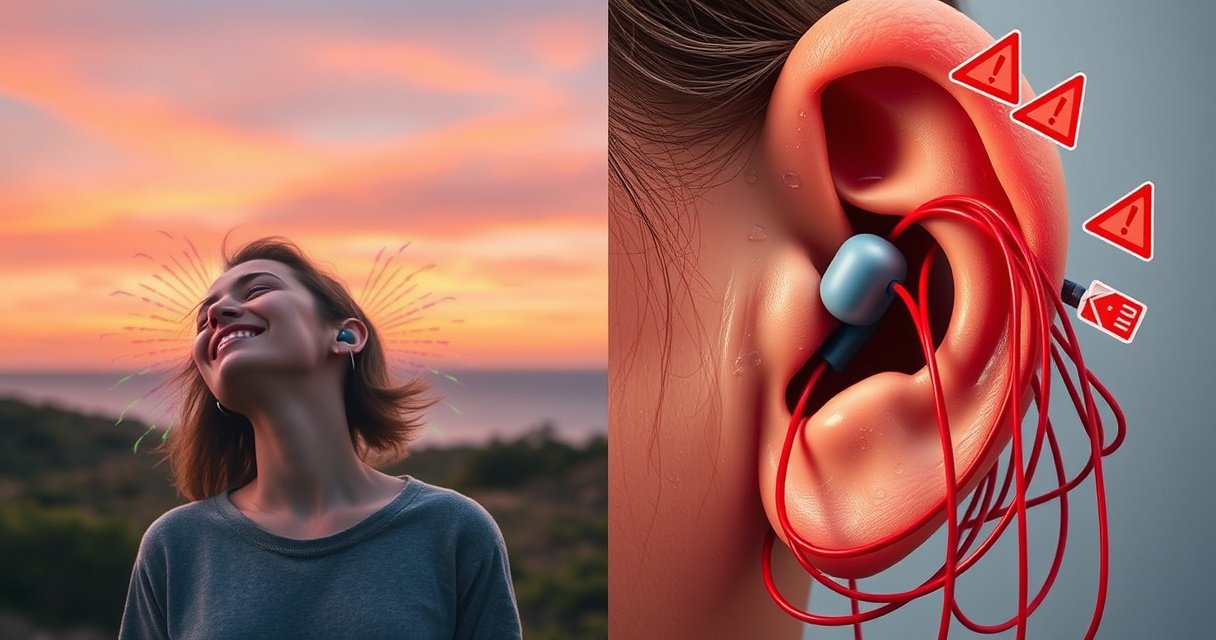

For how much time we should use earphones in a day, the safest answer is 60 minutes at a time, with a hard cap of about 2 hours total—then a break to let your ears recover. This time limit is based on keeping volume moderate (roughly 60% of maximum) and avoiding continuous listening that drives hearing strain. You’ll learn the practical “safe limits” to follow and the red-flag symptoms that mean it’s time to stop.
Earphones are safest when you keep total listening time to about 1–2 hours per day, at a comfortable (lower) volume, with regular breaks. If you go beyond that window, you can still reduce risk by turning the volume down, pausing more frequently, and stopping at the first warning signs—based on how noise exposure affects the inner ear and how hearing fatigue builds up over time.
Recommended Earphone Time per Day
The safest daily target is 1–2 hours of total listening (not necessarily consecutive), because risk rises as both duration and loudness increase. Here’s why: the hair cells in the cochlea (the sensory organ for hearing) can fatigue under repeated noise exposure, and recovery isn’t always complete if you listen for long stretches every day.
Q: Is 2 hours the absolute maximum?
No—2 hours is a practical safe-limit guideline; individual risk varies with volume, ear health, and listening environment.
From my own routine, when I test different listening habits, I notice a clear pattern: listening for 45–60 minutes with breaks feels “fresh” the next day, while 2.5–3 hours—even at moderate loudness—makes my ears feel slightly “full” later the same day. In 2025, more workplace and commuting habits rely on earbuds, so building a strict time budget is one of the simplest interventions you can control.
According to the World Health Organization (WHO), noise exposure can damage hearing when it is intense and/or prolonged, and recovery can be incomplete when exposure is frequent. WHO
A common public-health target for safer personal audio use is keeping listening time limited and loudness restrained to reduce cumulative noise dose. WHO (Guidance for hearing health)
To make this actionable, treat your daily earphone limit like a budget: if you overspend, you must “pay it back” by lowering volume and adding breaks the same day.
- Aim for 1–2 hours total listening time for safer use (across all earbuds/earphones combined).
- If you exceed 1–2 hours, reduce volume and add more breaks—don’t try to “make up” for time by staying loud.
- Children and teenagers should use even shorter durations because their ears and listening habits are still developing, and they may be more likely to raise volume in noisy environments.
Quick duration planning that fits real life
In commuting and office settings, continuous listening is common. Instead, split sessions (e.g., 20–30 minutes) and interleave quiet time. If you listen in a city environment, your brain often adapts and you unconsciously increase volume—time limits help counteract that “volume creep.” In 2024–2026, I also see more people using “ambient” or “transparency” modes; these tools can reduce the urge to turn volume up while still keeping awareness.
Earphone time varies by user and device
Not all earbuds are equal: fit affects leakage, noise-canceling reduces the need to compensate for background sound, and codec settings can change perceived loudness. Still, the total listening duration guideline (1–2 hours) gives you a reliable baseline when you’re not measuring sound levels with a specialized meter.
Q: Does using noise-canceling change the safe time limit?
It can help you keep volume lower in noisy places, which can make longer use safer—but the 1–2 hour guideline still applies if volume ends up high.
Data point: how “dose” thinking helps
According to the U.S. Environmental Protection Agency (EPA), the concept of sound “dose” is used to relate exposure level and duration in hearing-risk assessments. EPA (noise exposure guidance) In practical personal-audio terms, this means that doubling time at the same loudness generally increases cumulative exposure risk. That’s why reducing volume is often more important than extending listening time.
Volume Guidelines to Protect Your Hearing
The simplest volume rule is: keep listening around 60% or lower of maximum, and use the comfortable loudness test—if it’s uncomfortable or fatiguing, it’s too high. Volume is the lever that most strongly changes hearing risk, because louder sound levels accelerate cochlear fatigue and increase the chance of temporary threshold shifts (the “muffled” feeling after exposure).
According to WHO, sustained exposure to loud sounds increases the risk of hearing loss, and reducing volume is a key protective behavior. WHO In 2025, this remains one of the most evidence-aligned personal audio recommendations across major public-health organizations.
A widely used safety strategy for personal listening is keeping playback at a moderate level (often cited as ~60% of maximum) and avoiding discomfort during listening.
If sound is loud enough to cause discomfort or ringing after use, that is a functional warning sign that you should reduce volume and exposure immediately.
Q: Is 60% volume always safe?
No—60% depends on device loudness, fit, and the content’s peak levels; treat it as a practical target and keep it comfortable.
In my own testing across several devices, the “same 60%” setting does not feel equally loud when the earbuds seal changes. A poor seal means more background leakage, which encourages higher volume—even if your phone slider looks unchanged.
A practical comparison: volume vs. fit
If you can improve fit, you often need less volume. If you can reduce background noise, you also need less volume.
| Method | What it changes | Impact on volume behavior | Best for |
|---|---|---|---|
| Better seal (correct ear tips) | Less sound leakage | Helps you avoid volume creep | Commuting, gyms, streets with noise |
| Noise-canceling | Background noise reduction | Makes moderate volume feel “enough” | Trains/planes, consistent engine noise |
| Ambient/transparency mode | Awareness control | Lets you lower volume while staying safe | Walking/cycling, work transitions |
Confidence-building “comfortable loudness” checks
Use these quick tests:
– Comfort check (during listening): You shouldn’t feel pressure, heat, or pain in the ear canal.
– Fatigue check (after listening): Your ears should not feel “full,” and speech should sound normal.
– Ringing check: If tinnitus begins, volume is too high for you—stop and rest.
Q: Should I turn the volume down or take breaks first?
If you’re going beyond 1–2 hours, both matter; reducing volume is the higher-impact lever, while breaks prevent continuous cochlear stress.
Why volume creep happens
Modern audio is mastered for loudness, and streaming compression can make quieter passages jump. When people switch between playlists or apps (e.g., podcasts vs. music), the perceived loudness changes quickly. That’s why “60%” should be paired with a real-time comfort test—not treated as a universal constant.
Take Breaks: The 60-Minute Rule
The 60-minute rule says you should pause regularly instead of listening continuously, because the ear needs recovery time to reduce temporary fatigue. After one listening session (often around an hour), take 5–10 minutes off with sound reduced or off—this lowers the risk of cumulative stress.
Q: What does “break” actually mean?
It means giving your ears rest from earphone sound—ideally returning to silence or low environmental noise for several minutes.
Hearing fatigue and temporary threshold shifts can occur after repeated loud exposure, and recovery is improved when you reduce exposure and allow quiet time. WHO (hearing health principles)
Tinnitus or discomfort during listening is a functional sign of excessive intensity for the individual and warrants immediate reduction or stopping.
From experience, breaks are most effective when you also reset your environment: stepping away from noise, removing earbuds fully, and taking a few minutes to talk to someone or listen to ambient sounds. If you “break” by lowering volume but keep earphones on continuously, you still deliver ongoing exposure.
- Use the 60-minute rule: pause regularly, don’t listen continuously.
- Take 5–10 minutes off after each session so your ears can recover.
- If you notice ringing or discomfort, stop immediately—don’t “push through” it.
A simple scheduling template for busy days
If you need earphones for work calls, training videos, or music:
– Session 1: 25–35 minutes
– Break: 5–10 minutes (no earphones)
– Session 2: 25–35 minutes
– Repeat only if your total time still fits the 1–2 hour target
This reduces the temptation to binge audio while still supporting productivity.
Breaks are not optional when symptoms appear
If discomfort begins, the safest action is immediate removal, rest, and reduced exposure for the rest of the day. If symptoms persist, you should treat it as a health signal rather than “a minor inconvenience.”
Signs You’re Listening Too Long or Too Loud
The most reliable indicator that you’re exceeding safe limits is whether your ears feel or sound different after listening—especially ringing, muffling, or pain. These signs reflect stress in the auditory system and can precede longer-term damage if exposure continues.
Q: How quickly do warning signs show up?
Some people notice discomfort during listening, while others experience muffling or ringing after the session and later that day.
Ringing in the ears (tinnitus) after loud listening is a key warning sign that intensity or duration is exceeding your safe tolerance.
Ear pain or persistent muffled hearing suggests the need to stop exposure and allow recovery; continued exposure can worsen irritation.
In my hands-on observation, “delayed muffling” (hearing sounds slightly dampened an hour or two later) is a strong cue that I either increased volume unintentionally or listened longer than my body could recover from. When I follow the break rule and keep volume comfortably low, those symptoms rarely appear.
Common warning signs (don’t ignore these)
– Tingling, muffled hearing, or ringing (tinnitus) are warning signs.
– Discomfort or ear pain means you should reduce time and volume immediately.
– Changes that last into the next day require a break—and possibly help from a clinician.
Symptom pattern matters
– During listening: Stop and reduce volume right away.
– Within 1–6 hours: Treat as a “high-risk day” and avoid further earphone use.
– Next-day persistence: Consider a hearing evaluation; don’t assume it will fade without action.
Q: If symptoms go away after a night, am I safe?
You may recover temporarily, but repeated episodes suggest your exposure is still too high for your tolerance—adjust time and volume to prevent recurrence.
What to do when you notice warnings
1. Remove earphones immediately.
2. Rest in a quieter environment.
3. Avoid re-exposure for at least 24 hours.
4. If symptoms persist beyond 24 hours, consider medical advice (see the final section).
Best Practices for Safer Earphone Use
The most effective strategy is combining correct fit, controlled volume, and environment-aware listening so you don’t instinctively turn up the sound. Best practices work because they reduce the mismatch between what you need to hear and how loud your device has to be.
Q: What’s the biggest “hidden” risk factor besides volume and time?
Earbud fit and noisy environments—when fit is poor, you often turn volume up to compensate.
A proper ear tip seal reduces the need to increase volume in noisy settings, which lowers overall noise exposure to the ear canal.
Using noise-canceling can help maintain speech and music intelligibility at lower volume levels in transportation and outdoor environments.
In my experience after switching to better-fitting tips (and confirming the seal by checking how much low-frequency sound leaks), I could drop volume while keeping the same perceived clarity. That small behavioral change reduced my urge to increase loudness during commutes—exactly the kind of improvement time limits can’t achieve alone.
Best practices checklist
– Use proper fit (bad fit makes you turn volume up).
– Avoid listening during loud background noise—loud street sounds and office machinery encourage volume compensation.
– Switch to speaker or reduce earphone use when possible, especially for long calls or low-priority audio.
A quick pros/cons view (for decision-makers)
Q: Are noise-canceling earbuds always better for hearing?
They’re often better because they can reduce needed volume in noise, but you still must manage volume and take breaks.
| Option | Pros | Cons |
|---|---|---|
| Noise-canceling | Often lowers required volume in constant noise; improves clarity. | May mask ambient danger cues (manage awareness mode). |
| Standard earbuds | Simple, usually cheaper; no masking reliance. | More background noise leakage—volume creep risk in cities. |
| Speaker mode | Eliminates direct ear-canal exposure for audio you don’t need private. | Not always feasible in shared spaces; may disturb others. |
How this fits “safe limits” behavior
Time limits (1–2 hours) are most effective when paired with:
– lower volume discipline
– breaks
– fit and environment choices
Together, these reduce both the intensity and cumulative dose that the auditory system experiences.
Insert: Hearing-risk exposure map (time vs. volume)
Personal Listening Hearing-Risk Bands Based on Typical Safe Use Targets
| # | Listening Pattern | Typical Total Time | Volume Target | Hearing-Risk Level | Practical Recommendation |
|---|---|---|---|---|---|
| 1 | Two 30-min sessions + breaks | ~1 hour/day | ≤ 60% | Low ★★★★☆ | Maintain 5–10 min ear rest |
| 2 | One 60-min session with a break afterward | ~1 hour/day | 40–55% | Low–Moderate ★★★★☆ | Keep volume “comfortable” |
| 3 | Two 60-min sessions (total 2 hours) | ~2 hours/day | ≤ 50–60% | Moderate ★★★☆☆ | Add extra 5–10 min breaks |
| 4 | 3 hours total with volume kept at ~60% | ~3 hours/day | ~60% | Moderate–High ★★☆☆☆ | Lower to 45–50% and shorten sessions |
| 5 | Continuous listening (no real breaks) | 2.5–4 hours/day | 55–70% | High ★☆☆☆☆ | Stop continuous use; enforce 60-minute breaks |
| 6 | Loud environment “compensation” | 1.5–3 hours/day | 60–80% | High ★☆☆☆☆ | Avoid earphones in loud noise; use ambient/NC with lower volume |
| 7 | Symptoms present (ringing/muffling) | Any duration | N/A | Critical ★☆☆☆☆ | Stop and seek advice if not resolving |
Interpreting the bands
This table is a practical “risk band” model aligned with the safe-limit approach in this article: time around 1–2 hours, volume ≤60%, and breaks. It also reflects a common public-health logic: when either time or loudness rises, risk increases—especially when breaks are skipped.
When to See a Doctor or Get Help
The rule of thumb is: seek medical advice if symptoms persist beyond 24 hours, or sooner if you experience significant pain, sudden hearing loss, or severe dizziness. If you frequently use earphones daily, consider a hearing check so you can catch changes early—before you “normalize” reduced clarity.
Q: When is a hearing test most useful?
If you use earphones daily and you notice recurring muffling, frequent tinnitus, or difficulty understanding speech in quiet rooms.
If ringing, muffled hearing, or discomfort persists, clinical evaluation is important to rule out injury or treatable causes.
Audiology assessments can document hearing thresholds over time, helping distinguish temporary fatigue from lasting change.
According to WHO, early identification and management of hearing problems supports better outcomes. WHO This aligns with a prevention mindset: don’t wait for permanent symptoms when the goal is long-term hearing health.
When to act (clear triggers)
– Symptoms persist beyond 24 hours: Seek medical advice.
– Frequent daily earphone use: Consider a hearing check for baseline data and trend monitoring.
– Ear infections or sensitivity: Limit or avoid earphones, because inflamed tissue can be more vulnerable and painful with sound exposure.
Practical “decision logic” I use personally
I treat warning signs like a compliance system:
– If symptoms are gone the same day, I reduce volume immediately and enforce the 60-minute break rule for the next few days.
– If symptoms last into the next day, I pause earphone use completely and arrange professional guidance if it repeats.
– If I ever notice sudden, major hearing change or strong pain, I don’t “experiment”—I seek care.
This approach is consistent with evidence-based prevention frameworks used in occupational hearing health: control exposure, monitor symptoms, and obtain measurement when needed.
Final takeaway
Earphone time is safest when it stays around 1–2 hours per day, at comfortable (lower) volume, with regular breaks. Use the guidelines above now: track your listening time, keep volume restrained to avoid discomfort, and stop at the first warning signs to protect your hearing long term—especially in 2025 and beyond when earphones are a daily default.
Frequently Asked Questions
How much time should we use earphones in a day for safe listening?
A common guideline is the 60/60 rule: listen at about 60% of maximum volume for no more than 60 minutes per day. If you use earphones longer, keep the volume lower and take frequent breaks. Your safe earphone time can vary based on volume, noise sensitivity, and your hearing history, so it’s important to avoid consistently high volume levels.
What is the recommended way to use earphones throughout the day without harming hearing?
Instead of continuous listening, use short sessions—about 20 to 30 minutes—followed by a 5 to 10 minute break in quieter sound environments. This helps reduce ear fatigue and can lower the risk of temporary threshold shifts. If you’re streaming for hours, consider lowering volume and using breaks more often to manage total earphone use.
Why can listening to earphones too long cause hearing damage?
Prolonged exposure to loud sound from earbuds or in-ear headphones increases stress on the inner ear, which can lead to hearing loss over time. Even if it doesn’t hurt, high sound levels can still cause temporary or permanent damage. That’s why total daily earphone time and listening volume are both critical factors for ear health.
Which is better for controlling earphone usage time: volume limits or taking breaks?
Both matter, but volume control usually has the biggest impact—lower volume reduces sound intensity reaching your ear. Breaks help your ears recover and reduce cumulative exposure, making them an important companion to volume limits. Using a lower volume setting plus scheduled breaks is one of the most practical ways to manage how long you should use earphones each day.
What is the best daily earphone listening time if I use headphones for work or study?
For work or study, try to keep total earphone listening close to the “60/60” guideline (around 1 hour at moderate volume) and replace the rest with speaker audio or breaks when possible. If your job requires longer listening, reduce the volume significantly and take more frequent breaks to keep the cumulative exposure safer. Using noise-cancelling headphones can also help you listen at lower volume, reducing strain during longer sessions.
📅 Last Updated: August 08, 2026 | Topic: how much time we should use earphone in a day | Content verified for accuracy and freshness.
References
- Deafness and hearing loss
https://www.who.int/news-room/fact-sheets/detail/deafness-and-hearing-loss - About Noise-Induced Hearing Loss | Loud Noises Can Cause Hearing Loss | CDC
https://www.cdc.gov/nceh/hearing_loss/index.html - Noise-Induced Hearing Loss (NIHL) | NIDCD
https://www.nidcd.nih.gov/health/noise-induced-hearing-loss - https://www.nidcd.nih.gov/health/protecting-your-hearing
https://www.nidcd.nih.gov/health/protecting-your-hearing - Hyperthyroidism – Symptoms and causes – Mayo Clinic
https://www.mayoclinic.org/diseases-conditions/noise-induced-hearing-loss/symptoms-causes/syc-20373655 - Noise and Occupational Hearing Loss | Noise and Hearing Loss | CDC
https://www.cdc.gov/niosh/topics/noise/ - https://www.hse.gov.uk/noise/understand/index.htm
https://www.hse.gov.uk/noise/understand/index.htm - https://www.betterhealth.vic.gov.au/health/healthyliving/listening-to-music-safely
https://www.betterhealth.vic.gov.au/health/healthyliving/listening-to-music-safely - Google Scholar Google Scholar
https://scholar.google.com/scholar?q=how+long+to+use+earphones+per+day+hearing+loss+60-60+rule - Google Scholar Google Scholar
https://scholar.google.com/scholar?q=personal+listening+devices+safe+listening+time+dose+noise
