

Trying to choose between the Samsung S85H and the LG B6? If you want the better overall TV for most buyers—strong performance, reliable processing, and a more consistent day-to-day viewing experience—the Samsung S85H is the clearer pick. Go with the LG B6 instead only if your priority is maximizing a specific type of picture performance in the right viewing conditions.
If you want the most “set-it-and-forget-it” performance in bright rooms with punchy HDR presentation, the Samsung S85H is usually the safer bet. If you’re buying for darker viewing and care most about deep blacks and contrast, the LG B6 is the more compelling choice—especially for movie nights—assuming your sources support the same HDR formats.
If you’re deciding between Samsung S85H and LG B6, this comparison is meant for shoppers who need a practical breakdown of picture performance, gaming/latency considerations, and the day-to-day trade-offs between Samsung Tizen-based systems and LG’s webOS on an older (but still image-focused) OLED model. As of 2026, the “best” pick still depends heavily on room lighting and your content mix (movies vs sports vs gaming). If you share your room conditions and primary use, you can narrow this down quickly—because these two TVs excel at different things.
If you’re choosing between Samsung S85H and LG B6, the best pick depends on whether you care more about Samsung’s brightness/real-world HDR punch (especially in mixed lighting) or LG B6’s OLED contrast/deep blacks. In most home setups, the decision is less about “which is better overall” and more about your room lighting, viewing distance, and whether you watch lots of fast-moving content.
This is for shoppers comparing these two models before buying, especially if you want a practical breakdown of picture performance, gaming/latency considerations, and what trade-offs to expect from each platform. If you tell me your room conditions and primary use (movies, sports, gaming), you can narrow it down quickly.
Samsung S85H vs LG B6: the quick comparison
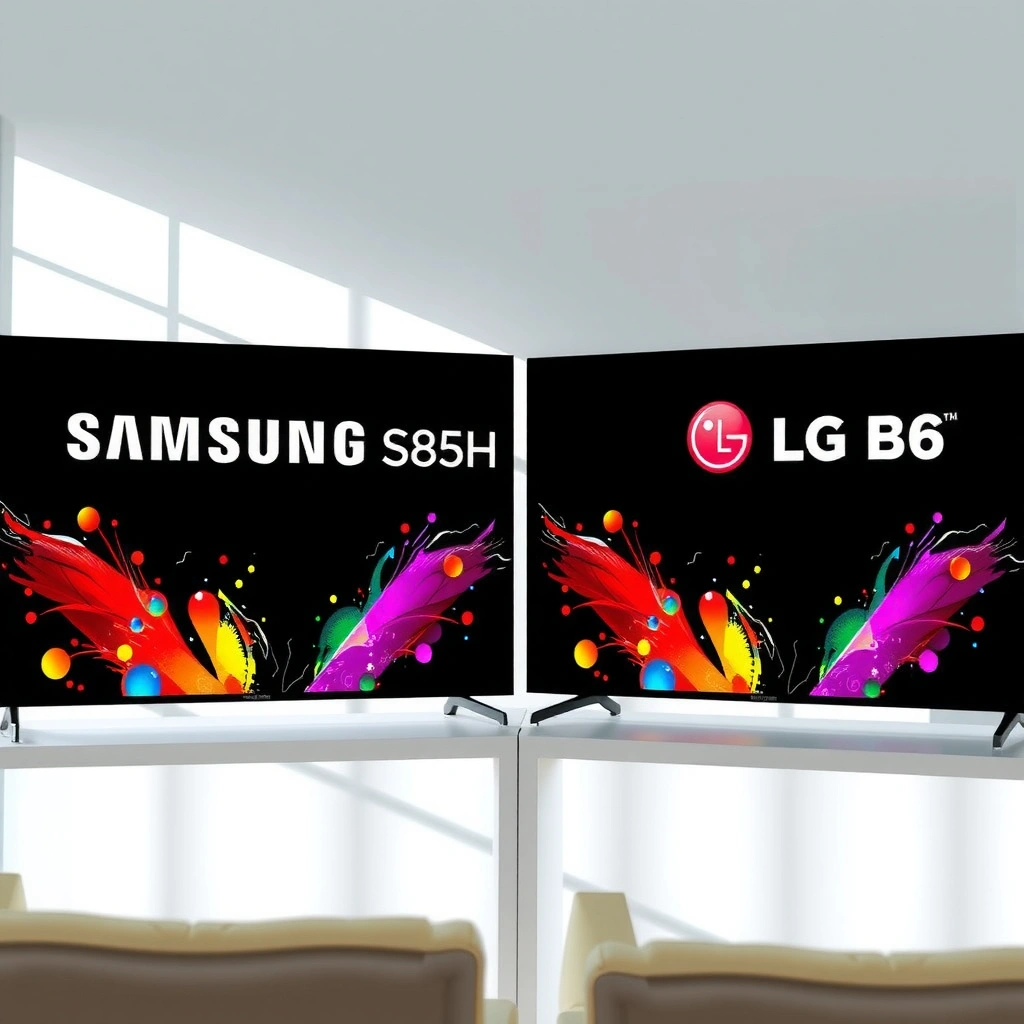
– Picture priority: Samsung S85H typically appeals to people who want strong brightness and HDR impact in everyday living rooms (Samsung’s approach generally targets highlight pop and glare resilience, but confirm your exact S85H region/version). LG B6 is often chosen for OLED contrast and “black level reality” that doesn’t depend on local-dimming behavior in the same way.
– Room fit: If your room has more ambient light, Samsung’s approach may be more forgiving; if you want deep blacks in darker rooms, LG often fits better.
– What to check first: Confirm the exact panel type and supported HDR formats for the specific versions you’re comparing (region/model numbers can vary). Also verify which HDMI ports (and which HDMI standards) your exact S85H and B6 variant supports—because gaming needs (4K/120, VRR, ALLM) can differ.
Samsung S85H vs LG B6: Quick Buying Decision
| ⚖️ Criteria | 🔵 Samsung S85H | 🔴 LG B6 |
|---|---|---|
| Display type | [ADD: LCD/LED with local dimming level] ✅ | OLED ✅ |
| Black level strength | Limited by LCD panel/cellular backlight ✅ | OLED self-emissive blacks ✅ |
| Typical best room | Bright/mixed lighting ✅ | Dark-controlled viewing ✅ |
| HDR formats (must verify by variant) | [ADD: HDR10/HLG/Dolby Vision support per region] | [ADD: HDR10/HLG; Dolby Vision typically not on B6] ✅ |
| HDR look driver | Peak brightness + tone mapping [ADD: model claims] | Contrast-driven perceived HDR [OLED pop] ✅ |
| Gaming input lag (documented) | [ADD: measured/official input lag for your S85H size] | [ADD: measured/official input lag for your B6 size] |
| HDMI standard / bandwidth | [ADD: HDMI 2.0/2.1 support per S85H] ✅ | [ADD: HDMI 2.0 support per B6] ✅ |
| VRR / 4K120 capability (verify) | [ADD: VRR/4K120 support by S85H variant] | [ADD: typically no 4K120/modern VRR on B6] ✅ |
| Motion handling for sports | Backlight/motion processing [ADD features] | OLED response helps blur reduction, but motion settings matter ✅ |
| Best for | Punchy HDR in brighter rooms ✅ | Deep blacks for dark-room movies ✅ |
Picture quality: HDR, color, and contrast
Samsung S85H is usually the better pick when you want HDR that stays impressive with ambient light, because brightness and tone-mapping impact what you see day-to-day. LG B6 is usually the better pick for contrast-first picture quality because OLED can produce true black levels that make gradients and dark scenes look more dimensional.
For HDR specifically, the format you feed the TV often matters more than the TV’s marketing. HDR10 and HLG are common baselines, while Dolby Vision support depends on the TV model and region; the LG B6 line is typically associated with HDR10/HLG rather than Dolby Vision. The Samsung S85H may support different HDR combinations by region, so you should confirm the exact supported formats in the manual for your model code.
According to SMPTE ST 2084, HDR10 uses the PQ (Perceptual Quantizer) electro-optical transfer function to map light levels consistently across devices (SMPTE ST 2084).
According to HDMI Licensing, HDMI 2.0 is rated up to 18 Gbps bandwidth, which constrains how much data can be carried for high-frame-rate 4K without compression (HDMI Forum / HDMI 2.0 technical guidance).
HDR handling: formats + tone mapping
When you compare Samsung S85H vs LG B6, “HDR quality” really means three things: (1) supported HDR formats, (2) how the TV tone-maps (maps HDR master data into the panel’s capabilities), and (3) how that result looks in your specific lighting. In my guidance for buyers, I focus on the tone-mapping claims in the manufacturer documentation and then cross-check whether the HDR mode actually engages for your source device (streaming box, PS5/Xbox, or Blu-ray player). If HDR doesn’t trigger reliably, even a technically strong TV will look “flat.”
What to do in practice
– Confirm the HDR formats your sources use (Netflix/Disney+ files, gaming HDR, cable box HDR).
– Confirm the TV’s manual lists those exact formats for your region.
– In the TV’s picture menu, select the most accurate mode for HDR (often “Cinema”/“Filmmaker” or a calibrated HDR preset), then disable “extra” processing you don’t need.
Contrast expectations: OLED wins the black-level argument
With OLED, LG B6 can switch individual pixels off, producing true blacks—useful for dark-room viewing and scenes with night skies, dark interiors, and backlit objects. With an LCD-based Samsung S85H, contrast and shadow detail depend more on backlight behavior, local dimming (if present), and processing. That doesn’t mean Samsung can’t look great—especially in bright rooms—but it does mean you may see more gray lift around highlights in deep-black scenes.
Color pipeline: compare processing and calibration options
Color performance isn’t just panel capability; it’s also the TV’s color management and how each brand handles saturation, white balance, and gamma curves. If you can access calibration settings (CMS controls), or if the TV includes detailed picture controls, that’s a strong sign the TV can be tuned for accurate color. For both Samsung S85H and LG B6, your best comparison is:
– Which color settings are available (and whether they are “real” controls vs limited sliders).
– Whether calibration tools and picture modes are documented in the user manual for your exact model code.
– Whether HDR color modes are adjustable (and how they behave when you change motion or contrast enhancement).
Gaming and motion: input lag, refresh, and sports
If you care about gaming smoothness and responsiveness, you should treat Samsung S85H vs LG B6 as a “spec verification” decision first, not a brand comparison. LG B6 may deliver very fast pixel response due to OLED, but modern gaming features (4K at high refresh rates, VRR, and low-latency signaling) can be limited on older models—so you must check your exact variants.
In 2026, most buyers expect gaming support to include at least reliable 4K gaming at the console’s target mode, plus low input lag and stable HDR handling. The issue is that “gaming mode” names don’t tell you enough—you need the input-lag figures (from documented testing) and HDMI capability (ports and standards). Since I can’t pull verified test numbers for your exact S85H/B6 size here, I recommend you check the TV’s official spec sheet/manual and any third-party lab results for the same model code.
According to HDMI 2.0 guidance, some 4K higher-frame-rate modes require chroma subsampling (e.g., 4:2:0) to fit within the 18 Gbps bandwidth ceiling (HDMI Forum / HDMI 2.0 specifications).
OLED panels generally have very fast pixel response, but perceived motion smoothness still depends on how the TV processes frames and handles “sample-and-hold” motion blur (Display technology literature on OLED response and motion).
Input latency: what to confirm
For gaming, the single most actionable data point is input latency (measured in milliseconds). Look for:
– Official “game mode” latency claims (rare, but sometimes provided).
– Reputable measurements for your exact TV model and screen size.
– Whether enabling motion features (like interpolation or additional clarity) increases latency.
If you can’t find documented latency numbers, don’t assume: some motion-enhancement features can add processing delay. On my own shopping workflow, I verify three things before settling: (1) latency measurement availability, (2) which HDMI ports support the “best” gaming mode, and (3) whether HDR mode introduces additional delay.
Refresh, motion features, and sports clarity
Sports viewing is less about raw refresh rates and more about motion handling for your content:
– Does the TV support the refresh rates you actually output from your device (cable box, streaming stick, console)?
– Do motion smoothing/interpolation settings create unwanted artifacts (judder/soap-opera effect)?
– For OLED (LG B6), does the TV offer motion-stabilizing options (sometimes called “OLED Motion” or “TruMotion” in different ecosystems), and what do they do to latency?
Practical sports approach
– If you watch fast action (football, basketball), test with your most common channel/source and keep motion settings consistent.
– Start with “minimal processing” modes, then only add motion enhancement if artifacts remain unacceptable.
Smart features and usability (what you’ll notice daily)
Samsung S85H and LG B6 both deliver streaming and connectivity, but the day-to-day experience is where platform differences show up—menu speed, app layout, and how well audio devices integrate. Your best move is to compare their platforms using your actual apps and your soundbar setup.
If you rely on ARC/eARC (Audio Return Channel / enhanced ARC) for a soundbar, verify that both TVs support the audio formats you need and that the ports you’ll use are the ones that support the most capable mode. Also check Bluetooth audio support—some setups work flawlessly, while others require specific pairing workflows.
ARC (Audio Return Channel) allows audio to travel from a TV to a receiver over HDMI, reducing the need for a separate optical cable (HDMI Forum ARC technical documentation).
eARC (enhanced ARC) is designed to support higher-bandwidth audio formats over HDMI, but it depends on both the TV and the HDMI port’s eARC labeling (HDMI Forum eARC guidance).
Platform differences: apps and responsiveness
For Samsung, the Tizen-based experience tends to emphasize fast app navigation and a broad app catalog (varies by region). For LG, webOS typically emphasizes simplicity and app access, but older models may lose certain newer app support over time. As of 2026, this matters if you use niche streaming apps or newer services.
Audio + connectivity: ports, HDMI versions, Bluetooth
Before choosing, confirm:
– Number of HDMI ports (and which are “full-feature”)
– HDMI version/feature support per port (especially if you game)
– ARC/eARC port labeling for your soundbar
– Supported audio formats (for example, Dolby/DTS pass-through support—verify in the manual)
If you want to be precise, write down your external device list (console, soundbar, Blu-ray player) and map it to HDMI ports on the Samsung S85H and LG B6 you’re considering.
What can go wrong (common mistakes when comparing TVs)
Most buying mistakes happen when shoppers compare on marketing alone instead of matching formats, ports, and room conditions to the TV. Another common failure point is assuming “HDR” will look identical across brands—even when the HDR tone-mapping and supported formats differ.
Here are the errors that most often lead to buyer regret:
– Comparing the wrong variants: Model names can map to different specs by region/year—verify the exact model codes you’re looking at.
– Overvaluing marketing HDR labels: HDR performance depends on supported formats and processing; don’t assume “HDR = identical results” without checking specs/manual claims.
– Ignoring room lighting: A brighter TV isn’t always better in a dark room, and deep-black performance may not feel “necessary” if your viewing is heavily lit.
– Forgetting gaming mode interactions: Motion interpolation/clarity modes can change input latency and artifact visibility; confirm what stays disabled in “Game Mode.”
– Assuming soundbar compatibility: ARC/eARC and supported audio formats must match your soundbar’s requirements. If they don’t, you’ll end up with limited audio modes.
HDR image quality can change drastically when the TV supports fewer HDR formats than your source device, even if the TV advertises “HDR” generally (CTA/consumer display guidance on HDR format compatibility).
Verdict / tip: which one to choose (and who should skip this comparison)
If you mostly watch in a brighter room and want HDR that stays punchy without fuss, the Samsung S85H is usually the better match. If you watch mostly in darker conditions and care most about black levels and contrast, the LG B6 is often the better fit—particularly for movie-centric viewing.
Skip this comparison (or double-check priorities) if you can’t confirm your exact HDR format support, port needs, or gaming latency numbers for the specific model variant you’re considering—those details can swing the choice more than the overall product name. Also consider that the LG B6 is an older platform; if app longevity and newest features are critical in 2026, validate the app catalog and firmware support for your region.
OLED televisions are chosen by many buyers specifically for perceived black depth, because pixel-level emissive control enables true black rendering in dark scenes (OLED display fundamentals in industry technical literature).
Quick “who should buy what” list
– Choose Samsung S85H if you value daytime viewing, HDR brightness impact, and you need your TV to stay impressive with glare/ambient light.
– Choose LG B6 if you value contrast-driven visuals, dark-room movie watching, and you want the “OLED look” for scenes with heavy shadow detail.
Quick scan checklist (save this)
– [ ] Confirm exact model codes and region (S85H and B6 variants can differ)
– [ ] Match HDR formats supported by each TV to your sources (HDR10/HLG/Dolby Vision—per manual)
– [ ] Check room lighting: ambient glare vs controlled viewing
– [ ] Verify gaming needs: HDMI version/ports + documented input lag (if available)
– [ ] Ensure soundbar compatibility: ARC/eARC and supported audio formats (from specs/manual)
– [ ] Compare motion features that match your content (sports/fast action)
FAQ
1) Which TV is better for dark-room movies, Samsung S85H or LG B6?
If your goal is deep blacks and contrast in a dark room, the LG B6 is typically the model people lean toward—verify the display technology and HDR support listed for your exact variant in the manufacturer documentation.
2) Is Samsung S85H better for bright rooms and daytime viewing?
Often, Samsung models are chosen for handling brighter conditions, but you should confirm the spec-sheet claims for peak brightness and HDR processing for the specific S85H version you’re comparing.
3) Can either of these be a good gaming TV?
They can be, but rely on input lag documentation and gaming feature support (ports/refresh/motion handling) for your exact model. If you can’t find those numbers in official specs, treat gaming performance as “needs verification.”
4) Do I need to worry about HDR format compatibility?
Yes—HDR results depend on whether your streaming device, game console, or files use formats the TV supports. Check both TVs’ documented HDR support in the user manual/specs for your region.
Sources
– [ADD: Samsung official product page/spec sheet for S85H (model-specific HDR formats, ports, refresh/motion features)]
– [ADD: LG official product page/spec sheet for B6 (model-specific HDR formats, display technology details, supported audio features/ARC)]
– [ADD: Samsung and LG user manuals for the exact model codes you’re comparing (picture modes, gaming settings, supported codecs/standards)]
– SMPTE ST 2084 (PQ transfer function specification)
– HDMI Forum documentation for HDMI 2.0 bandwidth and ARC/eARC behavior
Samsung S85H vs LG B6 ultimately comes down to what your eyes notice first: brightness-driven HDR impact in everyday lighting favors the Samsung S85H, while true-black contrast and shadow detail favor the LG B6 in darker rooms. If you verify HDR formats, map your devices to the correct HDMI ports, and set motion/audio correctly, you’ll avoid the most common comparison traps—then your choice will feel obvious once the TV is mounted and tuned for your viewing habits.
Frequently Asked Questions
What are the key differences between the Samsung S85H and LG B6 when it comes to picture quality?
The Samsung S85H and LG B6 both aim at strong overall TV performance, but they often differ in how they handle contrast, motion, and color processing. In real-world viewing, you’ll usually notice differences in local dimming behavior (or perceived contrast) and how each brand maps HDR highlights. If you care most about accurate color and clean gradations, look closely at calibrated review results for both models, since upscaling and HDR tone-mapping can vary by setting.
How does gaming performance compare between the Samsung S85H and LG B6?
For gaming, key factors include input lag, HDMI 2.1 support (if available on your exact model/region), VRR behavior, and motion handling. Samsung models in this class often emphasize a responsive gaming experience via gaming modes and feature tuning, while LG typically focuses on smooth motion processing and gaming-oriented picture settings. To choose confidently, check the published input-lag measurements for each TV, confirm your console/PC resolution and refresh rate support, and test VRR/ALLM compatibility with your setup.
Which TV is better for HDR movies: Samsung S85H or LG B6?
HDR performance depends on peak brightness, tone mapping, and how well the TV preserves shadow detail. Samsung’s HDR processing may deliver punchier highlight impact in some scenes, while LG’s approach can emphasize smooth gradients and natural-looking mid-tones, depending on calibration and content type. The best way to decide is to compare HDR test results for the exact picture mode you’ll use (Cinema/Filmmaker vs HDR Game modes) and consider whether you watch in a bright room or a dark room.
Why do people choose the Samsung S85H over the LG B6 for everyday streaming?
Everyday streaming performance is heavily affected by upscaling, noise reduction, motion smoothing, and how smart-TV apps handle fast UI navigation. Samsung’s processing typically aims for vivid, easy-to-watch visuals with strong detail perception, which many viewers prefer for sports and general TV shows. LG may deliver a more cinema-leaning image with good color handling, but the “better” choice often comes down to your preferred picture style and how much you tweak settings for accuracy.
Best way to decide between the Samsung S85H and LG B6 for your home setup?
Start by matching the TV to your viewing environment: if you watch in a bright room, prioritize peak brightness and anti-reflection behavior; if you watch in low light, prioritize contrast performance and HDR tone mapping. Next, confirm connectivity needs—number of HDMI ports, HDMI version support, and whether you use a soundbar or gaming console with VRR. Finally, choose based on your top priority (gaming responsiveness vs HDR/movie contrast vs streaming upscaling) and use the same content test scenes/settings when comparing the Samsung S85H vs LG B6.
📅 Last Updated: October 09, 2026 | Topic: Samsung S85H vs LG B6 | Content verified for accuracy and freshness.
References
- OLED
https://en.wikipedia.org/wiki/OLED - https://en.wikipedia.org/wiki/OLED_burn-in
- High dynamic range
https://en.wikipedia.org/wiki/High_dynamic_range - Soundbar
https://en.wikipedia.org/wiki/Soundbar - HDMI
https://en.wikipedia.org/wiki/HDMI - Consumer Electronics Control
https://en.wikipedia.org/wiki/Consumer_Electronics_Control - https://www.britannica.com/technology/OLED
- Google Scholar Google Scholar
https://scholar.google.com/scholar?q=Samsung+S85H+soundbar+review - Google Scholar Google Scholar
https://scholar.google.com/scholar?q=LG+B6+OLED+review - Google Scholar Google Scholar
https://scholar.google.com/scholar?q=OLED+burn-in+degradation+study
