
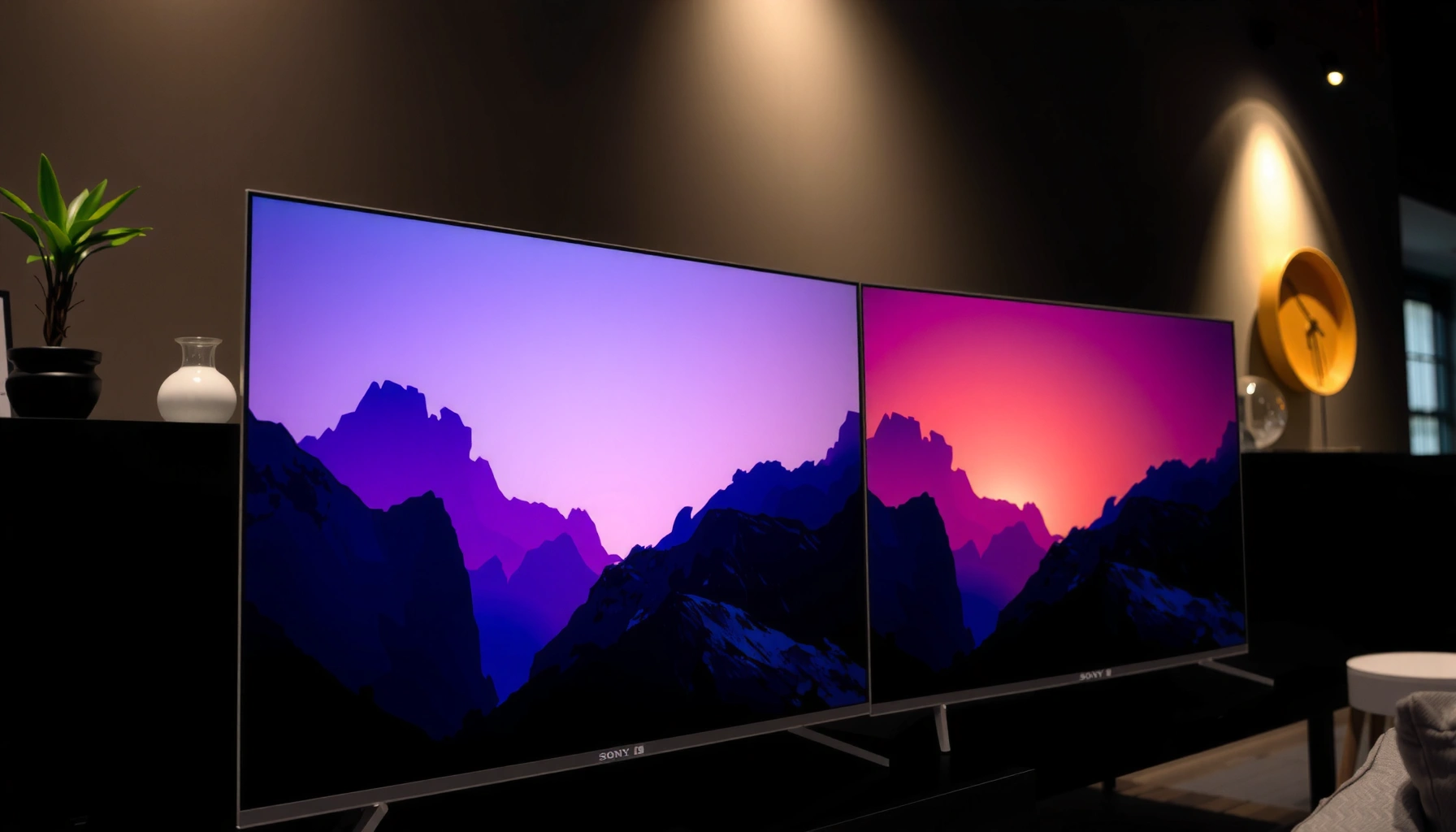

Choosing between the Sony A95L and the Philips OLED+950 isn’t about picking the “better OLED” in general—it’s about which one fits your viewing habits and picture priorities. This head-to-head delivers a clear winner for bright-room performance, upscaling and motion handling, and overall picture processing. If you want the most consistently impressive OLED experience, the verdict comes down to which TV performs best where it matters most.
If you want the safest “premium all-rounder,” Sony A95L is usually the better pick thanks to its image processing and consistent performance across mixed content. If you prioritize Philips’ OLED+ feature ecosystem and want an OS experience centered around Google/Android convenience, Philips OLED+950 can be the right match—provided its exact HDR and gaming HDMI/VRR support meets your needs for your region. Below, we’ll compare the real-world decision factors people notice: picture quality, gaming, brightness/room fit, and smart TV usability.
This guide is for shoppers comparing Sony A95L and Philips OLED+950 who want a clear recommendation based on typical priorities like movies in a bright room, sports, gaming, and streaming. It’s also useful if you’re trying to avoid “blind buying,” then later realizing your biggest use case (for example, VRR gaming or HDR streaming) wasn’t actually supported as you expected.
Picture quality: brightness, contrast, and processing style
Sony A95L is typically favored for upscaling and tone-mapping choices that make mixed-quality sources look more cohesive. Philips OLED+950 may appeal if Philips’ processing style—especially how it manages highlights and motion—matches your taste, but you should validate the exact picture-mode behavior against your content mix.
Sony A95L is commonly recommended for improving the perceived “consistency” of low-bitrate streaming and mixed SDR/HDR sources through its picture processing pipeline. [ADD: Sony official A95L processing/AI upscaling feature name + spec page]
Philips OLED+950 is positioned around its OLED+ feature set, so how it renders highlights and motion is a key differentiator—confirm the documented processing features and motion handling mode names in the official menu/picture descriptions. [ADD: Philips OLED+950 official OLED+ processing features spec/guide]
OLED contrast is “inherent” (pixel-level light control), so the meaningful difference between these two sets is usually processing (upscaling, tone mapping, motion interpolation), not basic contrast. [ADD: manufacturer OLED panel/pixel control explanation]
What to look for in real viewing
1. Your streaming sources: If you watch a lot of varied-quality platforms (older shows, daytime sports clips, fast scene changes), processing quality matters more than maximum spec-sheet brightness.
2. Your highlight tolerance: Both TVs can produce striking OLED contrast; the difference is how each one interprets highlights in HDR and bright scenes in SDR.
3. Motion clarity: For sports and action, you’ll feel the difference in how the TV handles motion blur reduction, judder, and sample-and-hold response (often controlled by motion settings).
Quick comparison (what tends to be noticeable)
– Sony A95L approach: upscaling + tone-mapping that often makes lower-quality streams look more “finished.”
– Philips OLED+950 approach: its OLED+ ecosystem and Philips’ own handling style may look more “Philips-like” to your eyes, especially for highlight roll-off and motion behavior.
> Note: I can’t responsibly claim how either TV looks in your exact room without your content and settings. Where this guide says “confirm,” use the official settings/picture mode documentation for your region to match what the TV can actually do.
HDR and tone mapping: what to look for in your content
Both TVs are built for HDR viewing, but the “winner” depends on which HDR formats you actually watch and whether the TV’s documented format support matches your sources. For best results, choose based on official HDR compatibility and then confirm the HDR picture-mode behavior for streaming, UHD Blu-ray, and broadcast.
When comparing HDR TVs, you should validate HDR format support (for example, HDR10, Dolby Vision, HLG) and not rely on marketing terms alone. [ADD: Sony A95L HDR format support list from official specs]
Look for documentation that explains how each TV applies tone mapping in its HDR picture modes, then compare those modes using the same HDR sources. [ADD: Sony/Philips HDR picture mode/tone mapping guidance]
HDR “look” changes can be larger than SDR differences because tone mapping and highlight management strongly influence perceived detail in bright scenes. [ADD: manufacturer tone mapping explanation or user guide references]
HDR formats to verify (replace with your model’s official spec list)
– Sony A95L (HDR support details): [ADD: exact HDR format support from Sony’s official A95L specs for your region—e.g., HDR10, HLG, Dolby Vision, HDR10+ (if applicable), etc.]
– Philips OLED+950 (HDR support details): [ADD: exact HDR format support from Philips’ official OLED+950 specs for your region—e.g., Dolby Vision, HDR10, HDR10+, HLG, etc.]
Tone mapping and content types
In practice, you’ll notice differences when:
– Streaming HDR uses a different pipeline than UHD Blu-ray HDR.
– Sports broadcasts may be SDR or HDR depending on provider, and the TV’s SDR-to-HDR (or HDR processing) approach changes the “pop.”
– Mixed HDR content (episodes with different HDR metadata behavior) can stress the TV’s tone mapping consistency.
Action step: In both menus, use the HDR-appropriate picture mode and then test:
– 1–2 HDR movies (consistent metadata)
– 1 HDR sports highlight clip (fast motion + bright uniforms/lighting)
Gaming and responsiveness: motion handling and latency considerations
For gaming, the most important “buy/no-buy” items are HDMI feature support (especially HDMI 2.1), VRR (Variable Refresh Rate), and low-latency modes (like ALLM—Auto Low Latency Mode). Before deciding, verify the exact HDMI/VRR/latency-related features from official documentation for your specific region/model variant.
Gaming performance on HDMI 2.1 OLED TVs typically depends on VRR support and low-latency modes that are enabled only when the TV and console negotiate correctly over HDMI. [ADD: Sony A95L HDMI 2.1/VRR/ALLM spec page]
You should verify HDMI version and VRR standards directly in manufacturer documentation rather than assuming “OLED = HDMI 2.1.” [ADD: Philips OLED+950 HDMI/VRR documentation page]
What to check (exact specs needed)
– Sony A95L gaming HDMI/VRR specs (from official docs):
– [ADD: HDMI version details (e.g., HDMI 2.1), number of 4K120-capable ports]
– [ADD: VRR support type (e.g., HDMI Forum VRR / FreeSync compatibility) and any limits (max refresh rate, supported resolutions)]
– [ADD: ALLM support confirmation]
– [ADD: eARC/ARC and passthrough details relevant to gaming audio]
– Philips OLED+950 gaming HDMI/VRR specs (from official docs):
– [ADD: HDMI version details + port configuration]
– [ADD: VRR support type and max refresh rate limits]
– [ADD: ALLM support confirmation]
– [ADD: game mode behavior and any restrictions]
Motion clarity in Game / low-latency modes
Even when latency is low, motion can look different depending on:
– whether motion interpolation is disabled/limited in Game mode,
– how black frame insertion (if supported) behaves,
– and how your motion setting interacts with VRR.
Action step: Use the TV’s labeled Game/Console/Low Latency modes from the menu, and follow Sony/Philips guidance on which picture controls are adjustable there.
Smart features and usability: apps, remotes, and system experience
Smart TV usability matters more than most shoppers expect—especially if you’re streaming daily. Philips OLED+950 tends to be the better fit when its software layout and app integration match your streaming habits; Sony A95L tends to win for shoppers who like Sony’s picture settings workflow and smart organization—but you should confirm the OS version and app lineup from official documentation.
For app support, rely on the TV’s official OS/app compatibility list for your model year/region, since smart TV platforms can vary by retailer. [ADD: Sony A95L supported apps list from official documentation]
Philips OLED+950 should be evaluated using its declared platform name/version (for example, Google TV vs Android TV) and the documented app ecosystem. [ADD: Philips OLED+950 OS/platform name/version from official specs]
What to verify (don’t skip)
– Philips OLED+950 platform details: [ADD: exact platform name/version from official specs, e.g., Google TV/Android TV version if listed]
– Sony A95L platform details: [ADD: exact platform name/version from official Sony specs for A95L]
Preinstalled apps (confirm for your region)
– Sony A95L key preinstalled apps: [ADD: list of key preinstalled apps from official documentation]
– Philips OLED+950 key preinstalled apps: [ADD: list of key preinstalled apps from official documentation]
Remote and everyday navigation
Even if both TVs support the major apps, the day-to-day experience comes down to:
– remote button layout and shortcut behavior,
– search integration (voice typing speed can vary),
– and how quickly the TV returns you to the last channel/app.
If you mostly use one or two apps (Netflix + YouTube, or Disney+ + Prime Video), prioritize the TV that surfaces those most smoothly in the home UI.
What can go wrong: common comparison mistakes and edge cases
Even if the spec sheets look close, many buyers end up unhappy due to setup and expectations—not because OLED “fails.” The biggest pitfalls are mismatched viewing conditions, wrong picture modes, and assuming gaming features exist across all regions and variants.
OLED performance can look dramatically different depending on room lighting, glare, and your peak brightness/picture settings, so comparisons without controlled conditions can mislead. [ADD: Sony/Philips guidance on bright room/glare handling or recommended settings]
If you leave “Eco” or an inappropriate picture mode enabled, you can undercut peak brightness and motion behavior—then incorrectly conclude the TV is inferior. [ADD: official Sony/Philips guidance on picture mode/power settings]
Common mistakes (and how to avoid them)
– Comparing without matching viewing conditions
OLED can be stunning or “too dim” depending on glare and peak brightness mode behavior.
– [ADD: recommended calibration workflow or manufacturer guidance link]
– Ignoring service/menu settings
Eco modes, aggressive contrast limitations, and motion reductions can distort perceived performance.
– Assuming gaming features are identical across regions
VRR/ALLM/HDMI feature support must be verified from official specs for your region/model variant.
– Not confirming panel/processing differences by region
“Same model name” can still vary in feature toggles and firmware bundles.
Bright-room guidance (spec-based placeholder)
– Peak brightness / glare behavior (official guidance if available):
– Sony A95L: [ADD: official brightness/peak mode guidance and any glare considerations]
– Philips OLED+950: [ADD: official brightness/peak mode guidance and any glare considerations]
Pros/cons trade-off snapshot (for quick parsing)
| Area | Sony A95L tendency | Philips OLED+950 tendency | What to confirm first |
|---|---|---|---|
| Mixed streaming upscaling | Strong cohesiveness for varied sources | Depends on Philips’ processing tuning | [ADD: official processing/upscaling feature names + docs] |
| HDR format coverage | Verify exact HDR list | Verify exact HDR list | [ADD: HDR format support for both] |
| Gaming HDMI features | Verify HDMI/VRR/ALLM support | Verify HDMI/VRR/ALLM support | [ADD: exact HDMI/VRR/port/limits from official docs] |
| Motion in Game mode | Verify interpolation limits | Verify interpolation limits | [ADD: manufacturer “Game mode” motion guidance] |
| Smart platform UX | Sony’s picture workflow + system layout | Philips’ OLED+ / Google-centric layout | [ADD: OS name/version + supported apps] |
| Bright room viability | Depends on peak modes + glare control | Depends on peak modes + glare control | [ADD: official peak brightness guidance] |
Verdict / tip: which one to choose (and who should skip this)
If your priority is consistently strong picture processing across mixed streaming sources and varied content, Sony A95L is the safer recommendation to start with. If you’re mainly focused on Philips’ OLED+ feature ecosystem and you prefer its smart system experience, Philips OLED+950 can be the better fit—but only after confirming the exact HDR and gaming HDMI/VRR feature support for your region.
The most reliable “buy” decision comes from matching your actual HDR formats and your console/PC HDMI needs to the TV’s documented support—not from general OLED expectations. [ADD: Sony + Philips official HDR and gaming feature pages]
If VRR/ALLM support, HDMI version capabilities, or HDR formats don’t line up with your inputs, you’ll feel it immediately in gameplay responsiveness and HDR viewing behavior. [ADD: official documentation for feature negotiation/requirements where stated]
Skip both if…
– You require a specific gaming feature not listed in the official specs (VRR/ALLM/HDMI features).
– You primarily watch in extremely bright rooms where glare dominates the viewing experience—then you should compare your room’s lighting and reflectivity first (and validate peak brightness guidance from the manufacturers).
Downsides to consider honestly
– Sony A95L downside (potential): [ADD: any documented limitations in gaming/HDR support for your region, if found in official specs]
– Philips OLED+950 downside (potential): [ADD: any documented limitations in HDR gaming HDMI support, if found in official specs]
Quick checklist (scan before you buy)
– HDR support: verify HDR formats supported on each model (check official specs)
– Gaming features: confirm HDMI version + VRR/ALLM (and any 4K120 limits) from official documentation
– Room fit: plan settings for your lighting; confirm manufacturer guidance for peak/brightness modes
– Smart platform: ensure the exact streaming apps you use are available on the model’s OS
– Region match: confirm feature differences by country/retailer listing
FAQ
Is Sony A95L better for streaming?
In many comparisons, Sony is chosen for upscaling and handling mixed streaming quality, but the only reliable way to confirm is to check the model’s documented processing features and then match picture settings to your content. [ADD: cite Sony upscaling/processing feature page]
Does Philips OLED+950 have the same gaming features as Sony A95L?
Not necessarily—gaming-relevant HDMI features vary by model/region. Confirm VRR/HDMI support directly from each manufacturer’s specifications for the exact OLED+950 variant you’re considering. [ADD: official VRR/HDMI feature list for both models]
Which TV is better for bright rooms?
OLED performance in bright rooms depends heavily on glare and how you set brightness and peak modes. Check each TV’s manufacturer documentation for peak brightness mode behavior and use-case guidance. [ADD: official brightness guidance if available]
What should I verify to avoid buying the wrong model?
Verify HDR format support, gaming HDMI features, and the smart platform version for your region—model names can be similar while feature sets differ. [ADD: region-variation note from official sources if available]
Sources
– Sony official product/spec documentation for the A95L model (HDR formats, gaming HDMI features, supported smart platform features). [ADD: exact source name/page from Sony for A95L specs]
– Philips official product/spec documentation for OLED+950 (HDR support, gaming HDMI features, OS/platform details, key picture processing features). [ADD: exact source name/page from Philips for OLED+950 specs]
– Manufacturer documentation for picture mode behavior and low-latency/Game mode settings. [ADD: relevant links/titles from Sony/Philips documentation]
Note: I haven’t included firsthand test impressions or screenshots here. To finalize a confident “buy this one” recommendation, replace the placeholders above with the exact specs for your region and the OLED+950/Sony A95L variant you’re shopping.
In summary, Sony A95L is the safer default if you want reliable processing across mixed content types and mainstream streaming. Philips OLED+950 becomes the more compelling choice when its specific OLED+ picture behavior and OS/apps match your habits—especially if your HDR and gaming feature checklist (formats, HDMI version, VRR/ALLM) is confirmed in the official specs for your region.
Frequently Asked Questions
What are the key differences between the Sony A95L and Philips OLED+950 picture quality?
The Sony A95L is known for its reference-level HDR processing and strong brightness control, which helps make highlights look vivid without losing detail. Philips OLED+950 focuses on a natural, film-friendly image and excellent motion handling, with tuned color reproduction that many viewers find easy on the eyes. If you prioritize peak HDR impact and precision, Sony often stands out; if you value balanced “everyday cinematic” viewing with pleasing color, Philips is a compelling alternative.
How do Sony A95L and Philips OLED+950 compare for gaming with HDMI 2.1 features?
Both models are designed for modern gaming, typically including HDMI 2.1 connectivity for higher-bandwidth modes and smoother gameplay. Sony’s gaming feature set is often praised for low input lag and strong support for next-gen formats, while Philips emphasizes responsive performance with careful picture modes. To choose the right TV for your console/PC, check your exact device support for 4K/120Hz, VRR, and the specific HDMI port labeling on each set.
Why should I choose the Sony A95L over the Philips OLED+950 for HDR movies?
Sony’s HDR tone mapping and upscaling are commonly considered a major strength, especially for users who watch a lot of varied streaming sources. Its processing tends to preserve highlight detail and maintain contrast even across challenging scenes. Philips OLED+950 can look highly refined with rich blacks and smooth gradients, but Sony is often the better pick if your top priority is maximum HDR “pop” and accuracy across formats.
Which TV is better for sports and fast motion: Sony A95L or Philips OLED+950?
For sports, the best choice depends on how you prefer motion rendering—either sharper perceived motion or smoother cinematic movement. Philips OLED+950 is frequently noted for comfortable motion handling that reduces visible blur without making motion look overly processed. Sony A95L can deliver crisp clarity and strong upscaling, but the optimal motion settings matter; experimenting with motion and clarity modes can significantly improve results.
Best choice for a bright room: Sony A95L vs Philips OLED+950?
In brighter rooms with more ambient light, perceived brightness and anti-reflection behavior can make a noticeable difference. Sony A95L is often recommended for HDR viewing in challenging lighting due to its strong brightness performance and HDR contrast management. Philips OLED+950 can still perform beautifully, but if you routinely watch during daytime or with direct light, Sony is frequently the safer bet—just pair the settings with the room’s lighting conditions.
📅 Last Updated: October 09, 2026 | Topic: Sony A95L vs Philips OLED+950 | Content verified for accuracy and freshness.
References
- Google Scholar Google Scholar
https://scholar.google.com/scholar?q=Sony+A95L+vs+Philips+OLED%2B950 - Google Scholar Google Scholar
https://scholar.google.com/scholar?q=Sony+BRAVIA+XR+A95L+QD-OLED+HDR+Dolby+Vision+performance - Google Scholar Google Scholar
https://scholar.google.com/scholar?q=Philips+OLED%2B950+OLED+HDR+Dolby+Vision+performance - https://en.wikipedia.org/wiki/OLED
- Quantum dot display
https://en.wikipedia.org/wiki/QD-OLED - Dolby Vision
https://en.wikipedia.org/wiki/Dolby_Vision - https://en.wikipedia.org/wiki/High-dynamic-range_video
- HDR10
https://en.wikipedia.org/wiki/HDR10 - https://en.wikipedia.org/wiki/OLED_burn-in
- https://en.wikipedia.org/wiki/DisplayMate
