
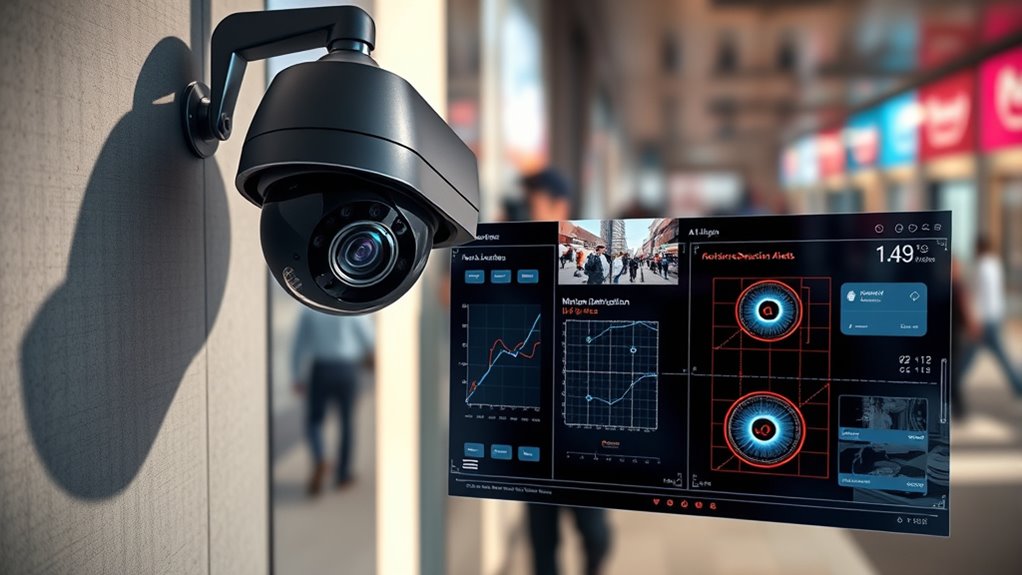

Edge AI transforms security camera processing by enabling real-time analytics directly on devices. This local processing reduces latency, enhancing your capability to detect and respond to threats quickly. It keeps data private by minimizing transfers to centralized servers, thereby improving security against unauthorized access. Additionally, you gain greater control over data management. Understanding the full potential and distinctions of Edge AI could offer valuable insights into its applications and benefits for modern surveillance systems.
Understanding Edge AI Technology
As you explore the domain of Edge AI technology, you'll find that it fundamentally reshapes how data is processed and analyzed in real time. The edge device capabilities offer significant enhancements over traditional cloud-based systems by executing complex algorithms locally. This local processing advantage minimizes latency, enabling instant decision-making and responsiveness. By offloading tasks from centralized servers, edge devices reduce bandwidth usage and increase efficiency, allowing for seamless operation even in low-connectivity environments. Furthermore, the ability to analyze data on-site guarantees that sensitive information remains within the local network, enhancing privacy and security. This shift not only empowers users with greater control over their data but also fosters innovation across various applications, paving the way for a more autonomous and efficient future.
Benefits of Edge AI in Security Cameras
While traditional security cameras often rely on cloud processing, the integration of Edge AI brings numerous advantages that greatly enhance surveillance capabilities. With edge deployment, you can process data locally, reducing latency and improving response times. This local processing also boosts analytics accuracy, allowing for more precise identification and reporting of anomalies.
| Benefit | Description |
|---|---|
| Reduced Latency | Faster response to incidents |
| Enhanced Privacy | Less data sent to the cloud |
| Cost Efficiency | Lower bandwidth and storage costs |
| Improved Analytics | Greater accuracy in detection |
Real-Time Data Processing Capabilities
With the advent of Edge AI, security cameras can now process data in real-time, enabling immediate analysis of video feeds for critical events. This shift offers several advantages:
- Real-time analytics: You get actionable insights without delay, allowing for quick decision-making.
- Instantaneous feedback: Security personnel can respond to incidents as they unfold, enhancing situational awareness.
- Reduced latency: By processing data locally, you minimize the time spent transmitting information to the cloud, optimizing response times.
These capabilities empower you to safeguard your environment more effectively. With Edge AI, the technology doesn't just observe; it actively interprets and reacts, ensuring that you're always one step ahead in maintaining security. Embracing this innovation means embracing a proactive stance in surveillance.
Enhanced Privacy and Data Security
The shift towards Edge AI not only enhances real-time analytics but also greatly improves privacy and data security for security camera systems. By processing data locally, Edge AI minimizes the risk of unauthorized access, ensuring that sensitive footage doesn't leave the device unnecessarily. This localized approach allows for robust data encryption, safeguarding footage with advanced algorithms that protect against interception. Furthermore, Edge AI systems often incorporate features that prioritize user consent, allowing individuals to control when and how their data is recorded or shared. This empowers users, granting them greater autonomy over their privacy. Ultimately, these enhancements contribute to a more secure environment, aligning technology with the fundamental rights of freedom and privacy that many individuals cherish.
Reducing Bandwidth Usage With Edge AI
As security camera systems increasingly rely on Edge AI, you'll find that bandwidth usage is greatly reduced, enhancing overall system efficiency. This optimization is essential in maintaining high performance without overwhelming network resources. Here are three key ways Edge AI achieves bandwidth optimization:
- Real-time video compression: Edge AI processes video feeds on-site, applying advanced compression techniques that minimize data size without sacrificing quality.
- Selective data transmission: Instead of sending all footage, Edge AI can filter and transmit only relevant events, markedly cutting down data flow.
- Adaptive streaming: It dynamically adjusts the quality of the video stream based on available bandwidth, ensuring continuous operation even under limited network conditions.
These strategies exemplify how Edge AI not only conserves bandwidth but also enhances the functionality of security camera systems.
Improved Threat Detection and Response
Bandwidth optimization through Edge AI not only streamlines data transmission but also enhances threat detection and response capabilities in security camera systems. By processing data locally, Edge AI enables rapid threat identification and supports response automation, allowing you to react to potential incidents much faster than traditional systems.
| Feature | Benefits |
|---|---|
| Local Processing | Reduces latency in threat detection |
| Real-time Alerts | Enables immediate response automation |
| Enhanced Analytics | Improves threat identification accuracy |
With Edge AI, you can leverage advanced algorithms to differentiate between normal and suspicious activities, ensuring that your security measures are both proactive and efficient. Embracing this technology empowers you to maintain a safer environment, giving you the freedom to focus on what matters most.
Case Studies: Successful Implementations
You'll find that real-world applications of Edge AI in security cameras have proven effective in both retail theft prevention and smart city surveillance. These case studies illustrate how advanced algorithms process data locally, enabling swift identification of suspicious activities and enhancing overall safety. By examining these successful implementations, you can gain insights into the transformative potential of Edge AI in various environments.
Retail Theft Prevention
While many retailers struggle with theft, implementing edge AI solutions in security cameras has proven to greatly enhance theft prevention efforts. By leveraging advanced security analytics, retailers can improve operational efficiency and build a more secure retail environment. Consider these key benefits:
- Real-time theft detection: Edge AI processes data locally, enabling immediate alerts for suspicious activities.
- Enhanced customer behavior analysis: Understanding shopper patterns helps in identifying potential theft scenarios.
- AI integration with existing surveillance technology: This guarantees seamless upgrades without overhauling infrastructure.
These implementations not only bolster loss prevention strategies but also empower retailers to create a safer shopping experience. With edge AI, you can transform your approach to security, guaranteeing your assets are protected while respecting customer freedom.
Smart City Surveillance
As urban environments increasingly adopt advanced security measures, smart city surveillance systems are becoming integral to enhancing public safety and operational efficiency. With the integration of edge AI, cities can not only monitor traffic but also guarantee urban safety by analyzing real-time data. Successful implementations showcase how this technology optimizes resource allocation and response times.
| Case Study | Key Features |
|---|---|
| City A | Traffic monitoring, crime detection |
| City B | Emergency response integration, pedestrian safety |
| City C | Real-time analytics, environmental monitoring |
| City D | AI-driven alerts, enhanced privacy protocols |
These examples illustrate how smart city surveillance can revolutionize urban management, allowing for a more responsive and secure environment.
Comparing Edge AI and Cloud-Based Solutions
When you compare Edge AI and cloud-based solutions for security camera processing, processing speed is an essential factor to take into account. Edge AI offers real-time analytics directly on the device, minimizing latency, while cloud solutions may introduce delays due to data transmission. Additionally, data privacy becomes a significant concern; Edge AI allows for on-site data handling, reducing the risk of exposure compared to centralized cloud storage.
Processing Speed Differences
Processing speed is a critical factor when comparing Edge AI and cloud-based solutions for security camera processing. You'll notice significant differences in processing latency, driven by how each system operates. Here are three key points to take into account:
- Local Processing: Edge AI processes data on-device, reducing latency and allowing real-time responses.
- Network Dependency: Cloud-based solutions rely on internet connectivity; any disruption can increase processing latency.
- Algorithm Efficiency: Edge AI often employs optimized algorithms tailored for quick decision-making, while cloud-based systems may experience delays in data transmission and processing.
Data Privacy Considerations
With the rapid advancement of AI technologies, data privacy has emerged as a significant concern in the domain of security camera processing. When comparing Edge AI to cloud-based solutions, you'll notice Edge AI often enhances data ownership. By processing data locally, it minimizes the risk of sensitive footage being transferred to external servers, thereby giving you greater control over your information. On the other hand, cloud-based solutions typically require adherence to complex consent policies, which can complicate your ability to manage who accesses your data. As privacy regulations evolve, choosing Edge AI can empower you to enforce personal data governance while maintaining compliance, ultimately allowing you the freedom to dictate how your surveillance data is handled.
Future Trends in Edge AI for Surveillance
As the demand for real-time surveillance solutions grows, advancements in Edge AI are set to revolutionize how security cameras operate. You can expect several future innovations that will enhance surveillance capabilities and personal freedom:
- Autonomous Systems: Cameras will leverage AI to make decisions independently, reducing the need for constant human oversight.
- Predictive Analytics: Edge AI will analyze patterns in real-time, enabling proactive responses to potential security threats.
- Enhanced Privacy Features: Future systems will integrate advanced encryption and anonymization techniques, ensuring that personal data remains secure.
These trends indicate a shift towards more intelligent, responsive, and privacy-conscious surveillance solutions. As technology evolves, you'll find that the balance between security needs and individual freedoms becomes increasingly attainable.
Challenges and Limitations of Edge AI
While Edge AI presents exciting advancements in security camera processing, it also faces several challenges and limitations that must be addressed. One major concern is scalability issues; as your system expands, the processing demands increase, possibly outpacing hardware capabilities. Additionally, hardware limitations can hinder performance, particularly in low-power devices that may not support complex algorithms.
| Challenge | Description |
|---|---|
| Scalability Issues | Difficulty in managing increased data processing as systems grow. |
| Hardware Limitations | Constraints in processing power and memory in edge devices. |
| Algorithm Complexity | Advanced AI models may require resources beyond edge capabilities. |
Understanding these challenges can help you make informed decisions when implementing Edge AI in your security camera systems.
Frequently Asked Questions
How Does Edge AI Differ From Traditional AI Processing Methods?
Edge AI processes data at the source, offering real-time analysis and enhancing data privacy, while traditional AI often relies on centralized processing. You'll experience faster responses and improved security, giving you more control over your information.
What Types of Algorithms Are Used in Edge AI for Security Cameras?
In edge AI for security cameras, you'll encounter algorithms like object detection for identifying specific items and anomaly detection for spotting unusual behavior. These methods enhance real-time analytics, ensuring efficient surveillance while maintaining data privacy.
Can Edge AI Work With Existing Security Camera Systems?
Yes, edge AI can work with existing security camera systems, but you'll face integration challenges and compatibility issues. Addressing these concerns requires evaluating hardware specifications and ensuring software compatibility for ideal performance and functionality.
How Does Edge AI Impact the Cost of Security Camera Systems?
Did you know that integrating Edge AI can reduce operational costs by up to 30%? It enhances deployment efficiency, allowing quicker installations and fewer resources, leading to significant cost savings while maintaining robust security monitoring capabilities.
What Are the Common Hardware Requirements for Implementing Edge AI?
To implement edge AI, you'll need robust hardware specifications, including high processing power, efficient GPUs or TPUs, adequate RAM, and optimized storage solutions. These components guarantee real-time data analysis and seamless operation in various applications.
