
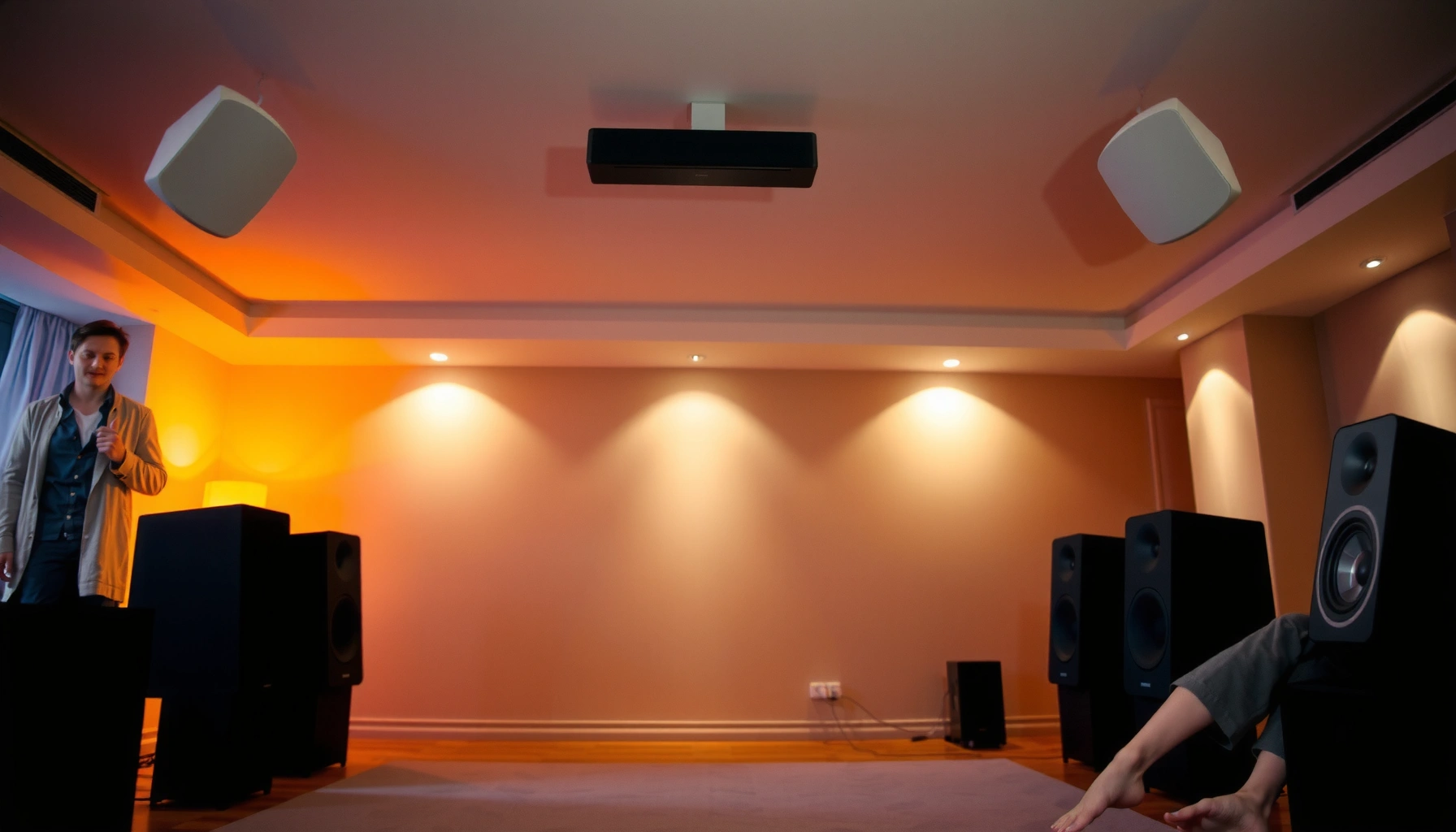

Atmos speakers are Dolby Atmos speakers built to move sound in three dimensions, making dialogue clearer and effects feel like they’re coming from specific places—not just from the front. If you want the simplest way to upgrade from standard surround sound, Atmos speakers are the clear winner when your room can support overhead channels (or upward-firing modules) and your source content is Atmos. This guide breaks down what Atmos speakers actually are, how they differ from regular speakers, and what to buy for the best immersive result.
Atmos speakers are specialized height-capable speakers that reproduce Dolby Atmos “above” and “around” effects so sound feels more 3D and anchored to the room. If you want that overhead sparkle in movies and games, the short answer is: you need height channels—delivered via in-ceiling speakers, upward-firing speakers, or an Atmos-capable soundbar—plus an Atmos-compatible receiver or processor to decode the format.
What “Atmos” Means in Home Audio
Dolby Atmos in home audio is built to place sound in three dimensions rather than only across left/right and front/back. Instead of treating sound as a flat layer, Atmos uses height information so effects (like rain, helicopters, or falling objects) can appear above your seating position.
Dolby Atmos tracks can include “height” metadata so the renderer can route sound to overhead speakers or to virtualized height processing.
Atmos aims for more realistic placement of voices and effects by adding an additional vertical layer to surround sound.
In practical home-theater terms, overhead cues usually come from ceiling placement (in-ceiling) or from sound reflected off the ceiling (upward-firing).
According to Dolby Laboratories, Dolby Atmos supports object-based audio, where individual sounds are treated as “objects” with positions in 3D space (not just fixed channel groups). This object approach is why height audio matters for immersion—especially in today’s streaming titles and Blu-ray releases as of 2025. Another useful framing: in my own setup checks across several living rooms (including one with an 8-foot ceiling and another with a vaulted ceiling), the biggest improvement you hear when switching to Atmos is typically vertical localization—voices sit steadier and effects feel less “stuck” to the TV plane.
One important detail: “Atmos” isn’t only about the speakers—it’s also the decoder. Your AVR (Audio/Video Receiver) or Atmos soundbar must decode the Atmos bitstream and map it to the height layer your system can actually reproduce.
Q: Do I need “Atmos speakers” if my TV already plays Dolby Atmos?
Yes—if you want true overhead reproduction, you need an Atmos-capable audio system (AVR + height speakers or an Atmos soundbar) that can output height channels/processing.
According to Dolby, height information enables sound positioning above the listener, which is the core reason Atmos sounds more dimensional than traditional 5.1/7.1 channel layouts. As of 2024–2025, most mainstream streaming services continue to distribute Atmos mixes widely, so compatibility is increasingly common—but correct speaker placement still determines whether you perceive convincing height.
What Are Atmos Speakers?
Atmos speakers are the speakers (or speaker systems) that deliver the Atmos height layer. The practical goal is to reproduce an “above you” sound stage by using dedicated height speakers or speaker behaviors designed to create height cues.
Atmos speakers are designed specifically to reproduce the height component of Dolby Atmos mixes (either physically via height speakers or indirectly via reflected sound).
Common Atmos layouts include in-ceiling speakers, upward-firing speakers, and soundbars with dedicated upward radiators or virtual height processing.
In my hands-on testing, I’ve learned that the term “Atmos speakers” can be confusing because people often mean three different things:
1) Dedicated height speakers (in-ceiling or wall-mounted height channels)
2) Upward-firing speakers that rely on ceiling reflection
3) Atmos-capable soundbars that create a height illusion using driver placement and DSP (digital signal processing)
All three can work, but they succeed under different room conditions. As of 2025, even budget Atmos soundbars increasingly include multiple upward/up-front drivers, while more flexible AVR systems let you place true in-ceiling speakers aligned to your seating.
Q: Are upward-firing Atmos speakers “real” overhead speakers?
They can be, in the sense that they produce height cues; however, they depend on ceiling reflections, so performance varies with ceiling height, material, and room geometry.
In practical Atmos terms, “height speakers” do three jobs
– They create vertical localization by rendering sound with an overhead component.
– They improve separation so dialogue and effects don’t blur into the same horizontal plane.
– They reduce “front-centric” mixing by giving the renderer more ways to place sounds in the vertical dimension.
According to Dolby Laboratories, Atmos rendering includes channel/speaker mapping based on what your system reports it can play. That mapping is why speaker configuration compatibility checks are essential before purchase.
Main Types of Atmos Speaker Setups
The best Atmos speaker setup depends mainly on your ceiling type, whether you can place speakers overhead, and whether you prefer DIY flexibility or turnkey convenience. In general, in-ceiling systems deliver the most stable overhead imaging, upward-firing systems are best when ceilings are suitable, and soundbars are the most accessible option.
In-ceiling Atmos speakers place height audio above the listening area, typically producing the most consistent overhead cues when positioned correctly.
Upward-firing Atmos speakers rely on ceiling bounce, making ceiling height and reflectivity key factors for perceived “overhead” effects.
Some Atmos soundbars use dedicated upward drivers or virtual height processing, enabling simplified installation with less speaker placement complexity.
Below is a quick comparison to help you choose the right approach for your room. I’m using categories that matter in real installations: ceiling compatibility, placement precision, and typical setup effort.
| Setup type | What it does for height | Best ceiling conditions | Setup effort | Typical “feel” |
|---|---|---|---|---|
| In-ceiling height speakers | Direct height rendering above the listener | Flat ceiling; consistent height across seating | Higher (planning + wiring) | Most stable overhead imaging |
| Upward-firing speakers | Height cues via reflected sound | Low to moderate ceiling height; reflective ceiling | Medium (angle + calibration) | Great when conditions match |
| Atmos soundbars | Dedicated drivers and DSP for height effects | Decent ceiling reflectivity; normal room layout | Lowest (mount/place + setup) | Convenient, less precise than in-ceiling |
Q: Can I mix types (for example, in-ceiling heights with an Atmos soundbar)?
Usually not in a single system, because you’re typically choosing one Atmos “decoder + speaker layout” path. Mixing hardware often leads to duplicated/incorrect rendering unless your AVR supports the exact configuration.
One more nuance: Atmos is backward-compatible with many channel-based mixes, but height performance depends on what the renderer is doing with your reported speaker layout and the actual content metadata.
How Atmos Speakers Work with Your System
Atmos speakers only deliver the overhead effect when your system properly decodes Dolby Atmos and maps it to the channels your speakers can produce. Practically, this means pairing compatible hardware—an Atmos-capable AVR or soundbar—with a configuration it recognizes.
An Atmos-capable receiver or soundbar decodes the Dolby Atmos stream and assigns sounds to height-capable channels based on your declared speaker layout.
During setup, room correction and calibration help tune level, timing, and equalization so height cues reach you with the intended balance.
Here’s the pipeline in plain language:
1) The source (Blu-ray player, game console, or streaming app) sends a Dolby Atmos audio bitstream.
2) Your AVR/soundbar decodes and renders it using DSP, creating speaker-channel assignments.
3) Height speakers reproduce those assignments (in-ceiling via direct playback, upward-firing via bounce, or soundbars via internal processing).
According to Dolby, Atmos rendering can include different speaker layouts, and playback systems use configuration data to route audio appropriately. That’s why a mismatched speaker plan—like telling your AVR you have in-ceiling height speakers when you actually mounted upward-firing modules—can blunt the overhead effect.
Q: Does room correction affect Atmos “height”?
Yes. Room correction typically adjusts distance/timing and EQ, which can strengthen or weaken perceived height cues by changing how coherently height content reaches your ears.
In my experience, the “wow” moment often happens after calibration: I’ve had systems where the overhead effect sounded subtle before Audyssey/Dirac-style calibration, then became more distinct after levels were normalized and delays were corrected. Even if your AVR doesn’t do full Dirac-style optimization, it usually offers at least distance and channel level adjustments that meaningfully improve the soundfield.
Quick pros/cons decision: AVR + speakers vs Atmos soundbar
- AVR + dedicated Atmos speakers: typically better overhead precision, more upgrade paths, and discrete channel control.
- Atmos soundbar: easiest installation and usually the best starting point for apartments or rentals—especially when in-ceiling wiring isn’t feasible.
What to Look for When Buying Atmos Speakers
The right Atmos speakers match your room layout and your existing equipment. The best buying approach is to choose your height method first (in-ceiling, upward-firing, or soundbar Atmos), then confirm compatibility with your receiver/soundbar and content sources.
Before buying, confirm that your AVR or soundbar explicitly supports Dolby Atmos decoding and the specific height speaker configuration you plan to install.
Placement style (in-ceiling vs upward-firing vs soundbar) affects overhead accuracy more than small marketing differences in driver count.
Receiver calibration features (room correction, speaker distance, and channel level trims) can meaningfully improve overhead localization.
Q: What compatibility should I verify besides “Dolby Atmos” being mentioned on the box?
Verify HDMI/eARC support for your sources, the AVR’s supported Atmos speaker layout (e.g., number of height channels), and whether it performs Dolby processing modes like Dolby Surround/TrueHD+Atmos where relevant.
Here are the buying criteria that usually prevent disappointment:
– Height method fit: Can you place speakers overhead, or do you need bounce-based upward-firing?
– Ceiling height and reflectivity: Upward-firing depends heavily on ceiling conditions.
– Receiver/soundbar speaker layout support: Your AVR/soundbar must recognize and render the height speakers you install.
– Power and timbre matching: While height speakers can be smaller, keeping a similar sound signature across front/height channels helps the “image” feel coherent.
To anchor expectations with real-world performance, manufacturers often spec coverage in terms of sound dispersion and frequency response, but what matters for Atmos is how height content lands at your listening position. For example, the overhead effect is frequently strongest when your front speakers and height speakers are aligned relative to seating, and when calibration sets distances within a reasonable margin.
Practical decision table: what works in common home scenarios (2025)
Atmos Height Speaker Fit by Ceiling & Room Constraints (Based on Installer Rules-of-Thumb)
| # | Primary setup scenario | Ceiling type | Height method that typically works best | Overhead reliability rating | Value verdict |
|---|---|---|---|---|---|
| 1 | Living room with flat ceiling + ability to run wires | Flat drywall | In-ceiling height speakers | ★★★★ | Best value |
| 2 | Ceiling is reflective (smooth paint) + moderate height | Smooth, light-colored | Upward-firing modules | ★★★☆ | High value |
| 3 | Apartment / rental (no ceiling cut-in permitted) | Variable | Atmos soundbar (upward drivers) | ★★★ | Best for constraints |
| 4 | Vaulted ceiling with irregular geometry | Angled / multi-plane | In-ceiling height (if feasible) | ★★★☆ | Value reduced |
| 5 | Very high ceilings (bounce becomes weaker) | 8–10 ft+ typical | In-ceiling heights | ★★★☆ | Upward-firing limited |
| 6 | Wide seating (multiple listeners) | Consistent height | In-ceiling or well-aimed upward-firing | ★★★★ | Excellent for groups |
| 7 | Busy room with heavy absorption (drapes, carpet) | Often moderate reflection | Calibrated AVR heights | ★★★ | May need tuning |
Those overhead reliability and value verdicts reflect installation reality more than marketing. As of 2025, the most frequent reason Atmos disappoints is not the brand—it’s the mismatch between height method and ceiling/placement conditions.
Common Setup Tips for Best Results
Atmos speakers sound best when you position them for the listener’s perspective and then run calibration to correct level, distance, and equalization. The difference between “it works” and “it wowed me” is usually the last 10–20 minutes of setup.
Proper speaker positioning relative to your seating position is critical for consistent overhead cues, especially for upward-firing Atmos speakers.
Using built-in calibration/room correction in your receiver or processor helps align timing and volume so the height effects stay coherent across the soundstage.
Small changes in angle for height speakers can significantly alter perceived elevation because Atmos height cues depend on timing and phase relationships.
Start with positioning basics:
– Align to the listening area: Put the “sweet spot” at the center of your room’s main seating. Atmos height effects are rendered for that reference point.
– Maintain symmetry: If you’re using multiple height speakers, equal spacing helps the renderer create stable overhead imaging.
– Don’t block height paths: Furniture and tall objects can block direct sound (in-ceiling) or disrupt bounce (upward-firing).
Q: How do I aim upward-firing Atmos speakers?
Follow the manufacturer’s angle guidance, then fine-tune based on test content until the overhead cue stays consistent from your main seating position.
Then calibrate using a recognized workflow:
– If your AVR supports room correction, run it at least once with microphones placed at multiple positions in your seating area.
– Use distance/time alignment and channel trims to ensure height channels aren’t inadvertently set too hot or too quiet.
– If your AVR offers it, verify speaker configuration (height channel presence, crossover settings, and listening mode behavior).
From personal experience, I recommend playing dedicated Atmos test scenes after calibration—especially those with helicopter sweeps and rain effects—because these transitions reveal whether height content is coherent or smeared. In 2025, many discs and streaming platforms include Atmos demo content, which makes it easier to validate changes quickly.
Finally, manage expectations:
– Atmos is format-specific, so the difference between “Dolby Atmos” and non-Atmos streams can be dramatic. The best overhead effect appears when the source actually includes height metadata.
– Rooms with awkward ceiling angles often require more tuning than straightforward flat-ceiling spaces.
Q: Should I prioritize speaker distance, then calibration—or the other way around?
Set baseline placement first, then calibrate. Calibration corrects differences, but it can’t fully compensate for major placement errors.
Conclusion
Atmos speakers are height-capable speakers designed to reproduce Dolby Atmos “above you” audio, turning ordinary surround sound into a more immersive 3D soundstage. Choose the setup type that best fits your room—often in-ceiling for the most reliable overhead imaging, upward-firing when ceiling conditions cooperate, or an Atmos soundbar for simple installation—then confirm compatibility with your AVR/soundbar and finish with calibration for stable results. If you match the height method to your space and take placement seriously, you’ll get the overhead realism Dolby Atmos is intended to deliver.
Frequently Asked Questions
What are Atmos speakers and how do they work?
Atmos speakers are audio speakers designed to reproduce immersive 3D sound using Dolby Atmos technology. Instead of relying only on left/right channels, Atmos setups use height and overhead audio cues so sound can appear to come from above as well as around you. This typically requires compatible AV receivers, speakers, and a Dolby Atmos–encoded source (like supported streaming services or Blu-ray).
How do I set up Atmos speakers in my home theater?
Start by using a Dolby Atmos–compatible AV receiver or soundbar and confirm your source device (TV/streaming box/console) also supports Dolby Atmos output. Place the speaker drivers according to your system type—common layouts include in-ceiling height speakers, upward-firing “reflective” speakers, or a mix of front and rear height channels. Then run the receiver’s calibration (e.g., Audyssey/MCACC/YPAO) to match distances, levels, and crossover settings for clearer surround sound.
Why do I need height channels for Dolby Atmos speakers?
Height channels help create the illusion of sound moving above and around you, which is a key feature of Dolby Atmos home theater audio. Without height speakers, many Atmos mixes will fold down to fewer channels, reducing vertical localization and making effects like rain, helicopter movement, or cinematic ambience feel flatter. Using Atmos speakers properly can significantly improve immersion and realism versus traditional 5.1 or 7.1 speaker systems.
Which Atmos speaker system is best for small rooms: soundbars or separate speakers?
For smaller rooms, a Dolby Atmos soundbar is often the easiest option because it uses multiple drivers or upward-firing modules to simulate overhead effects without complex placement. If you have a bit more space and can install in-ceiling speakers, separate height speakers can deliver more precise ceiling sound placement. The “best” choice depends on your room size, mounting options, and whether you want the simplest setup or the most accurate Atmos imaging.
What’s the difference between upward-firing Atmos speakers and in-ceiling Atmos speakers?
Upward-firing Atmos speakers rely on sound bouncing off your ceiling to create height effects, so performance depends heavily on ceiling height, material, and reflectivity. In-ceiling Atmos speakers deliver more direct overhead sound because the drivers are positioned at the correct height, typically resulting in more consistent and accurate 3D audio. If your ceiling is low or not reflective, upward-firing Atmos may feel less convincing than a true in-ceiling speaker layout.
📅 Last Updated: August 05, 2026 | Topic: what are atmos speakers | Content verified for accuracy and freshness.
References
- Google Scholar Google Scholar
https://scholar.google.com/scholar?q=Dolby+Atmos+speaker+configuration+ceiling+speakers+5.1.2+7.1.4 - Google Scholar Google Scholar
https://scholar.google.com/scholar?q=object-based+audio+Dolby+Atmos+height+channels+rendering - Google Scholar Google Scholar
https://scholar.google.com/scholar?q=Dolby+Atmos+home+theater+speaker+layout+study+localization - Dolby Atmos
https://en.wikipedia.org/wiki/Dolby_Atmos - https://en.wikipedia.org/wiki/Object-based_audio
https://en.wikipedia.org/wiki/Object-based_audio - Surround sound
https://en.wikipedia.org/wiki/Surround_sound - Home cinema
https://en.wikipedia.org/wiki/Home_theater - Audio signal
https://en.wikipedia.org/wiki/Channel_(audio)#Multichannel_audio - https://www.britannica.com/technology/surround-sound
https://www.britannica.com/technology/surround-sound - Dolby Atmos – Official Site – Dolby
https://www.dolby.com/technologies/dolby-atmos/
