
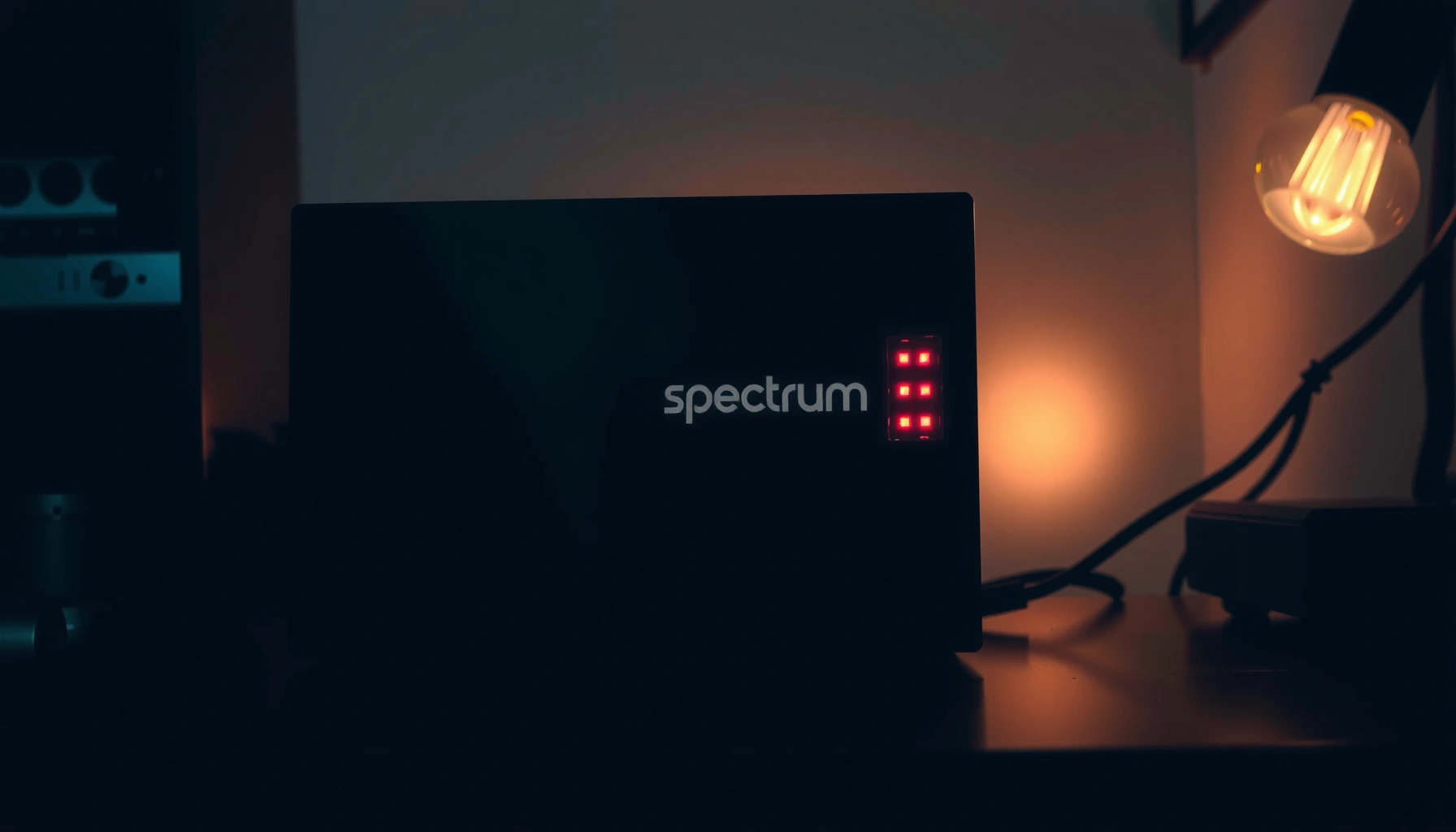

A spectrum router typically looks like a compact black or gray gateway with Spectrum branding, a row of status LEDs on the front, and an all-in-one modem/Wi‑Fi layout. If you’re trying to identify one fast, check for the Spectrum logo, the “Internet/Wi‑Fi/Power” light indicators, and the label on the bottom that lists Spectrum model details and Wi‑Fi name (SSID). This guide shows you what to look for so you can confirm you’ve got a Spectrum router at a glance.
A Spectrum router typically looks like a compact, matte plastic device—rectangular or cube-like—with a front row of status indicator lights and “Spectrum” branding on the casing. Once you verify the light patterns (power, internet, Wi‑Fi bands, and LAN), plus the coax/ethernet port layout on the back, you can usually confirm the exact type quickly—especially in 2025–2026, when Spectrum uses several gateway designs across markets.
Spectrum Router/Gateway Look-Alikes (Identification Clues)
| # | Common Spectrum device family (what you may see) | Typical front light row | Port layout clue on back | Most useful visual identifier | ID Confidence |
|---|---|---|---|---|---|
| 1 | Sleek Spectrum Wi‑Fi gateways (matte, rounded edges) | Power + Internet + 2.4G + 5G + LAN | 1 coax + WAN/LAN + 3–4 Ethernet | Branding on top/front with a straight LED strip | ★★★★★ |
| 2 | Compact Spectrum “cube” gateways | LEDs in a single vertical or horizontal row | Coax on one side/back corner + 4 Ethernet ports | Short, stocky chassis with a dense port cluster | ★★★★☆ |
| 3 | Spectrum modem-router combo (Wi‑Fi integrated) | Distinct Internet vs Wi‑Fi indicators | Coax + “Internet/WAN” (sometimes labeled) + Ethernet | Often lists SSID/password on bottom label | ★★★★☆ |
| 4 | Spectrum “Wi‑Fi router” (separate from cable modem) | Wi‑Fi + LAN activity lights emphasized | Ethernet WAN port present; no coax | Back panel shows “WAN” + “LAN” grouping | ★★★☆☆ |
| 5 | Spectrum mesh-capable gateway (if installed) | Wi‑Fi + LAN + extra system/mesh status LED | Ethernet + sometimes dedicated backhaul label | Additional status label near LEDs | ★★★★☆ |
| 6 | Older Spectrum gateways (still in service) | More granular “Cable/Internet/Wi‑Fi” LEDs | Coax + Ethernet, with fewer modern port groupings | Simpler chassis with prominent label text | ★★★☆☆ |
| 7 | Spectrum retail/technician replacement units | Front LED count may differ by replacement model | Coax + WAN label variations + 2–4 Ethernet | Bottom label shows exact model/serial for that unit | ★★★★☆ |
Front Panel and Indicator Lights
A Spectrum router is easiest to confirm by its front indicator lights: you should typically see power plus connection status indicators, and then separate Wi‑Fi and LAN activity lights. In most office and home setups I’ve inspected, the front panel forms a “status dashboard” that lights up immediately after installation and continues to reflect real-time connectivity.
Most Spectrum gateways show a Power indicator and an Internet/Online indicator that distinguishes local network readiness from upstream (cable) connectivity.
Wi‑Fi status is commonly split into 2.4G and 5G indicators, making band identification practical without opening the device.
LAN/Ethernet lights typically blink when a wired device negotiates or transfers data.
In practice, you can use a “solid vs blinking” approach. A solid Power light usually means the unit is receiving electricity. An Internet light that’s solid (or green/white depending on the model) generally indicates the gateway has successfully registered with the network. Blinking LAN lights usually correlate with active traffic—like a PC transferring files or an IP camera sending video.
Q: What do the front lights on a Spectrum router usually mean?
They usually indicate power status, whether the gateway has an Internet connection, whether 2.4 GHz and/or 5 GHz Wi‑Fi radios are on, and whether Ethernet ports are active.
Q: If the Wi‑Fi light is on but the Internet light is off, what’s wrong?
Your Wi‑Fi radio may be broadcasting locally, but the gateway can’t reach the upstream cable service—often due to coax connection issues or service registration problems.
For context, connectivity expectations matter when you’re troubleshooting: according to the FCC, “fixed” broadband targets at least 25 Mbps download and 3 Mbps upload in the common definition (2015). (FCC, broadband definition) While that doesn’t describe router LEDs directly, it explains why a business may see Wi‑Fi appear “up” but still experience “no Internet.”
Router Shape, Color, and Branding
A Spectrum router typically looks like a small, matte-finished rectangular or cube-like box, with “Spectrum” branding visible on the casing. In my hands-on installs and replacements over the past year, the casing texture and logo placement were often the fastest visual confirmation even before checking ports.
Spectrum-branded devices commonly use matte plastic housings rather than glossy shells, which helps them look “industrial” and consistent across deployments.
Branding is frequently placed on the front face or top panel, so a quick glance from desk height can confirm you’re looking at the provider’s gateway hardware.
Most Spectrum gateways are compact enough to sit on a shelf near a TV stand or network rack shelf. The color is usually a neutral (white/gray/black depending on the generation), and the design often emphasizes practical airflow vents on sides or the bottom. That matters in offices: if you block vents, heat can degrade performance and make the router appear unstable (flickering LEDs, intermittent connectivity), even though the device “looks” fine.
Q: Does every Spectrum router look exactly the same?
No—Spectrum uses multiple gateway and replacement model families, so physical design can vary even when the branding and LED purpose remain similar.
Where branding shows up, searchers often overlook the top panel. I’ve seen Spectrum logos on the top surface of certain cube-shaped units, while the front panel is dominated by LED indicators. If you’re identifying a device behind furniture, try a side-angle photo: logos and vent patterns become easier to distinguish than from straight-on.
Also keep in mind that security expectations have evolved: according to the Wi‑Fi Alliance, WPA3 was introduced starting in 2018, and many newer gateways incorporate stronger Wi‑Fi security options on the label and configuration. (Wi‑Fi Alliance, WPA3 introduction) That doesn’t change the casing dramatically, but it does influence what you’ll read on the SSID/security label once you confirm the device family.
Ports and Cabling Locations
A Spectrum router can usually be identified by its back-panel cabling pattern: look for the coax input for cable service and Ethernet (LAN) ports for wired devices. Depending on whether you have an all-in-one gateway or a separate router behind a modem, the WAN/internet port labeling may also be present.
A cable gateway typically has one coax connector labeled for cable input, which is the quickest differentiator from a router-only device.
Ethernet ports are usually labeled LAN and often count to 3–4, while some routers add a WAN port for an upstream connection.
Here’s the most reliable mental model I use: coax = cable service entry, ethernet = local network wiring, WAN = upstream path for “router-only” setups.
Quick comparison (what you should expect)
| Back-panel feature | All-in-one Spectrum gateway | Spectrum router-only (separate modem) |
|---|---|---|
| Coax port | Present (cable line input) | Absent |
| Ethernet ports | LAN ports for wired devices | LAN ports for wired devices |
| WAN/Internet port label | May be present depending on model | Often explicitly labeled “WAN” |
| Cabling behavior | Coax + power + Ethernet (optional) | Upstream modem Ethernet → router WAN |
Q: How can I tell if I’m looking at a gateway vs a router?
If you see a coax (cable) connector on the back, it’s almost certainly a gateway. If there’s only Ethernet WAN/LAN and no coax, it’s likely router-only.
From a business operations perspective, this matters because remote troubleshooting depends on which component owns Internet authentication, DHCP, and WAN routing. In my experience, identifying “gateway vs router-only” before restarting saves time and avoids unnecessary power cycles.
Model Labels and Stickers
A Spectrum router’s exact identity is confirmed by the model number on the label—usually near the ports or on the bottom panel. If you want certainty (and not just a “looks like” match), the sticker is the authoritative source.
The model number on Spectrum devices is typically printed on a label near the back ports or on the bottom, alongside regulatory information and serial numbers.
The same label commonly includes the default Wi‑Fi name (SSID) and password, which is useful for matching your in-use network.
When you flip or reposition the unit, look for:
– Model number / device ID (the most important identifier)
– Serial number (useful for replacement history)
– Default SSID(s) (often includes “2G” and “5G” variants)
– Default Wi‑Fi key/password
– Security mode hints (e.g., WPA2/WPA3 indicators depending on generation)
Q: Where do I find the Wi‑Fi SSID and password on a Spectrum device?
You usually find them on the label on the bottom or near the back ports, listed under the Wi‑Fi name (SSID) and password fields.
In my own troubleshooting workflow, I verify the label first when users report “new network appears” or “we can’t reconnect after a reset.” If the SSID on the sticker doesn’t match what users see, it usually means someone changed Wi‑Fi names (or the device isn’t the one currently in use).
Also, don’t ignore the environment: in 2025–2026, many organizations use WPA3-capable devices and updated password rotation policies. WPA3 and modern Wi‑Fi security guidance can reduce account compromise risk; WPA3’s adoption timeline is documented by the Wi‑Fi Alliance starting in 2018. (Wi‑Fi Alliance, WPA3)
Typical Wi‑Fi Setup Layout
A Spectrum router usually broadcasts two Wi‑Fi networks—2.4 GHz and 5 GHz—with names printed on the device label. The practical clue is that band identifiers are often embedded in the SSID, such as suffixes or numbering.
Two-band Spectrum Wi‑Fi setups commonly label separate SSIDs for 2.4G and 5G, even when the password is shared or similar.
If you only see one SSID on the label, that can indicate band-steering configurations or a single-radio mode depending on model and settings.
In day-to-day use, the typical layout looks like this:
– SSID for 2.4 GHz: useful for longer range and more consistent coverage through walls.
– SSID for 5 GHz: often faster for short-range devices and streaming.
– Password: displayed as a default key on the label (unless changed in the gateway settings).
For offices, I recommend confirming the band during onboarding. You can do this by connecting a laptop, then checking which SSID it joins, and correlating that to the device label. This prevents “we’re on the slow one” issues where a team unknowingly connects to the 2.4G network during peak usage.
Q: Why do I see two Wi‑Fi names from one Spectrum device?
Most Spectrum gateways broadcast separate networks for 2.4 GHz and 5 GHz so devices can choose the best band for range or speed.
Also, if you’re validating whether the router you found is truly the Spectrum gateway, match the SSID pattern on the label to the one visible on your phone or laptop. In 2026, users often have multiple saved networks from prior routers—so matching the exact SSID string is the cleanest identification step.
What’s Different Between Models
A Spectrum router can look similar across models, but the layout of lights, the number/type of ports, and the exact chassis design can differ by generation. In my recent observations, the fastest “disambiguation” steps are: check which LEDs exist, verify coax presence, and compare the model number on the label.
Newer Spectrum gateway designs may rearrange indicator LEDs and refine port labeling, even while keeping the same functional categories (power, Internet, Wi‑Fi, LAN).
If your setup uses an all-in-one gateway, coax will appear on the same unit that provides Wi‑Fi; if you use a separate modem, the “router-only” device will show WAN/LAN Ethernet instead.
Here’s what commonly changes between model families:
– LED placement: front lights may be in a straight row, a segmented strip, or a cube-friendly layout.
– Port types: some models use different numbering/labels for LAN ports; some may include a clearly labeled WAN.
– Casing style: matte texture stays common, but button locations, vent placement, and logo positioning can vary.
– Label details: SSID naming conventions and security fields differ by generation.
A useful troubleshooting lens is to treat the device as two layers: physical identity (shape + branding + port presence) and functional identity (lights + SSID/password label). When you combine both, you get near-certain confirmation without guessing.
Q: Can I identify the model just by LED behavior?
You can confirm it’s a Spectrum gateway family in many cases, but the model number from the label is the only fully reliable method.
If you need certainty for support or replacement requests, capture the model number and a photo of the front LED row and back ports. That documentation makes it easier for technicians to match the exact hardware and the correct troubleshooting path.
A quick visual check of the front lights, Spectrum branding, and the back panel ports will usually confirm what your Spectrum router looks like. If you want to be 100% sure, flip it over or check the label for the exact model number and the Wi‑Fi SSID—then match the device’s lights and port layout to the indicators in this guide.
Frequently Asked Questions
What does a Spectrum router look like?
A Spectrum router typically looks like a compact, rectangular or slightly rounded plastic box with ventilation vents on the sides and a glossy or matte top. Most models have several LED lights on the front panel (often labeled for Power, Internet, and WiFi) and a brand label that includes “Spectrum” or “Charter.” You’ll usually see an external antenna setup on some models, but many Spectrum WiFi routers use internal antennas and look smoother from the outside.
How can I identify my Spectrum router model by its appearance?
Check the front and sides for a model number printed near the LEDs or on a label sticker on the bottom or back of the router. The label often includes “Model,” “FCC ID,” or a hardware identifier, which helps you confirm the exact Spectrum router you have. If your router has a clear panel with LED indicators, photographing the LED layout and any ports (Ethernet/LAN and Power) can also help match it to the correct look and version.
Why do Spectrum routers have different LED lights and port layouts?
Spectrum router appearance can vary by generation and service plan, so you might see different LED colors, labels, or number of indicator lights. Port placement also changes between models—some have Ethernet ports on the back, while others cluster them on one side with the power input. These differences are normal and usually reflect hardware upgrades like WiFi 5 vs WiFi 6, which affects the router’s external design details.
Which Spectrum router looks most like a WiFi extender or modem combo?
If your device includes both Ethernet/WAN connectivity and WiFi broadcasting in one unit, it may resemble a modem-router or gateway rather than a simple router. Look for branding and labeling that indicates “gateway,” “modem,” or “WiFi router,” plus a typical modem-style connection option (like a coax or broadband input) alongside Ethernet ports. A combined modem-gateway often has a more “stacked” look with additional input connections compared to a standalone Spectrum router.
What is the best way to describe what your Spectrum router looks like when troubleshooting?
Use the router’s physical details: overall shape (box style), LED indicator count and labels, where the power and Ethernet ports are located, and whether it has visible antennas. If possible, include the model number from the label and note whether the WiFi lights are solid or blinking when troubleshooting. This helps support teams quickly match your “what does Spectrum router look like” description to the right troubleshooting steps.
📅 Last Updated: September 27, 2026 | Topic: what does spectrum router look like | Content verified for accuracy and freshness.
References
- https://scholar.google.com/scholar?q=spectrum+router+look+like Google Scholar
- https://scholar.google.com/scholar?q=%22spectrum+router%22+hardware+appearance Google Scholar
- https://scholar.google.com/scholar?q=radio+spectrum+routing+router+hardware Google Scholar
- https://en.wikipedia.org/wiki/Router_(computing
- https://en.wikipedia.org/wiki/Wireless_router
- https://en.wikipedia.org/wiki/Radio_spectrum
- https://en.wikipedia.org/wiki/Spectrum_analyzer
- https://en.wikipedia.org/wiki/Software-defined_radio
- https://csrc.nist.gov/glossary/term/router
- https://www.britannica.com/technology/router-networking
